
Apple of Eden 2: Difference between revisions
imported>Jasca Ducato m Undo revision 541175 by MasterKenway (talk) List has already been removed previously as the information provided is covered in the main body |
m Text replacement - "<gallery captionalign="center" position="center">" to "<gallery captionalign="center" position="center" widths="180">" |
||
| (114 intermediate revisions by 41 users not shown) | |||
| Line 1: | Line 1: | ||
{{Era| | {{Era|Technology}} | ||
{{Quote|If you are asked, say I sent the Apple away. Tell them I sent it to Cyprus, or Cipango, or that I dropped it into the sea. Tell them anything to keep men away from this place. This Apple must not be found, not until the time is right.|Altaïr Ibn-La'Ahad | {{Quote|If you are asked, say I sent the Apple away. Tell them I sent it to Cyprus, or Cipango, or that I dropped it into the sea. Tell them anything to keep men away from this place. This Apple must not be found, not until the time is right.|Altaïr Ibn-La'Ahad to his son Darim regarding the Apple, 1257.|Assassin's Creed: Revelations|Lost Legacy (memory)}} | ||
{{Item Infobox | {{Item Infobox | ||
|image = Apple of Eden | |image=ACO Apple of Eden.png | ||
|type = [[Pieces of Eden|Piece of Eden]] ([[Apples of Eden|Apple]]) | |type=[[Pieces of Eden|Piece of Eden]] ([[Apples of Eden|Apple]]) | ||
|powers = * | |powers=*Illusion projection<ref name="ACO">''[[Assassin's Creed: Origins]]''</ref> | ||
*Human mind control | *Human mind-control<ref name="Al Mualim Assassination">''[[Assassin's Creed]]'' – [[Assassination (Al Mualim)]]</ref> | ||
|current = Destroyed | *Advanced knowledge<ref name="Al Mualim Assassination"/><ref name="ACR">''[[Assassin's Creed: Revelations]]''</ref> | ||
|period = *Prehistory | *Access to [[calculations]]<ref name="ACR"/> | ||
*High Middle Ages | *Apparitions conjuration<ref name="Al Mualim Assassination"/><ref name="ACO"/> | ||
* | *Casting tangible holograms<ref name="ACR"/><ref name="ACO"/> | ||
*Invisibility<ref name="Al Mualim Assassination"/><ref name="ACO"/> | |||
|current=Destroyed | |||
|period=*Prehistory | |||
*[[Ptolemaic Kingdom|Ptolemaic Egypt]]<ref>''[[Assassin's Creed: Graphics]]''</ref> | |||
*[[Middle Ages|High Middle Ages]] | |||
*[[Renaissance]] | |||
*[[Modern times]] | *[[Modern times]] | ||
|created = [[ | |created=[[Isu]] | ||
|made = Prehistory | |made=Prehistory | ||
|destroyed = Early 21st century, during the [[DIA satellite accident]] | |destroyed=Early 21st century, during the [[DIA satellite accident]] | ||
|notable = *[[ | |notable=*[[Medunamun]] | ||
*[[Flavius Metellus]] | |||
*[[Bayek]] | |||
*[[Al Mualim]] | |||
*[[Altaïr Ibn-La'Ahad]] | *[[Altaïr Ibn-La'Ahad]] | ||
*[[Elizabeth I of England]] | *[[Elizabeth I of England]] | ||
*[[Mahatma Gandhi]]}} | *[[Mahatma Gandhi]] | ||
'''Apple of Eden #2''' was a [[ | }} | ||
'''Apple of Eden #2''' was a [[Piece of Eden]] created by the [[Isu]] with the primary purpose of controlling the [[neurotransmitter]]s in [[human]]s to ensure their obedience. Like other Pieces of Eden, it has a long and storied history and has been referred to by many names over the centuries. | |||
Some of its most notable owners include the [[Assassins|Hidden One]] [[Bayek]] of [[Siwa]] and the [[Levantine Brotherhood of Assassins|Levantine Assassin]] [[Altaïr Ibn-La'Ahad]], the latter of whom possessed it for the majority of his life and used its capabilities and advanced knowledge to reform and improve the Assassin Brotherhood. | |||
== | ==Names== | ||
Due to its long history, this Apple of Eden was given many names by its wielders over the centuries. Following its initial rediscovery in the 1st century BCE, it was known as the '''Oracle's Relic''', due in part to it being in the possession of the [[Oracle of Amun]], [[Medunamun]].<ref name="The False Oracle">''[[Assassin's Creed: Origins]]'' – [[The False Oracle]]</ref> Shortly thereafter, once it came into the possession of the [[Medjay]] [[Bayek]] of [[Siwa]], it was referred to several times as the '''Orb of Siwa'''<ref name="Blade of the Goddess">''[[Assassin's Creed: Origins]]'' – [[Aya: Blade of the Goddess]]</ref><ref name="The Aftermath">''[[Assassin's Creed: Origins]]'' – [[The Aftermath]]</ref> and, eventually, as the '''Light of Amun-Ra'''.<ref name="Final Weighing">''[[Assassin's Creed: Origins]]'' – [[The Final Weighing]]</ref> | |||
Centuries later, when the Apple resurfaced beneath [[Solomon's Temple]] in [[Jerusalem]], [[Al Mualim]] referred to it only as the '''Templars' treasure'''. Upon discovering the vault, [[Malik Al-Sayf]] and [[Kadar Al-Sayf]] referred to it as the '''[[Ark of the Covenant]]'''.<ref name="Acquisition">''[[Assassin's Creed]]'' – [[Acquisition]]</ref><ref name="Failure">''[[Assassin's Creed]]'' – [[Failure]]</ref> The artifact continued to be broadly referred to as the '''Templar Treasure''', interchangeably with the '''Piece of Eden''', a usage which persisted throughout Al Mualim's lifetime.<ref name="Al Mualim Assassination"/> In the twenty-first century, it continued to be called the '''Piece of Eden''' and, alternately, the '''artifact from Masyaf''',<ref name="The Piece of Eden">''[[Assassin's Creed]]'' – [[21st century conversations#Assassin's Creed|Modern day]]: "The Piece of Eden"</ref> before [[Abstergo Industries]] and the Assassins came to refer to it as '''Apple of Eden #2'''.<ref name="AC2">''[[Assassin's Creed II]]''</ref> | |||
==Usage== | |||
{{Quote|He who holds it, commands the hearts and minds of whoever looks upon it. Whoever "tastes" of it, as they say.|Al Mualim describing the Apple's powers to Altaïr Ibn-La'Ahad, 1191.|Assassin's Creed|Assassination (Majd Addin)}} | |||
[[File:ACO The Final Weighing 47.png|thumb|250px|left|Bayek fighting holograms conjured by the Apple of Eden]] | |||
Like other [[Apples of Eden]], it was designed to create illusions and control people's minds.<ref name="Al Mualim Assassination"/> The Apple could presumably be used to look into [[Calculations|possible future outcomes]], using the {{Wiki|Probability theory|theory of probability}}, as well as impart knowledge of formulae and practices surpassing those of its wielder's time, as evidenced in [[Altaïr Ibn-La'Ahad's Codex]].<ref name="Codex">''[[Assassin's Creed II]]'' – [[Altaïr Ibn-La'Ahad's Codex]]</ref> | |||
[[ | While utilizing the Apple's powers, [[Flavius Metellus]] showed a number of advanced abilities; these included conjuring holograms of his fellow [[Order of the Ancients]] members to attack [[Bayek]], turning himself invisible, and generating a kinetic force which slowed down Bayek momentarily.<ref name="Final Weighing"/> | ||
[[Al Mualim]] displayed similar abilities while using the Apple to fight [[Altaïr Ibn-La'Ahad]], being able to temporarily restrain his opponent, mask brainwashed [[Assassins]] as Altaïr's previous targets to attack him, and turn himself invisible, though Altaïr's [[Eagle Vision]] allowed him to see through the artifact's illusions.<ref name="Al Mualim Assassination"/> In his later years, Altaïr mastered the Apple after studying it for most of his life, and he could use it to conjure an entire army of holographic soldiers.<ref name="Passing the Torch">''[[Assassin's Creed: Revelations]]'' – [[Passing the Torch]]</ref> | |||
==Owners== | |||
*[[Isu]] (until 75,000 BCE)<ref>''[[Assassin's Creed: Initiates]]'' – Timeline</ref> | |||
*[[Order of the Ancients]] (until 48 BCE)<ref name="ACO"/> | |||
**[[Khemu]] (briefly; 49 BCE)<ref name="ACO"/> | |||
**[[Medunamun]] (49 BCE – 48 BCE)<ref name="ACO"/> | |||
*[[Bayek]] (48 BCE)<ref name="ACO"/> | |||
*[[Amunet|Aya]] (48 BCE)<ref name="ACO"/> | |||
*[[Apollodorus]] (48 BCE – 47 BCE)<ref name="ACO"/> | |||
*[[Flavius Metellus]] (47 BCE)<ref name="ACO"/> | |||
*Bayek (47 BCE – 46 BCE)<ref name="ACO"/> | |||
*[[Levantine Rite of the Templar Order|Levantine Rite]] of the [[Templars|Templar Order]] (1191)<ref>''[[Assassin's Creed]]''</ref> | |||
*[[Levantine Brotherhood of Assassins|Levantine Brotherhood]] of [[Assassins]] (1191 – 1257) | |||
**[[Malik Al-Sayf]] (1191)<ref name="Failure"/> | |||
**[[Al Mualim]] (1191)<ref name="Al Mualim Assassination"/> | |||
**[[Abbas Sofian]] (1191)<ref name="ACR"/> | |||
**[[Altaïr Ibn-La'Ahad]] (1191 – 1257)<ref name="Al Mualim Assassination"/> | |||
*[[Elizabeth I of England]] (1559 – 1603)<ref name="Glyphs"/> | |||
*[[Mahatma Gandhi]] (? – 1948)<ref name="Glyphs"/> | |||
*Templar Order (1948 – 21st century)<ref name="Glyphs"/> | |||
[[File: | ==History== | ||
===Ptolemaic Egypt=== | |||
{{Quote|That cursed marked sphere should stay hidden forever. Caused so much pain.|Bayek, as he hid the Apple in a chest, 46 BCE.|Assassin's Creed: Origins|Last of the Medjay}} | |||
[[File:Origins Quest04TheFalseOracle Part01.PNG|thumb|250px|A captive Khemu holding the Apple]] | |||
The Apple was first known to be in the possession of the [[Order of the Ancients]] in [[Egypt]] during the 1st century BCE. In 49 BCE, the Order brought the Apple to the [[Temple of Amun]] in [[Siwa]], believing the artifact was connected to the [[Siwa Vault|Isu vault]] beneath the temple, and captured the [[Medjay]] [[Bayek]] and his son [[Khemu]] to force him to open the vault. However, Bayek lacked the knowledge the Order sought and a fight occured, during which Khemu was killed and the Medjay was left for dead.<ref name="The False Oracle"/> | |||
After their failure in Siwa, the Order entrusted the Apple to one of their own, [[Medunamun]], who was appointed [[Oracle of Amun]] and continued looking for ways to access the Isu vault under the Temple of Amun. Medunamun used the Apple to torture various priests and villagers for information until his death in 48 BCE at the hands of Bayek, who subsequently claimed the artifact.<ref name="The False Oracle"/> Bayek later gave the Apple to his wife [[Amunet|Aya]], who in turn gave it to [[Cleopatra]]'s advisor [[Apollodorus]] for safekeeping.<ref name="Blade of the Goddess"/> | |||
[[File:ACO Flavius and Apple.png|thumb|left|250px|Flavius holding the Apple]] | |||
In 47 BCE, Apollodorus was killed by [[Flavius Metellus]], the ''de facto'' leader of the Order, who took the Apple and used its power to enslave all of [[Cyrenaica]] to his will.<ref name="The Aftermath"/> Combining the Apple with [[Scepter of Alexander the Great|Alexander's Staff of Eden]], which the Order also had in their possession, Flavius and [[Lucius Septimius]] unlocked the Siwa Vault, finding a holographic projection of the globe displaying the locations of other Isu sites.<ref name="Final Weighing"/> | |||
Not long after, Bayek, seeking revenge on Flavius for his role in Khemu's death, tracked him to [[Cyrene]], where he killed him in combat at the [[Temple of Mars]] despite Flavius using the artifact's powers to deceive the Medjay.<ref name="Final Weighing"/> Having reclaimed the Apple, Bayek stored it in a [[Treasure chest|chest]] in Aya's [[The Den|old hideout]] beneath the [[Library of Alexandria]], hoping to keep it hidden away forever.<ref name="Last of the Medjay">''[[Assassin's Creed: Origins]]'' – [[Last of the Medjay]]</ref> | |||
[[ | |||
===Middle Ages=== | |||
====Acquisition by the Assassins==== | |||
{{Quote|The Piece of Eden is temptation given form.|Al Mualim to Altaïr Ibn-La'Ahad, about the Apple of Eden, 1191.|Assassin's Creed|Assassination (Jubair al Hakim)}} | |||
At some point between the 1st century BCE and the 9th century CE, the Apple was taken from [[Alexandria]], placed within the [[Ark of the Covenant]], and hidden in the catacombs of [[Solomon]]'s [[Solomon's Temple|Temple]] in [[Jerusalem]].<ref name="Acquisition"/> Circa 862, the [[Mentor]] of the [[Hidden Ones of Alamut|Alamut Hidden Ones]], [[Rayhan]], heard rumors about the artifact and planned to expand the Hidden Ones' influence by establishing several [[Assassin bureau|bureaus]] in Jerusalem and a stronghold to the north.<ref>''[[Assassin's Creed: Mirage]]'' – [[Notes from Basim's travels]]: "A New Home for the Hidden Ones"</ref> | |||
[[File:Failure_4.png|thumb|250px|The Apple of Eden in its casing]] | |||
In 1191, during the [[Third Crusade]], ten [[Templars]] led by the [[Grand Master of the Templar Order|Grand Master]] [[Robert de Sablé]] located the [[Ark of the Covenant]] beneath [[Solomon's Temple]] in [[Jerusalem]], within which the Apple was held, and sought to claim it for themselves.<ref name="Acquisition"/> Among their number was [[Al Mualim]], the Mentor of the [[Levantine Brotherhood of Assassins]], the Templars' sworn enemies, who had secretly conspired with them to recover the artifact.<ref>''[[Assassin's Creed]]'' – [[Assassination II (Robert de Sablé)]]</ref> Secretly betraying his Templar allies to claim the artifact for himself, Al Mualim sent three of his Assassins – [[Altaïr Ibn-La'Ahad]] and the brothers [[Malik Al-Sayf|Malik]] and [[Kadar Al-Sayf]] – to the vault beneath Solomon's Temple in Jerusalem to retrieve it and bring it back to the Assassins' fortress in [[Masyaf]].<ref name="Acquisition"/> | |||
During the mission, Altaïr tried to kill Robert but was overpowered by the Grand Master. As Altaïr was routed by the Templars, the Al-Sayf brothers were forced to fight the Templars alone.<ref name="Acquisition"/> Despite suffering a grievous injury to his left arm and losing his brother Kadar, Malik was able to retrieve the Apple and bring it back to Al Mualim.<ref name="Failure"/> For the next few months, Al Mualim kept the Apple close at all times, while sending Altaïr to kill Robert and the other eight Templars who knew of the artifact.<ref>''[[Assassin's Creed]]'' – [[Assassination (Majd Addin)]]</ref> | |||
[[File:Masyaf Confront.png|thumb|left|250px|Al Mualim confronting Altaïr with the Apple]] | |||
During Altaïr's absence, Al Mualim used the Apple's power to enthrall the Assassins and villagers of Masyaf, seeking to create his own [[New World Order|perfect world]]. When Al Mualim was [[Retaking of Masyaf|confronted]] by Altaïr upon his return, he utilized the Apple's abilities to defend himself, such as creating several illusions of the Templars Altaïr had slain, along with phantom copies of himself. However, Altaïr was able to kill Al Mualim and take the Apple from him. As he was joined by Malik and his men, the Apple projected a map showing the locations of more Pieces of Eden around the globe.<ref name="Al Mualim Assassination"/> | |||
Following Al Mualim's defeat, Altaïr, fearing that the Mentor might have deceived him with another illusion, decided to burn his body to be certain of his death. As this was against the Assassins' beliefs, several in the Order opposed him, most notably Altaïr's former friend and rival [[Abbas Sofian]]. The Order was soon split into two factions, and a fight broke out between them after Abbas shoved Altaïr off the cliff they were both standing on.<ref name="The Mentor's Wake">''[[Assassin's Creed: Revelations]]'' – [[The Mentor's Wake]]</ref> | |||
Altaïr and | |||
[[File:Mentor's wake 11.png|thumb|250px|The Apple draining the life from Abbas]] | |||
Abbas quickly fled the scene and returned to Al Mualim's study, retrieving the Apple, then climbed a watchtower outside the Masyaf fortress. However, Abbas was unable to use the Apple's powers properly, and the artifact began to drain the life from him and other the other Assassins. Altaïr, who was more resistant to the Piece of Eden's effects, managed to climb the tower and recover the artifact from Abbas before it killed him.<ref name="The Mentor's Wake"/> To this, Abbas apologized for his mistake, and the Order united under Altaïr, who was appointed the new Mentor.<ref name="ACTSC">''[[Assassin's Creed: The Secret Crusade]]''</ref> | |||
====Altaïr's research==== | |||
{{Quote|Have you anything to teach us? Or will you lead us all to ruin?|Altaïr, regarding the Apple, 1191.|Assassin's Creed: Revelations|The Mentor's Wake}} | |||
Despite this accident, Altaïr decided to keep the Apple and carefully studied it throughout most of his life, using it to advance the Assassin Order, creating several new techniques and weapons for the Assassins to use.<ref name="Codex"/> Altaïr also carried it with him during his journey to [[Cyprus]] to eliminate the Templars there. Continuing to study it in secret, he wrote his discoveries in his [[Altaïr Ibn-La'Ahad's Codex|Codex]], and used it once in public to calm down a mob that was falsely rallied against him.<ref name="Bloodlines">''[[Assassin's Creed: Bloodlines]]''</ref> | |||
In 1217, Altaïr, his wife [[Maria Thorpe]] and their eldest son [[Darim Ibn-La'Ahad|Darim]] traveled to Mongolia to [[Assassination of Genghis Khan|assassinate]] [[Genghis Khan]] and eliminate the [[Mongol Empire|Mongol threat]]. In their absence, Abbas staged a ''coup d'état'', executing Altaïr's youngest son [[Sef Ibn-La'Ahad|Sef]] and Malik to seize leadership of the Levantine Assassins. When Altaïr and his family returned to Masyaf a decade later, they learned what had happened and decided to confront Abbas and his followers.<ref name="ACTSC"/> | |||
[[File:New regime 8.png|thumb|left|250px|Altaïr using the Apple against Swami]] | |||
During the meeting, Abbas claimed that Altaïr had been corrupted by the Apple, which he had held for over three decades, and demanded that he hand over the artifact. Taunting Abbas, Altaïr let him take the Apple, and Abbas' henchman [[Swami]] came to retrieve it. As Swami revealed himself as Sef's killer,<ref name="A New Regime"/> a furious Altaïr used the Apple to force the Assassin to start mutilating himself, but he was stopped by Maria.<ref name="ACTSC"/> In the resulting confusion, Swami murdered Maria before he himself was killed by Altaïr, who subsequently fled Masyaf alongside Darim, going into a self-imposed exile in [[Alamut]].<ref name="A New Regime">''[[Assassin's Creed: Revelations]]'' – [[A New Regime]]</ref> | |||
During his exile, Altaïr studied the Apple intensely, managing to create a [[Hidden Gun|gun attachement]] for his [[Hidden Blade]] through the knowledge he gained.<ref name="Codex"/> Additionally, the Apple led Altaïr to a small Isu [[Alamut Temple|temple]] beneath Alamut, from which he retrieved six [[Memory Seals]].<ref>''[[Assassin's Creed Revelations: Official Game Guide]]''</ref> Eventually, in 1247, Altaïr returned from his exile and, gaining the support of his fellow Assassins, killed Abbas with his Hidden Gun to reclaim leadership of the Levantine Brotherhood.<ref name="The Mentor's Return">''[[Assassin's Creed: Revelations]]'' – [[The Mentor's Return]]</ref> | |||
[[ | During the last decade of his life, Altaïr ordered the construction of a [[Library of Altaïr Ibn-La'Ahad|library]] in Masyaf, secretly intending to hide the Apple there after his death.<ref name="Lost Legacy">''[[Assassin's Creed: Revelations]]'' – [[Lost Legacy (memory)|Lost Legacy]]</ref> In August 1257, as Masyaf came under [[Fall of Masyaf|siege]] by the Mongols led by [[Hülegü Khan]], who sought retaliation for Genghis Khan's death, Altaïr used the Apple's powers to repel the attack. He then gave his books, including his Codex, and five of his Memory Seals to the [[Venice|Venetian]] tradesmen and Assassins [[Niccolò Polo|Niccolò]] and [[Maffeo Polo]], trusting them to hide them somewhere safe.<ref name="Passing the Torch"/> | ||
Altaïr | |||
[[File:Lost legacy 3.png|thumb|250px|Altaïr placing the Apple on its pedestal]] | |||
Knowing another Mongol attack to be inevitable, Altaïr had Masyaf evacuated before bidding farewell to Darim in front of the entrance to his library. As his son deduced the library's true purpose, Altaïr told him not to tell anyone about it and to lie that he had sent the Apple away, to keep it hidden from "eager hands". With that, he sealed himself inside the library and, after hiding the Apple in a secret wall compartment, passed away from old age.<ref name="Lost Legacy"/> | |||
===Renaissance=== | ===Renaissance=== | ||
{{Quote|Another artifact? No. You will stay here. I have seen enough for one life.|Ezio Auditore upon finding the Apple.|Assassin's Creed: Revelations}} | {{Quote|Another artifact? No. You will stay here. I have seen enough for one life.|Ezio Auditore upon finding the Apple, 1512.|Assassin's Creed: Revelations|A Homecoming}} | ||
In 1509, the Mentor of the [[Italian Assassins | In 1509, [[Ezio Auditore da Firenze]], the Mentor of the [[Italian Brotherhood of Assassins|Italian Assassins]], found a letter written by his father [[Giovanni Auditore da Firenze|Giovanni]] mentioning Altaïr's library underneath Masyaf and the vast amount of knowledge it supposedly held. Intrigued by his discovery, Ezio set out on a journey to the Holy Land to reach a better understanding of the Order through Altaïr's knowledge.<ref name="The Hangman">''[[Assassin's Creed: Revelations]]'' – [[The Hangman]]</ref> Ezio arrived in Masyaf in the winter of 1511, and retrieved Niccolò Polo's journal, ''[[The Secret Crusade]]'', from [[Leandros]], the leader of a small army of [[Byzantine Rite of the Templar Order|Byzantine Templars]] tasked with opening Altaïr's library.<ref name="The Wounded Eagle">''[[Assassin's Creed: Revelations]]'' – [[The Wounded Eagle]]</ref> | ||
[[File:Message 1.png|thumb|250px|left|Ezio discovering the Apple]] | |||
Learning about the five Memory Seals which served as the keys to the library, the Assassin proceeded to make his way to [[Constantinople]] to look for the artifacts and prevent the Templars from acquiring them. After several months of searching, during which he was aided by the local [[Ottoman Brotherhood of Assassins|Ottoman Assassins]] and a bookseller named [[Sofia Sartor]], Ezio was able to obtain the Seals, and together with Sofia, made his way to Masyaf once again.<ref name="End of the Road">''[[Assassin's Creed: Revelations]]'' – [[End of the Road]]</ref> | |||
Ezio | Entering the library, Ezio found Altaïr's remains, as well as the sixth Memory Seal.<ref name="A Homecoming">''[[Assassin's Creed: Revelations]]'' – [[A Homecoming]]</ref> Through it, Ezio relived Altaïr's final moments and discovered the Apple's location, but decided not to take the artifact from its pedestal, leaving it in the library. At that moment, the Apple imparted a message from the [[Nexus]], intended for Ezio's descendant, [[Desmond Miles]], who was viewing his [[Genetic memory|genetic memories]] in the [[Animus]]. In the message, [[Jupiter]] recounted the Isu's [[Great Catastrophe|final days]] and provided Desmond with the means to access the [[Grand Temple]].<ref name="The Message">''[[Assassin's Creed: Revelations]]'' – [[The Message]]</ref> | ||
The Assassin | ===Elizabethan era=== | ||
{{Quote|You may think this picture a riddle, an allegory, an artist's fancy. It is not. The object in the hand of the Faerie Queen is real. So is its power. And so are the goddesses.|John Dee, describing the painting he gave to Elizabeth Jane Weston, 1603.|Assassin's Creed: Project Legacy|Divine Science: Chapter 3 – Elizabeth Jane Weston}} | |||
[[File:Glyph 2 1.png|thumb|250px|The Apple hidden in the globus cruciger]] | |||
Despite both Altaïr's and Ezio's protective actions, the Apple soon found its way into the hands of Queen [[Elizabeth I of England|Elizabeth I]] of [[England]], who succeeded her sister [[Mary I of England|Mary I]] after she was killed by the Assassins.<ref name="Glyphs">''[[Assassin's Creed II]]'' – [[Glyphs]]</ref> Elizabeth made ample use of the Apple during her reign, so much so that her trusted advisor [[John Dee]] became aware of the artifact and its powers.<ref name="Project Legacy">''[[Assassin's Creed: Project Legacy]]'' – [[Divine Science: Chapter 3 – Elizabeth Jane Weston]]</ref> | |||
[[ | Dee later gave a painting of Queen Elizabeth holding the Apple during an alternative rendition of the {{Wiki|Judgement of Paris}}, as a wedding present to [[Elizabeth Jane Weston]], the stepdaughter of his former colleague [[Edward Kelley]], after Elizabeth's death.<ref name="Project Legacy"/> | ||
===Modern times=== | |||
{{Quote|I'll send you the driver. We've trained him with PE2 in our labs, he shouldn't be any trouble.|An unknown Templar in a letter, referring to William Greer.|Assassin's Creed II|Glyphs}} | |||
By the 20th century, the Apple had passed into the hands of [[Mahatma Gandhi]], who used it to acquire a large religious following in [[India]]. However, the Templars discovered this, and had Gandhi murdered on 30 January 1948 to obtain the Apple.<ref name="Glyphs"/> | |||
By 1963, the Templars were in possession of both this Apple and [[Apple of Eden 1|another one]], and used them during their [[Assassination of John F. Kennedy|assassination]] of U.S. President [[John F. Kennedy]], who possessed a [[Apple of Eden 3|third Apple]]. [[William Greer]], the Secret Service agent assigned to drive Kenney's limousine, was trained in the use of Apple of Eden #2 and was instructed to steal the president's Apple after he was killed.<ref name="Glyphs"/> | |||
Later on, during the early 21st century, [[Abstergo Industries]] experimented with Apple of Eden #2 in an underground Abstergo Industries facility beneath {{Wiki|Denver International Airport}}.<ref name="The Piece of Eden"/> This continued until what would later be called the [[DIA satellite accident]];<ref name="Email">''[[Assassin's Creed]]'' – [[Warren Vidic's email]] – Subject header: "Additional Subjects?"</ref> [[Daniel Cross]], who was visiting the facility, suddenly experienced a psychotic episode as a result of his [[Bleeding Effect]] and his close proximity to the Apple.<ref>''[[Assassin's Creed: Initiates]]'' – [[The Desmond Files]]: "Assignment in Denver"</ref> The manic Templar killed everyone in the facility, while the Apple was destroyed in unspecified circumstances that resulted in the devastation of the airport and the deaths of many innocents.<ref name="Email"/> | |||
==Behind the scenes== | |||
In ''[[Assassin's Creed]]'', the Apple was described as being made of silver, but in all subsequent games it was given a golden appearance to match the color of the other Apples of Eden. | |||
Unlike [[Apple of Eden 6|Ezio's Apple of Eden]], Altaïr's health did not drain while he used the Apple.<ref name="Passing the Torch"/> | |||
A deleted [[database]] entry in ''[[Assassin's Creed III]]'' for the Apples of Eden revealed that Templars working for Queen Elizabeth sent out an envoy to Masyaf in the late 16th century to find and recover the Apple from Altaïr's library. | |||
==Gallery== | |||
<gallery captionalign="center" position="center" widths="180"> | |||
Origins Quest04TheFalseOracle Part07.PNG|Bayek holding the bloodied Apple after beating Medunamun to death with it | |||
ACO The Final Weighing 46.jpg|Flavius using the Apple against Bayek | |||
ACO Last of the Medjay 8.png|Bayek hiding the Apple beneath the Library of Alexandria | |||
AC1 Ark of the Covenant.png|The Ark of the Covenant, which used to house the Apple | |||
Almualim-poe-study.png|Al Mualim showing the Apple to Altaïr | |||
AssassinsCreed Al Mualim holding the Piece of Eden.png|Al Mualim wielding the Apple | |||
AC-AltairMalikMap.png|The Apple projecting a holographic map | |||
Mentor's wake 16.png|Altaïr gazing into the Apple | |||
Message 2.png|The Apple creating a Synch Nexus for Ezio | |||
AC Blade of Shao Jun - Pieces of Eden.png|The Apple in ''[[Assassin's Creed: Blade of Shao Jun]]'' | |||
ACRPG - Apple 2.jpg|The Apple in ''[[Assassin's Creed Roleplaying Game]]'' | |||
</gallery> | |||
== | ==Appearances== | ||
* | *''[[Assassin's Creed]]'' {{1st}} | ||
*''[[Assassin's Creed: Bloodlines]]'' | |||
*''[[Assassin's Creed II]]'' {{Mo}} | |||
*''[[Assassin's Creed: The Fall]]'' {{c|vision}} | |||
*''[[Assassin's Creed: The Secret Crusade]]'' | |||
*''[[Assassin's Creed: Revelations]]'' | |||
*[[Assassin's Creed: Revelations (novel)|''Assassin's Creed: Revelations'' novel]] | |||
*''[[Assassin's Creed: Project Legacy]]'' {{Mo}} | |||
*''[[Assassin's Creed: Origins]]'' | |||
*''[[Assassin's Creed: Blade of Shao Jun]]'' {{c|cameo}} | |||
*''[[Assassin's Creed: Mirage]]'' {{Imo}} | |||
*''[[Assassin's Creed Roleplaying Game]] | |||
==References== | ==References== | ||
{{Reflist}} | {{Scroll box|content={{Reflist|2}}}} | ||
{{ | {{Isu}} | ||
[[Category: | <!--[[nl:Appel uit het paradijs 2] | ||
[ru:Второе Яблоко] | |||
[uk:Друге Яблуко] | |||
[fr:Pomme d'Éden n°2]--> | |||
[[Category:Apples of Eden]] | |||
Latest revision as of 01:11, 17 October 2026
- "If you are asked, say I sent the Apple away. Tell them I sent it to Cyprus, or Cipango, or that I dropped it into the sea. Tell them anything to keep men away from this place. This Apple must not be found, not until the time is right."
- ―Altaïr Ibn-La'Ahad to his son Darim regarding the Apple, 1257.[src]-[m]
Apple of Eden #2 was a Piece of Eden created by the Isu with the primary purpose of controlling the neurotransmitters in humans to ensure their obedience. Like other Pieces of Eden, it has a long and storied history and has been referred to by many names over the centuries.
Some of its most notable owners include the Hidden One Bayek of Siwa and the Levantine Assassin Altaïr Ibn-La'Ahad, the latter of whom possessed it for the majority of his life and used its capabilities and advanced knowledge to reform and improve the Assassin Brotherhood.
Names[edit | edit source]
Due to its long history, this Apple of Eden was given many names by its wielders over the centuries. Following its initial rediscovery in the 1st century BCE, it was known as the Oracle's Relic, due in part to it being in the possession of the Oracle of Amun, Medunamun.[5] Shortly thereafter, once it came into the possession of the Medjay Bayek of Siwa, it was referred to several times as the Orb of Siwa[6][7] and, eventually, as the Light of Amun-Ra.[8]
Centuries later, when the Apple resurfaced beneath Solomon's Temple in Jerusalem, Al Mualim referred to it only as the Templars' treasure. Upon discovering the vault, Malik Al-Sayf and Kadar Al-Sayf referred to it as the Ark of the Covenant.[9][10] The artifact continued to be broadly referred to as the Templar Treasure, interchangeably with the Piece of Eden, a usage which persisted throughout Al Mualim's lifetime.[2] In the twenty-first century, it continued to be called the Piece of Eden and, alternately, the artifact from Masyaf,[11] before Abstergo Industries and the Assassins came to refer to it as Apple of Eden #2.[12]
Usage[edit | edit source]

Like other Apples of Eden, it was designed to create illusions and control people's minds.[2] The Apple could presumably be used to look into possible future outcomes, using the theory of probability, as well as impart knowledge of formulae and practices surpassing those of its wielder's time, as evidenced in Altaïr Ibn-La'Ahad's Codex.[13]
While utilizing the Apple's powers, Flavius Metellus showed a number of advanced abilities; these included conjuring holograms of his fellow Order of the Ancients members to attack Bayek, turning himself invisible, and generating a kinetic force which slowed down Bayek momentarily.[8]
Al Mualim displayed similar abilities while using the Apple to fight Altaïr Ibn-La'Ahad, being able to temporarily restrain his opponent, mask brainwashed Assassins as Altaïr's previous targets to attack him, and turn himself invisible, though Altaïr's Eagle Vision allowed him to see through the artifact's illusions.[2] In his later years, Altaïr mastered the Apple after studying it for most of his life, and he could use it to conjure an entire army of holographic soldiers.[14]
Owners[edit | edit source]
- Isu (until 75,000 BCE)[15]
- Order of the Ancients (until 48 BCE)[1]
- Bayek (48 BCE)[1]
- Aya (48 BCE)[1]
- Apollodorus (48 BCE – 47 BCE)[1]
- Flavius Metellus (47 BCE)[1]
- Bayek (47 BCE – 46 BCE)[1]
- Levantine Rite of the Templar Order (1191)[16]
- Levantine Brotherhood of Assassins (1191 – 1257)
- Malik Al-Sayf (1191)[10]
- Al Mualim (1191)[2]
- Abbas Sofian (1191)[3]
- Altaïr Ibn-La'Ahad (1191 – 1257)[2]
- Elizabeth I of England (1559 – 1603)[17]
- Mahatma Gandhi (? – 1948)[17]
- Templar Order (1948 – 21st century)[17]
History[edit | edit source]
Ptolemaic Egypt[edit | edit source]

The Apple was first known to be in the possession of the Order of the Ancients in Egypt during the 1st century BCE. In 49 BCE, the Order brought the Apple to the Temple of Amun in Siwa, believing the artifact was connected to the Isu vault beneath the temple, and captured the Medjay Bayek and his son Khemu to force him to open the vault. However, Bayek lacked the knowledge the Order sought and a fight occured, during which Khemu was killed and the Medjay was left for dead.[5]
After their failure in Siwa, the Order entrusted the Apple to one of their own, Medunamun, who was appointed Oracle of Amun and continued looking for ways to access the Isu vault under the Temple of Amun. Medunamun used the Apple to torture various priests and villagers for information until his death in 48 BCE at the hands of Bayek, who subsequently claimed the artifact.[5] Bayek later gave the Apple to his wife Aya, who in turn gave it to Cleopatra's advisor Apollodorus for safekeeping.[6]

In 47 BCE, Apollodorus was killed by Flavius Metellus, the de facto leader of the Order, who took the Apple and used its power to enslave all of Cyrenaica to his will.[7] Combining the Apple with Alexander's Staff of Eden, which the Order also had in their possession, Flavius and Lucius Septimius unlocked the Siwa Vault, finding a holographic projection of the globe displaying the locations of other Isu sites.[8]
Not long after, Bayek, seeking revenge on Flavius for his role in Khemu's death, tracked him to Cyrene, where he killed him in combat at the Temple of Mars despite Flavius using the artifact's powers to deceive the Medjay.[8] Having reclaimed the Apple, Bayek stored it in a chest in Aya's old hideout beneath the Library of Alexandria, hoping to keep it hidden away forever.[18]
Middle Ages[edit | edit source]
Acquisition by the Assassins[edit | edit source]
At some point between the 1st century BCE and the 9th century CE, the Apple was taken from Alexandria, placed within the Ark of the Covenant, and hidden in the catacombs of Solomon's Temple in Jerusalem.[9] Circa 862, the Mentor of the Alamut Hidden Ones, Rayhan, heard rumors about the artifact and planned to expand the Hidden Ones' influence by establishing several bureaus in Jerusalem and a stronghold to the north.[19]

In 1191, during the Third Crusade, ten Templars led by the Grand Master Robert de Sablé located the Ark of the Covenant beneath Solomon's Temple in Jerusalem, within which the Apple was held, and sought to claim it for themselves.[9] Among their number was Al Mualim, the Mentor of the Levantine Brotherhood of Assassins, the Templars' sworn enemies, who had secretly conspired with them to recover the artifact.[20] Secretly betraying his Templar allies to claim the artifact for himself, Al Mualim sent three of his Assassins – Altaïr Ibn-La'Ahad and the brothers Malik and Kadar Al-Sayf – to the vault beneath Solomon's Temple in Jerusalem to retrieve it and bring it back to the Assassins' fortress in Masyaf.[9]
During the mission, Altaïr tried to kill Robert but was overpowered by the Grand Master. As Altaïr was routed by the Templars, the Al-Sayf brothers were forced to fight the Templars alone.[9] Despite suffering a grievous injury to his left arm and losing his brother Kadar, Malik was able to retrieve the Apple and bring it back to Al Mualim.[10] For the next few months, Al Mualim kept the Apple close at all times, while sending Altaïr to kill Robert and the other eight Templars who knew of the artifact.[21]

During Altaïr's absence, Al Mualim used the Apple's power to enthrall the Assassins and villagers of Masyaf, seeking to create his own perfect world. When Al Mualim was confronted by Altaïr upon his return, he utilized the Apple's abilities to defend himself, such as creating several illusions of the Templars Altaïr had slain, along with phantom copies of himself. However, Altaïr was able to kill Al Mualim and take the Apple from him. As he was joined by Malik and his men, the Apple projected a map showing the locations of more Pieces of Eden around the globe.[2]
Following Al Mualim's defeat, Altaïr, fearing that the Mentor might have deceived him with another illusion, decided to burn his body to be certain of his death. As this was against the Assassins' beliefs, several in the Order opposed him, most notably Altaïr's former friend and rival Abbas Sofian. The Order was soon split into two factions, and a fight broke out between them after Abbas shoved Altaïr off the cliff they were both standing on.[22]

Abbas quickly fled the scene and returned to Al Mualim's study, retrieving the Apple, then climbed a watchtower outside the Masyaf fortress. However, Abbas was unable to use the Apple's powers properly, and the artifact began to drain the life from him and other the other Assassins. Altaïr, who was more resistant to the Piece of Eden's effects, managed to climb the tower and recover the artifact from Abbas before it killed him.[22] To this, Abbas apologized for his mistake, and the Order united under Altaïr, who was appointed the new Mentor.[23]
Altaïr's research[edit | edit source]
Despite this accident, Altaïr decided to keep the Apple and carefully studied it throughout most of his life, using it to advance the Assassin Order, creating several new techniques and weapons for the Assassins to use.[13] Altaïr also carried it with him during his journey to Cyprus to eliminate the Templars there. Continuing to study it in secret, he wrote his discoveries in his Codex, and used it once in public to calm down a mob that was falsely rallied against him.[24]
In 1217, Altaïr, his wife Maria Thorpe and their eldest son Darim traveled to Mongolia to assassinate Genghis Khan and eliminate the Mongol threat. In their absence, Abbas staged a coup d'état, executing Altaïr's youngest son Sef and Malik to seize leadership of the Levantine Assassins. When Altaïr and his family returned to Masyaf a decade later, they learned what had happened and decided to confront Abbas and his followers.[23]

During the meeting, Abbas claimed that Altaïr had been corrupted by the Apple, which he had held for over three decades, and demanded that he hand over the artifact. Taunting Abbas, Altaïr let him take the Apple, and Abbas' henchman Swami came to retrieve it. As Swami revealed himself as Sef's killer,[25] a furious Altaïr used the Apple to force the Assassin to start mutilating himself, but he was stopped by Maria.[23] In the resulting confusion, Swami murdered Maria before he himself was killed by Altaïr, who subsequently fled Masyaf alongside Darim, going into a self-imposed exile in Alamut.[25]
During his exile, Altaïr studied the Apple intensely, managing to create a gun attachement for his Hidden Blade through the knowledge he gained.[13] Additionally, the Apple led Altaïr to a small Isu temple beneath Alamut, from which he retrieved six Memory Seals.[26] Eventually, in 1247, Altaïr returned from his exile and, gaining the support of his fellow Assassins, killed Abbas with his Hidden Gun to reclaim leadership of the Levantine Brotherhood.[27]
During the last decade of his life, Altaïr ordered the construction of a library in Masyaf, secretly intending to hide the Apple there after his death.[28] In August 1257, as Masyaf came under siege by the Mongols led by Hülegü Khan, who sought retaliation for Genghis Khan's death, Altaïr used the Apple's powers to repel the attack. He then gave his books, including his Codex, and five of his Memory Seals to the Venetian tradesmen and Assassins Niccolò and Maffeo Polo, trusting them to hide them somewhere safe.[14]

Knowing another Mongol attack to be inevitable, Altaïr had Masyaf evacuated before bidding farewell to Darim in front of the entrance to his library. As his son deduced the library's true purpose, Altaïr told him not to tell anyone about it and to lie that he had sent the Apple away, to keep it hidden from "eager hands". With that, he sealed himself inside the library and, after hiding the Apple in a secret wall compartment, passed away from old age.[28]
Renaissance[edit | edit source]
In 1509, Ezio Auditore da Firenze, the Mentor of the Italian Assassins, found a letter written by his father Giovanni mentioning Altaïr's library underneath Masyaf and the vast amount of knowledge it supposedly held. Intrigued by his discovery, Ezio set out on a journey to the Holy Land to reach a better understanding of the Order through Altaïr's knowledge.[29] Ezio arrived in Masyaf in the winter of 1511, and retrieved Niccolò Polo's journal, The Secret Crusade, from Leandros, the leader of a small army of Byzantine Templars tasked with opening Altaïr's library.[30]

Learning about the five Memory Seals which served as the keys to the library, the Assassin proceeded to make his way to Constantinople to look for the artifacts and prevent the Templars from acquiring them. After several months of searching, during which he was aided by the local Ottoman Assassins and a bookseller named Sofia Sartor, Ezio was able to obtain the Seals, and together with Sofia, made his way to Masyaf once again.[31]
Entering the library, Ezio found Altaïr's remains, as well as the sixth Memory Seal.[32] Through it, Ezio relived Altaïr's final moments and discovered the Apple's location, but decided not to take the artifact from its pedestal, leaving it in the library. At that moment, the Apple imparted a message from the Nexus, intended for Ezio's descendant, Desmond Miles, who was viewing his genetic memories in the Animus. In the message, Jupiter recounted the Isu's final days and provided Desmond with the means to access the Grand Temple.[33]
Elizabethan era[edit | edit source]

Despite both Altaïr's and Ezio's protective actions, the Apple soon found its way into the hands of Queen Elizabeth I of England, who succeeded her sister Mary I after she was killed by the Assassins.[17] Elizabeth made ample use of the Apple during her reign, so much so that her trusted advisor John Dee became aware of the artifact and its powers.[34]
Dee later gave a painting of Queen Elizabeth holding the Apple during an alternative rendition of the Judgement of Paris, as a wedding present to Elizabeth Jane Weston, the stepdaughter of his former colleague Edward Kelley, after Elizabeth's death.[34]
Modern times[edit | edit source]
By the 20th century, the Apple had passed into the hands of Mahatma Gandhi, who used it to acquire a large religious following in India. However, the Templars discovered this, and had Gandhi murdered on 30 January 1948 to obtain the Apple.[17]
By 1963, the Templars were in possession of both this Apple and another one, and used them during their assassination of U.S. President John F. Kennedy, who possessed a third Apple. William Greer, the Secret Service agent assigned to drive Kenney's limousine, was trained in the use of Apple of Eden #2 and was instructed to steal the president's Apple after he was killed.[17]
Later on, during the early 21st century, Abstergo Industries experimented with Apple of Eden #2 in an underground Abstergo Industries facility beneath Denver International Airport.[11] This continued until what would later be called the DIA satellite accident;[35] Daniel Cross, who was visiting the facility, suddenly experienced a psychotic episode as a result of his Bleeding Effect and his close proximity to the Apple.[36] The manic Templar killed everyone in the facility, while the Apple was destroyed in unspecified circumstances that resulted in the devastation of the airport and the deaths of many innocents.[35]
Behind the scenes[edit | edit source]
In Assassin's Creed, the Apple was described as being made of silver, but in all subsequent games it was given a golden appearance to match the color of the other Apples of Eden.
Unlike Ezio's Apple of Eden, Altaïr's health did not drain while he used the Apple.[14]
A deleted database entry in Assassin's Creed III for the Apples of Eden revealed that Templars working for Queen Elizabeth sent out an envoy to Masyaf in the late 16th century to find and recover the Apple from Altaïr's library.
Gallery[edit | edit source]
-
 Bayek holding the bloodied Apple after beating Medunamun to death with it
 -
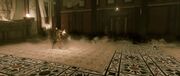 Flavius using the Apple against Bayek
 -
 Bayek hiding the Apple beneath the Library of Alexandria
 -
 The Ark of the Covenant, which used to house the Apple
 -
 Al Mualim showing the Apple to Altaïr
 -
 Al Mualim wielding the Apple
 -
 The Apple projecting a holographic map
 -
 Altaïr gazing into the Apple
 -
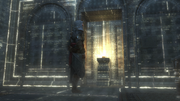 The Apple creating a Synch Nexus for Ezio
 -
 The Apple in Assassin's Creed: Blade of Shao Jun
 -
 The Apple in Assassin's Creed Roleplaying Game


Appearances[edit | edit source]
- Assassin's Creed (first appearance)
- Assassin's Creed: Bloodlines
- Assassin's Creed II (mentioned only)
- Assassin's Creed: The Fall (vision)
- Assassin's Creed: The Secret Crusade
- Assassin's Creed: Revelations
- Assassin's Creed: Revelations novel
- Assassin's Creed: Project Legacy (mentioned only)
- Assassin's Creed: Origins
- Assassin's Creed: Blade of Shao Jun (cameo)
- Assassin's Creed: Mirage (indirect mention only)
- Assassin's Creed Roleplaying Game
References[edit | edit source]
