


Durga: Difference between revisions
mNo edit summary |
|||
| (One intermediate revision by the same user not shown) | |||
| Line 30: | Line 30: | ||
{{Isu}} | {{Isu}} | ||
{{ACBM}} | {{ACBM}} | ||
<!-- | <!--[es:Durga] | ||
[fr:Durga] | |||
[nl:Durga] | |||
[ru:Дурга] | |||
[uk:Дурга] | |||
[zh:难近母]--> | |||
[[Category:Individuals]] | [[Category:Individuals]] | ||
[[Category:Isu]] | [[Category:Isu]] | ||
[[Category:Hindu deities]] | [[Category:Hindu deities]] | ||
[[Category:Individuals who held Pieces of Eden]] | [[Category:Individuals who held Pieces of Eden]] | ||
Latest revision as of 21:49, 11 May 2026
Durga was an Isu who was later revered in Hinduism as a Devi.
Biography[edit | edit source]
During the Isu Era, Durga came into possession of the Koh-i-Noor, a Piece of Eden shaped like a diamond. Somehow transferring part of her consciousness into the artifact, Durga left behind a message for humanity, intended to be viewed millennia later.[1]
Legacy and influence[edit | edit source]
By the 19th century, a statue of Durga was located amongst Isu ruins deep in the caverns beneath Ranjit Singh's summer palace in Amritsar, India. The statue was decorated with at least two Pieces of Eden, namely an Apple and a Staff of Eden, accompanied by its centerpiece, the Koh-i-Noor.[2]
In 1839, as Pyara Kaur was set upon by the British Templar Francis Cotton, the princess somehow activated the Koh-i-Noor. Possessing Pyara through the artifact, Durga delivered a speech in which she referred to humanity as "splintered", but that the race was guided through messages left behind by her own across time. Horrified at Durga's appearance, Cotton fired multiple shots at her with his pistol; one of the shots hit and shattered the Koh-i-Noor, severing Pyara's connection to the Isu.[1]
Gallery[edit | edit source]
-
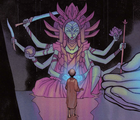 A statue of Durga
 -
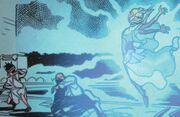 Durga manifesting
 -
 Durga as the Koh-i-Noor was shattered


Appearances[edit | edit source]
References[edit | edit source]

| |||||||||||||||||||||||||