

Hachi-rou

|
He who increaseth knowledge, increaseth sorrow. This article contains spoilers, meaning it has information and facts concerning Assassin's Creed: Shadows – Tales of Iga. If you do not want to know about these events, it is recommended to read on with caution, or not at all. |
Hachi-rou (died 1569), also known as Go-Rouku, was a Japanese samurai and later a shinobi under Momochi Sandayu during the late Sengoku period. By 1569, he later joined the Kakushiba ikki under Fujibayashi Tsuyu. However, within the same year, he lost his life during an attack at Daisen-ryō Kofun.
Biography[edit | edit source]
In 1560, Hachi-rou joined two other samurai and sought to attack a village in Iga. There, they killed a local named Bunkichi and beheaded him. When the samurai demanded a tribute in exchange to spare the rest, a young farmer's son Fujibayashi Masayasu attacked Hachi-rou and knocked him out. Although while Masayasu was overwhelmed by the remaining samurai, he was soon aided by shinobi Hattori Hanzō, who killed the two samurai. With this, Hachi-rou managed to survive and left the scene.[1]
In 1561, having been saved by the villager to leave behind his other life, Hachi-rou later joined as a new student under Momochi Sandayu. He later trained besides other students, such as Konan.[2] Within the next year, he continued training under Sandayu and later took on a new name, "Go-Rouku". Sandayu soon sent him to find Masayasu and their ally Tsuyu to tell them about a message from Hanzō about his mission in Mikawa.[3]
In 1569, Hachi-rou had joined Tsuyu's Kakushiba ikki and answered her call to defend the Daisen-ryō Kofun and safeguard the Imperial Regalia. Unfortunately, he and his fellow league members all fell to their attackers, the shadow collective, the Shinbakufu. Despite losing his arm to one of their rōnin Kuroiwa Gonjou-rou, he tried to stop the intruders but was ultimately cut down by one of the soldiers.[4]
Gallery[edit | edit source]
-
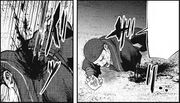 Hachi-rou's death in Tales of Iga

Appearances[edit | edit source]
References[edit | edit source]