


Hephaistos: Difference between revisions
imported>Darman36 m Dammit |
imported>Lady Kyashira mNo edit summary |
||
| Line 2: | Line 2: | ||
{{Quote|When I was flesh, I apprenticed with Hephaestus, the maker. The War of Unification raged. We created devastating Swords to end it, but then... killed. I created Shrouds, to heal.|Consus, mentioning his master, Hephaestus.|Assassin's Creed: Syndicate|Database: Reconstructed Data 003}} | {{Quote|When I was flesh, I apprenticed with Hephaestus, the maker. The War of Unification raged. We created devastating Swords to end it, but then... killed. I created Shrouds, to heal.|Consus, mentioning his master, Hephaestus.|Assassin's Creed: Syndicate|Database: Reconstructed Data 003}} | ||
{{Character Infobox | {{Character Infobox | ||
|name = Hephaistos | |||
|native = | |||
|image = Wiki noimage.jpg | |image = Wiki noimage.jpg | ||
|birth = | |||
|death = | |||
|active = [[Isu Era]] | |active = [[Isu Era]] | ||
|species = [[Isu]] | |species = [[Isu]] | ||
|database = | |||
|affiliates = [[Atlantis]]<br>[[Consus]] | |affiliates = [[Atlantis]]<br>[[Consus]] | ||
}} | }} | ||
| Line 15: | Line 20: | ||
==Mythology== | ==Mythology== | ||
Hephaistos, like many of the Isu, later came to be revered by [[human]]s as gods, most notably in the [[Greek mythology|Greek]] and [[Roman civilization|Roman pantheons]] as the god of [[Blacksmith|smithing]] and fire, forgework, and volcanoes. | |||
In Greek mythology, Hephaistos was said to have a limp, and when this was discovered by the goddess [[Hera]], who was said to have been his mother, she threw him off [[Mount Olympos]]. Hephaistos landed in the sea near [[Lemnos]], where sea deities rescued him.<ref>''Assassin's Creed: Odyssey'' – [[Historical Locations]]: Lemnos: Temple of Hephaistos</ref> | |||
Hephaistos also helped the hero [[Herakles]] with at least one of his [[Labours of Hercules|tasks]], albeit indirectly, as he was the creator of the rattle which the goddess [[Athena]] gave to Herakles to scare the [[Stymphalian birds]] out of hiding.<ref>''[[Discovery Tour: Ancient Greece]]'' – Arkadia: The Stymphalian Birds</ref> | Hephaistos also helped the hero [[Herakles]] with at least one of his [[Labours of Hercules|tasks]], albeit indirectly, as he was the creator of the rattle which the goddess [[Athena]] gave to Herakles to scare the [[Stymphalian birds]] out of hiding.<ref>''[[Discovery Tour: Ancient Greece]]'' – Arkadia: The Stymphalian Birds</ref> | ||
| Line 22: | Line 29: | ||
==Influence and legacy== | ==Influence and legacy== | ||
Hephaistos' | Many of Hephaistos' creations survived the [[Great Catastrophe|end]] of the Isu's reign, becoming objects of divine origin among humanity. During the 5th century BCE, the islands of [[Thasos]] and Lemnos were known as the [[Hephaistos Islands]], with the latter housing a notable [[Temple of Hephaistos, Lemnos|temple]] dedicated to Hephaistos. The volcanic island north of [[Argolis]] was called the [[Foundry of Hephaistos]].In addition, the ''[[polis]]'' [[Athens]] housed a [[Temple of Hephaistos, Athens|temple]] dedicated to him. Some claimed that a [[Myson Cave|cave]] hiding curious architecture in its depths in the northern parts of [[Malis]] held Hephaistos' [[Hephaistos' Workshop|workshop]].<ref name="ACOD" /> | ||
Also during this time, [[Kassandra]] made her living as a [[mercenary]]. Due to her nature as a [[hybrid]] with high concentrations of Isu DNA, she had access to a [[Skill Tree (Assassin's Creed: Odyssey)|range of powers]] within the Spear of Leonidas, one of which included the ability to temporarily imbue her weapons with the divine flames of Hephaistos' forge.<ref name="ACOD"/> | Also during this time, [[Kassandra]] made her living as a [[mercenary]]. Due to her nature as a [[hybrid]] with high concentrations of Isu DNA, she had access to a [[Skill Tree (Assassin's Creed: Odyssey)|range of powers]] within the Spear of Leonidas, one of which included the ability to temporarily imbue her weapons with the divine flames of Hephaistos' forge.<ref name="ACOD"/> | ||
Revision as of 14:34, 20 October 2021
Hephaistos, alternatively Hephaestus, was an Isu metal forger and weaponsmith who lived during the War of Unification. He was also the teacher of Consus, another Isu.
Biography
During the Isu Era, Hephaistos was known as "the maker" among his people, having invented many Pieces of Eden and at one point trained Consus, who later used his teachings to develop his own Pieces of Eden, such as the healing devices known as the Shrouds.[1] During his time in Atlantis, Hephaistos also constructed a forge beneath Poseidon's palace and created numerous weapon blueprints which could be used with it.[2]
Likewise, he was the engineer responsible for the Ancient Forge on the island of Andros and the smith behind the the Spear of Leonidas, which could be upgraded at this forge. The Forge held the apparent mold for the spear, as well as the molds for a sword, a battleaxe, and a halberd. The Hammer of Hephaistos wielded by the Cyclops Arges was allegedly another one of his creations. [3]
Mythology
Hephaistos, like many of the Isu, later came to be revered by humans as gods, most notably in the Greek and Roman pantheons as the god of smithing and fire, forgework, and volcanoes.
In Greek mythology, Hephaistos was said to have a limp, and when this was discovered by the goddess Hera, who was said to have been his mother, she threw him off Mount Olympos. Hephaistos landed in the sea near Lemnos, where sea deities rescued him.[4]
Hephaistos also helped the hero Herakles with at least one of his tasks, albeit indirectly, as he was the creator of the rattle which the goddess Athena gave to Herakles to scare the Stymphalian birds out of hiding.[5]
Hephaistos was also later credited as the acting midwife for Zeus when it had come the time for Athena to be born, cleaved Zeus' head open with a labrys to free the goddess.[6]
Influence and legacy
Many of Hephaistos' creations survived the end of the Isu's reign, becoming objects of divine origin among humanity. During the 5th century BCE, the islands of Thasos and Lemnos were known as the Hephaistos Islands, with the latter housing a notable temple dedicated to Hephaistos. The volcanic island north of Argolis was called the Foundry of Hephaistos.In addition, the polis Athens housed a temple dedicated to him. Some claimed that a cave hiding curious architecture in its depths in the northern parts of Malis held Hephaistos' workshop.[3]
Also during this time, Kassandra made her living as a mercenary. Due to her nature as a hybrid with high concentrations of Isu DNA, she had access to a range of powers within the Spear of Leonidas, one of which included the ability to temporarily imbue her weapons with the divine flames of Hephaistos' forge.[3]
In 2012, Desmond Miles' Assassin cell named their email communications network after the god.[7][8]
Behind the scenes
The mural depicting Hephaistos riding a donkey in Assassin's Creed: Odyssey is based on a vase painting from the 5th century BCE.
Gallery
-
 Hephaistos (right of center) amongst the Greek pantheon
 -
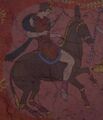 A 5th century BCE mural of Hephaistos, holding tongs and riding a donkey


Appearances
- Assassin's Creed: Syndicate (mentioned in Database entry only)
- Assassin's Creed: Odyssey (statue only)
- The Fate of Atlantis: Fields of Elysium (mentioned only)
- The Fate of Atlantis: Judgment of Atlantis (Voice only)
- Discovery Tour: Ancient Greece
- Assassin's Creed: Rebellion (mentioned only)
References
- ↑ Assassin's Creed: Syndicate – Database: Reconstructed Data 003
- ↑ Assassin's Creed: Odyssey – The Fate of Atlantis: Judgment of Atlantis
- ↑ 3.0 3.1 3.2 Assassin's Creed: Odyssey
- ↑ Assassin's Creed: Odyssey – Historical Locations: Lemnos: Temple of Hephaistos
- ↑ Discovery Tour: Ancient Greece – Arkadia: The Stymphalian Birds
- ↑ Assassin's Creed: Origins
- ↑ Assassin's Creed: Brotherhood
- ↑ Assassin's Creed III
