

Shakyamuni: Difference between revisions
imported>Lady Kyashira mNo edit summary |
imported>Gener4l Cl4ank4 No edit summary |
||
| Line 18: | Line 18: | ||
The śarīra that had been drawn from Shakyamuni's remains became the first of many of these memory receptacles collected by the Buddhist monks. Their spiritual masters protected them fiercely, enshrining them in their temples, and passing them on from generation to generation.<ref name="Dynasty 7" /> | The śarīra that had been drawn from Shakyamuni's remains became the first of many of these memory receptacles collected by the Buddhist monks. Their spiritual masters protected them fiercely, enshrining them in their temples, and passing them on from generation to generation.<ref name="Dynasty 7" /> | ||
The proliferation of Buddhism also inspired the creation of numerous art based on the life of the Buddha alongside statues of the many successors that came after him. These sculptures sometimes reached colossal heights, with one example being the [[Mengshan Giant Buddha]] built under the {{wiki|Northern Qi}} in [[Taiyuan]].<ref name="Dynasty 32">''[[Assassin's Creed: Dynasty]]'' – [[The Last Stand of Justice (Part 8)]]</ref> | |||
[[File:ACFT - Saito and the monk praying.png|thumb|180px|left|Saito and a monk praying to a statue of Shakyamuni]] | [[File:ACFT - Saito and the monk praying.png|thumb|180px|left|Saito and a monk praying to a statue of Shakyamuni]] | ||
The | The [[Shwedagon Pagoda]], a sacred Buddhist site in [[Yangon]], [[Myanmar]], is adorned with statues of Shakyamuni, where visitors can pray and make their offerings to the Buddha. In 1725, while visiting the site to retrieve a [[Piece of Eden]] housed within the pagoda, [[Shimazu Saito]] went to pray to a statue of Shakyamuni alongside a Buddhist monk, where they briefly discussed the Buddha's teachings.<ref name="ACFT 97">''[[Assassin's Creed: Forgotten Temple]]'' – [[Assassin's Creed: Forgotten Temple Episode 97|Episode 97]]</ref> | ||
The [[ | The province of {{wiki|Gansu}} in the {{wiki|People's Republic of China}} today is also home to labyrinthine caves filled with thousands of Buddhist statues and murals, among the most famous being the [[Maijishan Grottoes]].<ref name="Maijishan Grottoes">''[[Assassin's Creed Chronicles: China]]'' – [[Database: Maijishan Grottoes]]</ref> One of the murals in {{wiki|Dunhuang}}, Gansu, appears to depict the legend of the Buddha resisting the temptation of {{wiki|Mara (demon)|Mara}} to sway him from his meditative quest for Enlightenment.<ref name="Dunhuang mural">[[commons:User:World Imaging|World Imaging]]. "[[commons:File:FireLanceAndGrenade10thCenturyDunhuang.jpg|Fire Lance and Grenade, 10th Century Dunhuang]]". ''{{Wiki|Wikimedia Commons}}''. Uploaded 6 August 2007.</ref> Replete with images of demons assaulting the Buddha, it is also purportedly the earliest known illustration of [[firearm]]s and [[Bomb|explosives]]: one demon wields a fire lance and another a flaming ball.<ref name="Song science">{{WP|Science and technology of the Song dynasty}}</ref> | ||
In 2012, this very section of the mural was included within one of the [[Glyph]] puzzles the [[Assassins|Assassin]] [[Clay Kaczmarek]] had hidden in the [[Animus]] for his successor [[Desmond Miles]] to solve. Prompting Desmond to locate [[Piece of Eden|Pieces of Eden]] among various works of art, Clay indicated that the flaming ball in the demon's hand was actually a depiction of an [[Apples of Eden|Apple of Eden]], not a bomb.<ref name="Glyph 4">''[[Assassin's Creed II]]'' – [[Glyphs|Glyph]] #4: "Infinite Knowledge"</ref> In this way, he suggested that an Apple of Eden was involved in the Buddha's life or at the very least one had surfaced in the [[Song dynasty]] when the painting was drawn.<ref name="Dunhuang mural" /><ref name="Glyph 4" /> Apart from this, Clay also hid a {{Wiki|binary}} code reading "{{Wiki|Me (mythology)|Sumerian, Me 23}}" within the painting.<ref name="Glyph 4" /> | |||
==Gallery== | ==Gallery== | ||
| Line 40: | Line 42: | ||
*''[[Assassin's Creed: Forgotten Temple]]'' {{Io|sculpture}} | *''[[Assassin's Creed: Forgotten Temple]]'' {{Io|sculpture}} | ||
*''[[Assassin's Creed: Brotherhood of Venice]] – [[Apocalypse]]'' {{Mo}} | *''[[Assassin's Creed: Brotherhood of Venice]] – [[Apocalypse]]'' {{Mo}} | ||
*''[[Assassin's Creed: Shadows]]'' {{ | *''[[Assassin's Creed: Shadows]]'' {{Io|sculpture}} | ||
==References== | ==References== | ||
Revision as of 00:28, 5 May 2025
Siddhārtha Gautama (died c. 483/400 BCE),[1] popularly known as Shakyamuni or simply the Buddha,[2] was a philosopher and spiritual leader on whose teachings Buddhism was founded. Those few who knew of his true nature called him a Precursor,[2] and he spent decades of his life teaching in India a path to liberation from suffering which involved attaining nirvana, an enlightened state which ceases the cycle of rebirth.[1]
Biography
In remote antiquity, Shakyamuni educated the masses of people living in the Indian states on the Buddhadharma. His guidance earned him innumerable disciples and the profound admiration of everyday people. Eventually, he chose to "relinquish his flesh" and passed away to the overwhelming grief of his followers. His body was cremated, but his disciples recovered among his ashes pearl-like stones of a rainbow of colours which were referred to as śarīra.[2]
Consecrated as sacred relics, the śarīra were actually reservoirs of Shakyamuni's genetic memories, thereby offering invaluable insights on the world of eons past—what the Japanese scholar Abe no Nakamaro later called "the truth of the world" in his letters to the poet Li Bai.[2]
Legacy
After his death, the Buddhadharma continued to be taught throughout India by the disciples he left behind. His teachings became Buddhism, and over the centuries, this religion spread throughout Asia along the Silk Road. By the latter Han dynasty, it had reached China via the Western Regions.[2] There, its influence became paramount during the Tang dynasty,[2] from which it was further disseminated into Japan.[3]
The śarīra that had been drawn from Shakyamuni's remains became the first of many of these memory receptacles collected by the Buddhist monks. Their spiritual masters protected them fiercely, enshrining them in their temples, and passing them on from generation to generation.[2]
The proliferation of Buddhism also inspired the creation of numerous art based on the life of the Buddha alongside statues of the many successors that came after him. These sculptures sometimes reached colossal heights, with one example being the Mengshan Giant Buddha built under the Northern Qi in Taiyuan.[4]

The Shwedagon Pagoda, a sacred Buddhist site in Yangon, Myanmar, is adorned with statues of Shakyamuni, where visitors can pray and make their offerings to the Buddha. In 1725, while visiting the site to retrieve a Piece of Eden housed within the pagoda, Shimazu Saito went to pray to a statue of Shakyamuni alongside a Buddhist monk, where they briefly discussed the Buddha's teachings.[5]
The province of Gansu in the People's Republic of China today is also home to labyrinthine caves filled with thousands of Buddhist statues and murals, among the most famous being the Maijishan Grottoes.[6] One of the murals in Dunhuang, Gansu, appears to depict the legend of the Buddha resisting the temptation of Mara to sway him from his meditative quest for Enlightenment.[7] Replete with images of demons assaulting the Buddha, it is also purportedly the earliest known illustration of firearms and explosives: one demon wields a fire lance and another a flaming ball.[8]
In 2012, this very section of the mural was included within one of the Glyph puzzles the Assassin Clay Kaczmarek had hidden in the Animus for his successor Desmond Miles to solve. Prompting Desmond to locate Pieces of Eden among various works of art, Clay indicated that the flaming ball in the demon's hand was actually a depiction of an Apple of Eden, not a bomb.[9] In this way, he suggested that an Apple of Eden was involved in the Buddha's life or at the very least one had surfaced in the Song dynasty when the painting was drawn.[7][9] Apart from this, Clay also hid a binary code reading "Sumerian, Me 23" within the painting.[9]
Gallery
-
 A statue of Shakyamuni
 -
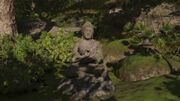 Statue of a seated Shakyamuni in Japan


Appearances
- Assassin's Creed II (first appearance) (painting only)
- Assassin's Creed: Dynasty (sculpture only)
- Assassin's Creed: Blade of Shao Jun (mentioned only)
- Assassin's Creed: The Imperial Jade Seal – Prophecy of the Emperor (sculpture only)
- Assassin's Creed: Mirage (mentioned only)
- Assassin's Creed: Forgotten Temple (sculpture only)
- Assassin's Creed: Brotherhood of Venice – Apocalypse (mentioned only)
- Assassin's Creed: Shadows (sculpture only)
References
- ↑ 1.0 1.1 1.2 1.3
 Gautama Buddha on Wikipedia
- ↑ 2.0 2.1 2.2 2.3 2.4 2.5 2.6 2.7 Assassin's Creed: Dynasty – The Flower Banquet (Part 7)
- ↑ Buddhism on Wikipedia
- ↑ Assassin's Creed: Dynasty – The Last Stand of Justice (Part 8)
- ↑ Assassin's Creed: Forgotten Temple – Episode 97
- ↑ Assassin's Creed Chronicles: China – Database: Maijishan Grottoes
- ↑ 7.0 7.1 World Imaging. "Fire Lance and Grenade, 10th Century Dunhuang". Wikimedia Commons. Uploaded 6 August 2007.
- ↑ Science and technology of the Song dynasty on Wikipedia
- ↑ 9.0 9.1 9.2 Assassin's Creed II – Glyph #4: "Infinite Knowledge"

