

Napoleon Bonaparte: Difference between revisions
Undo revision 588909 by 174.93.6.240 (talk) |
|||
| (239 intermediate revisions by 73 users not shown) | |||
| Line 1: | Line 1: | ||
{{Era| | {{Era|Individuals}}{{WP-REAL|Napoleon}} | ||
{{WP-REAL}} | {{Quote|The masses will gladly renounce their freedom if all can entertain the hope of rising to the top. With the artifact inside the temple, I will bring them the illusion of hope. And I will lead us to glory.|Napoleon Bonaparte, 1794.|Assassin's Creed: Unity|The Book Thief}} | ||
{{ | |||
{{Character Infobox | {{Character Infobox | ||
|image = ACU Napoleon | |name = Napoleon Bonaparte | ||
|birth = 15 August 1769<br>Ajaccio, Corsica, France | |image = ACU Napoleon Render.png | ||
|death = 5 May 1821 | |birth = 15 August 1769<br>{{Wiki|Ajaccio}}, [[Corsica]], [[Kingdom of France]] | ||
| | |death = 5 May 1821 {{c|aged 51}}<br>{{Wiki|Longwood, Saint Helena|Longwood}}, {{Wiki|Saint Helena}}, [[United Kingdom]] | ||
| | |species = [[Human]] | ||
|database = [[Database: Napoleon Bonaparte|Napoleon Bonaparte]] | |||
''' | |affiliates = *[[French Army]] | ||
*{{Wiki|House of Bonaparte}} | |||
*[[French Empire]] | |||
*[[Raider]]s | |||
*[[Assassins]] | |||
**[[Parisian Brotherhood of Assassins|French Brotherhood]] | |||
}} | |||
'''Napoléon Bonaparte''' (1769 – 1821), born '''Napoleone di Buonaparte''' and later known as '''Napoleon I''', was a [[Corsica]]n military and political leader who ruled first as the First Consul of [[France]] from 1799 to 1804, then as [[French Empire|Emperor of the French]] from 1804 to 1815. He rose to power amidst the chaos and political turmoil of the [[French Revolution]], secretly aided by an [[Apple of Eden 1|Apple of Eden]] he had discovered. On many occasions, he was an ally of the [[Assassins]], and maintained a long and complicated friendship with the [[Parisian Brotherhood of Assassins|French Assassin]] [[Arno Dorian]]. | |||
==Biography== | |||
===Early life=== | |||
Born on the [[Mediterranean Sea|Mediterranean]] island of Corsica, shortly after its acquisition by France, Napoleon Bonaparte was the son of Carlo Buonaparte, a former supporter of Corsican independentist leader {{Wiki|Pasquale Paoli}}. When his father switched sides, he was rewarded with a coveted position that enabled him to enroll Napoleon and his brother [[Joseph Bonaparte|Joseph]] in France's Collége d'Autun.<ref name="HPS">''[[Assassin's Creed Unity: Abstergo Entertainment – Employee Handbook]]'' – [[Historic Personage Sheets]]: Napoleon Bonaparte</ref> | |||
Bonaparte is | Between 1779 and 1784, Napoleon studied at the military college of Brienne, where he was the subject of abuse by his peers due to his foreign accent and rustic manners.<ref name="HPS"/><ref name="Database">''[[Assassin's Creed: Unity]]'' – [[Database: Napoleon Bonaparte]]</ref> Later, he studied at the [[École Militaire]] of [[Paris]] but as his father died in 1785, he graduated early as a second lieutenant of artillery.<ref name="HPS"/> | ||
Between 1785 and 1791, Napoleon only served 33 months under the flag while taking 38 months of leave.<ref name="HPS"/><ref name="Database"/> | |||
===French Revolution=== | |||
====Beginning in the Army==== | |||
In 1791, during the [[French Revolution]], Napoleon became an associate of Pascale Paoli in Corsica. Despite their cooperation together, the relationship between them became strained. Due to exceeding his leave of absence, Napoleon was dismissed from the army on 1 January 1792. Nonetheless, he was still appointed as colonel of a battalion tasked with suppressing a peaceful demonstration against the [[Civil Constitution of the Clergy]]. Against the orders of his superiors, Napoleon's troops took control of the citadel of {{Wiki|Ajaccio}}.<ref name="Database"/> | |||
Later, Napoleon went to Paris where he participated in the {{Wiki|Demonstration of 20 June 1792|20 June demonstration}}.<ref name="Database"/> At some point, he met [[Frédéric Rouille]], a Captain from the [[National Guard]] and secretly a [[Parisian Rite of the Templar Order|French Templar]]. Napoleon described him as "a persistent thorn".<ref name="The King's Correspondence"/> | |||
====Meeting Arno Dorian==== | |||
{{Quote|You certainly don't look like a blood-crazed revolutionary. The hood... is a bit sinister though, if you don't mind my saying.|Napoleon, during his first encounter with Arno, 1792.|Assassin's Creed: Unity|The King's Correspondence}} | |||
During the [[10 August]] insurrection, Napoleon infiltrated the [[Tuileries Palace]] to acquire an [[Isu]] [[Saint-Denis Temple key|key]] that had been placed in a chest and hidden in a secret vault by [[Louis XVI of France|King Louis]] in the latter's study. At the same time, the palace was under attack by several revolutionary extremists led by Frédéric Rouille.<ref name="The King's Correspondence">''[[Assassin's Creed: Unity]]'' – [[The King's Correspondence]]</ref> | |||
[[File:The King's Correspondence 8.png|left|thumb|250px|Napoleon holding Arno Dorian at gunpoint]] | |||
In the office, Napoleon ambushed at gunpoint an [[Assassins|Assassin]] who was searching for documents that could expose the [[Parisian Brotherhood of Assassins|Parisian Brotherhood]]. Understanding they were not searching for the same prize, Napoleon proposed to the Assassin that they work together. With the Assassin's [[Eagle Vision]], they discovered the King's hidden vault. While the Assassin burnt the documents, Napoleon opened the casket which contained the Isu key and hid it in his mantle.<ref name="The King's Correspondence"/> | |||
As they were about to leave, they were attacked by Rouille's men who were searching for [[Honoré Gabriel Riqueti, comte de Mirabeau|Mirabeau's]] documents. While the Assassin held them off, Napoleon turned a handle to open up a secret elevator hidden in the office. Succeeding in opening the passageway, Napoleon shot down the last revolutionary who was charging the Assassin. Just as they were taking the elevator, Rouille himself burst into the office looking for the documents, missing them by a second. Noticing the Assassin's reaction to seeing Rouille, Napoleon elaborated a little on his rivalry with the captain.<ref name="The King's Correspondence"/> | |||
Walking through the sewers, the Assassin introduced himself as [[Arno Dorian]]. Impressed by Arno's combat abilities, Napoleon offered him a future position in the military, an offer which the Assassin turned down. The pair was then aided by Bonaparte's soldiers, who managed to blow a hole in the palace's wall and provide them with an escape route. As Arno asked again about Rouille, Napoleon promised to help him find the captain.<ref name="The King's Correspondence"/> | |||
During the following months, Napoleon made several unsuccessful attempts to have Rouille assigned to a more remote posting, being both exasperated and impressed by the captain's resourcefulness and connections. In September 1792, Napoleon learned that Rouille was participating in the [[September Massacres]] at the [[Grand Châtelet]] prison. On his way home, Napoleon was accosted by several revolutionaries who mistook him for a noble by his uniform, though they let him go once he proclaimed his allegiance to the French Republic. Later on, he met with Arno and informed him of Rouille's location. Thanks to his information, Arno was successful in assassinating Rouille in the Grand Châtelet.<ref name="September Massacres">''[[Assassin's Creed: Unity]]'' – [[September Massacres (memory)|September Massacres]]</ref> | |||
With the fall of the Monarchy, Paris was threatened by the [[Austria]]n army. Learning that royalists were sending messages to the [[Charles William Ferdinand, Duke of Brunswick-Wolfenbüttel|Duke of Brunswick]] through [[Chappe signal towers]], Napoleon tasked General [[Thomas-Alexandre Dumas]] to find Arno and enlist his help to sabotage the towers, a mission the Assassin succeeded in.<ref>''[[Assassin's Creed: Unity]]'' – [[A Nice Chappe]]</ref> | |||
====Mediterranean campaign==== | |||
In April 1793, the Corsican Civil War began and Napoleon became an enemy of Pascale Paoli. Showing his support for France, Napoleon adopted the French version of his surname, "Bonaparte", and relocated to France. In June, he joined his regiment at Nice and supported the [[Jacobins]], earning the nickname of the "booted jacobin".<ref name="HPS"/><ref name="Database"/> | |||
[[File:A Crown of Thorns 7.png|250px|thumb|Napoleon and Rose at the siege of Toulon]] | |||
In September 1793, Napoleon participated in the [[Siege of Toulon]] and, with the help of [[Philippe Rose]], who provided cannons, he took the city.<ref name="A Crown of Thorns">''[[Assassin's Creed: Unity]] – [[Dead Kings]]'' – [[A Crown of Thorns]]</ref> Due to his experience as an artillery master, Napoleon earned the attention of brothers {{Wiki|Augustin Robespierre|Augustin}} and [[Maximilien de Robespierre]], the former appointing him as a brigadier general, granting him command of the artillery of the [[French Army]] in Italy.<ref name="Database"/> | |||
Unbeknownst to Napoleon, Maximilien de Robespierre was a Templar and was concerned with the Corsican's rising popularity within the army. Thus, he conspired with his colleague [[Louis Antoine de Saint-Just]] to discredit Napoleon by providing him with defective armaments for Napoleon's men. However, Arno Dorian was able to sabotage the defective weapons before they could be delivered to Napoleon, safeguarding his career.<ref name="Up in Arms">''[[Assassin's Creed: Unity]]'' – [[Up in Arms]]</ref> | |||
====Excavating Saint-Denis==== | |||
{{Quote|Find me the door that this key unlocks, and I shall reward you beyond your wildest dreams.|Napoleon, hiring Rose to find the Temple, 1794.|Assassin's Creed: Unity|The Book Thief}} | |||
[[File:ACU The Book Thief 3.jpg|thumb|250px|left|Napoleon checking up on Rose's progress]] | |||
In August of 1794, after the [[Thermidorian Reaction|fall of Maximilien de Robespierre]], Napoleon secretly hired Philippe Rose to excavate the Isu [[Saint-Denis Temple|Temple]] underneath [[Saint-Denis]] in order to obtain the [[Apple of Eden 1|Apple of Eden]] hidden there. On 4 August, Napoleon personally came to check up on Rose. When shown a carving of the Temple, Napoleon noted that a part of the carving resembled the Isu key he had retrieved two years prior. He ordered Rose to find the door, promising to pay the captain handsomely. He then took note of a young boy, [[Léon]], who was captured by the [[raider]]s. Napoleon instructed Rose to escort the boy back to the surface, but once Bonaparte had left, the raiders intended to murder Léon.<ref name="The Book Thief">''[[Assassin's Creed: Unity]] – [[Dead Kings]]'' – [[The Book Thief]]</ref> | |||
Napoleon then moved to another part of the catacombs, where one of his lieutenants complained about Rose, asking whether he could be trusted. Napoleon compared Rose to a rat wanting food and was confident that he could control him, even though he knew that Rose was untrustworthy. Assuring the lieutenant that what he did was for the good of France, he then placed the Isu key in a box and entrusted it to the soldier.<ref name="The Book Thief"/> | |||
[[File:A Crown of Thorns 15.png|thumb|250px|Napoleon being arrested]] | |||
Unbeknownst to Napoleon, a soldier had convinced Rose to take the Apple of Eden to a higher bidder. Sent on a mission by the [[Donatien Alphonse François, Marquis de Sade|Marquis de Sade]], Arno Dorian became entangled in Napoleon's quest for the artifact, and in the process killed Rose. He managed to retrieve the Apple first and sent it to [[Al Mualim (1794)|Al Mualim]] in [[Egypt]], where Napoleon could never acquire it.<ref name="A Crown of Thorns"/> | |||
On 6 August, Napoleon was placed under house arrest on charges of treason, desertion and supporting Maximilien de Robespierre during the [[Reign of Terror]].<ref name="A Crown of Thorns"/> Eighteen days later, due to his influence in politics, Napoleon was released and acquitted of all charges.<ref name="Napoleon's Arrest">''[[Assassin's Creed: Unity]] – [[Dead Kings]]'' – [[Database: Napoleon's Arrest]]</ref> | |||
====Collaboration with Arno==== | |||
Around 1795, Napoleon became engaged to [[Désirée Clary]], who was intended to be engaged to Napoleon's brother. As Napoleon feared for Désirée's safety, he sent his fellow captain [[Jean-Baptiste Bernadotte]] and Arno Dorian to protect her from ''Sans-Culottes''.<ref name="Désirée Desired">''[[Assassin's Creed: Unity]]'' – [[Désirée Desired]]</ref> After the Assassin succeeded, Napoleon suspected that Bernadotte was in love with his fiancée, and tasked Arno to find evidence while he was dining with Clary at the [[Restaurant Boulanger]]. During the dinner, Napoleon was confronted by Bernadotte, creating a scandal and gossip. When some patrons insulted Clary, Bernadotte fought them with the help of Arno. Embarrassed, Désirée demanded that Bernadotte leave her alone.<ref name="Désirée Dismayed">''[[Assassin's Creed: Unity]]'' – [[Désirée Dismayed]]</ref> | |||
At some point, Napoleon lost interest in Clary as he fell in love with [[Joséphine de Beauharnais]], the widow of a noble who died during the Terror. When Arno snuck into his house and stole Clary's love letters, Napoleon did not mind the theft at all.<ref>''[[Assassin's Creed: Unity]]'' – [[Désirée Delighted]]</ref> | |||
Later, as Napoleon intended to take Josephine on a romantic stroll, the couple was escorted by Arno, who had been tasked by Thomas-Alexandre Dumas to protect them from Royalists. Nervous, Napoleon had difficulty completing his sentences during the meeting. While Joséphine told him about her former marriage, Napoleon fascinated her with his Corsican accent and military career. At the end of the meeting, a captivated Napoleon complimented her eyes and insisted that they meet again. Despite clearly being exhausted from the ordeal, he was confident that their stroll together had gone well.<ref name="A Romantic Stroll">''[[Assassin's Creed: Unity]]'' – [[A Romantic Stroll]]</ref> | |||
====Rise to power==== | |||
{{Quote|Napoleon's claim to fame was using cannons on the streets of Paris. Outnumbered 6 to 1, he crushed Royalist forces marching on the National Convention.|Bishop, regarding Napoleon's rise to power, 2014.|Assassin's Creed: Unity|The Infernal Machine}} | |||
[[File:ACU. Napoleon cannon.png|thumb|left|250px|Napoleon during the 13 Vendémiaire uprising]] | |||
During the [[Directory]], Napoleon had a successful career, beginning with the crushing of the [[13 Vendémiaire]] uprising in 1795. Despite commanding only five thousand troops against twenty-five thousand insurgents, Napoleon defeated the Royalists through the use of cannons provided by his lieutenant [[Joachim Murat]]. Before the [[Church of Saint-Roch]], Napoleon used grapeshot on the crowd.<ref name="The Infernal Machine">''[[Assassin's Creed: Unity]]'' – [[The Infernal Machine]]</ref> Bonaparte was later named commander of the Army of Interior while Murat became his aide-de-camp.<ref name="HPS"/><ref name="Joachim Murat">''[[Assassin's Creed: Unity]]'' – [[Database: Joachim Murat]]</ref> | |||
In 1796, Napoleon was placed at the head of the Army of Italy. Under his command, a group of a mere 30,000 men won several key victories against the Austrians, helping to expand the French Republic's influence and elevate Napoleon's reputation.<ref name="HPS"/> During this campaign, he compared General Thomas-Alexandre Dumas to a [[Roman Republic|Roman]] hero.<ref>''[[Assassin's Creed: Unity]]'' – [[The Tournament (Unity)|The Tournament]]</ref> That year, he also married Joséphine, but their initial years were marked by infidelity and considerable time apart.<ref name="HPS"/><ref name="Joséphine de Beauharnais">''[[Assassin's Creed: Unity]]'' – [[Database: Josephine de Beauharnais]]</ref> | |||
In 1797, Napoleon {{Wiki|Fall of the Republic of Venice|invaded}} Venice,<ref name="Armoire">''[[L'Armoire de Fer]]''</ref> dissolving the approximately 1,100 year old [[Republic of Venice|republic]]<ref>{{WP|Fall of the Republic of Venice}}</ref> and stealing the {{Wiki|Horses of Saint Mark|four bronze horses}} that adorned the [[Basilica di San Marco]] for use decorating the {{Wiki|Arc de Triomphe du Carrousel}}.<ref name="Armoire"/> | |||
[[File:DTAE Napoleon before the Sphinx.png|thumb|250px|''Bonaparte Before the Sphinx'' by Jean-Léon Gérôme]] | |||
In 1798, Napoleon embarked on a campaign to Egypt and [[Syria]], officially to undermine the [[British Empire]]; in reality, his main goal was to recover the Apple of Eden he had failed to obtain in Saint-Denis.<ref name="HPS"/><ref name="Napoleon's Arrest"/> Near [[Cairo]], he won the {{Wiki|Battle of the Pyramids}} against the [[Ottoman Empire]], but his fleet was defeated on 1 August by the [[Royal Navy|British Navy]] led by Admiral [[Horatio Nelson, 1st Viscount Nelson|Horatio Nelson]] during the Battle of the Nile.<ref name="Database"/><ref name="HPS"/> In the wake of the battle, Britain, Austria, [[Russia]] and the Ottomans formed a new coalition against France.<ref name="HPS"/> | |||
In 1799, one of Napoleon's soldiers, Pierre-François Bouchard, found the [[Rosetta Stone]], a granodiorite stele dating from the 2nd century BCE, inscribed with a decree written in Egyptian hieroglyphs, Demotic, and Greek scripts.<ref>''[[Assassin's Creed: Unity]]'' – [[Database: The Rosetta Stone]]</ref> That same year, General Dumas was captured in the Kingdom of [[Naples]], but Napoleon did nothing to secure his release as their relationship had become strained over time.<ref>''[[Assassin's Creed: Unity]]'' – [[Database: Thomas-Alexandre Dumas]]</ref> | |||
After successfully retrieving the Apple of Eden, Napoleon returned home in October 1799. As the Jacobins took control of France in a coup, Napoleon allied with the Director [[Emmanuel Joseph Sieyès]] to stage another coup.<ref name="HPS"/> Using his newfound power,<ref name="Den">{{Youtube|Rt9q3F1JS7E|The Assassin's Den - ft. Jeffrey Yohalem (Dead Kings discussion and more)|UCfB8dJdMxEofkcybwAskjqQ|Loomer|quote={{Cite|7 June 2024}}}}</ref> Bonaparte seized power for himself during the {{Wiki|coup of 18 Brumaire}} in 9 November, becoming the First Consul of France.<ref name="Mines">''[[Le Secret des Mines]]''</ref><ref name="HPS"/> | |||
===Ruler of France=== | |||
====First Consul of France==== | |||
During his consulate, Napoleon initiated well-received reforms to France's education, economy and legal system.<ref name="HPS"/> In 1800, his sister Caroline married General Joachim Murat.<ref name="Joachim Murat"/> In May of the same year, Bonaparte took command of an army in Lyon and crossed the Great St Bernard Pass to confront the Austrians in Italy.<ref name="Mines"/> | |||
[[File:The Infernal Machine 2.png|thumb|250px|left|The Infernal Machine's explosion]] | |||
On the night of 24 December 1800, while Napoleon went to the opera, he was targeted by the last remaining Royalists of the 13 Vendémiaire coup, led by [[François-Joseph Carbon]]. As they plotted to use "[[Infernal Machine|The Infernal Machine]]" in the Rue Saint-Nicaise, Arno Dorian and another Assassin eliminated all of the [[sniper]]s who aimed at Napoleon's carriage. The plan backfired when the Infernal Machine detonated too early, far away from Napoleon's carriage. Napoleon's men then escorted the Consul to safety while the Assassins eliminated Carbon and the conspirators, preventing any further assassination attempts. Napoleon himself remained oblivious to the Assassins' presence.<ref name="The Infernal Machine"/> | |||
In 1801, Napoleon offered the [[Luxembourg Palace]] to the French Senate.<ref>''[[Assassin's Creed: Unity]]'' – [[Database: Palais et Jardin du Luxembourg]]</ref> That same year, he reinstated Roman Catholicism as the state religion of France.<ref name="HPS"/> He also ordered the arrest of the anonymous author of the violent erotic works ''Justine'' and ''Juliette''. The author was identified as the [[Donatien Alphonse François, Marquis de Sade|Marquis de Sade]], who spent the rest of his life in Charenton prison, with Napoleon personally overseeing his imprisonment.<ref>''[[Assassin's Creed Unity: Abstergo Entertainment – Employee Handbook]]'' – [[Historic Personage Sheets]]: Marquis de Sade</ref> In Egypt, his troops lost the Battle of Aboukir Bay, and the British took the Rosetta Stone.<ref name="Database"/><ref>''[[Discovery Tour: Ancient Egypt]]'' – [[Tours: Jean-François Champollion]]: The Rosetta Stone</ref> | |||
In 1802, Napoleon was elected Consul for life.<ref name="HPS"/> During the last few years of the [[Haitian Revolution]], Napoleon saw [[Toussaint Louverture]] as a threat and sent [[Charles Leclerc]] to remove him from power and reinstate [[slavery]] in the colony of [[Haiti|Saint-Domingue]]. Leclerc succeeded, but later in the war, French troops were forced out of Saint-Domingue.<ref>''[[Assassin's Creed: Initiates]]'' – [[Eseosa's Codex]]: "Leclerc's Expedition: Cap Français, Saint-Domingue, 1802"</ref> As a result, Napoleon, seeing the rebelling colonies as more of a continuous liability, sold the French colonies to the [[United States]], in what would be known as the {{Wiki|Louisiana Purchase}}.<ref>''[[Assassin's Creed: Initiates]]'' – [[Eseosa's Codex]]: "What Price Freedom: Davenport Manor, British America, 1804-03-01"</ref> | |||
In 1803, Napoleon again went to war against a coalition composed of Britain, Austria, and Russia.<ref name="HPS"/> He also ordered the arrest of the fortune teller [[Marie Anne Lenormand]], a friend of his wife, on charges of treason.<ref name="Mademoiselle Lenormand">''[[Assassin's Creed: Unity]]'' – [[Database: Mademoiselle Lenormand]]</ref> In 1804, he established the Napoleonic Code, permitting freedom of religion, forbidding privileges based solely on birth, and ensuring that government jobs went to the most qualified.<ref name="HPS"/> | |||
====Emperor of the French==== | |||
[[File:NapoleonAlps.jpg|thumb|220px|''Napoleon Crossing the Alps'' by Jacques-Louis David]] | |||
In 1804, after five years as the First Consul of France, Napoleon declared himself Emperor of France as Napoleon I. In 1805, the French fleet was once again defeated at the Battle of Trafalgar by the British Navy of Horatio Nelson, who lost his life during the conflict. Napoleon turned his attention to Austria and Russia, securing victory after victory, including at the [[Battle of Ulm|Battles of Ulm]] and Austerlitz. During this time, Jean-Baptiste Bernadotte served under his command.<ref>''[[Assassin's Creed: Unity]]'' – [[Database: Jean Bernadotte]]</ref> | |||
In the five following years, the [[French Empire]] flourished and grew, and Napoleon appointed his brother-in-law Joachim Murat as Marshal and later King of Naples, but their relationship became strained.<ref name="HPS"/><ref name="Joachim Murat"/> | |||
In 1805, Napoleon covertly sent one of his agents, the [[Belgium|Flemish]] [[Jan van der Graff]], to steal the [[Koh-i-Noor]], a [[Piece of Eden]] owned by the Ottoman Sultan [[Selim III]].<ref>''[[Assassin's Creed: Templars]]'' – [[Assassin's Creed: Templars 6|Issue #6]]</ref> Despite the fact that van der Graff eventually recovered the artifact after spending three years in the Sultan's dungeon, he had in the meantime joined the Templars and kept the Koh-i-Noor.<ref>''[[Assassin's Creed: Templars]]'' – [[Assassin's Creed: Templars 9|Issue #9]]</ref> | |||
[[File:ACU The Temple 15.jpg|thumb|left|250px|Arno and Napoleon recovering Germain's corpse]] | |||
In 1808, Napoleon decided to demolish the [[Temple (Paris)|Temple]], as it had become a place of pilgrimage for nostalgic Royalists. Before demolishing it, he accompanied Arno Dorian to retrieve the skeletal remains of [[François-Thomas Germain]] from the Temple's underground sanctuary, which he was awed by. The pair then buried Germain's decomposing body in the [[Catacombs of Paris|Parisian Catacombs]].<ref>''[[Assassin's Creed: Unity]]'' – [[The Temple]]</ref> During this period, Napoleon also ordered the destruction of the Grand Châtelet.<ref>''[[Assassin's Creed: Unity]]'' – [[Database: Grand Châtelet]]</ref> | |||
That same year, Napoleon invaded [[Spain]] and appointed his brother Joseph as King of Spain.<ref>''[[Assassin's Creed DNA]]'' – Timeline: 1808</ref> In 1809, Napoleon ordered once again the arrest of Mademoiselle Lenormand for treason.<ref name="Mademoiselle Lenormand"/> In 1810, Napoleon divorced Joséphine de Beauharnais after she had failed to bear him any heirs, but he authorized her to keep the title of Empress.<ref name="Joséphine de Beauharnais"/> He remarried with Marie Louise of Austria and had a son named [[Napoleon II|Napoleon]].<ref name="HPS"/> | |||
By 1812, Napoleon still retained the Apple of Eden.<ref name="Glyphs">''[[Assassin's Creed II]]'' – [[Glyphs|Glyph]] 2: "Sixty-Four Squares"</ref> He invaded Russia with the Grand Army but the campaign proved disastrous, with a mere 10,000 men fit for battle among the 600,000 soldiers. During this time, a coup was made in France to dethrone the emperor but it failed. In 1814, the Allies invaded France, forcing Napoleon to abdicate on 30 March.<ref name="HPS"/> | |||
====Exile and return==== | |||
[[File:AE Napoleon's exile.jpg|thumb|250px|A British caricature of Napoleon titled ''The journey of a modern hero, to the island of Elba'']] | |||
After his defeat, Napoleon was exiled to the island of Elba in the Mediterranean Sea. Even though the House of Bourbon re-established the [[Kingdom of France]], Napoleon rallied his followers and led a coup in March 1815, becoming emperor once more.<ref name="HPS"/> | |||
As the Allies retaliated, his brother-in-law Joachim Murat was defeated by the Austrians on 2 May.<ref name="Joachim Murat"/> On 16 June, Napoleon defeated the Prussians, but the next day at Waterloo, his army was defeated by the British and the Prussians. On 22 June, he abdicated again and left the throne to his son Napoleon II, but the coalition did not recognize the younger Bonaparte's legitimacy as ruler of France.<ref name="HPS"/> | |||
===Later life and death=== | |||
Napoleon was once again exiled but this time to the remote island of St. Helena in the southern [[Atlantic Ocean]], where he remained under house arrest. Before being exiled, he hid the [[Apple of Eden 1|Apple of Eden]] in a crypt underneath [[Les Invalides]].<ref name="Secret">''[[Le Secret de Napoléon Ier]]''</ref> At the island, he was allowed a great deal of freedom and leisure, but such a life was not for him.<ref name="HPS"/> In October, his brother-in-law Joachim Murat was captured and executed.<ref name="Joachim Murat"/> | |||
In 1817, his health began to decline,<ref name="HPS"/> and he expressed his wish to see his ashes rest on the banks of the Seine, amidst the French people he loved so much and where he had left his precious relic.<ref name="Secret"/> By 1821, Napoleon was confined to bed, and he died on 5 May of that year.<ref name="HPS"/> | |||
==Legacy== | |||
In 1840, Napoleon's executor, General [[Henri-Gatien Bertrand]], participated in the repatriation of the late emperor's body to France, and he was moved to the Saint-Jérôme chapel at Les Invalides, along with some of his items. Bertrand retrieved the Apple of Eden from the crypt, hiding it closer to the late Emperor, under a golden cushion atop of which rested Napoleon's precious sword from Austerlitz.<ref name="Secret"/> | |||
Between 1852 and 1870, his nephew [[Napoleon III|Louis-Napoleon Bonaparte]] established the [[Second French Empire]] and became Emperor Napoleon III.<ref>''[[Assassin's Creed: The Engine of History – The Magus Conspiracy]]</ref><ref>''[[Assassin's Creed: The Engine of History – The Resurrection Plot]]</ref> | |||
In 2012, the Assassin [[Clay Kaczmarek]] collected details on Napoleon's Apple of Eden while [[Abstergo Industries]] held him captive at their [[Animus Project laboratory]] in [[Rome]]. He then hid the information within the [[Animus|Animus 1.28]] in [[Glyphs|Glyph]] puzzles for his successor, [[Desmond Miles]], to find.<ref name="Glyphs"/> Sometime in early September,<ref name="Initiates">''[[Assassin's Creed: Initiates]]'' – [[The Desmond Files]]</ref> Desmond solved the puzzle set titled "Sixty-Four Squares", in which the Apple was revealed to have been one of many held by other heads of state, including Queen [[Elizabeth I of England|Elizabeth I]] and [[George Washington]].<ref name="Glyphs"/> | |||
==Personality and traits== | |||
{{Quote|A man of principle.|Arno half-sarcastically describing Napoleon, 1792.|Assassin's Creed: Unity|September Massacres (memory)}} | |||
Napoleon was an eloquent and collected man who rarely lost his temper, only displaying subtle signs of annoyance when pressured. However, he was prone to losing composure when conversing with Joséphine, frequently stuttering and pausing nervously; he admitted to her that she had left him breathless.<ref name="A Romantic Stroll"/> | |||
When he met Arno, Napoleon was also extremely ambitious, yet pragmatic and liberally idealistic.<ref name="Den"/> Despite his affiliation to the revolutionary cause, he saw those in charge were inefficient in leading France and instead brought about chaos and anarchy.<ref name="September Massacres"/> | |||
As he got older, Napoleon became more jaded and disillusioned, akin to how Arno had been. He came to the belief that mankind was meant to be subjugated by a higher authority in order to bring peace, not too different from the Templars' [[New World Order|ideology]]. This made him crave power, becoming somewhat megalomaniacal in nature.<ref name="Den"/> In his pursuit for power, he became somewhat ruthless, burning several rats alive while in the ruins of Saint-Denis, simply to prove a point to his lieutenant. However, he nonetheless ordered for the boy, Léon, to be safely escorted back to the surface, seeing him to be harmless.<ref name="The Book Thief"/> | |||
Napoleon also displayed a habit of speaking in military jargon, describing how to 'flank' Joséphine while still remaining engaged with Désirée.<ref name="A Romantic Stroll"/> He maintained an upper-class attitude towards those around him, which made him very intolerable among his colleagues such as Bernadotte and Dumas.<ref name="Désirée Desired"/> He also had some sardonic wit, pointing out the shady and indiscreet appearance of Arno's Assassin outfit.<ref name="The King's Correspondence"/> | |||
Following their first encounter, Napoleon and Arno quickly bonded, despite their philosophical differences. Arno's devotion towards the Assassin philosophy of freedom sharply contrasted with Napoleon's belief that peace could only be brought about through power and control over the masses. Regardless, Napoleon trusted Arno enough to allow him to help run personal errands with Désirée,<ref name="Désirée Dismayed"/> while Arno in turn seemed confident enough to speak about his relationship with [[Élise de la Serre]] in Bonaparte's presence, albeit in a joking manner.<ref name="ACU">''[[Assassin's Creed: Unity]]''</ref> Though Arno thwarted Napoleon's plans with the Apple of Eden in Saint-Denis, the two did not interact or meet each other at the time, and they maintained contact for several years afterwards,<ref name="A Crown of Thorns"/> developing something of an uneasy friendship.<ref>''[[Assassin's Creed: Unity]]'' – [[Database: Arno Victor Dorian]]</ref> | |||
===Skills and equipment=== | |||
{{Quote|Better than anyone, he knew how to exploit his victories and cover up his defeats for the sake of public opinion.|Shaun Hastings, 2014.|Assassin's Creed: Unity|Database: Napoleon Bonaparte}} | |||
Napoleon was a gifted and capable leader, able to come up with military strategies that granted him victory even in the face of overwhelming odds. During the 13 Vendémiaire coup, despite being severely outnumbered, Bonaparte managed to defeat the Royalists with minimum casualties through the use of cannon fire.<ref name="The Infernal Machine"/> His charisma also played a pivotal role in his rise to power, garnering massive popularity in many of his campaigns. His popularity was such that even Robespierre feared Napoleon's popularity would overshadow his own.<ref name="Up in Arms"/> | |||
[[File:The King's Correspondence 15.png|thumb|250px|Napoleon shooting a Republican extremist]] | |||
As a commander of artillery, Napoleon was a skilled marksman, capable of shooting down an extremist rebel charging towards him without misfiring. Napoleon carried a cavalry saber as well as dual flintlock pistols, but the former was largely ceremonial as he was never seen using it. He also displayed quick reflexes, being able to catch Arno off-guard and hold him at gunpoint during their initial meeting.<ref name="The King's Correspondence"/> | |||
Due to his influence in both military and politics, Napoleon was extremely resourceful for a man of his rank in the army. This was seen by his knowledge of the Apple of Eden in Saint-Denis, whereas neither the Assassins nor the Templars were even aware of its existence.<ref name="The Book Thief"/> | |||
==Behind the scenes== | |||
Napoleon Bonaparte is a historical figure and character first introduced in the [[Glyphs]] of ''[[Assassin's Creed II]]''. He made his first physical appearance in the 2014 video game ''[[Assassin's Creed: Unity]]'', where he was voiced by [[Brent Skagford]]. | |||
The name Napoléon is a compound name composed from the Greek elements neapolis (new city) and leōn (lion): hence, "lion of the new city." His surname Bonaparte is of Italian origin; it is composed of the elements bona (buona) 'good' + parte 'solution', 'match', a name bestowed as an expression of satisfaction at the child's arrival. | |||
Léon referred to Napoleon as "the little commandant", a reference to Napoleon's depiction in many forms of popular culture as being of short stature. This is a result of the difference between the measurements of the French ''pouce'' (2.71 cm) and the British inch (2.54 cm). Napoleon was actually 1.68 meters (5 ft 6 in) tall, making him of average height for the time period. This nickname was also a reference to how Napoleon was addressed by his subordinates, due to his camaraderie with them. | |||
==Gallery== | ==Gallery== | ||
<gallery captionalign="center" position="center | <gallery captionalign="center" position="center" widths="180"> | ||
ACU Napoleon - Concept Art.jpg|Concept art of Napoleon | ACU Napoleon - Concept Art.jpg|Concept art of Napoleon | ||
ACU Napoleon Promo.jpg|Promotional art of Napoleon | |||
Napoleon | ACU Napoleon Dead Kings Promotional Art.jpg|Promotional art of Napoleon for ''Dead Kings'' | ||
The King's Correspondence 12.png|Napoleon finding the Temple key | |||
The King's Correspondence 17.png|Arno and Napoleon escaping Louis XVI's office | |||
The King's Correspondence 20.png|Napoleon leaving the Tuileries | |||
AC2 - The Emperor Napoleon in His Study at the Tuileries.jpg|''The Emperor Napoleon in His Study at the Tuileries'' by Jacques-Louis David | |||
Napoleon Bonaparte Who's In Your Blood.jpg|Napoleon Bonaparte in ''[[Who's In Your Blood?]]'' | |||
</gallery> | </gallery> | ||
== | ==Appearances== | ||
{{Reflist}} | *''[[Assassin's Creed II]]'' {{1st}} {{Io|paint}} | ||
*''[[Assassin's Creed: Initiates]]'' {{Mo}} | |||
*''[[Assassin's Creed IV: Black Flag]]'' {{Mo}} | |||
*''[[Assassin's Creed: Unity]]'' | |||
**''[[Dead Kings]]'' | |||
*''[[Assassin's Creed Unity: Abstergo Entertainment – Employee Handbook]]'' {{Mo}} | |||
*''[[Assassin's Creed: Templars]]'' {{Mo}} | |||
*''[[Discovery Tour: Ancient Egypt]]'' {{Mo}} | |||
*''[[Le Secret de Napoléon Ier]]'' | |||
*''[[L'Armoire de Fer]]'' {{Mo}} | |||
*''[[Le Secret des Mines]]'' {{Mo}} | |||
*''[[Echoes of History]]'' {{Mo}} | |||
==References== | |||
{{Scroll box|content={{Reflist|2}}}} | |||
{{Assassins nav}} | |||
{{ACU}} | {{ACU}} | ||
{{Hootside}} | |||
{{DEFAULTSORT:Bonaparte, Napoleon}} | {{DEFAULTSORT:Bonaparte, Napoleon}} | ||
[[Category:1769 births]] | [[Category:1769 births]] | ||
[[Category:1821 deaths]] | [[Category:1821 deaths]] | ||
[[Category:Individuals]] | [[Category:Individuals]] | ||
[[Category:French people]] | |||
[[Category:Corsicans]] | [[Category:Corsicans]] | ||
[[Category: | [[Category:Parisians]] | ||
[[Category:Generals]] | |||
[[Category:Military commanders]] | |||
[[Category:Mathematicians]] | |||
[[Category:Freemasons]] | |||
[[Category:French Army personnel]] | |||
[[Category:House of Bonaparte]] | |||
[[Category:Monarchs of France]] | [[Category:Monarchs of France]] | ||
[[Category: | [[Category:Monarchs of Italy]] | ||
[[Category:Monarchs of Germany]] | |||
[[Category:Assassin allies]] | |||
[[Category:Individuals who held Pieces of Eden]] | [[Category:Individuals who held Pieces of Eden]] | ||
[[ | <!--[de:Napoleon Bonaparte] | ||
[es:Napoleón Bonaparte] | |||
[fr:Napoléon Bonaparte] | |||
[it:Napoleone Bonaparte] | |||
[pl:Napoleon Bonaparte] | |||
[pt-br:Napoleão Bonaparte] | |||
[ru:Наполеон I Бонапарт] | |||
[zh:拿破仑·波拿巴]--> | |||
Latest revision as of 22:27, 2 September 2026
Napoléon Bonaparte (1769 – 1821), born Napoleone di Buonaparte and later known as Napoleon I, was a Corsican military and political leader who ruled first as the First Consul of France from 1799 to 1804, then as Emperor of the French from 1804 to 1815. He rose to power amidst the chaos and political turmoil of the French Revolution, secretly aided by an Apple of Eden he had discovered. On many occasions, he was an ally of the Assassins, and maintained a long and complicated friendship with the French Assassin Arno Dorian.
Biography[edit | edit source]
Early life[edit | edit source]
Born on the Mediterranean island of Corsica, shortly after its acquisition by France, Napoleon Bonaparte was the son of Carlo Buonaparte, a former supporter of Corsican independentist leader Pasquale Paoli. When his father switched sides, he was rewarded with a coveted position that enabled him to enroll Napoleon and his brother Joseph in France's Collége d'Autun.[1]
Between 1779 and 1784, Napoleon studied at the military college of Brienne, where he was the subject of abuse by his peers due to his foreign accent and rustic manners.[1][2] Later, he studied at the École Militaire of Paris but as his father died in 1785, he graduated early as a second lieutenant of artillery.[1]
Between 1785 and 1791, Napoleon only served 33 months under the flag while taking 38 months of leave.[1][2]
French Revolution[edit | edit source]
Beginning in the Army[edit | edit source]
In 1791, during the French Revolution, Napoleon became an associate of Pascale Paoli in Corsica. Despite their cooperation together, the relationship between them became strained. Due to exceeding his leave of absence, Napoleon was dismissed from the army on 1 January 1792. Nonetheless, he was still appointed as colonel of a battalion tasked with suppressing a peaceful demonstration against the Civil Constitution of the Clergy. Against the orders of his superiors, Napoleon's troops took control of the citadel of Ajaccio.[2]
Later, Napoleon went to Paris where he participated in the 20 June demonstration.[2] At some point, he met Frédéric Rouille, a Captain from the National Guard and secretly a French Templar. Napoleon described him as "a persistent thorn".[3]
Meeting Arno Dorian[edit | edit source]
During the 10 August insurrection, Napoleon infiltrated the Tuileries Palace to acquire an Isu key that had been placed in a chest and hidden in a secret vault by King Louis in the latter's study. At the same time, the palace was under attack by several revolutionary extremists led by Frédéric Rouille.[3]

In the office, Napoleon ambushed at gunpoint an Assassin who was searching for documents that could expose the Parisian Brotherhood. Understanding they were not searching for the same prize, Napoleon proposed to the Assassin that they work together. With the Assassin's Eagle Vision, they discovered the King's hidden vault. While the Assassin burnt the documents, Napoleon opened the casket which contained the Isu key and hid it in his mantle.[3]
As they were about to leave, they were attacked by Rouille's men who were searching for Mirabeau's documents. While the Assassin held them off, Napoleon turned a handle to open up a secret elevator hidden in the office. Succeeding in opening the passageway, Napoleon shot down the last revolutionary who was charging the Assassin. Just as they were taking the elevator, Rouille himself burst into the office looking for the documents, missing them by a second. Noticing the Assassin's reaction to seeing Rouille, Napoleon elaborated a little on his rivalry with the captain.[3]
Walking through the sewers, the Assassin introduced himself as Arno Dorian. Impressed by Arno's combat abilities, Napoleon offered him a future position in the military, an offer which the Assassin turned down. The pair was then aided by Bonaparte's soldiers, who managed to blow a hole in the palace's wall and provide them with an escape route. As Arno asked again about Rouille, Napoleon promised to help him find the captain.[3]
During the following months, Napoleon made several unsuccessful attempts to have Rouille assigned to a more remote posting, being both exasperated and impressed by the captain's resourcefulness and connections. In September 1792, Napoleon learned that Rouille was participating in the September Massacres at the Grand Châtelet prison. On his way home, Napoleon was accosted by several revolutionaries who mistook him for a noble by his uniform, though they let him go once he proclaimed his allegiance to the French Republic. Later on, he met with Arno and informed him of Rouille's location. Thanks to his information, Arno was successful in assassinating Rouille in the Grand Châtelet.[4]
With the fall of the Monarchy, Paris was threatened by the Austrian army. Learning that royalists were sending messages to the Duke of Brunswick through Chappe signal towers, Napoleon tasked General Thomas-Alexandre Dumas to find Arno and enlist his help to sabotage the towers, a mission the Assassin succeeded in.[5]
Mediterranean campaign[edit | edit source]
In April 1793, the Corsican Civil War began and Napoleon became an enemy of Pascale Paoli. Showing his support for France, Napoleon adopted the French version of his surname, "Bonaparte", and relocated to France. In June, he joined his regiment at Nice and supported the Jacobins, earning the nickname of the "booted jacobin".[1][2]

In September 1793, Napoleon participated in the Siege of Toulon and, with the help of Philippe Rose, who provided cannons, he took the city.[6] Due to his experience as an artillery master, Napoleon earned the attention of brothers Augustin and Maximilien de Robespierre, the former appointing him as a brigadier general, granting him command of the artillery of the French Army in Italy.[2]
Unbeknownst to Napoleon, Maximilien de Robespierre was a Templar and was concerned with the Corsican's rising popularity within the army. Thus, he conspired with his colleague Louis Antoine de Saint-Just to discredit Napoleon by providing him with defective armaments for Napoleon's men. However, Arno Dorian was able to sabotage the defective weapons before they could be delivered to Napoleon, safeguarding his career.[7]
Excavating Saint-Denis[edit | edit source]

In August of 1794, after the fall of Maximilien de Robespierre, Napoleon secretly hired Philippe Rose to excavate the Isu Temple underneath Saint-Denis in order to obtain the Apple of Eden hidden there. On 4 August, Napoleon personally came to check up on Rose. When shown a carving of the Temple, Napoleon noted that a part of the carving resembled the Isu key he had retrieved two years prior. He ordered Rose to find the door, promising to pay the captain handsomely. He then took note of a young boy, Léon, who was captured by the raiders. Napoleon instructed Rose to escort the boy back to the surface, but once Bonaparte had left, the raiders intended to murder Léon.[8]
Napoleon then moved to another part of the catacombs, where one of his lieutenants complained about Rose, asking whether he could be trusted. Napoleon compared Rose to a rat wanting food and was confident that he could control him, even though he knew that Rose was untrustworthy. Assuring the lieutenant that what he did was for the good of France, he then placed the Isu key in a box and entrusted it to the soldier.[8]

Unbeknownst to Napoleon, a soldier had convinced Rose to take the Apple of Eden to a higher bidder. Sent on a mission by the Marquis de Sade, Arno Dorian became entangled in Napoleon's quest for the artifact, and in the process killed Rose. He managed to retrieve the Apple first and sent it to Al Mualim in Egypt, where Napoleon could never acquire it.[6]
On 6 August, Napoleon was placed under house arrest on charges of treason, desertion and supporting Maximilien de Robespierre during the Reign of Terror.[6] Eighteen days later, due to his influence in politics, Napoleon was released and acquitted of all charges.[9]
Collaboration with Arno[edit | edit source]
Around 1795, Napoleon became engaged to Désirée Clary, who was intended to be engaged to Napoleon's brother. As Napoleon feared for Désirée's safety, he sent his fellow captain Jean-Baptiste Bernadotte and Arno Dorian to protect her from Sans-Culottes.[10] After the Assassin succeeded, Napoleon suspected that Bernadotte was in love with his fiancée, and tasked Arno to find evidence while he was dining with Clary at the Restaurant Boulanger. During the dinner, Napoleon was confronted by Bernadotte, creating a scandal and gossip. When some patrons insulted Clary, Bernadotte fought them with the help of Arno. Embarrassed, Désirée demanded that Bernadotte leave her alone.[11]
At some point, Napoleon lost interest in Clary as he fell in love with Joséphine de Beauharnais, the widow of a noble who died during the Terror. When Arno snuck into his house and stole Clary's love letters, Napoleon did not mind the theft at all.[12]
Later, as Napoleon intended to take Josephine on a romantic stroll, the couple was escorted by Arno, who had been tasked by Thomas-Alexandre Dumas to protect them from Royalists. Nervous, Napoleon had difficulty completing his sentences during the meeting. While Joséphine told him about her former marriage, Napoleon fascinated her with his Corsican accent and military career. At the end of the meeting, a captivated Napoleon complimented her eyes and insisted that they meet again. Despite clearly being exhausted from the ordeal, he was confident that their stroll together had gone well.[13]
Rise to power[edit | edit source]

During the Directory, Napoleon had a successful career, beginning with the crushing of the 13 Vendémiaire uprising in 1795. Despite commanding only five thousand troops against twenty-five thousand insurgents, Napoleon defeated the Royalists through the use of cannons provided by his lieutenant Joachim Murat. Before the Church of Saint-Roch, Napoleon used grapeshot on the crowd.[14] Bonaparte was later named commander of the Army of Interior while Murat became his aide-de-camp.[1][15]
In 1796, Napoleon was placed at the head of the Army of Italy. Under his command, a group of a mere 30,000 men won several key victories against the Austrians, helping to expand the French Republic's influence and elevate Napoleon's reputation.[1] During this campaign, he compared General Thomas-Alexandre Dumas to a Roman hero.[16] That year, he also married Joséphine, but their initial years were marked by infidelity and considerable time apart.[1][17]
In 1797, Napoleon invaded Venice,[18] dissolving the approximately 1,100 year old republic[19] and stealing the four bronze horses that adorned the Basilica di San Marco for use decorating the Arc de Triomphe du Carrousel.[18]

In 1798, Napoleon embarked on a campaign to Egypt and Syria, officially to undermine the British Empire; in reality, his main goal was to recover the Apple of Eden he had failed to obtain in Saint-Denis.[1][9] Near Cairo, he won the Battle of the Pyramids against the Ottoman Empire, but his fleet was defeated on 1 August by the British Navy led by Admiral Horatio Nelson during the Battle of the Nile.[2][1] In the wake of the battle, Britain, Austria, Russia and the Ottomans formed a new coalition against France.[1]
In 1799, one of Napoleon's soldiers, Pierre-François Bouchard, found the Rosetta Stone, a granodiorite stele dating from the 2nd century BCE, inscribed with a decree written in Egyptian hieroglyphs, Demotic, and Greek scripts.[20] That same year, General Dumas was captured in the Kingdom of Naples, but Napoleon did nothing to secure his release as their relationship had become strained over time.[21]
After successfully retrieving the Apple of Eden, Napoleon returned home in October 1799. As the Jacobins took control of France in a coup, Napoleon allied with the Director Emmanuel Joseph Sieyès to stage another coup.[1] Using his newfound power,[22] Bonaparte seized power for himself during the coup of 18 Brumaire in 9 November, becoming the First Consul of France.[23][1]
Ruler of France[edit | edit source]
First Consul of France[edit | edit source]
During his consulate, Napoleon initiated well-received reforms to France's education, economy and legal system.[1] In 1800, his sister Caroline married General Joachim Murat.[15] In May of the same year, Bonaparte took command of an army in Lyon and crossed the Great St Bernard Pass to confront the Austrians in Italy.[23]

On the night of 24 December 1800, while Napoleon went to the opera, he was targeted by the last remaining Royalists of the 13 Vendémiaire coup, led by François-Joseph Carbon. As they plotted to use "The Infernal Machine" in the Rue Saint-Nicaise, Arno Dorian and another Assassin eliminated all of the snipers who aimed at Napoleon's carriage. The plan backfired when the Infernal Machine detonated too early, far away from Napoleon's carriage. Napoleon's men then escorted the Consul to safety while the Assassins eliminated Carbon and the conspirators, preventing any further assassination attempts. Napoleon himself remained oblivious to the Assassins' presence.[14]
In 1801, Napoleon offered the Luxembourg Palace to the French Senate.[24] That same year, he reinstated Roman Catholicism as the state religion of France.[1] He also ordered the arrest of the anonymous author of the violent erotic works Justine and Juliette. The author was identified as the Marquis de Sade, who spent the rest of his life in Charenton prison, with Napoleon personally overseeing his imprisonment.[25] In Egypt, his troops lost the Battle of Aboukir Bay, and the British took the Rosetta Stone.[2][26]
In 1802, Napoleon was elected Consul for life.[1] During the last few years of the Haitian Revolution, Napoleon saw Toussaint Louverture as a threat and sent Charles Leclerc to remove him from power and reinstate slavery in the colony of Saint-Domingue. Leclerc succeeded, but later in the war, French troops were forced out of Saint-Domingue.[27] As a result, Napoleon, seeing the rebelling colonies as more of a continuous liability, sold the French colonies to the United States, in what would be known as the Louisiana Purchase.[28]
In 1803, Napoleon again went to war against a coalition composed of Britain, Austria, and Russia.[1] He also ordered the arrest of the fortune teller Marie Anne Lenormand, a friend of his wife, on charges of treason.[29] In 1804, he established the Napoleonic Code, permitting freedom of religion, forbidding privileges based solely on birth, and ensuring that government jobs went to the most qualified.[1]
Emperor of the French[edit | edit source]

In 1804, after five years as the First Consul of France, Napoleon declared himself Emperor of France as Napoleon I. In 1805, the French fleet was once again defeated at the Battle of Trafalgar by the British Navy of Horatio Nelson, who lost his life during the conflict. Napoleon turned his attention to Austria and Russia, securing victory after victory, including at the Battles of Ulm and Austerlitz. During this time, Jean-Baptiste Bernadotte served under his command.[30]
In the five following years, the French Empire flourished and grew, and Napoleon appointed his brother-in-law Joachim Murat as Marshal and later King of Naples, but their relationship became strained.[1][15]
In 1805, Napoleon covertly sent one of his agents, the Flemish Jan van der Graff, to steal the Koh-i-Noor, a Piece of Eden owned by the Ottoman Sultan Selim III.[31] Despite the fact that van der Graff eventually recovered the artifact after spending three years in the Sultan's dungeon, he had in the meantime joined the Templars and kept the Koh-i-Noor.[32]

In 1808, Napoleon decided to demolish the Temple, as it had become a place of pilgrimage for nostalgic Royalists. Before demolishing it, he accompanied Arno Dorian to retrieve the skeletal remains of François-Thomas Germain from the Temple's underground sanctuary, which he was awed by. The pair then buried Germain's decomposing body in the Parisian Catacombs.[33] During this period, Napoleon also ordered the destruction of the Grand Châtelet.[34]
That same year, Napoleon invaded Spain and appointed his brother Joseph as King of Spain.[35] In 1809, Napoleon ordered once again the arrest of Mademoiselle Lenormand for treason.[29] In 1810, Napoleon divorced Joséphine de Beauharnais after she had failed to bear him any heirs, but he authorized her to keep the title of Empress.[17] He remarried with Marie Louise of Austria and had a son named Napoleon.[1]
By 1812, Napoleon still retained the Apple of Eden.[36] He invaded Russia with the Grand Army but the campaign proved disastrous, with a mere 10,000 men fit for battle among the 600,000 soldiers. During this time, a coup was made in France to dethrone the emperor but it failed. In 1814, the Allies invaded France, forcing Napoleon to abdicate on 30 March.[1]
Exile and return[edit | edit source]

After his defeat, Napoleon was exiled to the island of Elba in the Mediterranean Sea. Even though the House of Bourbon re-established the Kingdom of France, Napoleon rallied his followers and led a coup in March 1815, becoming emperor once more.[1]
As the Allies retaliated, his brother-in-law Joachim Murat was defeated by the Austrians on 2 May.[15] On 16 June, Napoleon defeated the Prussians, but the next day at Waterloo, his army was defeated by the British and the Prussians. On 22 June, he abdicated again and left the throne to his son Napoleon II, but the coalition did not recognize the younger Bonaparte's legitimacy as ruler of France.[1]
Later life and death[edit | edit source]
Napoleon was once again exiled but this time to the remote island of St. Helena in the southern Atlantic Ocean, where he remained under house arrest. Before being exiled, he hid the Apple of Eden in a crypt underneath Les Invalides.[37] At the island, he was allowed a great deal of freedom and leisure, but such a life was not for him.[1] In October, his brother-in-law Joachim Murat was captured and executed.[15]
In 1817, his health began to decline,[1] and he expressed his wish to see his ashes rest on the banks of the Seine, amidst the French people he loved so much and where he had left his precious relic.[37] By 1821, Napoleon was confined to bed, and he died on 5 May of that year.[1]
Legacy[edit | edit source]
In 1840, Napoleon's executor, General Henri-Gatien Bertrand, participated in the repatriation of the late emperor's body to France, and he was moved to the Saint-Jérôme chapel at Les Invalides, along with some of his items. Bertrand retrieved the Apple of Eden from the crypt, hiding it closer to the late Emperor, under a golden cushion atop of which rested Napoleon's precious sword from Austerlitz.[37]
Between 1852 and 1870, his nephew Louis-Napoleon Bonaparte established the Second French Empire and became Emperor Napoleon III.[38][39]
In 2012, the Assassin Clay Kaczmarek collected details on Napoleon's Apple of Eden while Abstergo Industries held him captive at their Animus Project laboratory in Rome. He then hid the information within the Animus 1.28 in Glyph puzzles for his successor, Desmond Miles, to find.[36] Sometime in early September,[40] Desmond solved the puzzle set titled "Sixty-Four Squares", in which the Apple was revealed to have been one of many held by other heads of state, including Queen Elizabeth I and George Washington.[36]
Personality and traits[edit | edit source]
Napoleon was an eloquent and collected man who rarely lost his temper, only displaying subtle signs of annoyance when pressured. However, he was prone to losing composure when conversing with Joséphine, frequently stuttering and pausing nervously; he admitted to her that she had left him breathless.[13]
When he met Arno, Napoleon was also extremely ambitious, yet pragmatic and liberally idealistic.[22] Despite his affiliation to the revolutionary cause, he saw those in charge were inefficient in leading France and instead brought about chaos and anarchy.[4]
As he got older, Napoleon became more jaded and disillusioned, akin to how Arno had been. He came to the belief that mankind was meant to be subjugated by a higher authority in order to bring peace, not too different from the Templars' ideology. This made him crave power, becoming somewhat megalomaniacal in nature.[22] In his pursuit for power, he became somewhat ruthless, burning several rats alive while in the ruins of Saint-Denis, simply to prove a point to his lieutenant. However, he nonetheless ordered for the boy, Léon, to be safely escorted back to the surface, seeing him to be harmless.[8]
Napoleon also displayed a habit of speaking in military jargon, describing how to 'flank' Joséphine while still remaining engaged with Désirée.[13] He maintained an upper-class attitude towards those around him, which made him very intolerable among his colleagues such as Bernadotte and Dumas.[10] He also had some sardonic wit, pointing out the shady and indiscreet appearance of Arno's Assassin outfit.[3]
Following their first encounter, Napoleon and Arno quickly bonded, despite their philosophical differences. Arno's devotion towards the Assassin philosophy of freedom sharply contrasted with Napoleon's belief that peace could only be brought about through power and control over the masses. Regardless, Napoleon trusted Arno enough to allow him to help run personal errands with Désirée,[11] while Arno in turn seemed confident enough to speak about his relationship with Élise de la Serre in Bonaparte's presence, albeit in a joking manner.[41] Though Arno thwarted Napoleon's plans with the Apple of Eden in Saint-Denis, the two did not interact or meet each other at the time, and they maintained contact for several years afterwards,[6] developing something of an uneasy friendship.[42]
Skills and equipment[edit | edit source]
Napoleon was a gifted and capable leader, able to come up with military strategies that granted him victory even in the face of overwhelming odds. During the 13 Vendémiaire coup, despite being severely outnumbered, Bonaparte managed to defeat the Royalists with minimum casualties through the use of cannon fire.[14] His charisma also played a pivotal role in his rise to power, garnering massive popularity in many of his campaigns. His popularity was such that even Robespierre feared Napoleon's popularity would overshadow his own.[7]

As a commander of artillery, Napoleon was a skilled marksman, capable of shooting down an extremist rebel charging towards him without misfiring. Napoleon carried a cavalry saber as well as dual flintlock pistols, but the former was largely ceremonial as he was never seen using it. He also displayed quick reflexes, being able to catch Arno off-guard and hold him at gunpoint during their initial meeting.[3]
Due to his influence in both military and politics, Napoleon was extremely resourceful for a man of his rank in the army. This was seen by his knowledge of the Apple of Eden in Saint-Denis, whereas neither the Assassins nor the Templars were even aware of its existence.[8]
Behind the scenes[edit | edit source]
Napoleon Bonaparte is a historical figure and character first introduced in the Glyphs of Assassin's Creed II. He made his first physical appearance in the 2014 video game Assassin's Creed: Unity, where he was voiced by Brent Skagford.
The name Napoléon is a compound name composed from the Greek elements neapolis (new city) and leōn (lion): hence, "lion of the new city." His surname Bonaparte is of Italian origin; it is composed of the elements bona (buona) 'good' + parte 'solution', 'match', a name bestowed as an expression of satisfaction at the child's arrival.
Léon referred to Napoleon as "the little commandant", a reference to Napoleon's depiction in many forms of popular culture as being of short stature. This is a result of the difference between the measurements of the French pouce (2.71 cm) and the British inch (2.54 cm). Napoleon was actually 1.68 meters (5 ft 6 in) tall, making him of average height for the time period. This nickname was also a reference to how Napoleon was addressed by his subordinates, due to his camaraderie with them.
Gallery[edit | edit source]
-
 Concept art of Napoleon
 -
 Promotional art of Napoleon
 -
 Promotional art of Napoleon for Dead Kings
 -
 Napoleon finding the Temple key
 -
 Arno and Napoleon escaping Louis XVI's office
 -
 Napoleon leaving the Tuileries
 -
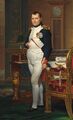 The Emperor Napoleon in His Study at the Tuileries by Jacques-Louis David
 -
 Napoleon Bonaparte in Who's In Your Blood?


Appearances[edit | edit source]
- Assassin's Creed II (first appearance) (painting only)
- Assassin's Creed: Initiates (mentioned only)
- Assassin's Creed IV: Black Flag (mentioned only)
- Assassin's Creed: Unity
- Assassin's Creed Unity: Abstergo Entertainment – Employee Handbook (mentioned only)
- Assassin's Creed: Templars (mentioned only)
- Discovery Tour: Ancient Egypt (mentioned only)
- Le Secret de Napoléon Ier
- L'Armoire de Fer (mentioned only)
- Le Secret des Mines (mentioned only)
- Echoes of History (mentioned only)
References[edit | edit source]


| |||||||||||||||||||||||||||||||
| |||||||||||||||||||||||||