

Byzantine Empire: Difference between revisions
imported>Uditore m Unnecessary, false correction edit. |
m Text replacement - "Basim Ibn Ishaq" to "Basim ibn Ishaq" |
||
| (237 intermediate revisions by 85 users not shown) | |||
| Line 1: | Line 1: | ||
{{Era| | {{Era|Organizations}}{{WP-REAL}} | ||
{{WP-REAL}} | {{Regime Infobox | ||
{{ | |title1 = Roman Empire | ||
[[ | |image1 = 500px-Palaiologos_Dynasty_emblem.svg.png | ||
The '''Byzantine Empire''' | |capital = [[Constantinople]] | ||
|government = [[Monarchy]] | |||
|head_of_state = Emperor | |||
|military = [[Byzantine army|Byzantine military]] | |||
|affiliation = [[Templars]] | |||
*[[Byzantine Rite of the Templar Order|Byzantine Rite]] | |||
|civilization = [[Roman civilization]] | |||
|languages = {{wiki|Latin}}<br>{{wiki|Greek language|Greek}} | |||
|religion = [[Christianity]] | |||
|demonym = Roman {{c|contemporaneous}}<br> Byzantine {{c|historiographical}} | |||
|founder(s) = [[Constantine I]] {{c|founder of Constantinople}}<br>[[Arcadius]] {{c|first ruler at final division of the Roman Empire}} | |||
|date_founded = 286 {{c|first division}}<br>330 {{c|founding of Constantinople}}<br>395 {{c|final division}} | |||
|date_dissolved = 29 May 1453 | |||
|last_ruler = [[Constantine XI Palaiologos]] | |||
}} | |||
The '''Roman Empire''', known historiographically as the '''Byzantine Empire''' or the '''Eastern Roman Empire''' and contemporarily by the common name '''Romania''', was the predominantly [[Greece|Greek]] and Hellenized continuation of the [[Roman Empire]] during {{Wiki|Late antiquity}} and the [[Middle Ages]]. | |||
The Byzantine capital, [[Constantinople]], was eventually [[Fall of Constantinople|conquered]] by the [[Ottoman Empire]] and fell into Ottoman control; until its collapse, the Byzantine Empire had been established for 1123 years. | |||
==History== | ==History== | ||
[[ | ===Early Assassin and Templar influence=== | ||
The foundations of the Byzantine Empire were laid in 330 CE, when the Roman Emperor [[Constantine I]] moved the empire's capital to Constantinople; the city thereafter served as the capital of the Eastern Roman Empire for over a millennium. A [[Roman Assassin|member]] of the [[Assassins|Hidden Ones]] was present in Constantinople to witness its rise as the new capital, becoming a close associate of Emperor Constantine.<ref>''[[Assassin's Creed Unity: Abstergo Entertainment – Employee Handbook]]''</ref> | |||
For the next several centuries, the Hidden Ones continued to build up their presence in the city, establishing a [[Assassin bureau|bureau]], which by the late 9th century came to be led by [[Basim ibn Ishaq]] of the [[Hidden Ones of Alamut|Alamut Brotherhood]]. In 867, Basim and his apprentice [[Hytham]] investigated a conspiracy orchestrated by the [[Order of the Ancients]], who helped [[Basil I]] eliminate his co-emperor [[Michael III]] to become the sole ruler of the Byzantine Empire.<ref name="TGC">''[[Assassin's Creed: The Golden City]]</ref> | |||
With Basil as their puppet, the Order later influenced him to plan the murder of his own son, [[Leo VI the Wise|Leo VI]], convincing the emperor that the boy was Michael's illegitimate son. However, Basim and Hytham, the latter of whom joined the [[Varangian]] guard to keep watch over Leo, foiled their first attempt. The two Hidden Ones soon allied themselves with [[Thyra]], a [[Vikings|Viking]] of the [[Eagle Clan]] and leader of the Varangian guard, and [[Justin]], Leo's bodyguard, to protect the young prince.<ref name="TGC"/> | |||
After more failed attempts by the Order to kill Leo, the Hidden Ones decided to set a trap during one of Basil's [[chariot]] races at the [[Hippodrome of Constantinople|Hippodrome]], allowing the Order to kidnap Leo before giving chase. Basim, Hytham, Thyra, and Justin cornered the Ancients in an alley, killing all of them and rescuing Leo. In the aftermath, Basil's alliance with the Order came to an end, and the Hidden Ones departed Constantinople after being personally thanked by Leo and his mother, Empress [[Eudocia Ingerina]].<ref name="TGC"/> | |||
===Downfall=== | |||
{{Quote|For the first time in many decades, the Assassins have a strong presence here. It wasn't always that way. Under the Byzantine Emperor, the Assassins were hunted down and killed on the spot.|Yusuf Tazim, 1511.|Assassin's Creed: Revelations|A Warm Welcome (Revelations)}} | |||
By the 13th century, the Assassins—the successors of the Hidden Ones—no longer held any influence in the Byzantine Empire. In 1204, [[Altaïr Ibn-La'Ahad]], the [[Mentor]] of the [[Levantine Brotherhood of Assassins|Levantine Assassins]], attempted to establish an [[Assassin Guild]] in Constantinople, but due to the chaos of the [[Fourth Crusade]], he was unable to recruit any potential Assassins. Eventually, a proper guild would be founded in the city by the [[Italy|Italian]] tradesmen and Assassins [[Niccolò Polo|Niccolò]] and [[Maffeo Polo]],<ref>''[[Assassin's Creed: The Secret Crusade]]''</ref> who also hid the five [[Masyaf Key]]s given to them by Altaïr shortly before his death.<ref>''[[Assassin's Creed: Revelations]]'' – [[Passing the Torch]]</ref> | |||
During the reign of the last Byzantine Emperor, [[Constantine XI Palaiologos]], Assassins throughout the empire were hunted down and executed. Following the Ottomans' conquest of Constantinople in 1453, the Byzantine Empire, which had been gradually declining over the past few centuries, finally collapsed. While this marked a turning point in [[Europe]]an history, it was also the start of a new era of prosperity for the Assassins, who secured a lasting peace with the Ottoman Empire and were allowed to operate within its borders as opposed to the persecution they had faced under the Byzantine regime.<ref name="A Warm Welcome">''[[Assassin's Creed: Revelations]]'' – [[A Warm Welcome (Revelations)|A Warm Welcome]]</ref> | |||
===Templar resurrection=== | |||
{{Quote|Five years ago, Templar influence here was minimal. A small faction with dreams of restoring the Byzantine throne. But they're growing in number, day by day. And with Sultan Bayezid on his way out, they may try something dramatic.|Yusuf Tazim, regarding the Byzantine Templars' goals, 1511.|Assassin's Creed: Revelations|A Warm Welcome (Revelations)}} | |||
During the early 16th century, as the [[Templars]] were being driven from [[Italy]] by the Assassins, the Byzantine Templars arose in the Ottoman Empire, appealing to members of the Greek population and other [[Christianity|Christians]] who longed to see the Byzantine Empire restored and the Ottoman Empire destroyed. Led by the ''de jure'' Byzantine Emperor [[Manuel Palaiologos]], the last heir of Constantine XI, the Templars set up their primary headquarters at [[Derinkuyu]] in Cappadocia, which had for centuries served as a haven for Byzantines against Turkish encroachment.<ref>''[[Assassin's Creed: Revelations]]'' – [[The Hidden City]]</ref> | |||
The Byzantine Templars' ultimate aim was to uproot the Ottoman Empire, retake control of Constantinople in particular, and ultimately bring the East and West back under a single rule.<ref name="Last of the Palaiologi">''[[Assassin's Creed: Revelations]]'' – [[Last of the Palaiologi]]</ref> For a time, however, they remained relatively quiet.<ref name="A Warm Welcome" /> | |||
=== | ===Masyaf=== | ||
{{Dialogue|Ezio|What is in that library is not for you. Not the Templars.|Leandros|Ah, you can have Altaïr's books, Ezio. We only want guidance. We only want directions... to the location of the Grand Temple.|Leandros' dying words to Ezio, 1511.|Assassin's Creed: Revelations|The Wounded Eagle}} | |||
By 1509, the Templars had become aware of the five Masyaf Keys hidden throughout Constantinople. After an [[Little Judgment Day|earthquake]] struck the city that year, the Templars discovered one of the keys buried under [[Topkapı Palace]], as the entrance to the key's chamber had been opened by the seismic activity.<ref name="Wounded Eagle">''[[Assassin's Creed: Revelations]]'' – [[The Wounded Eagle]]</ref> | |||
Following this discovery, the Byzantine Templars became more active and militant in their desire to retake Constantinople and find the remaining four keys.<ref name="A Warm Welcome" /> The [[Masyaf]] expedition and Topkapı key were entrusted to Manuel Palaiologos, who by then had been supplanted as [[Templar leader]] by the younger and more charismatic Ottoman prince [[Ahmet]].<ref name="Escape">''[[Assassin's Creed: Revelations]]'' – [[Escape (Revelations)|Escape]]</ref><ref>''[[Assassin's Creed Encyclopedia]]''</ref> | |||
== | [[File:The_Wounded_Eagle_3.png|thumb|left|250px|Leandros instructing Byzantine remnant soldiers]] | ||
{{ | By 1511, a Byzantine Templar captain named [[Leandros]] had occupied the region surrounding Masyaf, where the [[library of Altaïr Ibn-La'Ahad]] was located.<ref>''[[Assassin's Creed: Revelations]]'' – [[The Hangman]]</ref> However, all attempts to excavate the library proved unsuccessful,<ref>''[[Assassin's Creed: Revelations]]'' – [[A Journal of Some Kind]]</ref> and Leanrdos and his men were eventually killed by the Mentor of the [[Italian Brotherhood of Assassins|Italian Assassins]], [[Ezio Auditore da Firenze]], who had also journeyed to Masyaf in search of the library and its ancient knowledge.<ref name="Wounded Eagle" /> | ||
The Templars, based on clues from Niccolò Polo's [[The Secret Crusade|journal]], later discovered that two Masyaf Keys were hidden in the [[Forum of the Ox]] and the [[Yerebatan Cistern]]. However, they were beaten to them by Ezio, who eliminated the Templars searching for the keys and claimed them himself.<ref>''[[Assassin's Creed: Revelations]]'' – [[The Yerebatan Cistern]]</ref><ref>''[[Assassin's Creed: Revelations]]'' – [[The Forum of the Ox]]</ref> | |||
===Constantinople=== | |||
{{Quote|The dream of our Order is universal. Ottoman, Byzantine... these are only labels. Costumes and facades. Beneath these trappings, all Templars are part of the same family.|Manuel Palaiologos' dying words, 1512.|Assassin's Creed: Revelations|Last of the Palaiologi}} | |||
As the Templars plotted to overthrow the Ottomans, many Byzantine soldiers were present in Constantinople by mid-1511. These soldiers rivaled the [[Ottoman Brotherhood of Assassins|Ottoman Assassins]], and by the month of May, they had seized all of the [[Assassin Den]]s for themselves aside from two, namely the one in [[Galata District|Galata]] and the one in the [[Imperial District]], near the [[Grand Bazaar]].<ref>''[[Assassin's Creed: Revelations]]'' – [[Advanced Tactics]]</ref> | |||
[[File:Cistern_2.png|thumb|250px|Two Byzantine soldiers in the Yerebatan Cistern]] | |||
Shortly after Ezio's arrival in the city, the Templars launched an attack on both of the remaining dens, and though they were routed at Galata,<ref>''[[Assassin's Creed: Revelations]]'' – [[On the Defense]]</ref> they managed to take the den at the Grand Bazaar. However, this would prove to be a temporary victory, as the Assassins retook the den shortly after.<ref>''[[Assassin's Creed: Revelations]]'' – [[On the Attack]]</ref> Over the eleven months that Ezio spent in the city, he managed to retake the dens one by one and severely weaken the Templars and, by extension, the Byzantines' influence.<ref name="ACR">''[[Assassin's Creed: Revelations]]''</ref> | |||
Following this, Ezio left for Cappadocia in search of Manuel Palaiologos, who possessed the last Masyaf Key.<ref>''[[Assassin's Creed: Revelations]]'' – [[Setting Sail]]</ref> Ultimately, Ezio killed the {{Wiki|Oghuz Turks|Turkmen}} Templar [[Shahkulu]],<ref>''[[Assassin's Creed: Revelations]]'' – [[The Renegade]]</ref> and then Manuel himself, claiming his Masyaf Key.<ref name="Last of the Palaiologi" /> With their deaths, the Byzantine Templars were virtually wiped out, and their dreams of restoring the Byzantine Empire also perished, as Ahmet was only interested in accessing Altaïr's library and using its knowledge to further the [[New World Order|Templar cause]];<ref name="Escape" /> a goal he would ultimately fail at.<ref>''[[Assassin's Creed: Revelations]]'' – [[End of the Road]]</ref> | |||
==Trivia== | |||
*The use of the term "Byzantine" in ''[[Assassin's Creed: Revelations]]'' is anachronistic, as this name was given to the Eastern Roman Empire by later historians, in order to distinguish between it and ancient Rome. Historically, the Byzantines would have referred to themselves as "Romans", "Greeks" and/or "Hellenes" (''Romaioi'', ''Graikoi'' and ''Ellines'' in Greek respectively) since they were the political continuation of the Roman Empire in the east, as well as the direct heirs of Hellenic civilization. | |||
*Once Ezio had liberated all of the [[Assassin Dens|Templar Dens]] and completed the [[Master Assassin]] memories, Byzantine soldiers would rarely be encountered in Constantinople, aside from a few lingering patrols in the [[Constantine District]], the bodyguards of Templar officials once [[Social Stealth|notoriety]] was high enough, small groups of soldiers harassing [[Assassin apprentice|recruitable civilians]], and Byzantine patrols that would occasionally appear and ambush Ezio (usually consisting of two or three militia and a [[Varangian]]). | |||
==Gallery== | |||
<gallery captionalign="center" position="center" widths="180"> | |||
ACR Soldier Art HD.png|Concept art of a Byzantine soldier | |||
ACR Byzantine Bombardier Concept.JPG|Concept art of a Byzantine Bombman | |||
Byzantine Gunman Artwork.jpg|Concept art of a Byzantine Gunman | |||
Byzantine Leader Artwork.jpg|Concept art of a Varangian | |||
Manuel Palaiologos.png|Manuel Palaiologos, heir to the Byzantine throne | |||
ACR Leandros.png|Leandros | |||
Guard-byzantine-ACR.png|Byzantine Militia | |||
ACR Byzantine Bombman render.png|Byzantine Bombman | |||
ACR Byzantine Gunman render.png|Byzantine Gunman | |||
Guard-varangian-ACR.png|[[Varangian]] | |||
Guard-almogavar-ACR.png|[[Almogavar]] | |||
</gallery> | |||
==Appearances== | |||
{{Incomplete list}} | |||
*''[[Assassin's Creed: The Secret Crusade]]'' {{1st}} | |||
*''[[Assassin's Creed: Revelations]]'' | |||
*[[Assassin's Creed: Revelations (novel)|''Assassin's Creed: Revelations'' novel]] | |||
*''[[Assassin's Creed: Recollection]]'' | |||
*''[[Assassin's Creed: Valhalla]]'' – ''[[Wrath of the Druids]]'' {{Mo}} | |||
*''[[Assassin's Creed: Valhalla – Song of Glory]]'' | |||
*''[[Assassin's Creed: The Silk Road]]'' | |||
*''[[Echoes of History]]'' {{Mo}} | |||
*''[[Assassin's Creed: The Golden City]]'' | |||
*''[[Assassin's Creed: Mirage]]'' {{Mo}} | |||
**''[[Valley of Memory]]'' {{Mo|"Rum"}} {{Mdat}} | |||
==References== | |||
{{Scroll box|content={{Reflist}}}} | |||
{{Templars nav}} | |||
{{ACR}} | {{ACR}} | ||
[[Category: | {{ACRec}} | ||
[[Category: | {{ACGC}} | ||
<!--[ru:Византийская империя] | |||
[zh:拜占庭帝国]--> | |||
[[Category:Mediterranean]] | |||
[[Category:Byzantine Empire]] | |||
[[Category:Roman governments]] | |||
Latest revision as of 01:15, 25 May 2026
The Roman Empire, known historiographically as the Byzantine Empire or the Eastern Roman Empire and contemporarily by the common name Romania, was the predominantly Greek and Hellenized continuation of the Roman Empire during Late antiquity and the Middle Ages.
The Byzantine capital, Constantinople, was eventually conquered by the Ottoman Empire and fell into Ottoman control; until its collapse, the Byzantine Empire had been established for 1123 years.
History[edit | edit source]
Early Assassin and Templar influence[edit | edit source]
The foundations of the Byzantine Empire were laid in 330 CE, when the Roman Emperor Constantine I moved the empire's capital to Constantinople; the city thereafter served as the capital of the Eastern Roman Empire for over a millennium. A member of the Hidden Ones was present in Constantinople to witness its rise as the new capital, becoming a close associate of Emperor Constantine.[1]
For the next several centuries, the Hidden Ones continued to build up their presence in the city, establishing a bureau, which by the late 9th century came to be led by Basim ibn Ishaq of the Alamut Brotherhood. In 867, Basim and his apprentice Hytham investigated a conspiracy orchestrated by the Order of the Ancients, who helped Basil I eliminate his co-emperor Michael III to become the sole ruler of the Byzantine Empire.[2]
With Basil as their puppet, the Order later influenced him to plan the murder of his own son, Leo VI, convincing the emperor that the boy was Michael's illegitimate son. However, Basim and Hytham, the latter of whom joined the Varangian guard to keep watch over Leo, foiled their first attempt. The two Hidden Ones soon allied themselves with Thyra, a Viking of the Eagle Clan and leader of the Varangian guard, and Justin, Leo's bodyguard, to protect the young prince.[2]
After more failed attempts by the Order to kill Leo, the Hidden Ones decided to set a trap during one of Basil's chariot races at the Hippodrome, allowing the Order to kidnap Leo before giving chase. Basim, Hytham, Thyra, and Justin cornered the Ancients in an alley, killing all of them and rescuing Leo. In the aftermath, Basil's alliance with the Order came to an end, and the Hidden Ones departed Constantinople after being personally thanked by Leo and his mother, Empress Eudocia Ingerina.[2]
Downfall[edit | edit source]
By the 13th century, the Assassins—the successors of the Hidden Ones—no longer held any influence in the Byzantine Empire. In 1204, Altaïr Ibn-La'Ahad, the Mentor of the Levantine Assassins, attempted to establish an Assassin Guild in Constantinople, but due to the chaos of the Fourth Crusade, he was unable to recruit any potential Assassins. Eventually, a proper guild would be founded in the city by the Italian tradesmen and Assassins Niccolò and Maffeo Polo,[3] who also hid the five Masyaf Keys given to them by Altaïr shortly before his death.[4]
During the reign of the last Byzantine Emperor, Constantine XI Palaiologos, Assassins throughout the empire were hunted down and executed. Following the Ottomans' conquest of Constantinople in 1453, the Byzantine Empire, which had been gradually declining over the past few centuries, finally collapsed. While this marked a turning point in European history, it was also the start of a new era of prosperity for the Assassins, who secured a lasting peace with the Ottoman Empire and were allowed to operate within its borders as opposed to the persecution they had faced under the Byzantine regime.[5]
Templar resurrection[edit | edit source]
- "Five years ago, Templar influence here was minimal. A small faction with dreams of restoring the Byzantine throne. But they're growing in number, day by day. And with Sultan Bayezid on his way out, they may try something dramatic."
- ―Yusuf Tazim, regarding the Byzantine Templars' goals, 1511.[src]-[m]
During the early 16th century, as the Templars were being driven from Italy by the Assassins, the Byzantine Templars arose in the Ottoman Empire, appealing to members of the Greek population and other Christians who longed to see the Byzantine Empire restored and the Ottoman Empire destroyed. Led by the de jure Byzantine Emperor Manuel Palaiologos, the last heir of Constantine XI, the Templars set up their primary headquarters at Derinkuyu in Cappadocia, which had for centuries served as a haven for Byzantines against Turkish encroachment.[6]
The Byzantine Templars' ultimate aim was to uproot the Ottoman Empire, retake control of Constantinople in particular, and ultimately bring the East and West back under a single rule.[7] For a time, however, they remained relatively quiet.[5]
Masyaf[edit | edit source]
By 1509, the Templars had become aware of the five Masyaf Keys hidden throughout Constantinople. After an earthquake struck the city that year, the Templars discovered one of the keys buried under Topkapı Palace, as the entrance to the key's chamber had been opened by the seismic activity.[8]
Following this discovery, the Byzantine Templars became more active and militant in their desire to retake Constantinople and find the remaining four keys.[5] The Masyaf expedition and Topkapı key were entrusted to Manuel Palaiologos, who by then had been supplanted as Templar leader by the younger and more charismatic Ottoman prince Ahmet.[9][10]

By 1511, a Byzantine Templar captain named Leandros had occupied the region surrounding Masyaf, where the library of Altaïr Ibn-La'Ahad was located.[11] However, all attempts to excavate the library proved unsuccessful,[12] and Leanrdos and his men were eventually killed by the Mentor of the Italian Assassins, Ezio Auditore da Firenze, who had also journeyed to Masyaf in search of the library and its ancient knowledge.[8]
The Templars, based on clues from Niccolò Polo's journal, later discovered that two Masyaf Keys were hidden in the Forum of the Ox and the Yerebatan Cistern. However, they were beaten to them by Ezio, who eliminated the Templars searching for the keys and claimed them himself.[13][14]
Constantinople[edit | edit source]
As the Templars plotted to overthrow the Ottomans, many Byzantine soldiers were present in Constantinople by mid-1511. These soldiers rivaled the Ottoman Assassins, and by the month of May, they had seized all of the Assassin Dens for themselves aside from two, namely the one in Galata and the one in the Imperial District, near the Grand Bazaar.[15]

Shortly after Ezio's arrival in the city, the Templars launched an attack on both of the remaining dens, and though they were routed at Galata,[16] they managed to take the den at the Grand Bazaar. However, this would prove to be a temporary victory, as the Assassins retook the den shortly after.[17] Over the eleven months that Ezio spent in the city, he managed to retake the dens one by one and severely weaken the Templars and, by extension, the Byzantines' influence.[18]
Following this, Ezio left for Cappadocia in search of Manuel Palaiologos, who possessed the last Masyaf Key.[19] Ultimately, Ezio killed the Turkmen Templar Shahkulu,[20] and then Manuel himself, claiming his Masyaf Key.[7] With their deaths, the Byzantine Templars were virtually wiped out, and their dreams of restoring the Byzantine Empire also perished, as Ahmet was only interested in accessing Altaïr's library and using its knowledge to further the Templar cause;[9] a goal he would ultimately fail at.[21]
Trivia[edit | edit source]
- The use of the term "Byzantine" in Assassin's Creed: Revelations is anachronistic, as this name was given to the Eastern Roman Empire by later historians, in order to distinguish between it and ancient Rome. Historically, the Byzantines would have referred to themselves as "Romans", "Greeks" and/or "Hellenes" (Romaioi, Graikoi and Ellines in Greek respectively) since they were the political continuation of the Roman Empire in the east, as well as the direct heirs of Hellenic civilization.
- Once Ezio had liberated all of the Templar Dens and completed the Master Assassin memories, Byzantine soldiers would rarely be encountered in Constantinople, aside from a few lingering patrols in the Constantine District, the bodyguards of Templar officials once notoriety was high enough, small groups of soldiers harassing recruitable civilians, and Byzantine patrols that would occasionally appear and ambush Ezio (usually consisting of two or three militia and a Varangian).
Gallery[edit | edit source]
-
 Concept art of a Byzantine soldier
 -
 Concept art of a Byzantine Bombman
 -
 Concept art of a Byzantine Gunman
 -
 Concept art of a Varangian
 -
 Manuel Palaiologos, heir to the Byzantine throne
 -
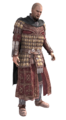 Leandros
 -
 Byzantine Militia
 -
 Byzantine Bombman
 -
 Byzantine Gunman
 -

-


Appearances[edit | edit source]
 This list is incomplete. You can help the Assassin's Creed Wiki by expanding it. This list is incomplete. You can help the Assassin's Creed Wiki by expanding it.
|
|---|
- Assassin's Creed: The Secret Crusade (first appearance)
- Assassin's Creed: Revelations
- Assassin's Creed: Revelations novel
- Assassin's Creed: Recollection
- Assassin's Creed: Valhalla – Wrath of the Druids (mentioned only)
- Assassin's Creed: Valhalla – Song of Glory
- Assassin's Creed: The Silk Road
- Echoes of History (mentioned only)
- Assassin's Creed: The Golden City
- Assassin's Creed: Mirage (mentioned only)
- Valley of Memory (mentioned only, as "Rum") (mentioned in Database entry only)
References[edit | edit source]


| |||||||||||||||||||||||||||||||||||||
| |||||||||||||||||||||||||||||||
| |||||||||||||||||||||||||