


Rodrigo Borgia: Difference between revisions
imported>Lady Kyashira |
imported>Soranin mNo edit summary |
||
| (43 intermediate revisions by 16 users not shown) | |||
| Line 1: | Line 1: | ||
{{Era|Individuals|Templars|Featured}} | {{Era|Individuals|Templars|Featured}}{{WP-REAL|Pope Alexander VI}} | ||
{{WP-REAL|Pope Alexander VI}} | {{Quote|He is Rodrigo Borgia, one of the most powerful men in all of Europe, and leader of the Templar Order.|Mario Auditore to his nephew Ezio, 1478.|Assassin's Creed II|A Change of Plans}} | ||
{{Quote|He is Rodrigo Borgia, one of the most powerful men in all of Europe, and leader of the Templar Order.|Mario Auditore to his nephew, | |||
{{Character Infobox | {{Character Infobox | ||
|image = ACB Rodrigo render.png | |image = ACB Rodrigo render.png | ||
|birth = 1 January 1431<br>{{Wiki|Xàtiva}}, {{Wiki|Kingdom of Valencia}}, | |birth = 1 January 1431<ref name="Wiki">{{WP|Pope Alexander VI}}</ref><br>{{Wiki|Xàtiva}}, {{Wiki|Kingdom of Valencia}}, [[Crown of Aragon]] | ||
|death = 18 August 1503 | |death = 18 August 1503 {{c|aged [[72]]}}<ref name="Apple a Day">''[[Assassin's Creed: Brotherhood]]'' – [[An Apple a Day]]</ref><br>[[Rome]], {{Wiki|Papal States}} | ||
|species = [[Human]] | |species = [[Human]] | ||
|database = [[Database: Rodrigo Borgia (Assassin's Creed II)|Rodrigo Borgia (Assassin's Creed II)]]<br>[[Database: Rodrigo Borgia (Brotherhood)|Rodrigo Borgia (Brotherhood)]] | |database = [[Database: Rodrigo Borgia (Assassin's Creed II)|Rodrigo Borgia (Assassin's Creed II)]]<br>[[Database: Rodrigo Borgia (Brotherhood)|Rodrigo Borgia (Brotherhood)]] | ||
|affiliates = [[House of Borgia]] | |affiliates = *[[House of Borgia]] | ||
*[[Roman Rite of the Templar Order| | *[[Templars]] | ||
**[[Roman Rite of the Templar Order|Roman Rite]] | |||
*[[Papacy]] | |||
'''Rodrigo Borgia''' (1431 – 1503), born '''Roderic Llançol i de Borja''', was the head of the {{Wiki|Catholic Church}} from 11 August 1492 until his death, reigning as '''Pope Alexander VI'''. From 1476, he | }} | ||
'''Rodrigo Borgia''' (1431 – 1503), born '''Roderic Llançol i de Borja''' (Valencian: ''Rodrigo Liançol i de Borja''; Spanish: ''Rodrigo Lanzoi y de Borja''), was the head of the {{Wiki|Catholic Church}} from 11 August 1492 until his death, reigning as '''Pope Alexander VI'''. From 1476, he was also the [[Grand Master of the Templar Order|Grand Master]] of the [[Roman Rite of the Templar Order|Roman Rite]] of the [[Templars|Templar Order]]. | |||
Originally hailing from [[Spain]], Rodrigo moved to [[Italy]] where he studied and joined the | Originally hailing from [[Spain]], Rodrigo moved to [[Italy]] where he studied and joined the Catholic Church, eventually becoming a [[cardinal]]. Using the influence he gained from his clerical position, Rodrigo masterminded several plots to murder political leaders across the country in an attempt to unify it under the Templar banner. As one of the wealthiest men in [[Europe]], Rodrigo's power as Grand Master spread all over the continent. | ||
In 1488, Rodrigo was responsible for shipping an [[Apple of Eden 6|Apple of Eden]] from [[Cyprus]] to [[Venice]], before it was stolen by his arch-enemy, [[Ezio Auditore da Firenze]] and his fellow [[Italian Brotherhood of Assassins|Italian Assassins]]. In 1492, via several bribes and power plays, Rodrigo won the [[Papacy|Papal]] conclave, and became one of the most controversial [[Renaissance]] popes. | In 1488, Rodrigo was responsible for shipping an [[Apple of Eden 6|Apple of Eden]] from [[Cyprus]] to [[Venice]], before it was stolen by his arch-enemy, [[Ezio Auditore da Firenze]] and his fellow [[Italian Brotherhood of Assassins|Italian Assassins]]. In 1492, via several bribes and power plays, Rodrigo won the [[Papacy|Papal]] conclave, and became one of the most controversial [[Renaissance]] popes. | ||
Under the leadership of the [[House of | Under the leadership of the [[House of Borgia]], the Templars focused primarily on establishing their power and control in Europe, losing sight of their true ideology. The Templars commonly refer to this era as the "Dark Age of the Order". | ||
==Biography== | ==Biography== | ||
===Early life=== | ===Early life=== | ||
Roderic Llançol was born at {{Wiki|Xàtiva}} in the Kingdom of Valencia, one of the component states of the Crown of Aragon, present-day Spain. His parents were Jofré Llançol i | Roderic Llançol was born in 1431 at {{Wiki|Xàtiva}} in the {{Wiki|Kingdom of Valencia}}, one of the component states of the Crown of [[Aragon]], present-day [[Spain]]. His parents were {{Wiki|Jofré Llançol i Escrivà}}, and his wife and relative Isabel de Borja. His family name was written Llançol in Valencian and Lanzol in Spanish. After the elevation of Roderic's maternal uncle Alonso de Borja to the [[Papacy]] as [[Callixtus III]] in 1455, Roderic adopted his mother's family name of Borja.<ref name="Wiki" /> | ||
===As a cardinal=== | ===As a cardinal=== | ||
Rodrigo moved to Italy at a young age and studied at the University of Rome; in 1456, he graduated in canonic law in Bologna. He was successively made bishop, cardinal, and vice-chancellor of the church through the influence of his uncle, the Pope, as nepotism was characteristic of the age. He served in the Roman Curia under five Popes (his uncle Callixtus III, [[Pius II]], [[Paul II]], [[Sixtus IV]] and [[Innocent VIII]]) and acquired much administrative experience, influence, and wealth, though not great power. | Rodrigo moved to [[Italy]] at a young age and studied at the University of Rome; in 1456, he graduated in canonic law in Bologna. He was successively made bishop, cardinal, and vice-chancellor of the church through the influence of his uncle, the [[Papacy|Pope]], as nepotism was characteristic of the age. He served in the Roman Curia under five Popes (his uncle Callixtus III, [[Pius II]], [[Paul II]], [[Sixtus IV]] and [[Innocent VIII]]) and acquired much administrative experience, influence, and wealth, though not great power.<ref name="Wiki" /> | ||
By the time Rodrigo served under Pope Sixtus IV, he had | By the time Rodrigo served under Pope Sixtus IV, he had joined the [[Templars|Templar Order]] in 1458, and later became [[Grand Master of the Templar Order|Grand Master]] of the [[Roman Rite of the Templar Order|Roman Rite]] in 1476. In this position, he aspired to unite all of Italy under the Templar banner. In order to achieve that goal, he made plans to take down the leaders of Italy's main cities, and place his own men in power.<ref name="ACL">''[[Assassin's Creed: Lineage]]''</ref> | ||
===Assassination of Galeazzo Maria Sforza=== | ===Assassination of Galeazzo Maria Sforza=== | ||
Rodrigo devised a plan to eliminate [[Galeazzo Maria Sforza]], the Duke of Milan, in which [[Giovanni Andrea Lampugnani]], [[Carlo Visconti]] and [[Gerolamo Olgiati]] would kill Sforza on the day of Santo Stefano.<ref name="ACL"/> | In December 1476, Rodrigo devised a plan to eliminate [[Galeazzo Maria Sforza]], the Duke of [[Milan]], in which [[Giovanni Andrea Lampugnani]], [[Carlo Visconti]] and [[Gerolamo Olgiati]] would kill Sforza on the day of Santo Stefano.<ref name="ACL" /> | ||
One night | [[File:Screen shot 2.png|left|thumb|260px|Rodrigo leading his men through Florence]] | ||
One night, as Rodrigo was on his way to leave [[Florence]] accompanied by several of his men, he was ambushed by the [[Assassins|Assassin]] [[Giovanni Auditore da Firenze]]. Rodrigo fled immediately while Giovanni battled his guards. Hidden behind a corner, he witnessed Giovanni capture one of his men, who later revealed the planned assassination of Galeazzo Sforza, a powerful ally of [[Lorenzo de' Medici]].<ref name="ACL" /> | |||
Giovanni subsequently attempted to prevent the assassination, though he arrived too late to do so. Rodrigo's plan to eliminate Sforza had succeeded, and so he began to devise his next scheme.<ref name="ACL" /> | |||
===Auditore execution=== | ===Auditore execution=== | ||
Giovanni | Giovanni learned that Rodrigo's plans would lead him to the city of Venice, after looting a Venetian [[ducat]] from Giovanni Lampugnani. Upon traveling there, he intercepted a message from [[Marco Barbarigo|Marco]] and [[Silvio Barbarigo]] to their master, Rodrigo.<ref name="ACL" /> | ||
[[File:Tadros.jpg|thumb|250px|Rodrigo walking through Rome]] | [[File:Tadros.jpg|thumb|250px|Rodrigo walking through Rome]] | ||
After [[Uberto Alberti]] and [[Antonio Maffei]] "failed" to decode the intercepted letter, the [[House of Medici|Medici]] and Uberto sent Giovanni to carry a copied version of the message to [[Rome]], in order to discover who was behind the plot. Arriving in the city, Giovanni handed the message to a man, and followed the letter as it passed through several hands before meeting its final destination: Rodrigo | After [[Uberto Alberti]] and [[Antonio Maffei]] "failed" to decode the intercepted letter, the [[House of Medici|Medici]] and Uberto sent Giovanni to carry a copied version of the message to [[Rome]], in order to discover who was behind the plot. Arriving in the city, Giovanni handed the message to a man, and followed the letter as it passed through several hands before meeting its final destination: Rodrigo.<ref name="ACL" /> | ||
The Templar quickly left to meet with Pope Sixtus IV and present him the letter, hoping to obtain military support in order to conquer Florence. After gaining Sixtus' favor, Rodrigo headed out of the [[Vaticano District|Vatican]], and into the streets of Rome once more.<ref name="ACL" /> | |||
Giovanni was still on Rodrigo's trail, and followed him all the way into [[St. Peter's Basilica]]. However, he fell into an ambush set by Rodrigo, who was aware the Assassin had been following him. Rodrigo tried to offer Giovanni a position among the Templars, but the Assassin refused, stating that Rodrigo would be dead before he could see the Templars' [[New World Order|fantasy]] become reality.<ref name="ACL" /> | |||
[[File: | [[File:Screen shot 3.13.jpg|left|thumb|270px|Rodrigo meeting with his fellow Templars]] | ||
Disappointed, Rodrigo ordered his men to attack Giovanni, but the Assassin routed all of them. Rodrigo, who had been watching from the sidelines, threw a [[Throwing knife|knife]] at Giovanni, which hit him in the chest; he then took the chance to flee the Basilica. Later that night, Rodrigo discussed the next step of his plan with his Templar brothers, and they all agreed that they had to dispose of Giovanni.<ref name="ACL" /> | |||
In order to remove the Assassin from the picture, Rodrigo conspired with Uberto and the [[House of Pazzi|Pazzi family]]. After careful planning, the Templars were able to frame Giovanni for the crimes of treason, and had him and two of his sons – [[Federico Auditore da Firenze|Federico]] and [[Petruccio Auditore da Firenze|Petruccio]] – arrested and imprisoned in the [[Palazzo della Signoria]].<ref name="Jailbird">''[[Assassin's Creed II]]'' – [[Jailbird]]</ref> | |||
[[File:LMS 10 v.png|thumb|250px|Rodrigo with Uberto at the Auditore execution]] | |||
The night before the trial of the [[House of Auditore|Auditore family]], Rodrigo resided at Uberto's house. [[Ezio Auditore da Firenze|Ezio Auditore]], Giovanni's remaining son, came by to give Uberto his father's documents that would prove his innocence. There, Ezio noticed Rodrigo behind Uberto but unaware of his importance, the young noble paid no further attention to the Templar; however, he refused to stay the night at Uberto's house all the same.<ref name="Family Heirloom">''[[Assassin's Creed II]]'' – [[Family Heirloom]]</ref> | |||
[[File: | |||
The following morning, Rodrigo attended the judgment and execution of Giovanni, Federico, and Petruccio. When Ezio arrived and witnessed his father and brothers' execution, Rodrigo pointed him out in the crowd. Uberto then called for the young man's arrest, though Ezio was able to escape from the guards.<ref name="Last Man Standing">''[[Assassin's Creed II]]'' – [[Last Man Standing]]</ref> | |||
===Pazzi conspiracy=== | |||
{{Quote|Gentlemen. Tomorrow, a new sun rises over Firenze.|Rodrigo encouraging the Pazzi conspirators, 1478.|Assassin's Creed II|Novella's Secret}} | |||
[[File:Novella's Secret 6.png|left|thumb|250px|Rodrigo discussing the Pazzi conspiracy]] | |||
In 1478, Rodrigo conspired to overthrow the government of Florence, targeting the city's leader, Lorenzo de' Medici, and his brother [[Giuliano de' Medici|Giuliano]]. With this, Rodrigo left for [[San Gimignano]], where he held a meeting with [[Francesco de' Pazzi|Francesco]], [[Jacopo de' Pazzi|Jacopo]], and [[Vieri de' Pazzi]]. Rodrigo left the town just before the [[Mercenary|mercenaries]] led by [[Mario Auditore]] and his nephew Ezio attacked. Their assault resulted in the death of Vieri.<ref name="Around">''[[Assassin's Creed II]]'' – [[What Goes Around]]</ref> | |||
Not long after that, Rodrigo met with Francesco and Jacopo de'Pazzi, Antonio Maffei, [[Bernardo Baroncelli]], [[Stefano da Bagnone]] and [[Francesco Salviati]] in a catacomb under the Basilica of [[Basilica di Santa Maria Novella|Santa Maria Novella]]. As the Pazzi conspirators confirmed their plan to Rodrigo, he reminded them to beware of the Assassins, and stated that the next day would be ''"a new dawn"'' for Florence.<ref name="Novella's Secret">''[[Assassin's Creed II]]'' – [[Novella's Secret]]</ref> | |||
However, Ezio thwarted the Templars' attempted takeover in Florence and killed off the remaining conspirators that Rodrigo had arranged to meet with in San Gimignano, where the Pazzi originally intended to request asylum with Rodrigo in either Venice or Rome. Jacopo, the only survivor, attended the meeting and claimed that the blame for the failure rested with his nephew, for his impatience, and with [[Emilio Barbarigo]], for supplying the Pazzi troops with sub-standard weaponry.<ref name="Friends">''[[Assassin's Creed II]]'' – [[With Friends Like These]]</ref> | |||
During | [[File:With Friends 2 v.png|thumb|250px|Jacopo apologizing to Rodrigo for his failure]] | ||
Enraged by Jacopo's insults and excuses, Rodrigo lectured his subordinate on his failure, then stabbed him in the abdomen with a [[stiletto]], aided by an eager Emilio.Ignoring Jacopo's pleas for mercy, Rodrigo stabbed him a second time in the neck with his sword, before he called out to Ezio who had tailed Jacopo to the meeting. Grabbed by Borgia guards, Ezio was brought into Rodrigo's sight.<ref name="Friends" /> | |||
Sarcastically apologizing for killing Jacopo for him, Rodrigo mocked Ezio, saying that he had been doing this for far longer than the [[novice]] Assassin. He then ordered his men to kill him, but left without bothering to ensure the deed was done. Ezio swiftly killed the guards restraining him and mercifully finished off Jacopo, but by then Rodrigo had fled beyond his reach.<ref name="Friends" /> | |||
===Venetian conspiracy=== | |||
{{Quote|I feel the need to involve myself more directly. The Pazzi disappointed us in Firenze. I pray you will not do the same.|Rodrigo, about personally attending the meeting, 1485.|Assassin's Creed II|Birds of a Feather}} | |||
Soon after the Pazzi conspiracy's failure, Rodrigo returned his attention to his plans for Venice. In 1485, he met with [[Carlo Grimaldi]] and the [[House of Barbarigo|Barbarigo family]] to plan the murder of the current Doge, [[Giovanni Mocenigo]], in order for them to seize control of Venice. During the meeting, Rodrigo chastised the Venetian Templars for making their own plans, rebuking them for their ''"inane prattle"'' as they argued over who would be the new Doge after they took Venice.<ref name="Birds of a Feather">''[[Assassin's Creed II]]'' – [[Birds of a Feather]]</ref> | |||
[[File:BoF 9.png|left|thumb|250px|Rodrigo on the [[Ponte di Rialto]] with the other Templars]] | |||
Rodrigo silenced the debate by announcing that [[Marco Barbarigo]] would be the next Doge, much to Marco's satisfaction and everyone else's annoyance. Marco then questioned the Grand Master's presence in Venice, as Ezio was also in the city and had already assassinated Emilio inside his own [[Palazzo della Seta|palazzo]]. Rodrigo replied that he felt the need to participate in his own schemes more directly, particularly after the failure of the Pazzi conspiracy.<ref name="Birds of a Feather" /> | |||
When [[Silvio Barbarigo]] mocked the Pazzi for their failure, Rodrigo interrupted him with the words that the Pazzi were a potent and venerable family reduced to rubble by a single young Assassin, the same one who now haunted Venice in search of them. After warning his humbled allies that the same fate would befall them should they underestimate Ezio, Rodrigo left for Rome, allowing them to carry out his plans.<ref name="Birds of a Feather" /> | |||
===Shipping the Apple of Eden=== | ===Shipping the Apple of Eden=== | ||
{{Quote|You claim not to be a believer. And yet, here you are... Don't you see him? The Prophet is already here... I AM the Prophet. Now give me the Apple.|Rodrigo upon confronting Ezio.|Assassin's Creed II}} | {{Quote|You claim not to be a believer. And yet, here you are... Don't you see him? The Prophet is already here... I AM the Prophet. Now give me the Apple.|Rodrigo upon confronting Ezio, 1488.|Assassin's Creed II|Play Along}} | ||
By 1486, Rodrigo had discovered that a fellow Templar, the Ottoman prince [[Cem]], had found the Piece of Eden he sought – an [[Apple of Eden 6|Apple of Eden]] – and had hidden it on [[Cyprus]],<ref>''[[Assassin's Creed: Recollection]]''</ref> so he sent a battalion of his men to retrieve it. Two years later, the men returned to [[Arsenale di Venezia|L'Arsenale]] with the artifact, and Rodrigo met with the courier who was to deliver it to him in the [[Cannaregio District]].<ref name="Play Along">''[[Assassin's Creed II]]'' – [[Play Along]]</ref> | |||
[[File:Play along 2.png|thumb|250px|Ezio confronting Rodrigo in Venice]] | [[File:Play along 2.png|thumb|250px|Ezio confronting Rodrigo in Venice]] | ||
However, before the Apple could be delivered to Rodrigo, Ezio had intercepted the courier and impersonated him, hoping to find and kill the Grand Master. Rodrigo was not surprised and readied himself to deal with Ezio personally. The two exchanged a brief conversation, in which Rodrigo claimed to be the Prophet, the one who would ultimately open the fabled [[Vatican Vault|Vault]]. The two then began an intense battle, in which Ezio ultimately emerged as the victor.<ref name="Play Along" /> | |||
Realizing that he could not defeat Ezio on his own, Rodrigo called in a supply of his personal guards to overwhelm him. Suddenly, many of Ezio's allies appeared, all of whom revealed themselves to be Assassins. They held off the guards to allow Ezio to re-challenge Rodrigo, who ultimately escaped before Ezio could kill him, leaving the Apple in the hands of the Assassins.<ref name=" | Realizing that he could not defeat Ezio on his own, Rodrigo called in a supply of his personal guards to overwhelm him. Suddenly, many of Ezio's allies appeared, all of whom revealed themselves to be Assassins. They held off the guards to allow Ezio to re-challenge Rodrigo, who ultimately escaped before Ezio could kill him, leaving the Apple in the hands of the Assassins.<ref name="Play Along" /> | ||
That same year, Rodrigo | That same year, Rodrigo tasked the Templar and Lord of [[Forlì]], [[Girolamo Riario]], with creating a map to help him find the scattered pages of [[Altaïr Ibn-La'Ahad]]'s [[Altaïr Ibn-La'Ahad's Codex|Codex]], which led to the Vault. However, Riario was soon murdered by the Orsi brothers – [[Checco Orsi|Checco]] and [[Ludovico Orsi|Ludovico]] – who had been hired by his own wife, [[Caterina Sforza]]. Unaware of this fact, Rodrigo hired the Orsi to obtain the map from Caterina, and they proceeded to lay [[Battle of Forlì|siege]] to Forlì with their army.<ref name="Warm Welcome">''[[Assassin's Creed II]]'' – ''[[Battle of Forlì (DLC)|Battle of Forlì]]'' – [[A Warm Welcome]]</ref> | ||
Unfortunately for | Upon learning that Caterina had been entrusted the Apple of Eden by the Assassins, the Orsi attempted to retrieve it and deliver it to Rodrigo. Unfortunately for the Grand Master, Ezio managed to kill both of the Orsi brothers and recover the Apple, though he lost it soon after to [[Girolamo Savonarola]], who would later prove to be an arch-enemy of Rodrigo.<ref name="Checcomate''>''[[Assassin's Creed II]]'' – ''[[Battle of Forlì (DLC)|Battle of Forlì]]'' – [[Checcomate]]</ref> | ||
===Deceiving Torquemada=== | ===Deceiving Torquemada=== | ||
{{Dialogue|Ezio|Rodrigo Borgia is an unbeliever like me, and yet you lavish him with favors.|Torquemada|Borgia is one of three Papal candidates this year. And he is as devoted to God as I am.|Ezio and Torquemada talking about Rodrigo.|Assassin's Creed II: Discovery}} | {{Dialogue|Ezio|Rodrigo Borgia is an unbeliever like me, and yet you lavish him with favors.|Torquemada|A fantastic tale, and a spurious one. Borgia is one of three Papal candidates this year. And he is as devoted to God as I am.|Ezio and Torquemada talking about Rodrigo, 1492.|Assassin's Creed II: Discovery|Assassinate Tomás Torquemada}} | ||
In 1491, Rodrigo manipulated the Spanish Inquisitor General [[Tomás de Torquemada]] into capturing and | In 1491, Rodrigo manipulated the Spanish Inquisitor General [[Tomás de Torquemada]],<ref name="Pedro Llorente">''[[Assassin's Creed II: Discovery]]'' – [[Find Pedro Llorente]]</ref> who was secretly a fellow Templar of the [[Spanish Rite of the Templar Order|Spanish Rite]],<ref name="Movie">[[Assassin's Creed (film)|''Assassin's Creed'' film]]</ref> into capturing and executing Assassins in Spain.<ref name="Pedro Llorente" /> Torquemada, who thought Rodrigo was as much as a believer of [[Christianity|God]] as he was, blindly followed his orders.<ref name="Torquemada">''[[Assassin's Creed II: Discovery]]'' – [[Assassinate Tomás Torquemada]]</ref> | ||
During this time, Rodrigo also found out about [[Christoffa Corombo]]'s plans to sail west. Already aware of the existence of the [[Americas]] and the treasures that lay there, the Templars wished to stop anyone from finding them before they could. To this end, Rodrigo arranged a meeting with Corombo in Venice, and laid a trap for him there. However, Corombo's friend [[Luis de Santángel]], an Assassin, was suspicious of the arrangement and sought out Ezio's help.<ref name="Thieves' Guild">''[[Assassin's Creed II: Discovery]]'' – [[Go to the Thieves' Guild]]</ref> Ezio rushed to Corombo's aid, successfully rescuing him and thwarting Rodrigo's plans.<ref name="Find Christoffa">''[[Assassin's Creed II: Discovery]]'' – [[Find Christoffa (1)]]</ref> | |||
===Papal rule=== | |||
{{Quote|The Spaniard, Rodrigo Borgia, has been elected Pope. He rules the Vatican and Rome as the Supreme Pontiff, Alexander VI! [...] The rumour is that Rodrigo simply bought most of the votes. Even Ascanio Sforza, who was the most likely candidate standing against him, voted for him!|Teodora Contanto talking about Rodrigo becoming Pope.|Assassin's Creed: Renaissance}} | |||
After Innocent VIII's death, Rodrigo allegedly bought the vote of the cardinals during the ensuing conclave and was elected as Pope Alexander VI on 11 August 1492, establishing his power in Rome. His true intent, however, was simply to get into the Vault that lay underneath the Vatican, where he believed God resided.<ref name="Bocca al Lupo">''[[Assassin's Creed II]]'' – [[In Bocca al Lupo]]</ref> | |||
In 1494, with the death of Lorenzo de' Medici, the chaotic rule of his son and successor [[Piero de' Medici|Piero]], and aided by the Apple of Eden he had obtained, Girolamo Savonarola [[Bonfire of the Vanities|assumed control]] of Florence. Rodrigo repeatedly sent his men to Florence in the hopes of retrieving the Apple, though all of his attempts failed.<ref name="Project Legacy">''[[Assassin's Creed: Project Legacy]]''</ref> In 1498, Savonarola was assassinated by Ezio,<ref name="Mob Justice">''[[Assassin's Creed II]]'' – ''[[Bonfire of the Vanities (DLC)|Bonfire of the Vanities]]'' – [[Mob Justice]]</ref> causing the Borgia family to fall into a state of chaos upon losing track of the Apple.<ref name="Project Legacy" /> | |||
[[File:IBAL 4.png|thumb|250px|Ezio confronting Rodrigo in the Sistine Chapel]] | |||
On 28 December 1499, Rodrigo was followed into the Vatican by Ezio for yet another assassination attempt. The Assassin infiltrated the [[Sistine Chapel]], where Rodrigo was conducting the High Mass, and attacked him from above. However, after turning to leave, Ezio witnessed Rodrigo rise from the ground and use the [[Papal Staff of Eden|Papal Staff]] – a [[Piece of Eden]] – to strike him down, along with everyone else in the room.<ref name="Bocca al Lupo" /> | |||
Rodrigo was surprised to see that Ezio was able to resist the power of his Staff, as the Assassin had brought his own Piece of Eden: the Apple that Rodrigo had relinquished. Ezio then summoned four illusionary clones of himself to assist in his battle against Rodrigo, eventually defeating him.<ref name="Bocca al Lupo" /> | |||
However, Rodrigo knocked Ezio aside with the Staff, and snatched the Apple from his hands. He then combined it with the Staff to open up the door to the Vault, and as Ezio tried to stop him, Rodrigo lifted him into the air with the power of the two combined Pieces of Eden.<ref name="Bocca al Lupo" /> | |||
Rodrigo | [[File:IBAL 9.png|thumb|250px|left|Rodrigo using the power of the Staff on Ezio]] | ||
As the Assassin hung helpless, Rodrigo stabbed Ezio with a dagger, and left him to bleed out on the floor of the Sistine Chapel. Though injured, Ezio eventually recovered and followed Rodrigo to the Vault, finding the Pope furiously pounding upon the door to the inner chambers, which refused to open.<ref name="Bocca al Lupo" /> | |||
Ezio then dropped down into the pit where Rodrigo was, and challenged him to one last [[fist]] fight, with no more weapons, plots, or decoys. Rodrigo accepted and, during the fight, stated that he had never believed in the Bible or God, having become Pope for the sole reason of gaining access to the Staff and the Vault. Ezio eventually defeated Rodrigo, holding the Pope at blade-point and telling him he was not the Prophet, and that he had never been.<ref name="Bocca al Lupo" /> | |||
Broken by this revelation and accepting defeat, Rodrigo told Ezio to kill him and put an end to it. However, Ezio refused, saying that killing him would not bring back his family. Additionally, the knowledge that he was not the Prophet, as he had believed, was an even sorer blow than anything else that Ezio could have thought of.<ref name="Bocca al Lupo" /> | |||
When Rodrigo's son [[Cesare Borgia|Cesare]] learned of his defeat, he led a [[Siege of Monteriggioni|siege]] of [[Monteriggioni]], though without Rodrigo's approval, in order to recover the Apple of Eden and kill the last of the Assassins.<ref name="Vilified">''[[Assassin's Creed: Brotherhood]]'' – [[Vilified]]</ref> By this time, Rodrigo was reduced to nothing but a figurehead, with Cesare ultimately taking over Rome.<ref name="ACB">''[[Assassin's Creed: Brotherhood]]''</ref> | |||
Broken by | ===Conflict with Cesare=== | ||
{{Quote|You risk upsetting the delicate balance of control we have worked so hard to tighten.|Rodrigo talking about the consequences of his son's actions, 1503.|Assassin's Creed: Brotherhood|In and Out}} | |||
Broken by his defeat in the Vault, Rodrigo gave up on fighting the Assassins and instead chose to attempt to preserve the Templars' power in Rome. However, Cesare was eager to take over all of Italy, a plan that Rodrigo did not approve of. As the Captain General of the Papal armies, however, Cesare held control over Rodrigo's military, and so he was able to carry out his plans without his father's consent.<ref name="In and Out">''[[Assassin's Creed: Brotherhood]]'' – [[In and Out]]</ref> | |||
[[File:In and Out 8.png|thumb|250px|Rodrigo and Cesare talking at the Pagan party]] | |||
A string of bad luck followed Rodrigo after the events in the Vault. In June 1500, an iron steeple from the roof of St. Peter's Basilica fell a few feet away from where he was walking. The following day, he was in a room in the Vatican that collapsed and killed everyone around him; only a piece of canopy wedged above him saved his life. A few weeks later, he grew ill from fever, and at the end of the year, he was charged by a stag during a hunting trip.<ref name="Database">''[[Assassin's Creed: Brotherhood]]'' – [[Database: Rodrigo Borgia (Brotherhood)|Database: Rodrigo Borgia]]</ref> | |||
At some point in 1503, Rodrigo allowed Lucrezia's illegitimate son [[Giovanni Borgia|Giovanni]] to use the Apple, hoping that the child would be able to wield it efficiently. He also asked him about [[Consus]], the entity that supposedly spoke inside Giovanni's head. Much to his pleasure, Giovanni was able to create an illusion of an eagle with the Apple.<ref>''[[Assassin's Creed: Project Legacy]]'' – [[Rome: Chapter 2 – Giovanni Borgia]]</ref> | |||
In August 1503, at [[Juan Borgia the Elder|Juan Borgia]]'s Pagan party, Rodrigo spoke to Cesare and reprimanded him, only to have his son brush aside his concerns and remind him of who was 'truly' in charge.<ref name="In and Out" /> Even though the Assassins uprooted many of the Templar's plots and officials in Rome over the course of the year, Rodrigo did little to stop them resulting in the loss of Cesare's funds through Juan Borgia and his French support through the Baron [[Octavian de Valois]].<ref name="Au Revoir">''[[Assassin's Creed: Brotherhood]]'' – [[Au Revoir]]</ref> | |||
===Death=== | |||
{{Dialogue|Rodrigo|You would not listen to reason.|Cesare|Father. Do you not see? I control all of this. If I want to live, I live. If I want to take, I take. If I want you to die, you die!|Rodrigo and Cesare shortly before the former's death, 1503.|Assassin's Creed: Brotherhood|An Apple a Day}} | |||
Later that month, Rodrigo, already heavily displeased with Cesare's ambition and entitlement, believed his son to be out of control. Fearing Cesare would jeopardize everything he had worked to maintain, Rodrigo decided that his best option was to remove Cesare. To achieve this, he seized Lucrezia's supply of [[cantarella]] and poisoned a few apples for Cesare to unwittingly eat.<ref name="Apple a Day" /> | |||
[[File:Apple a day 1.png|left|thumb|250px|Rodrigo meeting with Cesare]] | |||
Waiting in his private apartments, Rodrigo was confronted by Cesare, who demanded to know what had happened to his funds and army. The Pope feigned ignorance at first and refused to lend Cesare any money to continue his campaigns, but eventually revealed that Octavian de Valois had been killed by the Assassins. A shocked Cesare asked his father why he had not done anything to stop them, but the elder Borgia reprimanded him for failing to take responsibility for his actions, as it had been Cesare's attack on Monteriggioni that had roused the Assassins' ire.<ref name="Apple a Day" /> | |||
Despite his significant losses, Cesare believed that the Apple of Eden would simply allow him to obtain everything he wanted and he did not need the Pope's help. He then demanded the artifact, but Rodrigo refused to disclose its location, remarking that he had given Cesare everything, yet his son was never satisfied.<ref name="Apple a Day" /> | |||
At that moment, Lucrezia burst into the room to warn Cesare of Rodrigo's plot,<ref name="Apple a Day" /> as she had noticed the missing supply of poison.<ref name="Requiem">''[[Assassin's Creed: Brotherhood]]'' – [[Requiem]]</ref> Having already taken a bite of a poisoned apple, Cesare spat it out before furiously attacking his father and shoving the remaining apple down his throat. He then interrogated Lucrezia for the Apple's whereabouts, beating the information out of her, and set out to retrieve the artifact.<ref name="Apple a Day" /> | |||
[[File:Apple a day 5.png|thumb|250px|Cesare killing Rodrigo]] | |||
Rodrigo succumbed to the poison shortly before Ezio arrived to kill him, but the Assassin nonetheless gave him his last rites.<ref name="Apple a Day" /> Although Rodrigo's attempt to kill his son failed, Cesare had ingested enough poison to make him severely ill, allowing Ezio to beat him to the Apple's location and recover the artifact for the Assassins.<ref name="Apple of Eden">''[[Assassin's Creed: Brotherhood]]'' – [[The Apple of Eden]]</ref> Ezio and his allies would subsequently use the Apple to erode what little influence the Borgia still possessed in Rome and defeat Cesare's remaining forces, leading to his arrest by the end of the year.<ref name="Roads">''[[Assassin's Creed: Brotherhood]]'' – [[All Roads Lead To...]]</ref> | |||
Rodrigo's death also opened up the position of Supreme Pontiff; though Cesare attempted to influence the election, the Borgia had lost control of the Vatican, and so Rodrigo was succeeded by [[Pius III]].<ref name="ACB novel">[[Assassin's Creed: Brotherhood (novel)|''Assassin's Creed: Brotherhood'' novel]]</ref> | |||
==Legacy== | ==Legacy== | ||
{{Quote|A cleric and ''bon vivant'' by any name, Rodrigo Borgia served as a Templar Grand Master from 1476 until his death. For too long, this man of faith and passion suffered under a smear campaign at the hands of his enemy, Ezio Auditore. Let him now be celebrated and remembered for his progressive outlook and focus on family values.|The description of Rodrigo's portrait for the "Great Minds in History".|Assassin's Creed IV: Black Flag|Noob's personal files}} | |||
During the 21st century, members of the Templar inner circle thought of Rodrigo Borgia as a debased tyrant instead of a respected Grand Master. Instead of spreading knowledge to enlighten his fellow man and break down the boundaries that keep men divided, Rodrigo used his power and position as Grand Master to corrupt the Templar purpose into gaining infinite power by any means.<ref name="Encyclopedia">''[[Assassin's Creed Encyclopedia]]''</ref> | During the 21st century, members of the Templar inner circle thought of Rodrigo Borgia as a debased tyrant instead of a respected Grand Master. Instead of spreading knowledge to enlighten his fellow man and break down the boundaries that keep men divided, Rodrigo used his power and position as Grand Master to corrupt the Templar purpose into gaining infinite power by any means.<ref name="Encyclopedia">''[[Assassin's Creed Encyclopedia]]''</ref> | ||
[[File:AC4 Rodrigo Borgia painting.png|thumb|190px|left|Rodrigo's portrait for Abstergo Entertainment's files]] | |||
True Templar motives were questionable, but they intended to serve the greater good; Rodrigo however wanted power for the sake of it, and saw total domination over all as his prize. The Borgia's leadership over the Order would later be known as the "Dark Age of the Order".<ref name="Encyclopedia" /> | True Templar motives were questionable, but they intended to serve the greater good; Rodrigo however wanted power for the sake of it, and saw total domination over all as his prize. The Borgia's leadership over the Order would later be known as the "Dark Age of the Order".<ref name="Encyclopedia" /> | ||
Nonetheless, when [[Abstergo Industries]], the main front of the Templars in the 21st century, commissioned a series of portraits of their most respected leaders, entitled "Great Minds | Nonetheless, when [[Abstergo Industries]], the main front of the Templars in the 21st century, commissioned a series of portraits of their most respected leaders, entitled "Great Minds in History", Rodrigo was among them. In a description accompanying his portrait, Rodrigo was described as a man of strong morals who greatly valued family, but attained a bad reputation due to the work of his enemy Ezio Auditore.<ref>''[[Assassin's Creed IV: Black Flag]]'' – [[Noob's personal files]]: "Great Minds in History"</ref> Additionally, [[Abstergo Entertainment]] centered one of their [[Helix]] experiences around Rodrigo, titling it "Triumph of the Borgias".<ref>''[[Assassin's Creed: Unity]]''</ref> A statue of Rodrigo was also built outside of the Abstergo Entertainment building in [[Montreal]].<ref name="AC4">''[[Assassin's Creed IV: Black Flag]]''</ref> | ||
In 2023, the Abstergo doctor and Templar [[Shimazu Sei]] listed Rodrigo as one of the prominent historical figures assassinated by Ezio Auditore, implying that most Templars were unaware of Rodrigo's death at the hands of his own son.<ref name="ACFT">''[[Assassin's Creed: Forgotten Temple]]'' – [[Assassin's Creed: Forgotten Temple Episode 13|Episode 13]]</ref> | |||
==Personality and traits== | |||
{{Quote|It's not approval I'm after. Just power.|Rodrigo during his duel with Ezio, 1499.|Assassin's Creed II|In Bocca al Lupo}} | |||
[[File:In Bocca Al Lupo 16.png|thumb|250px|Rodrigo challenging Ezio in the Sistine Chapel]] | |||
Initially an ambitious middle-aged man, Rodrigo was intent, as Cesare later would be, on taking Italy in the name of the Templar Order and exterminating the Assassins. After becoming Pope, his obsession of not only conquering Italy but also of realizing what he believed to be his true calling as the Prophet intensified. He actively sought to take the Apple of Eden from Savonarola, as demonstrated when he sent battalions of his family's soldiers to Florence to retrieve it.<ref name="AC2">''[[Assassin's Creed II]]''</ref> | |||
After his duel with Ezio in the Vault, and the shattering revelation that he was not the Prophet, Rodrigo was reduced to being an empty shell, and instead of continuing to pursue his dreams of infinite power and the extermination of the Assassin Order, he focused on maintaining his monopoly over Rome. However, he still cared for the principles of the Templar Order other than just power and he died trying to protect it from his son Cesare, who he believed was corrupting their work for personal gain. He also gained a respect for the Assassins as worthy foes rather than his previous disregard of them and made an effort to avoid coming into conflict with them, reprimanding his errant son for provoking them.<ref name="ACB" /> | |||
==Behind the scenes== | |||
Rodrigo Borgia is a historical figure introduced in the 2009 short film ''[[Assassin's Creed: Lineage]]'', where he was portrayed by [[Manuel Tadros]]. He later appeared in the 2009 video game ''[[Assassin's Creed II]]'' and its 2010 sequel ''[[Assassin's Creed: Brotherhood]]'', where Tadros reprised his role both times. | |||
==Trivia== | ==Trivia== | ||
*Rodrigo was called "the Spaniard" by the Assassins, due to his Spanish origins. | *Rodrigo was called "the Spaniard" by the Assassins, due to his Spanish origins. | ||
*In the {{Wiki|Prophecy of the Popes}}, Rodrigo is named "Bos Albanus in portu", meaning "Alban bull in the harbor".<ref>''Assassin's Creed: Project Legacy'' | *In the {{Wiki|Prophecy of the Popes}}, Rodrigo is named "Bos Albanus in portu", meaning "Alban bull in the harbor".<ref>''[[Assassin's Creed: Project Legacy]]'' – [[Mnemonic sets]]</ref> | ||
**Rodrigo had served as {{Wiki|Roman Catholic Suburbicarian Diocese of Albano|bishop of Albano}} and then as {{Wiki|Roman Catholic Suburbicarian Diocese of Porto-Santa Rufina|cardinal-bishop of Porto}} before becoming Pope. Furthermore, his personal papal emblem featured the Borgia bull. | **Rodrigo had served as {{Wiki|Roman Catholic Suburbicarian Diocese of Albano|bishop of Albano}} and then as {{Wiki|Roman Catholic Suburbicarian Diocese of Porto-Santa Rufina|cardinal-bishop of Porto}} before becoming Pope. Furthermore, his personal papal emblem featured the Borgia bull. | ||
*During some of Rodrigo's appearances, a dim red lighting effect could be seen on Rodrigo's hood and upper body, even though there was no source for this light. | *During some of Rodrigo's appearances, a dim red lighting effect could be seen on Rodrigo's hood and upper body, even though there was no source for this light. | ||
*In the simulated training map of [[Castel Gandolfo]] in the [[Animi Training Program]], portraits of Rodrigo could be seen on the walls of the location's interior. | * In the simulated training map of [[Castel Gandolfo]] in the [[Animi Training Program]], portraits of Rodrigo could be seen on the walls of the location's interior. | ||
*In ''[[Assassin's Creed: Revelations]]'', while Ezio was disguised as a minstrel, he sang a song about Rodrigo before and after he became Pope. | *In ''[[Assassin's Creed: Revelations]]'', while Ezio was disguised as a minstrel, he sang a song about Rodrigo before and after he became Pope. | ||
*In the [[Assassin's Creed: Revelations (novel)|''Revelations'' novel]], Giovanni Auditore mentioned Rodrigo indirectly, referring to "a man in Rome" that had taken command of their enemies. | *In the [[Assassin's Creed: Revelations (novel)|''Revelations'' novel]], Giovanni Auditore mentioned Rodrigo indirectly, referring to "a man in Rome" that had taken command of their enemies. | ||
*When Ezio entered the [[Sistine Chapel]] to assassinate Rodrigo, he was proclaiming the {{Wiki|Nicene Creed}} in Latin to the congregation. Ironically, Rodrigo later stated that he did not believe the concept of the Nicene Creed, which confesses the wholeness of the Roman Catholic doctrine. | *When Ezio entered the [[Sistine Chapel]] to assassinate Rodrigo, he was proclaiming the {{Wiki|Nicene Creed}} in Latin to the congregation. Ironically, Rodrigo later stated that he did not believe the concept of the Nicene Creed, which confesses the wholeness of the Roman Catholic doctrine. | ||
;Combat | ;Combat | ||
*It is possible to kill Rodrigo while in the Sistine Chapel, if Ezio [[Poison Blade|poisoned]] him. After this, the Assassin could wield the Staff of Eden, although he could not use any of its powers. | *It is possible to kill Rodrigo while in the Sistine Chapel, if Ezio [[Poison Blade|poisoned]] him. After this, the Assassin could wield the Staff of Eden, although he could not use any of its powers. | ||
*Occasionally, during the fight with Rodrigo in the Sistine Chapel, he could be seen as wielding a spear instead of the Staff. | *Occasionally, during the fight with Rodrigo in the Sistine Chapel, he could be seen as wielding a spear instead of the Staff. | ||
*Although Ezio did not kill Rodrigo, he was listed as dead in the [[Animus]]' Conspirator Web after [[Desmond Miles]] completed the main memories of '' | *Although Ezio did not kill Rodrigo, he was listed as dead in the [[Animus]]' Conspirator Web after [[Desmond Miles]] completed the main memories of ''Assassin's Creed II'' and re-entered the virtual machine. | ||
; Papacy | |||
;Papacy | |||
*Rodrigo was the first Pope to be elected from a conclave in the Sistine Chapel. | *Rodrigo was the first Pope to be elected from a conclave in the Sistine Chapel. | ||
*In Rodrigo's assassination target video, there was a scene with Rodrigo in his Papal robes standing next to his fellow Templars, who were seated at a table. This was impossible, because by the time Rodrigo became Pope, Ezio had killed all the other Templars present. The Pazzi, the Barbarigo, and Carlo Grimaldi, for example, were shown at the table. | *In Rodrigo's assassination target video, there was a scene with Rodrigo in his Papal robes standing next to his fellow Templars, who were seated at a table. This was impossible, because by the time Rodrigo became Pope, Ezio had killed all the other Templars present. The Pazzi, the Barbarigo, and Carlo Grimaldi, for example, were shown at the table. | ||
*In the assassination target video for the Orsi brothers set in 1488, in the [[Battle of Forlì (DLC)| | *In the assassination target video for the Orsi brothers set in 1488, in the ''[[Battle of Forlì (DLC)|Battle of Forlì]]'' DLC, Rodrigo was again shown in his Papal robes, even though he would not be elected Pope until 1492. | ||
; Death | |||
;Death | |||
*Rodrigo's fate in ''[[Assassin's Creed: Renaissance]]'' differs from that shown in ''Assassin's Creed II''. In the game, after Ezio defeats and spares him, Rodrigo is left alone to come to terms with his misery as Ezio enters the Vault. In the novel, however, when Ezio emerges from the Vault, Rodrigo commits suicide with poison. His last act is to ask Ezio what he saw in the Vault, to which Ezio replies ''"Nothing. No one,"'' leading him to die believing everything he had done in life was for nothing. | *Rodrigo's fate in ''[[Assassin's Creed: Renaissance]]'' differs from that shown in ''Assassin's Creed II''. In the game, after Ezio defeats and spares him, Rodrigo is left alone to come to terms with his misery as Ezio enters the Vault. In the novel, however, when Ezio emerges from the Vault, Rodrigo commits suicide with poison. His last act is to ask Ezio what he saw in the Vault, to which Ezio replies ''"Nothing. No one,"'' leading him to die believing everything he had done in life was for nothing. | ||
**In the [[Assassin's Creed: Brotherhood (novel)|novelization of ''Assassin's Creed: Brotherhood'']], however, Rodrigo evidently survives this suicide attempt, and Mario Auditore suggests that he had not taken enough poison, or that he had been faking. | **In the [[Assassin's Creed: Brotherhood (novel)|novelization of ''Assassin's Creed: Brotherhood'']], however, Rodrigo evidently survives this suicide attempt, and Mario Auditore suggests that he had not taken enough poison, or that he had been faking. | ||
*Rodrigo died at the age of [[72]], a recurring factor in the ''Assassin's Creed'' series, especially in '' | *Rodrigo died at the age of [[72]], a recurring factor in the ''Assassin's Creed'' series, especially in ''Assassin's Creed: Brotherhood'', the game in which he died. | ||
;Mobile game | ;Mobile game | ||
*In the non-canonical [[Assassin's Creed II (mobile game)|mobile adaptation]] of '' | *In the non-canonical [[Assassin's Creed II (mobile game)|mobile adaptation]] of ''Assassin's Creed II'', Rodrigo Borgia fights Ezio Auditore in Forlì in 1486 rather than in Rome in 1499. Unlike in the main game, he is portrayed as hunchbacked and perishes in the duel. The game implies that he only obtains the Apple of Eden during this expedition to Forlì, where he and Silvio Barbarigo—spelled "Sylvio Barbarigo"—searches for it at a tomb in the wetlands. After killing Sylvio, Ezio proceeds to confront Rodrigo in the game's final boss fight. Upon meeting him, Rodrigo's dialogue suggests that Ezio had not been aware that he was the mastermind behind the execution of Ezio's family until that moment. His Staff of Eden is shown with markedly different powers, and the fight is divided into three stages. | ||
**In the first stage, Rodrigo casually strodes towards Ezio, during which the Assassin cannot harm him but can be harmed in turn by contact with his body. After a few rounds of this, Rodrigo then charges his staff to empower his speed, allowing him to charge furiously at Ezio in a technique that leaves afterimages behind. To inflict damage, Ezio must dodge this move whenever Rodrigo performs it then strike him when he is fatigued from its strain. After losing some amount of health, he uses the Staff to summon pillars of fire erupting from the ground, another technique that severely weakens him after each usage, providing more windows of opportunity for Ezio to injure him should he dodge them. Once he loses more than half his health, he teleports further away to the next stage of the fight. | **In the first stage, Rodrigo casually strodes towards Ezio, during which the Assassin cannot harm him but can be harmed in turn by contact with his body. After a few rounds of this, Rodrigo then charges his staff to empower his speed, allowing him to charge furiously at Ezio in a technique that leaves afterimages behind. To inflict damage, Ezio must dodge this move whenever Rodrigo performs it then strike him when he is fatigued from its strain. After losing some amount of health, he uses the Staff to summon pillars of fire erupting from the ground, another technique that severely weakens him after each usage, providing more windows of opportunity for Ezio to injure him should he dodge them. Once he loses more than half his health, he teleports further away to the next stage of the fight. | ||
**In the second stage, there are three rocky platforms floating in the air, under which Rodrigo stands with pillars of fire all around. Ezio can only remain safe while on the platforms but cannot reach his enemy, who meanwhile uses the Staff to summon boulders plummeting from the sky on two of three of the platforms at one time. Each time that Ezio evades these boulders, Rodrigo teleports himself to one of the platforms to directly attack Ezio. While the attack cannot be blocked by any means, Ezio can dodge them, at which point the exhausted Rodrigo is again left immobilized, allowing Ezio to strike him again. This cycle repeats until Rodrigo is left with only a quarter of his health, which then compels him to teleport even further away for the third and final stage of the fight. | **In the second stage, there are three rocky platforms floating in the air, under which Rodrigo stands with pillars of fire all around. Ezio can only remain safe while on the platforms but cannot reach his enemy, who meanwhile uses the Staff to summon boulders plummeting from the sky on two of three of the platforms at one time. Each time that Ezio evades these boulders, Rodrigo teleports himself to one of the platforms to directly attack Ezio. While the attack cannot be blocked by any means, Ezio can dodge them, at which point the exhausted Rodrigo is again left immobilized, allowing Ezio to strike him again. This cycle repeats until Rodrigo is left with only a quarter of his health, which then compels him to teleport even further away for the third and final stage of the fight. | ||
**In the final stage, Rodrigo surrounds himself in a shield of black electricity and orbiting balls of energy. He charges at Ezio in this state several times before sitting back to hurl a volley of three fireballs with his Staff. Ezio deflects these fireballs back at him using his sword, prompting Rodrigo to do the same. The fireballs therefore cycle back and forth between them until Rodrigo fails due to fatigue and is struck, leaving him vulnerable to more attacks by the Assassin. Once he recovers, he regenerates his shield, and the pattern of the fight repeats until he at last loses all his health. At this point, he moves to the center of the stage, plants his staff on the ground, levitates, and begins charging his ultimate attack. Ezio interrupts him by striking a mechanism that plummets two spiked columns down on top of him, killing him. At his death, his body dissolves into a myriad of fleeing, wailing, dark spirits. | **In the final stage, Rodrigo surrounds himself in a shield of black electricity and orbiting balls of energy. He charges at Ezio in this state several times before sitting back to hurl a volley of three fireballs with his Staff. Ezio deflects these fireballs back at him using his sword, prompting Rodrigo to do the same. The fireballs therefore cycle back and forth between them until Rodrigo fails due to fatigue and is struck, leaving him vulnerable to more attacks by the Assassin. Once he recovers, he regenerates his shield, and the pattern of the fight repeats until he at last loses all his health. At this point, he moves to the center of the stage, plants his staff on the ground, levitates, and begins charging his ultimate attack. Ezio interrupts him by striking a mechanism that plummets two spiked columns down on top of him, killing him. At his death, his body dissolves into a myriad of fleeing, wailing, dark spirits. | ||
*Despite being killed by Ezio, in the mobile sequel of ''[[Assassin's Creed: Brotherhood (mobile game)|Assassin's Creed: Brotherhood]]'', which is also entirely set in 1486 suggesting continuity with this game, Ezio explicitly retorts to Cesare Borgia that he regrets sparing his father's life. | * Despite being killed by Ezio, in the mobile sequel of ''[[Assassin's Creed: Brotherhood (mobile game)|Assassin's Creed: Brotherhood]]'', which is also entirely set in 1486 suggesting continuity with this game, Ezio explicitly retorts to Cesare Borgia that he regrets sparing his father's life. | ||
==Gallery== | ==Gallery== | ||
<gallery captionalign="center" position="center | <gallery captionalign="center" position="center" widths="180"> | ||
CU Rodrigo Borgia Before Pope.jpg| | CU Rodrigo Borgia Before Pope.jpg|Concept art of Rodrigo before becoming Pope | ||
CU Rodrigo Borgia Pope.jpg| | CU Rodrigo Borgia Pope.jpg|Concept art of Rodrigo after becoming Pope | ||
AC2 Rodrigo Borgia Model.jpg|Model of Rodrigo in ''Assassin's Creed II'' | AC2 Rodrigo Borgia Model.jpg|Model of Rodrigo in ''Assassin's Creed II'' | ||
Rodrigo models by Nicolas Collings.jpg|Models of Rodrigo in ''Assassin's Creed II'' | |||
AC2 - Pope Rodrigo Borgia model.jpg|3D model of Rodrigo as Pope holding the Papal Staff and Apple of Eden | |||
Borgia lineage.jpg|Rodrigo in ''Assassin's Creed: Lineage'' | |||
Rodrigo Borgia V.png|Render of Rodrigo in ''Assassin's Creed II'' | Rodrigo Borgia V.png|Render of Rodrigo in ''Assassin's Creed II'' | ||
Char rodrigo.png|Rodrigo | Char rodrigo.png|Render of Rodrigo in ''Assassin's Creed: Brotherhood'' | ||
Borgia | AC2 Rodrigo Borgia painting.jpg|Rodrigo's portrait in the Villa Auditore's gallery | ||
ACB Rodrigo Borgia portrait.jpg|Rodrigo's portrait at the Tiber Island headquarters | |||
ACFT - Rodrigo Borgia.png|Rodrigo in ''Assassin's Creed: Forgotten Temple'' | |||
Rodrigo.png|Rodrigo's | |||
</gallery> | </gallery> | ||
| Line 197: | Line 215: | ||
*''[[Assassin's Creed: Lineage]]'' {{1st}} | *''[[Assassin's Creed: Lineage]]'' {{1st}} | ||
*''[[Assassin's Creed II]]'' | *''[[Assassin's Creed II]]'' | ||
**''[[Battle of Forlì (DLC)|Battle of Forlì]]'' {{Mo}} | |||
*''[[Assassin's Creed II: Discovery]]'' {{Mo}} | |||
*''[[Assassin's Creed: Renaissance]]'' | *''[[Assassin's Creed: Renaissance]]'' | ||
*''[[Assassin's Creed: Ascendance]]'' | *''[[Assassin's Creed: Ascendance]]'' | ||
| Line 202: | Line 222: | ||
*''[[Assassin's Creed: Brotherhood]]'' | *''[[Assassin's Creed: Brotherhood]]'' | ||
*[[Assassin's Creed: Brotherhood (novel)|''Assassin's Creed: Brotherhood'' novel]] | *[[Assassin's Creed: Brotherhood (novel)|''Assassin's Creed: Brotherhood'' novel]] | ||
*''[[Assassin's Creed: Revelations]]'' {{Mo}} | |||
*''[[Assassin's Creed IV: Black Flag]]'' {{io|painting}} | |||
*''[[Assassin's Creed: Rogue]]'' {{Mo}} | |||
*''[[Assassin's Creed: Unity]]'' {{c|appears on Helix Navigator}} | |||
*''[[Assassin's Creed: Recollection]]'' | *''[[Assassin's Creed: Recollection]]'' | ||
*''[[Assassin's Creed: Rebellion]]'' {{Mdat}} | |||
**''[[Naples, 1499 CE]]'' {{Mo}} | |||
*''[[Echoes of History]]'' {{Mo}} | |||
*''[[Assassin's Creed: Forgotten Temple]]'' {{c|cameo}} | |||
*''[[Assassin's Creed: Shadows]]'' {{Imo}} | |||
*''[[Assassin's Creed: Shadows – Tales of Iga]]'' {{c|cameo}} | |||
==References== | ==References== | ||
{{Reflist}} | {{Scroll box|content={{Reflist|2}}}} | ||
{{Templars nav}} | {{Templars nav}} | ||
{{ | {{ACLin}} | ||
{{ | {{ACII}} | ||
{{ACB}} | |||
{{ACPL}} | {{ACPL}} | ||
{{DEFAULTSORT:Borgia, Rodrigo}} | {{DEFAULTSORT:Borgia, Rodrigo}} | ||
[[Category:1431 births]] | [[Category:1431 births]] | ||
[[Category:1503 deaths]] | [[Category:1503 deaths]] | ||
| Line 232: | Line 251: | ||
[[Category:Archbishops]] | [[Category:Archbishops]] | ||
[[Category:Popes]] | [[Category:Popes]] | ||
[[Category: | [[Category:Templars]] | ||
[[Category:Italian Templars]] | [[Category:Italian Templars]] | ||
[[Category:Grand Masters]] | [[Category:Grand Masters]] | ||
[[Category:House of Borgia|Rodrigo Borgia]] | [[Category:House of Borgia|Rodrigo Borgia]] | ||
[[Category:Individuals who held Pieces of Eden]] | [[Category:Individuals who held Pieces of Eden]] | ||
[[de:Rodrigo Borgia]] | |||
[[es:Rodrigo Borgia]] | |||
[[fa:Rodrigo Borgia]] | |||
[[fr:Rodrigo Borgia]] | |||
[[he:רודריגו בורג'ה]] | |||
[[hu:Rodrigo Borgia]] | |||
[[it:Rodrigo Borgia]] | |||
[[ja:ロドリゴ・ボルジア]] | |||
[[ko:로드리고 보르지아]] | |||
[[lt:Rodrigo Borgia]] | |||
[[nl:Rodrigo Borgia]] | |||
[[pl:Rodrigo Borgia]] | |||
[[pt-br:Rodrigo Bórgia]] | |||
[[ru:Родриго Борджиа]] | |||
[[zh:罗德里戈·博吉亚]] | |||
Latest revision as of 00:40, 23 December 2025
Rodrigo Borgia (1431 – 1503), born Roderic Llançol i de Borja (Valencian: Rodrigo Liançol i de Borja; Spanish: Rodrigo Lanzoi y de Borja), was the head of the Catholic Church from 11 August 1492 until his death, reigning as Pope Alexander VI. From 1476, he was also the Grand Master of the Roman Rite of the Templar Order.
Originally hailing from Spain, Rodrigo moved to Italy where he studied and joined the Catholic Church, eventually becoming a cardinal. Using the influence he gained from his clerical position, Rodrigo masterminded several plots to murder political leaders across the country in an attempt to unify it under the Templar banner. As one of the wealthiest men in Europe, Rodrigo's power as Grand Master spread all over the continent.
In 1488, Rodrigo was responsible for shipping an Apple of Eden from Cyprus to Venice, before it was stolen by his arch-enemy, Ezio Auditore da Firenze and his fellow Italian Assassins. In 1492, via several bribes and power plays, Rodrigo won the Papal conclave, and became one of the most controversial Renaissance popes.
Under the leadership of the House of Borgia, the Templars focused primarily on establishing their power and control in Europe, losing sight of their true ideology. The Templars commonly refer to this era as the "Dark Age of the Order".
Biography[edit | edit source]
Early life[edit | edit source]
Roderic Llançol was born in 1431 at Xàtiva in the Kingdom of Valencia, one of the component states of the Crown of Aragon, present-day Spain. His parents were Jofré Llançol i Escrivà, and his wife and relative Isabel de Borja. His family name was written Llançol in Valencian and Lanzol in Spanish. After the elevation of Roderic's maternal uncle Alonso de Borja to the Papacy as Callixtus III in 1455, Roderic adopted his mother's family name of Borja.[1]
As a cardinal[edit | edit source]
Rodrigo moved to Italy at a young age and studied at the University of Rome; in 1456, he graduated in canonic law in Bologna. He was successively made bishop, cardinal, and vice-chancellor of the church through the influence of his uncle, the Pope, as nepotism was characteristic of the age. He served in the Roman Curia under five Popes (his uncle Callixtus III, Pius II, Paul II, Sixtus IV and Innocent VIII) and acquired much administrative experience, influence, and wealth, though not great power.[1]
By the time Rodrigo served under Pope Sixtus IV, he had joined the Templar Order in 1458, and later became Grand Master of the Roman Rite in 1476. In this position, he aspired to unite all of Italy under the Templar banner. In order to achieve that goal, he made plans to take down the leaders of Italy's main cities, and place his own men in power.[3]
Assassination of Galeazzo Maria Sforza[edit | edit source]
In December 1476, Rodrigo devised a plan to eliminate Galeazzo Maria Sforza, the Duke of Milan, in which Giovanni Andrea Lampugnani, Carlo Visconti and Gerolamo Olgiati would kill Sforza on the day of Santo Stefano.[3]

One night, as Rodrigo was on his way to leave Florence accompanied by several of his men, he was ambushed by the Assassin Giovanni Auditore da Firenze. Rodrigo fled immediately while Giovanni battled his guards. Hidden behind a corner, he witnessed Giovanni capture one of his men, who later revealed the planned assassination of Galeazzo Sforza, a powerful ally of Lorenzo de' Medici.[3]
Giovanni subsequently attempted to prevent the assassination, though he arrived too late to do so. Rodrigo's plan to eliminate Sforza had succeeded, and so he began to devise his next scheme.[3]
Auditore execution[edit | edit source]
Giovanni learned that Rodrigo's plans would lead him to the city of Venice, after looting a Venetian ducat from Giovanni Lampugnani. Upon traveling there, he intercepted a message from Marco and Silvio Barbarigo to their master, Rodrigo.[3]

After Uberto Alberti and Antonio Maffei "failed" to decode the intercepted letter, the Medici and Uberto sent Giovanni to carry a copied version of the message to Rome, in order to discover who was behind the plot. Arriving in the city, Giovanni handed the message to a man, and followed the letter as it passed through several hands before meeting its final destination: Rodrigo.[3]
The Templar quickly left to meet with Pope Sixtus IV and present him the letter, hoping to obtain military support in order to conquer Florence. After gaining Sixtus' favor, Rodrigo headed out of the Vatican, and into the streets of Rome once more.[3]
Giovanni was still on Rodrigo's trail, and followed him all the way into St. Peter's Basilica. However, he fell into an ambush set by Rodrigo, who was aware the Assassin had been following him. Rodrigo tried to offer Giovanni a position among the Templars, but the Assassin refused, stating that Rodrigo would be dead before he could see the Templars' fantasy become reality.[3]

Disappointed, Rodrigo ordered his men to attack Giovanni, but the Assassin routed all of them. Rodrigo, who had been watching from the sidelines, threw a knife at Giovanni, which hit him in the chest; he then took the chance to flee the Basilica. Later that night, Rodrigo discussed the next step of his plan with his Templar brothers, and they all agreed that they had to dispose of Giovanni.[3]
In order to remove the Assassin from the picture, Rodrigo conspired with Uberto and the Pazzi family. After careful planning, the Templars were able to frame Giovanni for the crimes of treason, and had him and two of his sons – Federico and Petruccio – arrested and imprisoned in the Palazzo della Signoria.[4]

The night before the trial of the Auditore family, Rodrigo resided at Uberto's house. Ezio Auditore, Giovanni's remaining son, came by to give Uberto his father's documents that would prove his innocence. There, Ezio noticed Rodrigo behind Uberto but unaware of his importance, the young noble paid no further attention to the Templar; however, he refused to stay the night at Uberto's house all the same.[5]
The following morning, Rodrigo attended the judgment and execution of Giovanni, Federico, and Petruccio. When Ezio arrived and witnessed his father and brothers' execution, Rodrigo pointed him out in the crowd. Uberto then called for the young man's arrest, though Ezio was able to escape from the guards.[6]
Pazzi conspiracy[edit | edit source]

In 1478, Rodrigo conspired to overthrow the government of Florence, targeting the city's leader, Lorenzo de' Medici, and his brother Giuliano. With this, Rodrigo left for San Gimignano, where he held a meeting with Francesco, Jacopo, and Vieri de' Pazzi. Rodrigo left the town just before the mercenaries led by Mario Auditore and his nephew Ezio attacked. Their assault resulted in the death of Vieri.[7]
Not long after that, Rodrigo met with Francesco and Jacopo de'Pazzi, Antonio Maffei, Bernardo Baroncelli, Stefano da Bagnone and Francesco Salviati in a catacomb under the Basilica of Santa Maria Novella. As the Pazzi conspirators confirmed their plan to Rodrigo, he reminded them to beware of the Assassins, and stated that the next day would be "a new dawn" for Florence.[8]
However, Ezio thwarted the Templars' attempted takeover in Florence and killed off the remaining conspirators that Rodrigo had arranged to meet with in San Gimignano, where the Pazzi originally intended to request asylum with Rodrigo in either Venice or Rome. Jacopo, the only survivor, attended the meeting and claimed that the blame for the failure rested with his nephew, for his impatience, and with Emilio Barbarigo, for supplying the Pazzi troops with sub-standard weaponry.[9]

Enraged by Jacopo's insults and excuses, Rodrigo lectured his subordinate on his failure, then stabbed him in the abdomen with a stiletto, aided by an eager Emilio.Ignoring Jacopo's pleas for mercy, Rodrigo stabbed him a second time in the neck with his sword, before he called out to Ezio who had tailed Jacopo to the meeting. Grabbed by Borgia guards, Ezio was brought into Rodrigo's sight.[9]
Sarcastically apologizing for killing Jacopo for him, Rodrigo mocked Ezio, saying that he had been doing this for far longer than the novice Assassin. He then ordered his men to kill him, but left without bothering to ensure the deed was done. Ezio swiftly killed the guards restraining him and mercifully finished off Jacopo, but by then Rodrigo had fled beyond his reach.[9]
Venetian conspiracy[edit | edit source]
Soon after the Pazzi conspiracy's failure, Rodrigo returned his attention to his plans for Venice. In 1485, he met with Carlo Grimaldi and the Barbarigo family to plan the murder of the current Doge, Giovanni Mocenigo, in order for them to seize control of Venice. During the meeting, Rodrigo chastised the Venetian Templars for making their own plans, rebuking them for their "inane prattle" as they argued over who would be the new Doge after they took Venice.[10]

Rodrigo silenced the debate by announcing that Marco Barbarigo would be the next Doge, much to Marco's satisfaction and everyone else's annoyance. Marco then questioned the Grand Master's presence in Venice, as Ezio was also in the city and had already assassinated Emilio inside his own palazzo. Rodrigo replied that he felt the need to participate in his own schemes more directly, particularly after the failure of the Pazzi conspiracy.[10]
When Silvio Barbarigo mocked the Pazzi for their failure, Rodrigo interrupted him with the words that the Pazzi were a potent and venerable family reduced to rubble by a single young Assassin, the same one who now haunted Venice in search of them. After warning his humbled allies that the same fate would befall them should they underestimate Ezio, Rodrigo left for Rome, allowing them to carry out his plans.[10]
Shipping the Apple of Eden[edit | edit source]
By 1486, Rodrigo had discovered that a fellow Templar, the Ottoman prince Cem, had found the Piece of Eden he sought – an Apple of Eden – and had hidden it on Cyprus,[11] so he sent a battalion of his men to retrieve it. Two years later, the men returned to L'Arsenale with the artifact, and Rodrigo met with the courier who was to deliver it to him in the Cannaregio District.[12]

However, before the Apple could be delivered to Rodrigo, Ezio had intercepted the courier and impersonated him, hoping to find and kill the Grand Master. Rodrigo was not surprised and readied himself to deal with Ezio personally. The two exchanged a brief conversation, in which Rodrigo claimed to be the Prophet, the one who would ultimately open the fabled Vault. The two then began an intense battle, in which Ezio ultimately emerged as the victor.[12]
Realizing that he could not defeat Ezio on his own, Rodrigo called in a supply of his personal guards to overwhelm him. Suddenly, many of Ezio's allies appeared, all of whom revealed themselves to be Assassins. They held off the guards to allow Ezio to re-challenge Rodrigo, who ultimately escaped before Ezio could kill him, leaving the Apple in the hands of the Assassins.[12]
That same year, Rodrigo tasked the Templar and Lord of Forlì, Girolamo Riario, with creating a map to help him find the scattered pages of Altaïr Ibn-La'Ahad's Codex, which led to the Vault. However, Riario was soon murdered by the Orsi brothers – Checco and Ludovico – who had been hired by his own wife, Caterina Sforza. Unaware of this fact, Rodrigo hired the Orsi to obtain the map from Caterina, and they proceeded to lay siege to Forlì with their army.[13]
Upon learning that Caterina had been entrusted the Apple of Eden by the Assassins, the Orsi attempted to retrieve it and deliver it to Rodrigo. Unfortunately for the Grand Master, Ezio managed to kill both of the Orsi brothers and recover the Apple, though he lost it soon after to Girolamo Savonarola, who would later prove to be an arch-enemy of Rodrigo.[14]
Deceiving Torquemada[edit | edit source]
In 1491, Rodrigo manipulated the Spanish Inquisitor General Tomás de Torquemada,[15] who was secretly a fellow Templar of the Spanish Rite,[16] into capturing and executing Assassins in Spain.[15] Torquemada, who thought Rodrigo was as much as a believer of God as he was, blindly followed his orders.[17]
During this time, Rodrigo also found out about Christoffa Corombo's plans to sail west. Already aware of the existence of the Americas and the treasures that lay there, the Templars wished to stop anyone from finding them before they could. To this end, Rodrigo arranged a meeting with Corombo in Venice, and laid a trap for him there. However, Corombo's friend Luis de Santángel, an Assassin, was suspicious of the arrangement and sought out Ezio's help.[18] Ezio rushed to Corombo's aid, successfully rescuing him and thwarting Rodrigo's plans.[19]
Papal rule[edit | edit source]
- "The Spaniard, Rodrigo Borgia, has been elected Pope. He rules the Vatican and Rome as the Supreme Pontiff, Alexander VI! [...] The rumour is that Rodrigo simply bought most of the votes. Even Ascanio Sforza, who was the most likely candidate standing against him, voted for him!"
- ―Teodora Contanto talking about Rodrigo becoming Pope.[src]
After Innocent VIII's death, Rodrigo allegedly bought the vote of the cardinals during the ensuing conclave and was elected as Pope Alexander VI on 11 August 1492, establishing his power in Rome. His true intent, however, was simply to get into the Vault that lay underneath the Vatican, where he believed God resided.[20]
In 1494, with the death of Lorenzo de' Medici, the chaotic rule of his son and successor Piero, and aided by the Apple of Eden he had obtained, Girolamo Savonarola assumed control of Florence. Rodrigo repeatedly sent his men to Florence in the hopes of retrieving the Apple, though all of his attempts failed.[21] In 1498, Savonarola was assassinated by Ezio,[22] causing the Borgia family to fall into a state of chaos upon losing track of the Apple.[21]

On 28 December 1499, Rodrigo was followed into the Vatican by Ezio for yet another assassination attempt. The Assassin infiltrated the Sistine Chapel, where Rodrigo was conducting the High Mass, and attacked him from above. However, after turning to leave, Ezio witnessed Rodrigo rise from the ground and use the Papal Staff – a Piece of Eden – to strike him down, along with everyone else in the room.[20]
Rodrigo was surprised to see that Ezio was able to resist the power of his Staff, as the Assassin had brought his own Piece of Eden: the Apple that Rodrigo had relinquished. Ezio then summoned four illusionary clones of himself to assist in his battle against Rodrigo, eventually defeating him.[20]
However, Rodrigo knocked Ezio aside with the Staff, and snatched the Apple from his hands. He then combined it with the Staff to open up the door to the Vault, and as Ezio tried to stop him, Rodrigo lifted him into the air with the power of the two combined Pieces of Eden.[20]

As the Assassin hung helpless, Rodrigo stabbed Ezio with a dagger, and left him to bleed out on the floor of the Sistine Chapel. Though injured, Ezio eventually recovered and followed Rodrigo to the Vault, finding the Pope furiously pounding upon the door to the inner chambers, which refused to open.[20]
Ezio then dropped down into the pit where Rodrigo was, and challenged him to one last fist fight, with no more weapons, plots, or decoys. Rodrigo accepted and, during the fight, stated that he had never believed in the Bible or God, having become Pope for the sole reason of gaining access to the Staff and the Vault. Ezio eventually defeated Rodrigo, holding the Pope at blade-point and telling him he was not the Prophet, and that he had never been.[20]
Broken by this revelation and accepting defeat, Rodrigo told Ezio to kill him and put an end to it. However, Ezio refused, saying that killing him would not bring back his family. Additionally, the knowledge that he was not the Prophet, as he had believed, was an even sorer blow than anything else that Ezio could have thought of.[20]
When Rodrigo's son Cesare learned of his defeat, he led a siege of Monteriggioni, though without Rodrigo's approval, in order to recover the Apple of Eden and kill the last of the Assassins.[23] By this time, Rodrigo was reduced to nothing but a figurehead, with Cesare ultimately taking over Rome.[24]
Conflict with Cesare[edit | edit source]
Broken by his defeat in the Vault, Rodrigo gave up on fighting the Assassins and instead chose to attempt to preserve the Templars' power in Rome. However, Cesare was eager to take over all of Italy, a plan that Rodrigo did not approve of. As the Captain General of the Papal armies, however, Cesare held control over Rodrigo's military, and so he was able to carry out his plans without his father's consent.[25]

A string of bad luck followed Rodrigo after the events in the Vault. In June 1500, an iron steeple from the roof of St. Peter's Basilica fell a few feet away from where he was walking. The following day, he was in a room in the Vatican that collapsed and killed everyone around him; only a piece of canopy wedged above him saved his life. A few weeks later, he grew ill from fever, and at the end of the year, he was charged by a stag during a hunting trip.[26]
At some point in 1503, Rodrigo allowed Lucrezia's illegitimate son Giovanni to use the Apple, hoping that the child would be able to wield it efficiently. He also asked him about Consus, the entity that supposedly spoke inside Giovanni's head. Much to his pleasure, Giovanni was able to create an illusion of an eagle with the Apple.[27]
In August 1503, at Juan Borgia's Pagan party, Rodrigo spoke to Cesare and reprimanded him, only to have his son brush aside his concerns and remind him of who was 'truly' in charge.[25] Even though the Assassins uprooted many of the Templar's plots and officials in Rome over the course of the year, Rodrigo did little to stop them resulting in the loss of Cesare's funds through Juan Borgia and his French support through the Baron Octavian de Valois.[28]
Death[edit | edit source]
Later that month, Rodrigo, already heavily displeased with Cesare's ambition and entitlement, believed his son to be out of control. Fearing Cesare would jeopardize everything he had worked to maintain, Rodrigo decided that his best option was to remove Cesare. To achieve this, he seized Lucrezia's supply of cantarella and poisoned a few apples for Cesare to unwittingly eat.[2]

Waiting in his private apartments, Rodrigo was confronted by Cesare, who demanded to know what had happened to his funds and army. The Pope feigned ignorance at first and refused to lend Cesare any money to continue his campaigns, but eventually revealed that Octavian de Valois had been killed by the Assassins. A shocked Cesare asked his father why he had not done anything to stop them, but the elder Borgia reprimanded him for failing to take responsibility for his actions, as it had been Cesare's attack on Monteriggioni that had roused the Assassins' ire.[2]
Despite his significant losses, Cesare believed that the Apple of Eden would simply allow him to obtain everything he wanted and he did not need the Pope's help. He then demanded the artifact, but Rodrigo refused to disclose its location, remarking that he had given Cesare everything, yet his son was never satisfied.[2]
At that moment, Lucrezia burst into the room to warn Cesare of Rodrigo's plot,[2] as she had noticed the missing supply of poison.[29] Having already taken a bite of a poisoned apple, Cesare spat it out before furiously attacking his father and shoving the remaining apple down his throat. He then interrogated Lucrezia for the Apple's whereabouts, beating the information out of her, and set out to retrieve the artifact.[2]

Rodrigo succumbed to the poison shortly before Ezio arrived to kill him, but the Assassin nonetheless gave him his last rites.[2] Although Rodrigo's attempt to kill his son failed, Cesare had ingested enough poison to make him severely ill, allowing Ezio to beat him to the Apple's location and recover the artifact for the Assassins.[30] Ezio and his allies would subsequently use the Apple to erode what little influence the Borgia still possessed in Rome and defeat Cesare's remaining forces, leading to his arrest by the end of the year.[31]
Rodrigo's death also opened up the position of Supreme Pontiff; though Cesare attempted to influence the election, the Borgia had lost control of the Vatican, and so Rodrigo was succeeded by Pius III.[32]
Legacy[edit | edit source]
- "A cleric and bon vivant by any name, Rodrigo Borgia served as a Templar Grand Master from 1476 until his death. For too long, this man of faith and passion suffered under a smear campaign at the hands of his enemy, Ezio Auditore. Let him now be celebrated and remembered for his progressive outlook and focus on family values."
- ―The description of Rodrigo's portrait for the "Great Minds in History".[src]-[m]
During the 21st century, members of the Templar inner circle thought of Rodrigo Borgia as a debased tyrant instead of a respected Grand Master. Instead of spreading knowledge to enlighten his fellow man and break down the boundaries that keep men divided, Rodrigo used his power and position as Grand Master to corrupt the Templar purpose into gaining infinite power by any means.[33]

True Templar motives were questionable, but they intended to serve the greater good; Rodrigo however wanted power for the sake of it, and saw total domination over all as his prize. The Borgia's leadership over the Order would later be known as the "Dark Age of the Order".[33]
Nonetheless, when Abstergo Industries, the main front of the Templars in the 21st century, commissioned a series of portraits of their most respected leaders, entitled "Great Minds in History", Rodrigo was among them. In a description accompanying his portrait, Rodrigo was described as a man of strong morals who greatly valued family, but attained a bad reputation due to the work of his enemy Ezio Auditore.[34] Additionally, Abstergo Entertainment centered one of their Helix experiences around Rodrigo, titling it "Triumph of the Borgias".[35] A statue of Rodrigo was also built outside of the Abstergo Entertainment building in Montreal.[36]
In 2023, the Abstergo doctor and Templar Shimazu Sei listed Rodrigo as one of the prominent historical figures assassinated by Ezio Auditore, implying that most Templars were unaware of Rodrigo's death at the hands of his own son.[37]
Personality and traits[edit | edit source]

Initially an ambitious middle-aged man, Rodrigo was intent, as Cesare later would be, on taking Italy in the name of the Templar Order and exterminating the Assassins. After becoming Pope, his obsession of not only conquering Italy but also of realizing what he believed to be his true calling as the Prophet intensified. He actively sought to take the Apple of Eden from Savonarola, as demonstrated when he sent battalions of his family's soldiers to Florence to retrieve it.[38]
After his duel with Ezio in the Vault, and the shattering revelation that he was not the Prophet, Rodrigo was reduced to being an empty shell, and instead of continuing to pursue his dreams of infinite power and the extermination of the Assassin Order, he focused on maintaining his monopoly over Rome. However, he still cared for the principles of the Templar Order other than just power and he died trying to protect it from his son Cesare, who he believed was corrupting their work for personal gain. He also gained a respect for the Assassins as worthy foes rather than his previous disregard of them and made an effort to avoid coming into conflict with them, reprimanding his errant son for provoking them.[24]
Behind the scenes[edit | edit source]
Rodrigo Borgia is a historical figure introduced in the 2009 short film Assassin's Creed: Lineage, where he was portrayed by Manuel Tadros. He later appeared in the 2009 video game Assassin's Creed II and its 2010 sequel Assassin's Creed: Brotherhood, where Tadros reprised his role both times.
Trivia[edit | edit source]
- Rodrigo was called "the Spaniard" by the Assassins, due to his Spanish origins.
- In the Prophecy of the Popes, Rodrigo is named "Bos Albanus in portu", meaning "Alban bull in the harbor".[39]
- Rodrigo had served as bishop of Albano and then as cardinal-bishop of Porto before becoming Pope. Furthermore, his personal papal emblem featured the Borgia bull.
- During some of Rodrigo's appearances, a dim red lighting effect could be seen on Rodrigo's hood and upper body, even though there was no source for this light.
- In the simulated training map of Castel Gandolfo in the Animi Training Program, portraits of Rodrigo could be seen on the walls of the location's interior.
- In Assassin's Creed: Revelations, while Ezio was disguised as a minstrel, he sang a song about Rodrigo before and after he became Pope.
- In the Revelations novel, Giovanni Auditore mentioned Rodrigo indirectly, referring to "a man in Rome" that had taken command of their enemies.
- When Ezio entered the Sistine Chapel to assassinate Rodrigo, he was proclaiming the Nicene Creed in Latin to the congregation. Ironically, Rodrigo later stated that he did not believe the concept of the Nicene Creed, which confesses the wholeness of the Roman Catholic doctrine.
- Combat
- It is possible to kill Rodrigo while in the Sistine Chapel, if Ezio poisoned him. After this, the Assassin could wield the Staff of Eden, although he could not use any of its powers.
- Occasionally, during the fight with Rodrigo in the Sistine Chapel, he could be seen as wielding a spear instead of the Staff.
- Although Ezio did not kill Rodrigo, he was listed as dead in the Animus' Conspirator Web after Desmond Miles completed the main memories of Assassin's Creed II and re-entered the virtual machine.
- Papacy
- Rodrigo was the first Pope to be elected from a conclave in the Sistine Chapel.
- In Rodrigo's assassination target video, there was a scene with Rodrigo in his Papal robes standing next to his fellow Templars, who were seated at a table. This was impossible, because by the time Rodrigo became Pope, Ezio had killed all the other Templars present. The Pazzi, the Barbarigo, and Carlo Grimaldi, for example, were shown at the table.
- In the assassination target video for the Orsi brothers set in 1488, in the Battle of Forlì DLC, Rodrigo was again shown in his Papal robes, even though he would not be elected Pope until 1492.
- Death
- Rodrigo's fate in Assassin's Creed: Renaissance differs from that shown in Assassin's Creed II. In the game, after Ezio defeats and spares him, Rodrigo is left alone to come to terms with his misery as Ezio enters the Vault. In the novel, however, when Ezio emerges from the Vault, Rodrigo commits suicide with poison. His last act is to ask Ezio what he saw in the Vault, to which Ezio replies "Nothing. No one," leading him to die believing everything he had done in life was for nothing.
- In the novelization of Assassin's Creed: Brotherhood, however, Rodrigo evidently survives this suicide attempt, and Mario Auditore suggests that he had not taken enough poison, or that he had been faking.
- Rodrigo died at the age of 72, a recurring factor in the Assassin's Creed series, especially in Assassin's Creed: Brotherhood, the game in which he died.
- Mobile game
- In the non-canonical mobile adaptation of Assassin's Creed II, Rodrigo Borgia fights Ezio Auditore in Forlì in 1486 rather than in Rome in 1499. Unlike in the main game, he is portrayed as hunchbacked and perishes in the duel. The game implies that he only obtains the Apple of Eden during this expedition to Forlì, where he and Silvio Barbarigo—spelled "Sylvio Barbarigo"—searches for it at a tomb in the wetlands. After killing Sylvio, Ezio proceeds to confront Rodrigo in the game's final boss fight. Upon meeting him, Rodrigo's dialogue suggests that Ezio had not been aware that he was the mastermind behind the execution of Ezio's family until that moment. His Staff of Eden is shown with markedly different powers, and the fight is divided into three stages.
- In the first stage, Rodrigo casually strodes towards Ezio, during which the Assassin cannot harm him but can be harmed in turn by contact with his body. After a few rounds of this, Rodrigo then charges his staff to empower his speed, allowing him to charge furiously at Ezio in a technique that leaves afterimages behind. To inflict damage, Ezio must dodge this move whenever Rodrigo performs it then strike him when he is fatigued from its strain. After losing some amount of health, he uses the Staff to summon pillars of fire erupting from the ground, another technique that severely weakens him after each usage, providing more windows of opportunity for Ezio to injure him should he dodge them. Once he loses more than half his health, he teleports further away to the next stage of the fight.
- In the second stage, there are three rocky platforms floating in the air, under which Rodrigo stands with pillars of fire all around. Ezio can only remain safe while on the platforms but cannot reach his enemy, who meanwhile uses the Staff to summon boulders plummeting from the sky on two of three of the platforms at one time. Each time that Ezio evades these boulders, Rodrigo teleports himself to one of the platforms to directly attack Ezio. While the attack cannot be blocked by any means, Ezio can dodge them, at which point the exhausted Rodrigo is again left immobilized, allowing Ezio to strike him again. This cycle repeats until Rodrigo is left with only a quarter of his health, which then compels him to teleport even further away for the third and final stage of the fight.
- In the final stage, Rodrigo surrounds himself in a shield of black electricity and orbiting balls of energy. He charges at Ezio in this state several times before sitting back to hurl a volley of three fireballs with his Staff. Ezio deflects these fireballs back at him using his sword, prompting Rodrigo to do the same. The fireballs therefore cycle back and forth between them until Rodrigo fails due to fatigue and is struck, leaving him vulnerable to more attacks by the Assassin. Once he recovers, he regenerates his shield, and the pattern of the fight repeats until he at last loses all his health. At this point, he moves to the center of the stage, plants his staff on the ground, levitates, and begins charging his ultimate attack. Ezio interrupts him by striking a mechanism that plummets two spiked columns down on top of him, killing him. At his death, his body dissolves into a myriad of fleeing, wailing, dark spirits.
- Despite being killed by Ezio, in the mobile sequel of Assassin's Creed: Brotherhood, which is also entirely set in 1486 suggesting continuity with this game, Ezio explicitly retorts to Cesare Borgia that he regrets sparing his father's life.
Gallery[edit | edit source]
-
 Concept art of Rodrigo before becoming Pope
 -
 Concept art of Rodrigo after becoming Pope
 -
 Model of Rodrigo in Assassin's Creed II
 -
 Models of Rodrigo in Assassin's Creed II
 -
 3D model of Rodrigo as Pope holding the Papal Staff and Apple of Eden
 -
 Rodrigo in Assassin's Creed: Lineage
 -
 Render of Rodrigo in Assassin's Creed II
 -
 Render of Rodrigo in Assassin's Creed: Brotherhood
 -
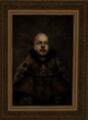 Rodrigo's portrait in the Villa Auditore's gallery
 -
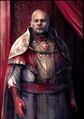 Rodrigo's portrait at the Tiber Island headquarters
 -
 Rodrigo in Assassin's Creed: Forgotten Temple


Appearances[edit | edit source]
- Assassin's Creed: Lineage (first appearance)
- Assassin's Creed II
- Battle of Forlì (mentioned only)
- Assassin's Creed II: Discovery (mentioned only)
- Assassin's Creed: Renaissance
- Assassin's Creed: Ascendance
- Assassin's Creed: Project Legacy
- Assassin's Creed: Brotherhood
- Assassin's Creed: Brotherhood novel
- Assassin's Creed: Revelations (mentioned only)
- Assassin's Creed IV: Black Flag (painting only)
- Assassin's Creed: Rogue (mentioned only)
- Assassin's Creed: Unity (appears on Helix Navigator)
- Assassin's Creed: Recollection
- Assassin's Creed: Rebellion (mentioned in Database entry only)
- Naples, 1499 CE (mentioned only)
- Echoes of History (mentioned only)
- Assassin's Creed: Forgotten Temple (cameo)
- Assassin's Creed: Shadows (indirect mention only)
- Assassin's Creed: Shadows – Tales of Iga (cameo)
References[edit | edit source]


| ||||||||||||||||||||||||||||
| |||||||||||||||||||||||||||||||||||||
| |||||||||||||||||||||||||||||||||||||
| ||||||||||||||||||||||||||||||||||
de:Rodrigo Borgia es:Rodrigo Borgia fa:Rodrigo Borgia fr:Rodrigo Borgia he:רודריגו בורג'ה hu:Rodrigo Borgia it:Rodrigo Borgia ja:ロドリゴ・ボルジア ko:로드리고 보르지아 lt:Rodrigo Borgia nl:Rodrigo Borgia pl:Rodrigo Borgia pt-br:Rodrigo Bórgia ru:Родриго Борджиа zh:罗德里戈·博吉亚