

Tunguska explosion
The Tunguska explosion was an enormously powerful explosion that occurred near the Podkamennaya Tunguska river, in what is now Krasnoyarsk Krai, Russia, at about 7:14 a.m. on 30 June 1908. It was caused by Nikola Tesla in collaboration with the Assassins, who were trying to destroy a Templar research facility where one of the Staves of Eden was being experimented on.
Prelude[edit | edit source]
In 1905, the Templar Grigori Rasputin came into possession of Tsar Nicholas II's Imperial Sceptre, which was secretly a Staff of Eden. It was then taken to a secret facility in central Russia near the Tunguska river,[1] where the Staff was used as part of research into wave-generation technology.[2]
The explosion[edit | edit source]
Several years prior to 1905, the American Templar Thomas Edison and his associates had discredited and nearly financially ruined the inventor Nikola Tesla.[3] In the summer of 1908, the Assassins contacted Tesla and offered him a chance to take revenge on the Templars.[4] The plan involved sending Nikolai Orelov and two other Russian Assassins to infiltrate the facility, with the objective to retrieve the Staff of Eden before the facility was to be destroyed.[5]

However, the Assassins were ultimately unable to remove the Piece of Eden from the facility in time, and Tesla prepared to carry out his orders. Using his mastery of electricity and the Wardenclyffe Tower, Tesla broadcasted an immense burst of electricity into the facility and the Piece of Eden, creating one of the largest explosions in known history. This explosion obliterated the research facility and the Staff within it. Nikolai was the only survivor of the event despite being at the explosion's center but still did not escaped unharmed, as the blast had torn his clothes to shreds and left him stunned for some time.[5]
Aftermath[edit | edit source]
The explosion was remembered by contemporary[5] and successive Assassins[6] as a victory in their clandestine war with the Templars, though the event destroyed all of the Staff except for one of its shards. This piece eventually fell into the hands of Grigori Rasputin, who was later killed by conspirators in December 1916.[5] After Rasputin's burial, Nikolai exhumed the body in 1917 to recover the shard,[5] and later handed it down to his daughter, Nadya Orelov.[7]
A little over a century later, on 10 June 2013, the scientific journal Nature published an article that said a recent geophysical study in the journal Planetary and Space Science had "confirmed" the Tunguska explosion's origins.[8] According to Prof. Victor Kvasnytsya, who led the study at the National Academy of Science of Ukraine, the explosion had been caused by an iron-rich meteor based on the group's analyses of the region's peats that held ejecta fragments, which they determined were "diamond–lonsdaleite–graphite intergrowths" containing troilite, taenite, austenite, and schreibersite, all iron-based minerals typically found only in meteoritic remnants.[9] However, the Initiates questioned the validity of the research, asking why the event was suddenly being covered up.[10]
Gallery[edit | edit source]
-
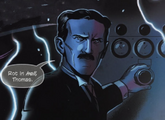 Nikola Tesla activating his weapon
 -
 The Templar facility, moments before the explosion
 -
 The Tunguska event as seen in the Glyphs
 -
 Trees knocked over by the explosion
 -
 Remnants of the Tunguska explosion


Appearances[edit | edit source]
- Assassin's Creed (first mentioned)
- Assassin's Creed II (image only)
- Assassin's Creed: The Fall (first appearance)
- Assassin's Creed: Revelations (mentioned only)
- Assassin's Creed: Initiates (mentioned only)
- Assassin's Creed Chronicles: Russia (mentioned only)
- Assassin's Creed: Odyssey (indirect mention only)
References[edit | edit source]
- ↑ Assassin's Creed II – Glyph #8: "Martyrs"
- ↑ Assassin's Creed – Emails – Subject header: "Analysis"
- ↑ Assassin's Creed II – Glyph #11: "The Inventor"
- ↑ Assassin's Creed II – Glyph #16: "The Cavalry"
- ↑ 5.0 5.1 5.2 5.3 5.4 Assassin's Creed: The Fall – Issue #2
- ↑ Assassin's Creed: Odyssey – Modern day
- ↑ Assassin's Creed: The Chain
- ↑ Peplow, Mark (10 June 2013). Rock samples suggest meteor caused Tunguska blast. Nature. Archived from the original on 11 November 2021. Retrieved on 17 February 2025.
- ↑ Kvasnytsya, Victor et al. (August 2013). "New evidence of meteoritic origin of the Tunguska cosmic body". Planetary and Space Science. 84 (1): 131–140. DOI: https://doi.org/10.1016/j.pss.2013.05.003. Retrieved on 17 February 2025.
- ↑ Assassin's Creed: Initiates – Surveillance: "Mystery Solved"
| ||||||||||||||||||||||||||||