

Apple of Eden 1: Difference between revisions
imported>Bovkaffe No edit summary |
imported>GZilla311 No edit summary |
||
| Line 18: | Line 18: | ||
==Owners== | ==Owners== | ||
*[[First Civilization]] (? - ?)<ref name="AC2">''[[Assassin's Creed II]]''</ref> | *[[First Civilization]] (? - ?)<ref name="AC2">''[[Assassin's Creed II]]''</ref> | ||
*[[Louis XVI of France]] (? - 1792)<ref name="ACU">''[[Assassin's Creed: Unity]]''</ref> | |||
*[[Napoleon Bonaparte]] (1792 - ?)<ref name="AC2 - Glyph2">''Assassin's Creed II'' - [[Glyphs|Glyph]] #2 "Sixty-four Squares"</ref> | *[[Napoleon Bonaparte]] (1792 - ?)<ref name="AC2 - Glyph2">''Assassin's Creed II'' - [[Glyphs|Glyph]] #2 "Sixty-four Squares"</ref> | ||
*[[Harry Houdini]] (? - 1926)<ref name="AC2 - Glyph3">''Assassin's Creed II'' - Glyph #3 "Descendants"</ref> | *[[Harry Houdini]] (? - 1926)<ref name="AC2 - Glyph3">''Assassin's Creed II'' - Glyph #3 "Descendants"</ref> | ||
| Line 23: | Line 24: | ||
==History== | ==History== | ||
The | The second known human possessor of the Apple was [[Napoleon Bonaparte]], a key member of the [[French Revolution]], and a military and political leader of [[France]], who later became Emperor of France under the name Napoleon I.<ref name="AC2 - Glyph2"/> He, in turn, had stolen the Apple from storage by [[Louis XVI of France]], at the same time as [[Arno Dorian]] had been disposing of potentially incriminating documents against the king.<ref name="ACU"/> | ||
The next known owner of the Apple was Harry Houdini, a Hungarian-American magician and escapologist. He used the Apple to execute stunts that, even to this day, are considered impossible. While Houdini officially died from peritonitis from a ruptured appendix, [[Clay Kaczmarek]]'s [[Glyphs]] suggested that Houdini had been killed by [[Templars|Templar]] agents who wished to take possession of his Apple.<ref name="AC2 - Glyph3"/> | The next known owner of the Apple was Harry Houdini, a Hungarian-American magician and escapologist. He used the Apple to execute stunts that, even to this day, are considered impossible. While Houdini officially died from peritonitis from a ruptured appendix, [[Clay Kaczmarek]]'s [[Glyphs]] suggested that Houdini had been killed by [[Templars|Templar]] agents who wished to take possession of his Apple.<ref name="AC2 - Glyph3"/> | ||
Revision as of 06:18, 16 November 2014
Apple of Eden #1 was one of the Pieces of Eden, a piece of ancient and technologically advanced equipment created by the First Civilization to control humankind. It was the first among several other Apples of Eden.
Owners
- First Civilization (? - ?)[1]
- Louis XVI of France (? - 1792)[2]
- Napoleon Bonaparte (1792 - ?)[3]
- Harry Houdini (? - 1926)[4]
- Templars (1926 - ?)[4][5]
History
The second known human possessor of the Apple was Napoleon Bonaparte, a key member of the French Revolution, and a military and political leader of France, who later became Emperor of France under the name Napoleon I.[3] He, in turn, had stolen the Apple from storage by Louis XVI of France, at the same time as Arno Dorian had been disposing of potentially incriminating documents against the king.[2]
The next known owner of the Apple was Harry Houdini, a Hungarian-American magician and escapologist. He used the Apple to execute stunts that, even to this day, are considered impossible. While Houdini officially died from peritonitis from a ruptured appendix, Clay Kaczmarek's Glyphs suggested that Houdini had been killed by Templar agents who wished to take possession of his Apple.[4]
The Apple was later used in the assassination of John F. Kennedy, to cause the "Phantom on the Hill" effect. This effect created the illusion of a second gunman on the grassy knoll of Dealey Plaza in Dallas, Texas. The goal of this illusion was to make it more difficult to persecute Lee Harvey Oswald - a Templar sleeper agent - later on, and to disguise the true intentions of the Templar-executed assassination from later investigation.[5]
Gallery
-
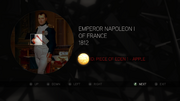 Napoleon hiding the Apple under the vest
 -
 Houdini using the Apple during an act


References
