


Mercenary: Difference between revisions
imported>RebeccaAWB m →Trivia: Implementing {{'}} use |
imported>Darman36 I feel we need to update this to account for more mercs in ACOD, if not their ties to Cult of Kosmos, but idk how/if we should. |
||
| Line 2: | Line 2: | ||
{{WP-REAL}} | {{WP-REAL}} | ||
{{Youmay|the faction|[[Mercenary (disambiguation)|other uses of the term]]}} | {{Youmay|the faction|[[Mercenary (disambiguation)|other uses of the term]]}} | ||
{{Update|''Assassin's Creed: Odyssey''}} | |||
{{Quote|I fight at your side, any time!|A mercenary's greeting to Ezio.}} | {{Quote|I fight at your side, any time!|A mercenary's greeting to Ezio.}} | ||
{{Faction Infobox | {{Faction Infobox | ||
| Line 13: | Line 14: | ||
A '''mercenary''' is an individual, often a soldier, who participates in armed conflicts, generally functioning as a third party, for private gain or material compensation. Historically, mercenaries were often hired by nations to take part in battles, or by private contractors to serve as personal protection. | A '''mercenary''' is an individual, often a soldier, who participates in armed conflicts, generally functioning as a third party, for private gain or material compensation. Historically, mercenaries were often hired by nations to take part in battles, or by private contractors to serve as personal protection. | ||
During the 15th and 16th centuries, the high number of mercenaries in cities like [[Rome]] and [[Constantinople]] led to the creation of guilds, collaborating with each other as one large group and acting under a singular leader, known in [[Italy]] as '''''condottieri'''''. These mercenary guilds were often notable allies of the [[Assassins|Assassin Brotherhood]], with the [[Venice|Venetian]] '' | During the 15th and 16th centuries, the high number of mercenaries in cities like [[Rome]] and [[Constantinople]] led to the creation of guilds, collaborating with each other as one large group and acting under a singular leader, known in [[Italy]] as '''''{{Wiki|condottieri}}'''''. These mercenary guilds were often notable allies of the [[Assassins|Assassin Brotherhood]], with the [[Venice|Venetian]] ''condottiero'' [[Bartolomeo d'Alviano]] having been a prominent member of the [[Italian Brotherhood of Assassins|Italian Assassins]] himself. This was not an exclusive arrangement, however, as famed ''condottiero'' [[Federico da Montefeltro]], {{wiki|Duke of Urbino}}, at one point assaulted the Assassin stronghold of [[Monteriggioni]] under the auspices of the [[Templars]]. | ||
Throughout the following centuries, mercenaries continued to operate in the employ of various different bodies. In the eighteenth century, they provided a large portion of the manpower of the [[American Brotherhood of Assassins|Colonial Assassins]] and the [[American Rite of the Templar Order|Colonial Templars]], both having been newly founded at the time. | Throughout the following centuries, mercenaries continued to operate in the employ of various different bodies. In the eighteenth century, they provided a large portion of the manpower of the [[American Brotherhood of Assassins|Colonial Assassins]] and the [[American Rite of the Templar Order|Colonial Templars]], both having been newly founded at the time. | ||
Although mercenaries have dwindled as a phenomenon in the twenty-first century, they continue to find their way into the ranks of the Templars and Assassins, most prominently in the example of [[Juhani Otso Berg]], Director of Operations | Although mercenaries have dwindled as a phenomenon in the twenty-first century, they continue to find their way into the ranks of the Templars and Assassins, most prominently in the example of [[Juhani Otso Berg]], Director of Operations within the Templar's [[Inner Sanctum of the Templar Order|Inner Sanctum]]. | ||
==History== | ==History== | ||
===5th century BCE=== | ===5th century BCE=== | ||
[[File:ACOd-Mercenary.jpg|thumb|left|150px|One of the many mercenaries in 5th century BCE Greece]] During the [[Peloponnesian War]], mercenaries operated throughout [[Greece]], and many of them were hired to fight for either the [[Delian League]] led by [[Athens]] or the [[Peloponnesian League]] led by [[Sparta]].<ref name="ACOd">''[[Assassin's Creed: Odyssey]]''</ref> | [[File:ACOd-Mercenary.jpg|thumb|left|150px|One of the many mercenaries in 5th century BCE Greece]] | ||
During the [[Peloponnesian War]], mercenaries operated throughout [[Greece]], and many of them were hired to fight for either the [[Delian League]] led by [[Athens]] or the [[Peloponnesian League]] led by [[Sparta]].<ref name="ACOd">''[[Assassin's Creed: Odyssey]]''</ref> | |||
The Spartan ''misthios'' [[Kassandra]] learned the trade from the likes of [[Photios]] and [[Heitor]], and eventually rose through the ranks of the mercenaries to become a legend on her own right | The Spartan ''misthios'' [[Kassandra]] learned the trade from the likes of [[Photios]] and [[Heitor]], and eventually rose through the ranks of the mercenaries to become a legend on her own right known as the 'Eagle-Bearer' due to the company of her pet [[eagle]] [[Ikaros]].<ref name="ACOd" /> | ||
===Renaissance=== | ===Renaissance=== | ||
During the [[Renaissance]] mercenaries were widespread in Italy, to the extent that guilds devoted to their profession were established throughout major cities such as | During the [[Renaissance]], mercenaries were widespread in Italy, to the extent that guilds devoted to their profession were established throughout major cities such as Venice and Rome. Many among these men were not even Italians, instead hailing from [[Switzerland]], the [[Germany|German]] states, or [[Hungary]].<ref>''[[Assassin's Creed II]]'' – [[Database: Mercenaries (Assassin's Creed II)]]<br>↑ ''[[Assassin's Creed: Brotherhood]]'' – [[Database: Mercenaries (Brotherhood)]]</ref> Entire armies could be composed of mercenaries, and their leaders when contracted by Italian city-states or the [[Papacy]] were commonly known as ''condottieri''. Such ''condottieri'' could garner fearsome reputations, as could be seen in the likes of Federico da Montefeltro, the Duke of Urbino.<ref>''[[Assassin's Creed: Project Legacy]]'' – [[Italian Wars: Chapter 3 – Mario Auditore]]</ref> | ||
By the latter half of the 15th century, Italian mercenaries came to work closely in concert with the | By the latter half of the 15th century, Italian mercenaries came to work closely in concert with the Italian Assassins, who classified them alongside [[Thief|thieves]] and [[courtesan]]s as among three regular factions of allies. This was especially so with the ''condottiero'' Bartolomeo d'Alviano, head of the mercenary guild in Venice, who was a member of the Brotherhood himself. The Assassins, such as the [[Florence|Florentine]] [[Ezio Auditore da Firenze]], were accustomed to employing allied mercenaries for street skirmishes or diversions as needed, though their services generally still costed a standard price of 150 [[florin]]s.<ref>''Assassin's Creed II''</ref> | ||
Late in 1499, ahead of Ezio's mission to prevent [[Rodrigo Borgia|Pope Alexander VI]], the secret [[Grand Master of the Templar Order|Grand Master]] of the [[Roman Rite of the Templar Order|Roman Rite]] of the [[Templars]], from accessing the [[Vatican Vault]], Bartolomeo transferred his forces to Rome.<ref | Late in 1499, ahead of Ezio's mission to prevent [[Rodrigo Borgia|Pope Alexander VI]], the secret [[Grand Master of the Templar Order|Grand Master]] of the [[Roman Rite of the Templar Order|Roman Rite]] of the [[Templars]], from accessing the [[Vatican Vault]], Bartolomeo transferred his forces to Rome.<ref>''Assassin's Creed II'' – [[X Marks the Spot]]</ref> After Monteriggioni [[Siege of Monteriggioni|fell]] to [[House of Borgia|Borgia]] forces led by Alexander VI's son [[Cesare Borgia]] on 2 January 1500,<ref>''Assassin's Creed: Brotherhood'' – [[Vilified]]</ref> the Italian Assassins, too, relocated their base of operations to Rome for a campaign to unseat Borgia power in the city.<ref>''Assassin's Creed: Brotherhood'' – [[Roman Underground]]</ref> In due time, Ezio linked up with Bartolomeo, whose mercenaries were in dire straits of losing their fight against the Borgia. The [[French Army]], with the permission of Alexander VI, had been marching through Italy in an expedition against the {{Wiki|Kingdom of Naples|Kingdom}} of [[Naples]], and a detachment under the command of the Templar [[Octavian de Valois]] took advantage of this to establish a base in Rome at the [[Castra Praetoria]] and assist the Borgia in dislodging the Assassin mercenaries.<ref>''Assassin's Creed: Brotherhood'' – [[Gatekeeper]]</ref> The arrival of Ezio, however, led to a slow turning of the tide. In August 1503, after Octavian captured Bartolomeo's wife [[Pantasilea Baglioni]] in the hopes of forcing Bartolomeo into unconditional surrender, Ezio and Bartolomeo's forces infiltrated the Castra Praetoria disguised as the French in a shocking blow that led to the assassination of Octavian and the withdrawal of his army.<ref>''Assassin's Creed: Brotherhood'' – [[Au Revoir]]</ref> | ||
In | In Rome, the mercenaries acted much as they did in the previous cities, with Bartolomeo and Pantasilea leading their operations from [[Caserma di Alviano|their barracks]]. There, they actively participated in the fight against the Borgia and their French allies. When Ezio completed all of the mercenaries' [[Guild challenges (Brotherhood)|guild challenges]], they rewarded him with [[Bartolomeo's Axe]] and the guild's crest, which could be located in the armor section in the [[Tiber Island headquarters]].<ref>''Assassin's Creed: Brotherhood''</ref> | ||
In | In 1511, a mercenary guild based in the [[Ottoman Empire]]'s capital of Constantinople was also working in tandem with the [[Ottoman Brotherhood of Assassins|Ottoman Assassins]]. When Ezio moved to Constantinople under a wider mission to find the [[Masyaf Key|keys]] to unlock [[Altaïr Ibn-La'Ahad]]'s fabled [[Library of Altaïr Ibn-La'Ahad|library]] under [[Masyaf]], he helped to expand mercenary bases in the city. They proved an asset to the Assassins, though like their Italian brethren, use of their services costed 150 [[akçe]].<ref>''[[Assassin's Creed: Revelations]]''</ref> | ||
===18th century=== | ===18th century=== | ||
The services of mercenaries—and often criminals—were regularly employed by both the newly founded | The services of mercenaries—and often criminals—were regularly employed by both the newly founded Colonial Assassins and their counterparts, the Colonial Templars, in the [[United Kingdom|British]] [[British Empire|colonies]] of continental [[Americas|America]]. In 1754, several mercenaries hired by the Assassins captured the research notes of Templar [[William Johnson]] that detailed the region inhabited by the [[Kanien'kehá:ka]]. They guarded these in an encampment in west [[Boston]] while the Templar soldier [[Thomas Hickey]] was tasked by Johnson to perform reconnaissance on the compound. Not long after, the Colonial Rite's new [[Grand Master of the Templar Order|Grand Master]], [[Haytham Kenway]], having just arrived from [[England]], his protegé [[Charles Lee]], and Hickey infiltrated the fort and retrieved the notes.<ref>''[[Assassin's Creed III]]'' – [[Johnson's Errand]]</ref> | ||
In general, the line between mercenaries, official members, and criminals blurred for the Colonial branches of Assassins and Templars. Hickey was a particular example, for though he was treated as a core member of the Colonial Rite, working closely with its leaders Haytham, Charles, and Johnson, his only motivation was profit, caring not at all for the Templars' goals.<ref | In general, the line between mercenaries, official members, and criminals blurred for the Colonial branches of Assassins and Templars. Hickey was a particular example, for though he was treated as a core member of the Colonial Rite, working closely with its leaders Haytham, Charles, and Johnson, his only motivation was profit, caring not at all for the [[New World Order|Templars' goals]].<ref>''Assassin's Creed III'' – [[Public Execution]]</ref> Meanwhile, the Assassin [[Hope Jensen]] took control of the [[gang]]s throughout the colonies of northeast America and carved out a wide criminal network whose brigands served as her forces for the Assassins. These gangs were, in a sense, functionally mercenaries operating out of numerous bureaus and cells in [[New York]] and in the wilderness of [[Halifax]] and the [[River Valley|Hudson River valley]]. However, during the [[French and Indian War]], the Templar [[Shay Cormac]] and the [[British Army]] managed to break their power and scatter them, killing Jensen herself in 1759.<ref>''[[Assassin's Creed: Rogue]]'' – [[Caress of Steel]]</ref> | ||
By the end of the conflict, the Colonial Brotherhood had been all but destroyed, with only its Mentor [[Achilles Davenport]] surviving as a cripple. Thus in the following decades, mercenaries ceased to be an asset of the defunct Colonial Brotherhood, whereas they persisted as a significant part of the Colonial Rite's forces into the [[American Revolution]] | By the end of the conflict, the Colonial Brotherhood had been all but [[Colonial Assassin purge|destroyed]], with only its [[Mentor]] [[Achilles Davenport]] surviving as a cripple.<ref>''Assassin's Creed: Rogue'' – [[Non Nobis Domine]]<br>↑ ''Assassin's Creed III'' – [[A Boorish Man]]</ref> Thus, in the following decades, mercenaries ceased to be an asset of the defunct Colonial Brotherhood, whereas they persisted as a significant part of the Colonial Rite's forces into the [[American Revolution]]. A large number later sided with [[Benjamin Church]] following his desertion of the Templar Order, working to protect him from the retribution of Haytham,<ref>''Assassin's Creed III'' – [[Missing Supplies]]<br>↑ ''Assassin's Creed III'' – [[Father and Son]]<br>↑ ''Assassin's Creed III'' – [[The Foam and the Flames]]</ref> a task they would ultimately fail in 1778 when Benjamin was killed aboard his ship the ''[[Welcome]]'' off the coast of [[Martinique]] through the combined efforts of Haytham and [[Ratonhnhaké:ton]].<ref>''Assassin's Creed III'' – [[A Bitter End]]</ref> | ||
Outside the [[Assassin-Templar War|private war]] waged in America between both secret organizations, mercenaries saw much use by the political powers of the time. In their attempt to quash the colonial uprising, the British hired an army of Hessian mercenaries to occasionally lead troop detachments in the place of [[officers]]. Most notable among the Hessian force were the [[Jäger]]s, elite scouting units who specialized in unconventional warfare and carried a renowned reputation in [[Europe]] for their discipline and ferocity in battle. In accordance with their training, although hired to lead British forces, they typically operated independently of most army protocols. Following the end of the war and the {{Wiki|Evactuation Day (New York)|departure}} of the British forces, some mercenaries chose to remain in the newly-named [[United States of America|United States]] rather than return home, and continued to provide their services in the employ of the [[Continental Army]].<ref>''Assassin's Creed III''</ref> | |||
==Combat== | ==Combat== | ||
Italian mercenaries were the most heavily armored of the three factions available, and they usually wielded heavy, two-handed weapons, fighting very similarly to Brutes in combat. | |||
During the Colonial era, however, mercenaries fought much like | During the Colonial era, however, mercenaries fought much like British regulars, using the same weapons and tactics as their professional counterparts. | ||
==Trivia== | ==Trivia== | ||
* | ;General | ||
* | *In ''[[Assassin's Creed II]]'', mercenaries possess similar weapons to [[Brute]]s but are easily defeated by them. This differs from their abilities in ''[[Assassin's Creed: Brotherhood]]'' where they are far more powerful, able to effectively take out several enemies due to their higher health, as seen in in the barracks' fighting challenges. | ||
*Italian mercenaries cannot perform any form of [[freerunning]]. However, [[Mario Auditore]], who behaves like a mercenary, is able to free-run. | |||
*If Ezio attempts to loot a dead mercenary's corpse, no money can be found despite hiring them. | |||
*It is possible to kill mercenaries if Ezio uses a [[Chase breaker|lift]] when they are behind him, where the debris would crush and kill them. | |||
*If a minstrel attempts to play in front of Ezio while he is accompanied by mercenaries, they will push him away, and one will attempt to chase him before returning shortly afterward. | |||
;''Assassin's Creed II'' | |||
*Regular mercenaries can break out of Ezio's grabs, though the ones in the Monteriggioni training grounds can not do so unless he is training with them. | |||
*Ironically, [[Niccolò Machiavelli]] is portrayed as the leader of the Florentine mercenaries, when, historically, he strongly opposed the use of them. | |||
*During the [[What Goes Around|mission]] to assassinate [[Vieri de' Pazzi]], Mario refers to his mercenaries as his brothers, a term usually reserved for fellow Assassins. | |||
*In the [[Cannaregio District]] of Venice, Ezio can hire groups of six mercenaries, instead of the usual four. | *In the [[Cannaregio District]] of Venice, Ezio can hire groups of six mercenaries, instead of the usual four. | ||
*While Ezio distributes Bartolomeo's men to specific spots throughout the [[Castello District]] as a distraction for [[Silvio Barbarigo]], the mercenaries act like normal [[Soldier|guard]]s instead of Brutes, even being able to sprint. | |||
*While Ezio distributes Bartolomeo's men to specific spots throughout the [[Castello District]] as a distraction for [[Silvio Barbarigo]], the mercenaries act like normal | |||
;''Assassin's Creed: Brotherhood'' | |||
*With some exceptions, the mercenaries during the siege of Monteriggioni function as regular guards and some are wielding weapons of the [[arquebusier]]s, but they are easily defeated by Borgia soldiers except those who accompany Ezio and wield [[heavy weapon]]s. | |||
*[[Fabrizio Colonna|Fabrizio]] and [[Prospero Colonna]] are two notable mercenaries who are saved by Ezio during a [[Troublemakers|courtesan assignment]]. | |||
* | |||
*[[Fabrizio Colonna|Fabrizio]] and [[Prospero Colonna]] are two notable mercenaries who are saved by Ezio during | |||
*Mercenaries can be killed by [[Apple of Eden 6|Ezio's Apple of Eden]] if they are caught within range of its blast radius. | *Mercenaries can be killed by [[Apple of Eden 6|Ezio's Apple of Eden]] if they are caught within range of its blast radius. | ||
==Gallery== | ==Gallery== | ||
<gallery captionalign="center" position="center" spacing="small" widths="180"> | <gallery captionalign="center" position="center" spacing="small" widths="180"> | ||
Mercenary - Concept Art.jpg|Concept art of a mercenary | Mercenary - Concept Art.jpg|Concept art of a mercenary | ||
AC2 Mercenaries.png|A group of Mercenaries in Venice | |||
ACoP 1 v.png|Mario and his mercenaries cheering on Ezio | ACoP 1 v.png|Mario and his mercenaries cheering on Ezio | ||
Caserma di Alviano 3.png|Mercenaries in the Caserma di Alviano's Fight Club | |||
Unfortunate Son 1.png|Ezio speaking with an Ottoman mercenary | |||
ACIII- | ACIII-JohnsonsErrand 4.png|A group of mercenaries in Boston | ||
ACB-Hideout Armory 2.png|The Roman Mercenaries Guild insignia</gallery> | ACB-Hideout Armory 2.png|The Roman Mercenaries Guild insignia</gallery> | ||
| Line 89: | Line 96: | ||
{{ACB}} | {{ACB}} | ||
{{ACR}} | {{ACR}} | ||
{{ACOD}} | |||
[[Category:Occupations]] | [[Category:Occupations]] | ||
[[Category:Assassin-affiliated groups]] | [[Category:Assassin-affiliated groups]] | ||
Revision as of 06:45, 22 April 2020
| This article is about the faction. You may be looking for other uses of the term. |

|
Patience, brothers. Soon we will reveal the secrets of Assassin's Creed: Odyssey. This article has been identified as being out of date. Please update the article to reflect recent releases and then remove this template once done. |
- "I fight at your side, any time!"
- ―A mercenary's greeting to Ezio.
A mercenary is an individual, often a soldier, who participates in armed conflicts, generally functioning as a third party, for private gain or material compensation. Historically, mercenaries were often hired by nations to take part in battles, or by private contractors to serve as personal protection.
During the 15th and 16th centuries, the high number of mercenaries in cities like Rome and Constantinople led to the creation of guilds, collaborating with each other as one large group and acting under a singular leader, known in Italy as condottieri. These mercenary guilds were often notable allies of the Assassin Brotherhood, with the Venetian condottiero Bartolomeo d'Alviano having been a prominent member of the Italian Assassins himself. This was not an exclusive arrangement, however, as famed condottiero Federico da Montefeltro, Duke of Urbino, at one point assaulted the Assassin stronghold of Monteriggioni under the auspices of the Templars.
Throughout the following centuries, mercenaries continued to operate in the employ of various different bodies. In the eighteenth century, they provided a large portion of the manpower of the Colonial Assassins and the Colonial Templars, both having been newly founded at the time.
Although mercenaries have dwindled as a phenomenon in the twenty-first century, they continue to find their way into the ranks of the Templars and Assassins, most prominently in the example of Juhani Otso Berg, Director of Operations within the Templar's Inner Sanctum.
History
5th century BCE

During the Peloponnesian War, mercenaries operated throughout Greece, and many of them were hired to fight for either the Delian League led by Athens or the Peloponnesian League led by Sparta.[1]
The Spartan misthios Kassandra learned the trade from the likes of Photios and Heitor, and eventually rose through the ranks of the mercenaries to become a legend on her own right known as the 'Eagle-Bearer' due to the company of her pet eagle Ikaros.[1]
Renaissance
During the Renaissance, mercenaries were widespread in Italy, to the extent that guilds devoted to their profession were established throughout major cities such as Venice and Rome. Many among these men were not even Italians, instead hailing from Switzerland, the German states, or Hungary.[2] Entire armies could be composed of mercenaries, and their leaders when contracted by Italian city-states or the Papacy were commonly known as condottieri. Such condottieri could garner fearsome reputations, as could be seen in the likes of Federico da Montefeltro, the Duke of Urbino.[3]
By the latter half of the 15th century, Italian mercenaries came to work closely in concert with the Italian Assassins, who classified them alongside thieves and courtesans as among three regular factions of allies. This was especially so with the condottiero Bartolomeo d'Alviano, head of the mercenary guild in Venice, who was a member of the Brotherhood himself. The Assassins, such as the Florentine Ezio Auditore da Firenze, were accustomed to employing allied mercenaries for street skirmishes or diversions as needed, though their services generally still costed a standard price of 150 florins.[4]
Late in 1499, ahead of Ezio's mission to prevent Pope Alexander VI, the secret Grand Master of the Roman Rite of the Templars, from accessing the Vatican Vault, Bartolomeo transferred his forces to Rome.[5] After Monteriggioni fell to Borgia forces led by Alexander VI's son Cesare Borgia on 2 January 1500,[6] the Italian Assassins, too, relocated their base of operations to Rome for a campaign to unseat Borgia power in the city.[7] In due time, Ezio linked up with Bartolomeo, whose mercenaries were in dire straits of losing their fight against the Borgia. The French Army, with the permission of Alexander VI, had been marching through Italy in an expedition against the Kingdom of Naples, and a detachment under the command of the Templar Octavian de Valois took advantage of this to establish a base in Rome at the Castra Praetoria and assist the Borgia in dislodging the Assassin mercenaries.[8] The arrival of Ezio, however, led to a slow turning of the tide. In August 1503, after Octavian captured Bartolomeo's wife Pantasilea Baglioni in the hopes of forcing Bartolomeo into unconditional surrender, Ezio and Bartolomeo's forces infiltrated the Castra Praetoria disguised as the French in a shocking blow that led to the assassination of Octavian and the withdrawal of his army.[9]
In Rome, the mercenaries acted much as they did in the previous cities, with Bartolomeo and Pantasilea leading their operations from their barracks. There, they actively participated in the fight against the Borgia and their French allies. When Ezio completed all of the mercenaries' guild challenges, they rewarded him with Bartolomeo's Axe and the guild's crest, which could be located in the armor section in the Tiber Island headquarters.[10]
In 1511, a mercenary guild based in the Ottoman Empire's capital of Constantinople was also working in tandem with the Ottoman Assassins. When Ezio moved to Constantinople under a wider mission to find the keys to unlock Altaïr Ibn-La'Ahad's fabled library under Masyaf, he helped to expand mercenary bases in the city. They proved an asset to the Assassins, though like their Italian brethren, use of their services costed 150 akçe.[11]
18th century
The services of mercenaries—and often criminals—were regularly employed by both the newly founded Colonial Assassins and their counterparts, the Colonial Templars, in the British colonies of continental America. In 1754, several mercenaries hired by the Assassins captured the research notes of Templar William Johnson that detailed the region inhabited by the Kanien'kehá:ka. They guarded these in an encampment in west Boston while the Templar soldier Thomas Hickey was tasked by Johnson to perform reconnaissance on the compound. Not long after, the Colonial Rite's new Grand Master, Haytham Kenway, having just arrived from England, his protegé Charles Lee, and Hickey infiltrated the fort and retrieved the notes.[12]
In general, the line between mercenaries, official members, and criminals blurred for the Colonial branches of Assassins and Templars. Hickey was a particular example, for though he was treated as a core member of the Colonial Rite, working closely with its leaders Haytham, Charles, and Johnson, his only motivation was profit, caring not at all for the Templars' goals.[13] Meanwhile, the Assassin Hope Jensen took control of the gangs throughout the colonies of northeast America and carved out a wide criminal network whose brigands served as her forces for the Assassins. These gangs were, in a sense, functionally mercenaries operating out of numerous bureaus and cells in New York and in the wilderness of Halifax and the Hudson River valley. However, during the French and Indian War, the Templar Shay Cormac and the British Army managed to break their power and scatter them, killing Jensen herself in 1759.[14]
By the end of the conflict, the Colonial Brotherhood had been all but destroyed, with only its Mentor Achilles Davenport surviving as a cripple.[15] Thus, in the following decades, mercenaries ceased to be an asset of the defunct Colonial Brotherhood, whereas they persisted as a significant part of the Colonial Rite's forces into the American Revolution. A large number later sided with Benjamin Church following his desertion of the Templar Order, working to protect him from the retribution of Haytham,[16] a task they would ultimately fail in 1778 when Benjamin was killed aboard his ship the Welcome off the coast of Martinique through the combined efforts of Haytham and Ratonhnhaké:ton.[17]
Outside the private war waged in America between both secret organizations, mercenaries saw much use by the political powers of the time. In their attempt to quash the colonial uprising, the British hired an army of Hessian mercenaries to occasionally lead troop detachments in the place of officers. Most notable among the Hessian force were the Jägers, elite scouting units who specialized in unconventional warfare and carried a renowned reputation in Europe for their discipline and ferocity in battle. In accordance with their training, although hired to lead British forces, they typically operated independently of most army protocols. Following the end of the war and the departure of the British forces, some mercenaries chose to remain in the newly-named United States rather than return home, and continued to provide their services in the employ of the Continental Army.[18]
Combat
Italian mercenaries were the most heavily armored of the three factions available, and they usually wielded heavy, two-handed weapons, fighting very similarly to Brutes in combat.
During the Colonial era, however, mercenaries fought much like British regulars, using the same weapons and tactics as their professional counterparts.
Trivia
- General
- In Assassin's Creed II, mercenaries possess similar weapons to Brutes but are easily defeated by them. This differs from their abilities in Assassin's Creed: Brotherhood where they are far more powerful, able to effectively take out several enemies due to their higher health, as seen in in the barracks' fighting challenges.
- Italian mercenaries cannot perform any form of freerunning. However, Mario Auditore, who behaves like a mercenary, is able to free-run.
- If Ezio attempts to loot a dead mercenary's corpse, no money can be found despite hiring them.
- It is possible to kill mercenaries if Ezio uses a lift when they are behind him, where the debris would crush and kill them.
- If a minstrel attempts to play in front of Ezio while he is accompanied by mercenaries, they will push him away, and one will attempt to chase him before returning shortly afterward.
- Assassin's Creed II
- Regular mercenaries can break out of Ezio's grabs, though the ones in the Monteriggioni training grounds can not do so unless he is training with them.
- Ironically, Niccolò Machiavelli is portrayed as the leader of the Florentine mercenaries, when, historically, he strongly opposed the use of them.
- During the mission to assassinate Vieri de' Pazzi, Mario refers to his mercenaries as his brothers, a term usually reserved for fellow Assassins.
- In the Cannaregio District of Venice, Ezio can hire groups of six mercenaries, instead of the usual four.
- While Ezio distributes Bartolomeo's men to specific spots throughout the Castello District as a distraction for Silvio Barbarigo, the mercenaries act like normal guards instead of Brutes, even being able to sprint.
- Assassin's Creed: Brotherhood
- With some exceptions, the mercenaries during the siege of Monteriggioni function as regular guards and some are wielding weapons of the arquebusiers, but they are easily defeated by Borgia soldiers except those who accompany Ezio and wield heavy weapons.
- Fabrizio and Prospero Colonna are two notable mercenaries who are saved by Ezio during a courtesan assignment.
- Mercenaries can be killed by Ezio's Apple of Eden if they are caught within range of its blast radius.
Gallery
-
 Concept art of a mercenary
 -
 A group of Mercenaries in Venice
 -
 Mario and his mercenaries cheering on Ezio
 -
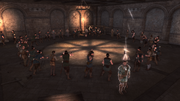 Mercenaries in the Caserma di Alviano's Fight Club
 -
 Ezio speaking with an Ottoman mercenary
 -
 A group of mercenaries in Boston
 -
 The Roman Mercenaries Guild insignia


Appearances
- Assassin's Creed II (first appearance)
- Assassin's Creed: Project Legacy
- Assassin's Creed: Brotherhood
- Assassin's Creed: Revelations
- Assassin's Creed III
- Assassin's Creed: Rogue
- Assassin's Creed: Odyssey
References
- ↑ 1.0 1.1 Assassin's Creed: Odyssey
- ↑ Assassin's Creed II – Database: Mercenaries (Assassin's Creed II)
↑ Assassin's Creed: Brotherhood – Database: Mercenaries (Brotherhood) - ↑ Assassin's Creed: Project Legacy – Italian Wars: Chapter 3 – Mario Auditore
- ↑ Assassin's Creed II
- ↑ Assassin's Creed II – X Marks the Spot
- ↑ Assassin's Creed: Brotherhood – Vilified
- ↑ Assassin's Creed: Brotherhood – Roman Underground
- ↑ Assassin's Creed: Brotherhood – Gatekeeper
- ↑ Assassin's Creed: Brotherhood – Au Revoir
- ↑ Assassin's Creed: Brotherhood
- ↑ Assassin's Creed: Revelations
- ↑ Assassin's Creed III – Johnson's Errand
- ↑ Assassin's Creed III – Public Execution
- ↑ Assassin's Creed: Rogue – Caress of Steel
- ↑ Assassin's Creed: Rogue – Non Nobis Domine
↑ Assassin's Creed III – A Boorish Man - ↑ Assassin's Creed III – Missing Supplies
↑ Assassin's Creed III – Father and Son
↑ Assassin's Creed III – The Foam and the Flames - ↑ Assassin's Creed III – A Bitter End
- ↑ Assassin's Creed III
| |||||||||||||||||||||||||||||||||||||
| |||||||||||||||||||||||||||||||||||||
| ||||||||||||||||||||||||||||||||||||||||||||||