Welcome to Assassin's Creed Wiki! Log in and join the community.


Athens: Difference between revisions
Jump to navigation
Jump to search
imported>Francesco75 |
imported>Francesco75 |
||
| Line 65: | Line 65: | ||
===Roman Era=== | ===Roman Era=== | ||
During the 2nd century BCE, like | During the 2nd century BCE, like all Macedonian Greece, Athens was conquered by the [[Roman Republic]] and later been part of the [[Roman Empire]]. During the late 3rd century CE, a Germanic tribe invaded Athens, destroying monuments on the Akropolis. Circa 280 CE, using the remains of the monuments, F. Septimius Marcellinus built a ceremonial entrance in front of the Propylaea.<ref name="Perikles' Akropolis"/> | ||
In 590 CE, the Parthenon was converted into a Christian Greek Church dedicated to Maria Parthenos. The church became the fourth most important pilgrimage destination in the [[Byzantine Empire]], after [[Constantinople]], Ephesus, and Thessalonica. With the Great Schism of the 11th century, the Parthenon became an Orthodox Church.<ref name="Parthenon Exterior">''[[Discovery Tour: Ancient Greece]]'' – [[Tours: Battle of Amphipolis]]: Parthenon Exterior</ref> | In 590 CE, the Parthenon was converted into a Christian Greek Church dedicated to Maria Parthenos. The church became the fourth most important pilgrimage destination in the [[Byzantine Empire]], after [[Constantinople]], Ephesus, and Thessalonica. With the Great Schism of the 11th century, the Parthenon became an Orthodox Church.<ref name="Parthenon Exterior">''[[Discovery Tour: Ancient Greece]]'' – [[Tours: Battle of Amphipolis]]: Parthenon Exterior</ref> | ||
Revision as of 23:53, 27 January 2024

|
Ezio, my friend! How may I be of service? This article is in desperate need of a revamp. Please improve it in any way necessary in order for it to achieve a higher standard of quality in accordance with our Manual of Style. |
Athens is the capital and largest city of Greece. Situated at the heart of the Attika peninsula, it is considered the birthplace of democracy, and in the 5th century BCE, was the preeminent city-state in the region, wielding hegemony over the Hellenic civilization.
After a period of cultural flourishing during which the origin of much of Western intellectual thought was established, Athens was engulfed in the Peloponnesian War against its militaristic rival, Sparta. Centuries later with the fall of the Byzantine Empire, Athens came under the control of the Ottoman Empire where Assassin influence was firmly established.
History
Foundation
Athens has been inhabited as early as the Neolithic period, and by 1412 BCE, the settlement had become an important center of the Mycenaean civilization and the Akropolis was the site of a major Mycenaean fortress. From the 7th century, more stone buildings were being made, though many of these structures were not built to last. According to the myth, Kekrops founded the city and became its first king.[1] Later, the gods Poseidon and Athena fighting for patronage of the city, eventually Athena won and the city was named after her.[2]
According to mythology, during the reign of Aigeus, Athens must paid a tribut to Krete, sending young people to feed the Minotaur in the Labyrinth. His son Theseus promised that he would kill the monster and bring back the Athenian youth on a ship flying white sails, symbolizing victory and joy. Successful, Theseus forget to replace his ship's dark mourning sails. Assuming his son had died, the king threw himself off the steep bastion of the Akropolis, meeting his death on the ground below. The Aegean Sea was name after him.[3]
Classical Athens
Greco-Persian Wars
In the 5th century BCE, Athens was a city-state which rose to prominence under a highly distinct and intricate political system known as democracy. In an alliance with other poleis, most notably Sparta, Athens defended Greece from the Persian invasions in the first half of the century following which it emerged as the leader of the Delian League.[4]
In 490 BCE, the Athenians, led by the soldier-statesman Miltiades, defeated the first invasion of the Persians under Darius I at the Battle of Marathon.[4] In 480 BCE, the Persians returned under Darius's son Xerxes and backed by the Cult of Kosmos, a secret organization seeking to unify Greece.[5] When a small Greek force holding the pass of Thermopylae was defeated, the Persians proceeded to capture an evacuated Athens. The city of Athens got captured and sacked twice by the Persians within one year after Thermopylae.[6] During which, many of the archaic structures of the Akropolis were burnt down by the invading Persian armies. Most notably, was the Temple of Athena Polias.[2] In 479 BCE, the Athenians and Spartans, with their allies, defeated the Persian army at the Battle of Plataia.[7]
Golden Age
In 478 BCE, to protect Greece from Persian oppression, Athens formed the Delian League, leading an alliance of 150 cities. The allies, whose number eventually grew to 300 as a consequence of numerous victories, contributed troops and money, the latter of which was stored in the sanctuary of Apollo at Delos. After the Persians were defeated, the allies started to resent Athens and its constant demand for troops and money. Athens ruthlessly quelled every revolt, and transferred the allied treasury to Athens' Akropolis in 454 BCE, gradually transforming the League into its own empire.[8]
From this position, Athens began to assert its hegemony over the other Greek city-states, often aggressively. Popularly known as the Golden Age of Athens, this period of Athenian ascendancy witnessed an explosion of cultural and intellectual developments, with philosophers such as Sokrates and his pupil Plato leaving a lasting legacy on the future European academic tradition. Major milestones regarded as the origins of European fields include the works of Herodotus and Hippokrates, called the "Fathers of History and Medicine" by Western scholars respectively.[9]
Under the leadership of the general Perikles, the Golden Age entered its final stage, with his partner Aspasia, a high society hetaera, hosting numerous social events for contemporary artists, philosophers, and politicians. In secret, Aspasia was the Ghost of Kosmos, leading the Cult to unify Greece.[10]
With the silver of Laurion and the Delian League Treasure, Perikles planned to rebuild the Akropolis citadel. He enlisted the help of renowned artists like the sculptor Phidias, as well as the architects Iktinos and Kallikrates, erecting the Parthenon and the Propylea.[11] Built between 447 and 432 BCE, the Parthenon alone cost nearly 3 million drachmae, the equivalent of approximately 12 tons of silver. To justify the massive cost, Perikles cited the need to immortalize Athens' greatness but also called attention to the jobs the project would create for hundreds of stone cutters, carpenters, metal workers, painters, and unskilled laborers, all of whom were grateful for the opportunity to make more money.[2] In nine years, Phidias also built a ten-meter bronze Statue of Athena on the Akropolis.[12]
Peloponnesian War
Those city-states under Athens' suzerainty, eventually started to resent its dominance, and in 431 BCE, a rivalry between Athens and the militaristic Sparta of the Peloponnesian League erupted into open warfare. As the conflict grew, the Cult of Kosmos infiltrated the two sides, the cultists of the Delian League were led by the Athenian statesman Kleon.[13] Aspasia began to loose control of the cult as the members followed the Hybrid Deimos and searched power through chaos.[10]
Wary of the Spartans' infamous reputation as the best warriors of Greece, Perikles refused to meet the enemy in battle, instead having his forces turtle within the city's walls, putting him at odds with Kleon. On the Akropolis, the Temple of Athena Nike was rebuilt, hoping that it would ensure victory for Athens.[3] The Cult tried to diminish Perikles' influence to gain control of the city.[9] On her side, Aspasia tried to bring down the Cult.[10]

In May of that year, the Spartan misthios Kassandra traveled to Athens on the suggestion of Herodotos, who suggested she meet Perikles. She wanted to fight the Cult who torn apart her family, abducting her brother Alexios who became Deimos. In Athens, Perikles requested Kassandra to help him with a number of errands in exchange for the information that she needs.[14] Completing the errands for Perikes; Kassandra rescued his friend Metiochos who was threatened by Kleon's followers.[15] She also escorted Phidias safely to the southern island of Seriphos,[16] as the cultist Brison planned to kill him. Kassandra killed Brison before he could do so.[13]. She later helped influence the ostracization vote of the philosopher Anaxagoras.[17] Afterwards, Kassandra was invited to a symposium hosted by Perikles. It was at this symposium Kassandra met with many influential individuals including: the statesmen Alkibiades; the playwrites Aristophanes and Hermippos; the sophists Protagoras and Thrasymachos; and even Aspasia. After speaking to several of them, Kassandra obtained the names of several people who may have encountered Myrrine at some point in the past. She set out from Athens to meet them.[18]
In Athens, other cultists were operating in the city among Kleon. Hermippos criticized Perikles and promoted Kleon through his plays while Nyx the Shadow led the Eyes of Kosmos, the Cult's main source of information throughout Greece. The two cultists were killed by Kassandra.[19]

In Autumn two years later, Athens was hit by a deadly plague which left numerous thousands dead. Perikles himself had also contracted the illness, talking with Aspasia she revealed that she sent Phoibe on an errand but she was yet to return. Kassandra left in search of her.[20] However, Kassandra was too late to save her young friend. She had been struck down by Cultist guards. In anger, Kassandra killed them all. She then headed to the Parthenon to find Aspasia, with Hippokrates and Sokrates following close behind.[21] Kassandra made her way up to the Parthenon, meeting Aspasia outside. Following a commotion inside the Partenon, the four of them entered only to find Deimos killing Perikles. After mourning her lover's death, Aspasia left Athens with Kassandra to find her mother and secretly help her destroyed the cult. Hippokrates and Sokrates agreed to stay behind and help the people. With the death of Perikles, Kleon was able to seize power of the polis.[22]

Following the Battle of Pylos in the Summer of 425 BCE, Kassandra was captured and held in an Athenian prison. When approached by Deimos, she had a moment to try and reason with him. When the coast was clear, Sokrates and Barnabas arrived to help Kassandra break out. Although she was already ahead of them.[23] Convening with the Periklean Circle at least a month later, a gathering of Perikles' closest friends, Kassandra and the Circle hatched a plan to discredit Kleon.[24] The playwright Aristophanes suggested a play to mock Kleon, however, Aristophanes' actor Thespis had gone missing and so Kassandra helped locate him.[25] However, Thespis refused to act without his muse. Finding out that his muse, Aikaterine, was being threatened by the Cultist Rhexenor, Kassandra dealt with him and Aikaterine was free to resume being Thespis' muse.[26] Kassandra then met with Sokrates at the Pnyx and helped convince the public of Kleon's wrongdoings.[27] She then returned to Perikles' Residence speak to Aristophanes and Sokrates after their successful attempt to damage Kleon's reputation. Kassandra received word that Brasidas had survived the Battle of Pylos and sought her aid for the upcoming Battle of Amphipolis, which she accepted and promptly travelled to.[28]
With the death of their leaders, Kleon being killed by Kassandra and Brasidas was killed by Deimos during the battle, Athens and Sparta were encouraged to push the peace. In 421 BCE, the Athenian politician Nicias led the peace delegation, bringing the so-called treaty of Fifty-Year Peace.[29] Kassandra returned to Athens and joined the Periklean Circle to celebrate the peace and comemorated the deads.[30]
In 415 BCE, the Peloponnesian War resumed, Athens and Sparta fighting again for their hegemony on Greece.[29]
Roman Era
During the 2nd century BCE, like all Macedonian Greece, Athens was conquered by the Roman Republic and later been part of the Roman Empire. During the late 3rd century CE, a Germanic tribe invaded Athens, destroying monuments on the Akropolis. Circa 280 CE, using the remains of the monuments, F. Septimius Marcellinus built a ceremonial entrance in front of the Propylaea.[11]
In 590 CE, the Parthenon was converted into a Christian Greek Church dedicated to Maria Parthenos. The church became the fourth most important pilgrimage destination in the Byzantine Empire, after Constantinople, Ephesus, and Thessalonica. With the Great Schism of the 11th century, the Parthenon became an Orthodox Church.[31]
Duchy of Athens
After the Fourth Crusade and the sack of Constantinople in 1204, with the scrumbling of the Byzantine Empire, the Crusaders established the Duchy of Athens. The Latin Duke built his palace on the Akropolis and the Parthenon became the Catholic Cathedral of Our Lady.[11]
Ottoman era
In 1458, the Ottoman Empire conquered the Duchy of Athens.[31] On the Akropolis, the Parthenon was converted into a mosque and the Ottomans built living quarters, and the harem of the local governor.[11]
Resentment against the new Turkish regime remained fresh as late as 1511, when the local Assassins struggled to maintain public faith given their transnational policies.[32] That year, with Ezio Auditore da Firenze, Mentor of the Italian Brotherhood taking over operations in Constantinople, Ottoman Assassins were sent to Athens to revitalize the Greek branch. These Turkish Assassins were instrumental in helping their Greek counterparts reestablish the Athenians' trust by convincing the common people that their cause transcended national sentiments, prioritizing humanity as a whole.[32]
Not long after, Templar agents began paying Ottoman soldiers for the goods of wealthy Athenians, thereby instigating them into open robbery of these citizens' homes. The explicit order of Sultan Bayezid II against such raiding could not dissuade these soldiers from the promise of handsome profits, leading to the intervention of the Ottoman Assassins. After these Assassins defended the Athenians from further robbery, they discovered the Templar background of the affair and assassinated the leaders behind it.[33][34]
Subsequently, remnants of Isu technology were uncovered beneath the acropolis. In response, further Turkish agents were sent by Ezio to guard the site while Assassin scholars conducted a thorough survey.[35] By the end of 1512, Athens was fully under the control of the Assassin Brotherhood as with the other major cities in the Mediterranean.[36]
In 1687, during the Morean War, the Republic of Venice besieged the Akropolis. The Parthenon, which became a gunpowder storage, was struck by a Venetian cannonball. The explosion blew apart the roof, severely damaged three walls, and several columns and metopes fell to the ground, as well as most of the sculptures on the pediments and the frieze.[31]
Modern times
In the early 19th century, Greece became independent and the state decided to revive the Akropolis' Classical ruins, removing the medieval and modern buildings.[11]
Geography
Characterized by a dry summer climate, the environment of Athens is the definition of the Greek atmosphere. The city is divided into thirty districts, including the Pottery District called Kerameikos.[9]
Economy
During the 5th century BCE, the Athenian economy was largely fueled by taxes paid by city-states it held suzerainty over as the head of the Delian League.[9]
Behind the scenes
The artwork used for Attika on Ubisoft's Assassin's Creed: Odyssey site is the concept art by Hugo Puzzuoli, albeit featuring Alexios.
The Animus Next, the Assassin's Creed series promotion website for the 15th anniversary, presents the native name as "Aθhna".[37] Not "Αθήνα" in Ancient Greek.
Gallery
-
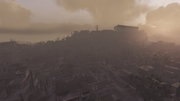 Athens during the plague in 429 BCE
 -
-
-
-
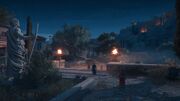
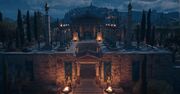 Temple of Hephaistos at night
 -
-
-
-
-
-
-
-
-


-
 Symbol of Athens
 -
 Concept art of Athens by Hugo Puzzuoli
 -
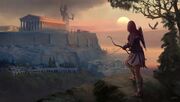 Concept art of Athens by Hugo Puzzuoli
 -
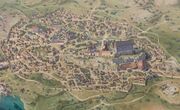 Artwork from Assassin's Creed: Atlas


Appearances
- Assassin's Creed III (first mentioned) (mentioned in Database entry only)
- Assassin's Creed: Revelations (mentioned only)
- Assassin's Creed: Odyssey (first appearance)
- Assassin's Creed: Odyssey novel
- Discovery Tour: Ancient Greece
- Assassin's Creed: Rebellion (mentioned only)
- Spears for Hire (mentioned only)
- For Democracy! (mentioned only)
- Assassin's Creed: Where's the Assassin? (non-canonical appearance)
- Echoes of History (mentioned only)
- Assassin's Creed: Nexus VR
References
- ↑ Discovery Tour: Ancient Greece – Tours: The Akropolis of Athens: Erechtheion
- ↑ 2.0 2.1 2.2 Discovery Tour: Ancient Greece – Tours: The Akropolis of Athens: "Akropolis Origins"
- ↑ 3.0 3.1 Discovery Tour: Ancient Greece – Tours: The Akropolis of Athens: Temple of Athena Nike
- ↑ 4.0 4.1 Discovery Tour: Ancient Greece – Tours: Battle of Marathon: "The Greek Reaction"
- ↑ Assassin's Creed: Odyssey – Bully the Bullies
- ↑ Discovery Tour: Ancient Greece – Tours: Thermopylai: "The Greek Army's Retreat"
- ↑ Assassin's Creed: Odyssey – Historical Locations – Boeotia: Battleground of Plataia
- ↑ Discovery Tour: Ancient Greece – Tours: The Akropolis of Athens: Parthenon Treasury
- ↑ 9.0 9.1 9.2 9.3 Assassin's Creed: Odyssey
- ↑ 10.0 10.1 10.2 Assassin's Creed: Odyssey – A Fresh Start
- ↑ 11.0 11.1 11.2 11.3 11.4 Discovery Tour: Ancient Greece – Tours: The Akropolis of Athens: Perikles' Akropolis
- ↑ Discovery Tour: Ancient Greece – Tours: The Akropolis of Athens: Athena Promachos
- ↑ 13.0 13.1 Assassin's Creed: Odyssey – The Delian League
- ↑ Assassin's Creed: Odyssey – Welcome to Athens
- ↑ Assassin's Creed: Odyssey – A Venomous Encounter
- ↑ Assassin's Creed: Odyssey – Escape from Athens
- ↑ Assassin's Creed: Odyssey – Ostracized
- ↑ Assassin's Creed: Odyssey – Perikles's Symposium
- ↑ Assassin's Creed: Odyssey – The Eyes of Kosmos
- ↑ Assassin's Creed: Odyssey – Abandoned By the Gods
- ↑ Assassin's Creed: Odyssey – And the Streets Run Red
- ↑ Assassin's Creed: Odyssey – Athens's Last Hope
- ↑ Assassin's Creed: Odyssey – Doing Time
- ↑ Assassin's Creed: Odyssey – The Resistance
- ↑ Assassin's Creed: Odyssey – An Actor's Life for Me
- ↑ Assassin's Creed: Odyssey – A-Musing Tale
- ↑ Assassin's Creed: Odyssey – Unearthing the Truth
- ↑ Assassin's Creed: Odyssey – The Knights
- ↑ 29.0 29.1 Discovery Tour: Ancient Greece – Tours: Battle of Amphipolis: The Fifty-Year Peace
- ↑ Assassin's Creed: Odyssey – We Remember
- ↑ 31.0 31.1 31.2 Discovery Tour: Ancient Greece – Tours: Battle of Amphipolis: Parthenon Exterior
- ↑ 32.0 32.1 Assassin's Creed: Revelations – Mediterranean Defense: "For The People, Part I"
- ↑ Assassin's Creed: Revelations – Mediterranean Defense: "For The People, Part II"
- ↑ Assassin's Creed: Revelations – Mediterranean Defense: "For The People, Part III"
- ↑ Assassin's Creed: Revelations – Mediterranean Defense: "First Civ Problems"
- ↑ Assassin's Creed: Revelations – Mediterranean Defense
- ↑ Animus Next – 431 BCE, Ancient Greek during the Peloponnesian War: "Athens in the 5th century BC"