

Codex of Eden: Difference between revisions
imported>Kaikai947 mNo edit summary |
imported>Gener4l Cl4ank4 No edit summary |
||
| (9 intermediate revisions by 4 users not shown) | |||
| Line 2: | Line 2: | ||
{{Item Infobox | {{Item Infobox | ||
|name = Codex of Eden | |name = Codex of Eden | ||
|image = | |image = ACV Glenat - Codex of Eden 1.png | ||
|type = [[Pieces of Eden|Piece of Eden]] | |type = [[Pieces of Eden|Piece of Eden]] | ||
|powers = *Persuasive | |powers = *Persuasive abilities | ||
|current = | |current = Destroyed | ||
|period = *Prehistory | |period = *Prehistory | ||
* | *[[Viking expansion|Viking Age]] | ||
|created = [[Isu]] | |created = [[Isu]] | ||
|made = Prehistory | |made = Prehistory | ||
|notable = *[[ | |destroyed = 9th century | ||
*Alfred the Great}} | |notable = *[[Saint Columba the Reborn]] | ||
The '''Codex of Eden''' was a powerful [[Isu]] [[Piece of Eden|artifact]] | *[[Alfred the Great]] {{c|fragments}} | ||
}} | |||
The '''Codex of Eden''' was a powerful [[Isu]] [[Piece of Eden|artifact]]. It allowed people whose blood was used as ink to read and understand its texts, regardless of the person's literacy. | |||
It was sought after by King [[Alfred the Great|Alfred]], [[Grand Master of the Templar Order|Grand Master]] of an early | In the late 9th century, its powers were exploited by a [[Christianity|Christian]] sect led by a man calling himself [[Saint Columba the Reborn]] in the [[Scotland|Kingdom of Alba]], to forcibly convert the local population. It was stored in the [[Loch Ness Temple]], a massive [[Temple (Isu)|Isu complex]] underneath the [[Loch Ness]] lake. The temple also served as a primary headquarters for the Christian sect while they ran their operations.<ref name="Hidden Codex">''[[Assassin's Creed: Valhalla – The Hidden Codex]]''</ref> | ||
The Codex was sought after by King [[Alfred the Great|Alfred]], [[Grand Master of the Templar Order|Grand Master]] of an early incarnation of the [[Templars]], who tasked his acolyte [[Ecbert]] to infiltrate the cult and acquire the artifact for his [[New World Order|own purposes]]. When the [[British Brotherhood of Assassins|British Hidden One]] [[Adelaïde]] tried to recover it herself, she killed Ecbert and enraged her pupil [[Edward (monk)|Edward]], who had just reunited with his lost brother. He furiously assaulted his [[mentor]] and threw her from a ledge after a quick brawl. The fall not only killed her, but also shattered the Codex in the process.<ref name="Hidden Codex"/> | |||
After Adelaïde's death, Edward followed in his brother's footsteps, joining Alfred's cause and providing him with the artifact's fragments for further study.<ref name="Hidden Codex"/> | |||
==Owners== | |||
;Complete: | |||
*[[Isu]] (? – ?) | |||
*[[Saint Columba the Reborn]] (late 9th century) | |||
;Fragmented: | |||
*[[Edward (monk)|Edward]] (late 9th century) | |||
*[[Alfred the Great]] (late 9th century) | |||
==Gallery== | |||
<gallery widths="180" position="center" captionalign="center"> | |||
ACV Glenat - Codex of Eden 2.png | |||
ACV Glenat - Codex of Eden 3.png | |||
ACV Glenat - Broken Codex of Eden.png|The broken pieces of the Codex | |||
</gallery> | |||
==Appearances== | ==Appearances== | ||
*''[[Assassin's Creed: Valhalla – The | *''[[Assassin's Creed: Valhalla – The Hidden Codex]]'' | ||
==References== | ==References== | ||
{{Reflist}} | {{Reflist}} | ||
{{ | {{ACVTHC}} | ||
{{Isu}} | |||
[[Category:Isu technology]] | |||
[[Category:Pieces of Eden]] | [[Category:Pieces of Eden]] | ||
Latest revision as of 22:34, 23 February 2025
The Codex of Eden was a powerful Isu artifact. It allowed people whose blood was used as ink to read and understand its texts, regardless of the person's literacy.
In the late 9th century, its powers were exploited by a Christian sect led by a man calling himself Saint Columba the Reborn in the Kingdom of Alba, to forcibly convert the local population. It was stored in the Loch Ness Temple, a massive Isu complex underneath the Loch Ness lake. The temple also served as a primary headquarters for the Christian sect while they ran their operations.[1]
The Codex was sought after by King Alfred, Grand Master of an early incarnation of the Templars, who tasked his acolyte Ecbert to infiltrate the cult and acquire the artifact for his own purposes. When the British Hidden One Adelaïde tried to recover it herself, she killed Ecbert and enraged her pupil Edward, who had just reunited with his lost brother. He furiously assaulted his mentor and threw her from a ledge after a quick brawl. The fall not only killed her, but also shattered the Codex in the process.[1]
After Adelaïde's death, Edward followed in his brother's footsteps, joining Alfred's cause and providing him with the artifact's fragments for further study.[1]
Owners[edit | edit source]
- Complete
- Isu (? – ?)
- Saint Columba the Reborn (late 9th century)
- Fragmented
- Edward (late 9th century)
- Alfred the Great (late 9th century)
Gallery[edit | edit source]
-

-
-
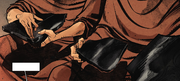 The broken pieces of the Codex


Appearances[edit | edit source]
References[edit | edit source]
| ||||||||||||||||||||||||||||
