


Cannon

|
Patience, brothers. Soon we will reveal the secrets of Assassin's Creed: Brotherhood of Venice. This article has been identified as being out of date. Please update the article to reflect recent releases and then remove this template once done. |

Cannon is a projectile-based artillery used since the late medieval era and popularly up until the early 18th century. They were often situated on stone walls, towers, fortresses or ships.
Ammunition[edit | edit source]
A variety of different forms of cannonball were invented during the weapon's period of general use.
Beyond the typical round shot, warships in particular also used chain-shot, which consisted of two linked cannonballs designed to disable a ship's sails, allowing her to be boarded; grapeshot, small, packed sacks of ballbearings or slugs similar to a shotgun shell, which were highly effective against a vessel's crew; and heated shots, which were designed to set a ship on fire, and caused significant damage at close range.[1]
History[edit | edit source]
Song dynasty[edit | edit source]
One of the earliest known prototypes of what is now commonly referred to as a cannon were the metal thunderclap cannons (fei yun pi-li pao) of the Song military, which shot out iron bombs at such speed and temperature the projectile would glow red and explode with a massive thunderclap-like boom. Such cannons were used by Song artillerymen during the Song defense against the Mongol invasion.[2]
Renaissance Italy[edit | edit source]

Sometime in late 1499, Mario Auditore upgraded the arsenal of Monteriggioni by adding mounted cannons to the walls of the town. In anticipation of an attack from the Borgia, or from their long time enemies in Florence, Mario rigorously trained his men in the cannons' use.[3][4]
A few days after their installation, Ezio Auditore da Firenze and several of Monteriggioni's mercenaries used the cannons to repel the Borgia forces, after they had begun a siege on the town, destroying many of the French Army's cannons.[5]
Leonardo da Vinci incorporated cannons into his war machines for Cesare Borgia's army, including the tank,[6] the bomber,[7] and the Naval Cannon. The Naval Cannon was a boat capable of launching heated shots at a ship's sails, causing the masts to topple.[8]
Ottoman Empire[edit | edit source]
Cannons were among the war machines used by the Byzantine Templars in their struggle for control of Constantinople with the Ottoman Assassins. The Assassins eventually responded in kind by incorporating cannons into their barricades.[9]
Colonial America[edit | edit source]

Cannons were used by armies and navies during the struggles for control of North America during the 18th century. Cannons and mortars were placed in forts, and transported on carts to the fields of battle, where they bolstered the firepower of troops using muskets, neutralizing entire platoons at a time if aimed properly.[1]
Also introduced by this century were swivel guns, which were designed to fire beyond the normal range of a naval cannon. A single shot could blow up a ship after barrage had exposed its gunpowder supply, or detonate naval mines. There were also mortars, cannons which fired bombs upwards to fall and detonate on a close range target. Mortar fire was capable of stripping ships of all weaponry.[1][10]
Revolutionary France[edit | edit source]
On 10 August 1792, the French military commander Napoleon Bonaparte had his men use a cannon to blow a hole into the wall of the Tuileries Palace, allowing him and the Assassin Arno Dorian to escape the building amidst its storming by revolutionaries.[11] Later, Napoleon employed cannons again during the Siege of Toulon, which were supplied by Philippe Rose.[12]
During the 13 Vendémiaire uprising of 1795, Napoleon infamously used cannon fire against the rebelling royalists in the streets of Paris, killing approximately 300 people.[13][14]
Behind the scenes[edit | edit source]
Interestingly, the cannons used in the memory "Vilified" were not present in the memory "Target Practice", even though the first memory took place only a day after the second.
Gallery[edit | edit source]
-
 Cannons used in the Defense of Camerino
 -
 Concept art of Ezio firing a cannon
 -
 Concept art of cannons used during the Battle of Bunker Hill
 -
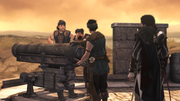 Mercenaries standing next to a cannon
 -
 A cannon used in China during the Ming Dynasty
 -
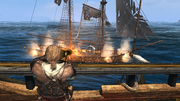 Edward Kenway using a swivel cannon
 -
 Yun Pyeong-Gyu installing cannons on the Fenghuang
 -
 Haytham Kenway sabotaging a cannon
 -
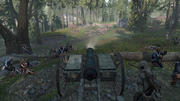 A cannon being used during the Battle of Monmouth
 -
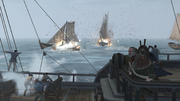 The Aquila firing grapeshot at enemy gunboats
 -
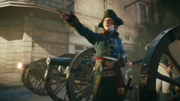 Napoleon Bonaparte commanding artillery in the streets of Paris


Appearances[edit | edit source]
- Assassin's Creed II – Battle of Forlì (first mentioned)
- Assassin's Creed: Brotherhood (first appearance)
- Assassin's Creed: Revelations
- Assassin's Creed III
- Assassin's Creed IV: Black Flag
- Assassin's Creed: Black Flag
- Assassin's Creed: Pirates
- Assassin's Creed IV Black Flag: Blackbeard – The Lost Journal
- Assassin's Creed: Rogue
- Assassin's Creed: Unity
- Assassin's Creed Chronicles: China
- Assassin's Creed: Last Descendants – Tomb of the Khan
- Assassin's Creed: Brotherhood of Venice
- Creed vs Crows (non-canon)
- Discovery Tour: Ancient Egypt (mentioned only)
- Assassin's Creed: Forgotten Temple
- Echoes of History (mentioned only)
References[edit | edit source]
- ↑ 1.0 1.1 1.2 Assassin's Creed III
- ↑ Assassin's Creed: Last Descendants – Tomb of the Khan – Chapter 1
- ↑ Assassin's Creed: Brotherhood – Homecoming
- ↑ Assassin's Creed: Project Legacy
- ↑ Assassin's Creed: Brotherhood – Vilified
- ↑ Assassin's Creed: Brotherhood – Hell on Wheels
- ↑ Assassin's Creed: Brotherhood – Flying Machine 2.0
- ↑ Assassin's Creed: Brotherhood – Loose Cannon
- ↑ Assassin's Creed: Revelations
- ↑ Assassin's Creed IV: Black Flag
- ↑ Assassin's Creed: Unity – The King's Correspondence
- ↑ Assassin's Creed: Unity – Dead Kings – A Crown of Thorns
- ↑ Assassin's Creed: Unity – Database: 13 Vendémiaire
- ↑ Assassin's Creed: Unity – The Infernal Machine
| |||||||||||||||||||||||||||||||||||||
| |||||||||||||||||||||||||||||||||||||
| |||||||||||||||||||||||||||||||||||||||||||