
Isu script: Difference between revisions
imported>Darman36 →Behind the scenes: Author, publisher link, and published date |
imported>Ficboy |
||
| Line 17: | Line 17: | ||
It is unknown whether the Isu script is an {{Wiki|alphabet}} or {{Wiki|logogram}} (i.e. whether each symbol represents a letter, individual phonemes, or a single word), but it is similar in look and style to {{Wiki|cuneiform script|cuneiform}}, the earliest known written script. | It is unknown whether the Isu script is an {{Wiki|alphabet}} or {{Wiki|logogram}} (i.e. whether each symbol represents a letter, individual phonemes, or a single word), but it is similar in look and style to {{Wiki|cuneiform script|cuneiform}}, the earliest known written script. | ||
According to Antoine Henry of {{Wiki|Ubisoft Singapore}}, the Isu script was designed to be the precursor to Proto-Indo-European languages, built from Latin, Greek, and Sanskrit.<ref>{{Cite web|url=https://www.rockpapershotgun.com/meet-the-developer-who-designed-assassins-creed-valhallas-fictional-isu-language|title= Meet the developer who designed Assassin's Creed Valhalla's [sic<nowiki>]</nowiki> fictional Isu language|archiveurl=https://web.archive.org/web/20210209205442/https://www.rockpapershotgun.com/meet-the-developer-who-designed-assassins-creed-valhallas-fictional-isu-language|archivedate=9 February 2021| author=Beckhelling, Imogen | date=1 February 2021|publisher=''{{Wiki|Rock, Paper, Shogun}}''|accessdate=16 March 2021}}</ref> | According to Antoine Henry of {{Wiki|Ubisoft Singapore}}, the Isu script was designed to be the precursor to Proto-Indo-European languages, built from {{wiki|Latin}}, {{wiki|Greek}}, and {{wiki|Sanskrit}}.<ref>{{Cite web|url=https://www.rockpapershotgun.com/meet-the-developer-who-designed-assassins-creed-valhallas-fictional-isu-language|title= Meet the developer who designed Assassin's Creed Valhalla's [sic<nowiki>]</nowiki> fictional Isu language|archiveurl=https://web.archive.org/web/20210209205442/https://www.rockpapershotgun.com/meet-the-developer-who-designed-assassins-creed-valhallas-fictional-isu-language|archivedate=9 February 2021| author=Beckhelling, Imogen | date=1 February 2021|publisher=''{{Wiki|Rock, Paper, Shogun}}''|accessdate=16 March 2021}}</ref> | ||
==Gallery== | ==Gallery== | ||
Revision as of 21:36, 3 April 2021

|
I wanted to ask you something. Which is... what's your name? This article title is conjecture. Although the article subject is canon, no official name for it has been given. |

- "The walls told us of your coming. When we once were. Look at them. Are they not fascinating?" [...] "These walls tell of a tragic story. A story we transcribed on our structures, on our artifacts. The stories written into the walls of these rooms. By whom, we never knew."
- ―The Messenger, 48 BCE.[src]-[m]

The Isu script was a system of writing employed by the Isu.
Often used to decorate various Isu complexes and technologies, the script was used to tell the history of the Isu.[1] To this end, the script could be found written into the walls and floors of various locations and was often interspersed with other symbols.[2][3][4][5][6][7][8]
Despite its fall from use following the Great Catastrophe and the near-extinction of the Isu, the script continued to be recognized and used in a symbolic manner by a number of humans. Nostradamus notably used a number of characters from the Isu script to hide his Enigmas through Paris during the 16th century.[9]
At least one document written in the Isu script, the Voynich manuscript,[10] survived up to at least the 19th century.[11]
By 2020, more examples of Isu script had been found across the world, with there being some success in translating a few fragments of it as seen in the efforts of Assassin Antony Henry.[12]
Behind the scenes
It is unknown whether the Isu script is an alphabet or logogram (i.e. whether each symbol represents a letter, individual phonemes, or a single word), but it is similar in look and style to cuneiform, the earliest known written script.
According to Antoine Henry of Ubisoft Singapore, the Isu script was designed to be the precursor to Proto-Indo-European languages, built from Latin, Greek, and Sanskrit.[13]
Gallery
-
 Oun-mAa Niye Ressoot adorned with script
 -
 Script in the activated Qeneb.too Kah'Aiye
 -
 Isu script in the Grand Temple
 -
 Script on the ceiling of the Vatican Vault
 -
 Script inside the Pythagorean Vault in Rome
 -
 Script on the pedestal within the Pythagorean Vault
 -
 Script on pillars in the Chichen Itza Temples
 -
 Isu script appearing on Desmond Miles' arm, 2012
 -

-
 Isu script on a piece of ceramic found in Jerusalem
 -
 Isu script on a tablet found in Qobustan, Azerbaijan
 -
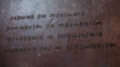 Isu script on a plate found in Serengeti, Tanzania
 -
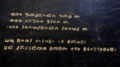


Appearances
- Assassin's Creed II (first appearance)
- Assassin's Creed: Brotherhood
- Assassin's Creed IV: Black Flag (Voynich manuscript)
- Assassin's Creed: Rogue (Voynich manuscript)
- Assassin's Creed: Brahman (Voynich manuscript)
- Assassin's Creed: Last Descendants – Locus (Voynich manuscript)
- Assassin's Creed: Unity
- Assassin's Creed: Origins
- Assassin's Creed: Odyssey
- Assassin's Creed: Rebellion – The Mask of the Ibis
- Assassin's Creed: Valhalla
References
- ↑ Assassin's Creed: Origins - Layla Hassan's personal files – The Empirical Truth
- ↑ Assassin's Creed II – In Bocca al Lupo
- ↑ Assassin's Creed: Brotherhood – The Da Vinci Disappearance – The Temple of Pythagoras
- ↑ Assassin's Creed III
- ↑ Assassin's Creed III: Liberation – The Secret of the Cenote
- ↑ Assassin's Creed III: Liberation – Return to Mexico
- ↑ Assassin's Creed: Origins
- ↑ Assassin's Creed: Odyssey
- ↑ Assassin's Creed: Unity
- ↑ Assassin's Creed: Rogue
- ↑ Assassin's Creed: Last Descendants – Locus
- ↑ Assassin's Creed: Valhalla – Layla Hassan's personal files – SecureShare
- ↑ Beckhelling, Imogen (1 February 2021). Meet the developer who designed Assassin's Creed Valhalla's [sic] fictional Isu language. Rock, Paper, Shogun. Archived from the original on 9 February 2021. Retrieved on 16 March 2021.

