

Tosha Khana: Difference between revisions
imported>Gener4l Cl4ank4 No edit summary |
mNo edit summary |
||
| Line 4: | Line 4: | ||
==History== | ==History== | ||
In June 1839, the temple was infiltrated by the [[Assassins|Assassin]] [[Arbaaz Mir]] and his mute servant [[Raza Soora]] to find the Koh-i-Noor. After walking through the hall of the temple adorned with statues of Hindu | In June 1839, the temple was infiltrated by the [[Assassins|Assassin]] [[Arbaaz Mir]] and his mute servant [[Raza Soora]] to find the Koh-i-Noor. After walking through the hall of the temple adorned with statues of [[Hinduism|Hindu]] gods, they found the artifact held by a statue of [[Durga]] and retrieved it.<ref name="ACBM"/> | ||
In 1841, the temple was infiltrated by [[Templars]] under the command of the [[Master Templar]] [[William Sleeman]], who had stolen the Koh-i-Noor.<ref>''[[Assassin's Creed Chronicles: India]]'' – [[The Secret Below]]</ref> At the center of the temple, Sleeman used the artifact in conjunction with a [[Precursor box]], which then revealed a [[Isu map|map]] pointing to [[Herat Temple|another temple]] in [[Afghanistan]]. When Arbaaz confronted Sleeman, the Templar shot at him, disturbing the complex and leading to its destruction.<ref>''Assassin's Creed Chronicles: India'' – [[The Enemy Revealed]]</ref> | In 1841, the temple was infiltrated by [[Templars]] under the command of the [[Master Templar]] [[William Sleeman]], who had stolen the Koh-i-Noor.<ref>''[[Assassin's Creed Chronicles: India]]'' – [[The Secret Below]]</ref> At the center of the temple, Sleeman used the artifact in conjunction with a [[Precursor box]], which then revealed a [[Isu map|map]] pointing to [[Herat Temple|another temple]] in [[Afghanistan]]. When Arbaaz confronted Sleeman, the Templar shot at him, disturbing the complex and leading to its destruction.<ref>''[[Assassin's Creed Chronicles: India]]'' – [[The Enemy Revealed]]</ref> | ||
==Trivia== | ==Trivia== | ||
| Line 15: | Line 15: | ||
ACBM-Ruins.jpg|Arbaaz Mir and Raza Soora at the entrance to the ruins | ACBM-Ruins.jpg|Arbaaz Mir and Raza Soora at the entrance to the ruins | ||
ACBM-Arbaaz Tosha Khana.jpg|Arbaaz admiring the statues | ACBM-Arbaaz Tosha Khana.jpg|Arbaaz admiring the statues | ||
ACBM-Tosha Khana.jpg| | ACBM-Tosha Khana.jpg|The treasure trove | ||
ACBrahman Isu Durga Statue.png|Statue of Durga | |||
ACCI Enemy Revealed (2).jpg|William Sleeman | ACCI Enemy Revealed (2).jpg|William Sleeman observing the map projection | ||
ACCI Enemy Revealed (5).jpg|The temple's destruction | ACCI Enemy Revealed (5).jpg|The temple's destruction | ||
</gallery> | </gallery> | ||
Latest revision as of 18:21, 3 May 2026
.jpg)
Tosha Khana was a temple built by the Isu, located beneath Maharaja Ranjit Singh's summer palace in Amritsar, India. The temple was used by the Maharaja to store the Koh-i-Noor diamond, a Piece of Eden.[1]
History[edit | edit source]
In June 1839, the temple was infiltrated by the Assassin Arbaaz Mir and his mute servant Raza Soora to find the Koh-i-Noor. After walking through the hall of the temple adorned with statues of Hindu gods, they found the artifact held by a statue of Durga and retrieved it.[1]
In 1841, the temple was infiltrated by Templars under the command of the Master Templar William Sleeman, who had stolen the Koh-i-Noor.[2] At the center of the temple, Sleeman used the artifact in conjunction with a Precursor box, which then revealed a map pointing to another temple in Afghanistan. When Arbaaz confronted Sleeman, the Templar shot at him, disturbing the complex and leading to its destruction.[3]
Trivia[edit | edit source]
- Toshakhana is a word of uncertain origin, but likely Persian or Sanskrit, meaning literally 'treasure house'.
Gallery[edit | edit source]
-
 Arbaaz Mir and Raza Soora at the entrance to the ruins
 -
 Arbaaz admiring the statues
 -
 The treasure trove
 -
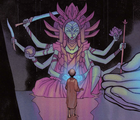 Statue of Durga
 -
 William Sleeman observing the map projection
 -
 The temple's destruction


.jpg)
.jpg)
Appearances[edit | edit source]
- Assassin's Creed: Brahman (first appearance)
- Assassin's Creed Chronicles: India
References[edit | edit source]
