
Qeneb.too Kah'Aiye: Difference between revisions
imported>Zero-ELEC Expanded and revised || Needs actual citation to memory for the third paragraph. |
imported>Kaikai947 mNo edit summary |
||
| Line 5: | Line 5: | ||
Around 48 BCE, the vault was visited by the [[Medjay]] [[Bayek]], who activated the vault's pedestal and witnessed a recording made by [[the Messenger]]. Dated one hundred and five days after the [[Toba catastrophe|Great Catastrophe]], the message displayed was intended for [[Layla Hassan]], who was reliving Bayek's memories in 2017.<ref name = "origins">''[[Assassin's Creed: Origins]]''</ref> | Around 48 BCE, the vault was visited by the [[Medjay]] [[Bayek]], who activated the vault's pedestal and witnessed a recording made by [[the Messenger]]. Dated one hundred and five days after the [[Toba catastrophe|Great Catastrophe]], the message displayed was intended for [[Layla Hassan]], who was reliving Bayek's memories in 2017.<ref name = "origins">''[[Assassin's Creed: Origins]]''</ref> | ||
Circa 38 BCE, a traveller looking for treasure removed an artifact from the Desheret Desert complex, which activated the complex and created illusions of undead soldiers. Bayek investigated the area upon hearing rumours of strange lights in the desert, and fought through the illusions. At the traveller's behest, the Medjay-turned-[[Hidden Ones|Hidden One]] sought to recover the artifact from the traveller's camel, which had run off. After finding the artifact and fighting through yet more illusions, Bayek returned the artifact, but was ambushed by more undead soldiers.<ref name = "origins"/> | Circa 38 BCE, a [[Parh|traveller]] looking for treasure removed an [[Seth-Anat stone|artifact]] from the Desheret Desert complex, which activated the complex and created illusions of undead soldiers. Bayek investigated the area upon hearing rumours of strange lights in the desert, and fought through the illusions. At the traveller's behest, the Medjay-turned-[[Hidden Ones|Hidden One]] sought to recover the artifact from the traveller's [[camel]], which had run off. After finding the artifact and fighting through yet more illusions, Bayek returned the artifact, but was ambushed by more undead soldiers.<ref name = "origins"/> | ||
==Trivia== | ==Trivia== | ||
Revision as of 04:05, 20 June 2018

|
He who increaseth knowledge, increaseth sorrow. This article contains spoilers, meaning it has information and facts concerning recent or upcoming releases from the Assassin's Creed series. If you do not want to know about these events, it is recommended to read on with caution, or not at all. |
Qeneb.too Kah'Aiye is an Isu vault located in the Desheret Desert in Egypt and is part of a large Isu complex partially covered by the sands.
Around 48 BCE, the vault was visited by the Medjay Bayek, who activated the vault's pedestal and witnessed a recording made by the Messenger. Dated one hundred and five days after the Great Catastrophe, the message displayed was intended for Layla Hassan, who was reliving Bayek's memories in 2017.[1]
Circa 38 BCE, a traveller looking for treasure removed an artifact from the Desheret Desert complex, which activated the complex and created illusions of undead soldiers. Bayek investigated the area upon hearing rumours of strange lights in the desert, and fought through the illusions. At the traveller's behest, the Medjay-turned-Hidden One sought to recover the artifact from the traveller's camel, which had run off. After finding the artifact and fighting through yet more illusions, Bayek returned the artifact, but was ambushed by more undead soldiers.[1]
Trivia
- Qeneb.too Kah'Aiye is a romanised version of the Egyptian (qnb.tw) (qAh'iy), roughly meaning Subjugate them bend to our will.[2]
Gallery
-
 The vault covered by the desert
 -
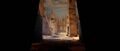 The entrance to the vault
 -
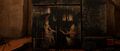 An ancient painting on one of the walls
 -
Projections produced by the pedestal


Appearance
Reference
- ↑ 1.0 1.1 Assassin's Creed: Origins
- ↑ Markuz, Sorrosyss, Hephaestus (2 February 2018). A Gaze into the Nexus: The Coded Language of the Isu. Access the Animus. Retrieved on 3 June 2018.

