

Macau: Difference between revisions
imported>Gener4l Cl4ank4 |
imported>Lady Kyashira mNo edit summary |
||
| Line 18: | Line 18: | ||
|targets = [[Yu Dayong]] | |targets = [[Yu Dayong]] | ||
}} | }} | ||
'''Macau''' (澳門), formerly known as '''Haojiang''' (濠冮),<ref name="ACChina 2">''[[Assassin's Creed: Blade of Shao Jun]]'' – [[The Assassin Brotherhood and The Templar Order]]</ref> is a city-state and autonomous territory on the southeastern coast of [[China]]. A major resort city, it lies on the west end of the {{wiki|Pearl River Delta}} across from [[Hong Kong]], China's other city-state. It was a former [[Portuguese Empire|colony]] of [[Portugal]] from 1557 to 1999, constituting the last [[Europe]]an colony in [[Asia]]. | '''Macau''' (澳門), alternatively '''Macao''' and formerly known as '''Haojiang''' (濠冮),<ref name="ACChina 2">''[[Assassin's Creed: Blade of Shao Jun]]'' – [[The Assassin Brotherhood and The Templar Order]]</ref> is a city-state and autonomous territory on the southeastern coast of [[China]]. A major resort city, it lies on the west end of the {{wiki|Pearl River Delta}} across from [[Hong Kong]], China's other city-state. It was a former [[Portuguese Empire|colony]] of [[Portugal]] from 1557 to 1999, constituting the last [[Europe]]an colony in [[Asia]]. | ||
As the site of Portuguese incursions during the 16th century, it became a significant port for the global [[slavery|slave trade]]. Under the [[Ming dynasty]], it also hosted the stronghold of the [[Templars|Templar]] slaver [[Yu Dayong]]. His assassination at the hands of the [[Assassins|Assassin]] [[Shao Jun]] in 1526 led to the Templars venting their fury on Macau by setting it ablaze, although it would continue to prosper for centuries after. | As the site of Portuguese incursions during the 16th century, it became a significant port for the global [[slavery|slave trade]]. Under the [[Ming dynasty]], it also hosted the stronghold of the [[Templars|Templar]] slaver [[Yu Dayong]]. His assassination at the hands of the [[Assassins|Assassin]] [[Shao Jun]] in 1526 led to the Templars venting their fury on Macau by setting it ablaze, although it would continue to prosper for centuries after. | ||
Revision as of 15:52, 6 September 2023

|
He who increaseth knowledge, increaseth sorrow. This article contains spoilers, meaning it has information and facts concerning recent or upcoming releases from the Assassin's Creed series. If you do not want to know about these events, it is recommended to read on with caution, or not at all. |
Macau (澳門), alternatively Macao and formerly known as Haojiang (濠冮),[1] is a city-state and autonomous territory on the southeastern coast of China. A major resort city, it lies on the west end of the Pearl River Delta across from Hong Kong, China's other city-state. It was a former colony of Portugal from 1557 to 1999, constituting the last European colony in Asia.
As the site of Portuguese incursions during the 16th century, it became a significant port for the global slave trade. Under the Ming dynasty, it also hosted the stronghold of the Templar slaver Yu Dayong. His assassination at the hands of the Assassin Shao Jun in 1526 led to the Templars venting their fury on Macau by setting it ablaze, although it would continue to prosper for centuries after.
History
In 1513, Portuguese explorer Jorge Álvares became the first of his people to arrive in China. Landing in what is now Macau, he laid the foundations for the area to become the main Portuguese access point into China.[2] As a port town, it became a major site for the Portuguese slave trade.[3]
In 1526, the city fortress was commanded by Yu Dayong, a Templar and one of the eunuchs known as the Eight Tigers. There, he prodigiously oversaw the slave trade, but the vengeful Assassin Shao Jun infiltrated the stronghold one night and assassinated the Templar.[4] As the Assassin made her escape, Yu's corpse was quickly discovered by Qiu Ju, another Tiger and one known for his brutality. In retaliation and in hopes of afflicting Shao with guilt, he ordered his men to set the port ablaze, killing many innocents in the process.[5]
In February 1725, the British Assassin Edward Kenway traveled to Macau after being informed by a West Indies Assassin of a lead regarding a Piece of Eden in Indochina. While in the city, Kenway met and befriended John Young, a navigator for the Dutch East India Company who had heard stories from his fellow company mate Hendrik regarding a supposed lost city of the Khmer Empire belonging to Those Who Came Before.[6] During their search for leads regarding the ruins' location, the pair ran afoul of several parties connected to them, including the Japanese Shimazu clan and one of its members, the Templar Shimazu Saito;[7] the affluential merchant Madam Lee;[8] and Lee's business rivals, Alan Jacob, Jan van Aert and Master Sun, who had allied with the Templars to sabotage Lee's operation.[9]
In 2023, after using the genetic genealogy site WhyYou developed by Abstergo Genetic Research Lab, Kenway's descendant Noa Kim was lured on a vacation prize trip to Macau. There, he was abducted by agents of Abstergo Industries and brought to their facility in the city, where he was forced to relive Kenway's memories in the Animus to help Abstergo locate the Piece of Eden found by his ancestor.[10]
Gallery
-
 Concept art of Macau's port
 -
 Concept art of Yu Dayong overlooking the port
 -
 Wang Yangming and Shao Jun sailing into Macau
 -
 A collapsing structure due to the fire, 1526.
 -
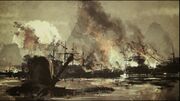 The port ablaze, 1526.
 -
 A map of Macau in the 1720s
 -
 Macau in 1725
 -
 Macau in 1725
 -
 Macau in the modern day


.jpg)
.jpg)
.jpg)


Appearances
- Assassin's Creed Chronicles: China (first appearance)
- Assassin's Creed: The Ming Storm (non-canon)
- Assassin's Creed: Turbulence in the Ming Dynasty (non-canon)
- Assassin's Creed: Blade of Shao Jun
- Assassin's Creed: Forgotten Temple
References
- ↑ Assassin's Creed: Blade of Shao Jun – The Assassin Brotherhood and The Templar Order
- ↑ Assassin's Creed Chronicles: China – Database: Portuguese Sailors
- ↑ Assassin's Creed Chronicles: China – The Port
- ↑ Assassin's Creed Chronicles: China – The Slaver
- ↑ Assassin's Creed Chronicles: China – Consequences
- ↑ Assassin's Creed: Forgotten Temple - Episode 2
- ↑ Assassin's Creed: Forgotten Temple - Episode 4
- ↑ Assassin's Creed: Forgotten Temple - Episode 10
- ↑ Assassin's Creed: Forgotten Temple - Episode 13
- ↑ Assassin's Creed: Forgotten Temple - Episode 1
| |||||||||||||||||||||||||
| ||||||||||||||||||||||||||||
| |||||||||||||||||||||||||||||||||||||