


Charles Lee
Charles Henry Lee (1731 – 1782) was a British soldier and veteran of the Seven Years' War, as well as a member of the Templar Order. After his induction into the Order, Lee took a position as Haytham Kenway's second-in-command, and it was in this role that he later joined the Continental Army during the American Revolutionary War as a General.
Throughout the Revolution, Lee competed against his political rival and superior, Commander George Washington, with the ultimate aim of taking control of the Patriot leadership and handing the newly formed nation over to his Templar brothers.
Following Haytham's death in 1781, Lee briefly became the Grand Master of the Colonial Templars, until his death in 1782 at the hands of Haytham's son, the Assassin Ratonhnhaké:ton.
Biography[edit | edit source]
Early life[edit | edit source]
Charles Lee was born in 1731 to John Lee, a prominent British Colonel, and Isabella Bunbury, the daughter of a British Conservative politician. Due to his father's reputation and encouragement, Charles pursued a military career at a young age. He was sent to a military academy in Switzerland, and by 1746, he had joined his father's regiment as an ensign. Five years later, in 1751, Lee returned to England and was commissioned to the rank of lieutenant.[1]
In 1754, Lee was sent to the British colonies in America to fight in the French and Indian War, serving under General Edward Braddock.[1] Around this time, he learned of and became affiliated with the Templar Order, of which Braddock was a member, and was keen to become a fully-fledged member. In response, Lee was given instructions by Reginald Birch, the Templar leader in Great Britain, to assist Haytham Kenway in his search for the Grand Temple, believed to be a hidden First Civilization storehouse.[2]
Meeting Haytham Kenway[edit | edit source]

Upon Haytham's arrival in Boston, Lee met the Grand Master at the docks and led him to the Green Dragon Tavern, where Haytham's fellow Templar, William Johnson, was residing.[2]
After a brief conversation with Johnson, Lee and Haytham set out to meet with Thomas Hickey, who was scouting a nearby bandit compound in an attempt to retrieve Johnson's stolen research. The three proceeded to raid the compound and accomplished their aims.[3]
Shortly thereafter, Lee and Haytham searched for Benjamin Church, who had been detained by a British officer named Silas Thatcher. After searching Church's ransacked home and eavesdropping on several guards and eyewitnesses, they deduced Church's location and headed to the docks, where Church was being held inside a warehouse. After Haytham stole a key to the warehouse from a guard, he and Lee rescued Church and brought him to the Green Dragon Tavern.[4]

A few days later, Lee and Haytham went to gather their final recruit, John Pitcairn, from General Braddock's encampment at Copp's Hill Battery. However, despite Braddock also being a Templar, Lee noted that and he and Haytham were clearly at odds. Furthermore, the general was already displeased with his superiors' orders to let Lee assist Haytham, which led him to deny their request to release Pitcairn from service and have them escorted out of the camp.[5]
In a plan to retrieve Pitcairn, Lee followed Braddock's entourage as they marched around Boston, and pretended to be a citizen angry at the British Regulars, provoking Braddock into a chase by throwing horse manure on him. Once he had Braddock on his tail, Lee lured the general and his men to a back alley, where they were ambushed by Haytham. After defeating Braddock's men, Haytham briefly threatened the general before he and Lee left with Pitcairn.[5]

With all of the Templar recruits assembled at the Green Dragon Tavern, Haytham proposed a plan to infiltrate Southgate Fort and kill Silas Thatcher, the notorious slaver who had kidnapped Church. Haytham reasoned that, by eliminating Silas, who was known to enslave the native Kanien'kehá:ka, they could gain the natives' trust and their knowledge of the surrounding lands, ultimately leading the Templars to the Grand Temple.[6]
After ambushing a slave cart transport destined for the fort, Lee and the others disguised themselves as British Regulars and led the convoy into the fort. Inside, Haytham stealthily freed the slaves while Lee and the others blended with and distracted the guards. However, upon realizing that the slaves had escaped, Silas raised the alarm. Lee and the others then fought and distracted the garrison, fending off Silas' troops while Haytham and Church killed the slaver, allowing them to free the remaining detainees.[6]
Induction into the Templar Order[edit | edit source]
- "I believe it is time we welcomed Charles into our fold. He has proven himself a loyal disciple—and served unerringly since the day he came to us. He should be able to share in our knowledge and reap all the benefits that such a gift implies."
- ―Haytham to his fellow Templars prior to inducting Lee, 1755.[src]-[m]

After several weeks, Haytham decided to establish contact with a Kanien'kehá:ka woman, Kaniehtí:io, who could prove a valuable ally in the search for the Grand Temple. Lee was able to find a lead, informing Haytham that she had been seen in the wilderness near Lexington. However, Lee left shortly after beginning the search, explaining that he had to return to his commission under Braddock.[7] During this time, Lee became well known among the Kanien'kehá:ka, who gave him the name Ounewaterika, meaning "Boiling Water".[8]
Months later, in July of 1755, Lee returned to Lexington to aid Haytham in his plan to kill General Braddock. In doing so, Haytham hoped to win Kaniehtí:io's trust so that she would lead him to the Grand Temple. Lee assisted by taking part in Braddock's expedition. When the expedition was ambushed by the French Army, Lee fired the first shot, killing the French Commander Daniel Liénard de Beaujeu. In the ensuing chaos, Haytham chased and mortally wounded Braddock.[9]

Haytham returned to the Green Dragon Tavern days later, revealing that the site Kaniehtí:io had shown him contained nothing of interest and disregarding it as merely a painted cave. He then changed their goal to establishing a permanent base in order to expand Templar influence in the colonies. Commending Lee for his dedication and loyalty, Haytham decided to formally induct him into the Templar Order, placing a Templar ring on his finger that had previously belonged to Braddock.[9]
Weeks later, Lee met with Haytham to deliver a letter from Jim Holden and to confirm that Braddock had died from the injuries the Grand Master had inflicted on him. He also revealed that the other Templars intended to continue the search for the Grand Temple, but Haytham advised against it, believing they should focus on more practical pursuits.[10]
Fighting in the French and Indian War[edit | edit source]
Following his induction into the Templar Order, Lee continued to serve in the British Army; he participated in several battles during the French and Indian War, such as the battles at the forts of Ticonderoga and Niagara, and the British conquest of Montreal.[1]

In 1758, after the death of fellow Templar and British commander George Monro at the hands of the Assassins, Lee traveled to Fort Arsenal in New York, where he attended the induction of Monro's protégé Shay Cormac into the Order.[11]
In November 1760, Lee, accompanied by Johnson, Hickey and Church, sought to meet with the elders of the local Kanien'kehá:ka tribe in Kanatahséton as part of the Templars' continued efforts to locate the Grand Temple, despite Haytham's orders to discontinue the search.[12]
En route to Kanatahséton, Lee encountered a young boy in the forest and forcibly demanded the location of his village, unaware that the child was Ratonhnhaké:ton, Haytham and Kaniehtí:io's son. Instead of answering, the boy defiantly asked for Lee's name, before warning him steadfastly that he would find him. Amused, Lee mocked the boy, saying that he would look forward to it, and left after Johnson knocked the child out with the butt of his musket.[12]

Soon after this encounter, Lee and the others found Kanatahséton but were turned away by the villagers, leading them to give up their search for the Grand Temple. Following the Templars' departure, Kanatahséton was set ablaze by British forces under George Washington's command, who suspected the villagers' allegiance to the French. After being unable to save his mother, Ratonhnhaké:ton mistakenly attributed the attack to the Templars and vowed revenge, especially against Lee.[12]
Lee returned to England in late 1760 and was promoted to the rank of Major, fighting in several campaigns in Portugal and Poland. Despite his service, Lee was not well paid, and so became a critic of several military and political figures in England. This backfired, however, as Lee found himself unable to advance his military career while his payment did not improve.[1]
Joining the Continental Army[edit | edit source]

Lee returned to America in 1770, rejoining his Templar brothers. Along with Haytham, he instigated the Boston Massacre by firing his pistol into the air, creating confusion and causing the guards to open fire on the protesting citizens. Although he was spotted by Ratonhnhaké:ton – by now a budding Assassin – Lee was able to evade detection.[13]
By 1773, the colonists had started to rebel against British rule, en masse. Beginning with the Boston Tea Party, the colony's citizens – aided by Ratonhnhaké:ton – dumped a large supply of British tea, owned by William Johnson, into the water of Boston's port as a show of defiance towards the tax laws. As a result, the Templars found themselves unable to smuggle the tea, cutting off one of their main sources of funding. This act was the first of many which would eventually lead to the outbreak of war between the British Crown and her colonies.[14]
On 12 January 1774, Lee attended a Templar meeting at the Restless Ghost tavern, where the Colonial Rite discussed how they could turn the nascent American Revolution into something to benefit their goals. It was here that Lee informed Haytham of the circumstances surrounding Kaniehtí:io's death in 1760, which the Templars had collectively decided to keep hidden due to their unsanctioned search for the Grand Temple. Lee also spoke of his encounter with a young Ratonhnhaké:ton, and noted the boy's resemblance to the Assassin who was now sabotaging their plans.[10]

In 1775, Lee resigned his commission from the British Army and joined the Continentals. He quickly established himself as a strong supporter of the Patriots and became a likely candidate for the position of Commander-in-Chief, alongside George Washington.[1] However, Lee's demand to be well compensated, which contrasted against Washington's selfless and modest insistence for little payment, saw him fall from favor for the position. As a result, Washington was ultimately chosen by the Continental Congress to lead the Army, to Lee's displeasure.[15]
Meanwhile, Lee was promoted to the rank of Major General and served directly under Washington. He also attended Washington's acceptance speech and watched with contempt and criticism. It was at this moment that Lee met a man named Connor, in actuality the self-same child he had assaulted over a decade before, but did not recognize him and merely dismissed him as Samuel Adams' lapdog.[15]
Plotting Washington's assassination[edit | edit source]

In 1776, the Templars tasked Thomas Hickey with killing Washington, in order to secure Lee the promotion to Commander-in-Chief. Unfortunately for them, Hickey was intercepted by Connor, and was soon arrested for counterfeiting and treason, alongside the Assassin.[16]
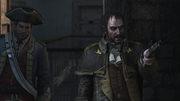
On receiving word of Hickey's shortcomings, Lee and Haytham visited him in Bridewell Prison, where they reprimanded him for his recklessness and revealed that he could not be pardoned due to Benjamin Tallmadge's investigation against him. Upon realizing that Connor, the Assassin, had also been locked up, Lee formulated a new plan.[17]
Connor was later able to steal the prison warden's key and went to assassinate Hickey in his cell, only to find the murdered body of the warden. At that moment, he was ambushed by both Hickey and Lee, who held him at gunpoint. With the Assassin at their mercy, the two Templars revealed their plan to frame him for the warden's murder and the assassination plot against Washington, so that Connor would be tried and executed.[17]

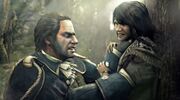
Lee justified his and the Templars' actions to Connor by slandering Washington, citing his poor military record and calling him unfit for leadership. Connor attempted to attack Lee, but was pinned down due to exhaustion. It was at that moment that Lee finally recognized Connor as the boy from the forest, to which the Assassin reminded Lee of his vow to find him. Lee laughed and remarked that Connor had likely expected their reunion to be under different circumstances, then choked and rendered him unconscious.[17]
The following day, the Templars implemented Lee's plan, which would not only have removed the threat of the Assassin, but also created the perfect opportunity to murder Washington, who personally attended the execution. After Lee and Haytham were able to speed up the process by omitting Connor's trial, the Assassin was taken to be publicly hanged before the assembled crowd in New York.[18]

Connor was escorted by Hickey to the gallows, with Lee presiding over the execution and sentencing the Assassin to death for his 'crimes' against Washington and the colonies. However, Connor was saved in part by Achilles Davenport and his Assassin recruits,[18] and also through the intervention of Haytham, who had recently discovered his familial link to the Assassin.[10] In the resulting confusion, Lee escaped while Connor assassinated Hickey, preventing him from killing Washington and proving his innocence.[18]
Lee continued serving under Washington, biding his time and secretly undermining Washington's orders and authority. Washington failed in his campaign to keep New York for the Patriots, and because of this, he ordered the evacuation of their forces as the British Army retook control of the city.[1]
However, Lee intentionally delayed the retreat and allowed himself to be captured by the British.[1][19] He was imprisoned, but since he had formally resigned his commission in the British Army rather than deserting, he was treated with civility and given comfortable accommodations and fine dining. Lee then took this opportunity to give the British information regarding the Continental Army, hoping it would lead to further weaken and disgrace Washington in battle.[1]
Battle of Monmouth[edit | edit source]
On his release from prison, Lee returned to Congress, where he attempted to convince them that the Continental Army was not strong enough to match the British forces. Nonetheless, Washington prepared his armies in Valley Forge to stop the British march from Philadelphia to New York in 1778. Washington also ordered the extermination of the Kanatahséton village, Connor's home, due to his suspicions of them allying with the British.[8]
Lee took advantage of this situation by traveling to Kanatahséton, where he met with Kanen'tó:kon and several others, and convinced them to join the war against the Continental Army in order to protect their land. He also manipulated Kanen'tó:kon into believing that Connor had betrayed the village and its people by allying himself with Washington.[8]
Following this, Lee took control of the Marquis de Lafayette's contingency forces at Monmouth and ordered a full retreat, while abandoning his post, leaving them unprepared against the advancing British forces. However, Connor arrived in time to help hold off the British Army and secured the Patriots' retreat, saving many lives of the Continental Army and sparing Washington a devastating defeat.[20]
Prompted by Lee's behavior, Connor and Lafayette soon revealed his treachery to Washington. As a result, Washington investigated, leading to Lee being court-martialed for insubordinate behavior and poor command decisions. He was found guilty and disgraced, though he was spared execution and was instead temporarily suspended from duty. As Lee continued to be vocal in his criticism of Washington, the Congress eventually removed him from the army permanently.[1]
Becoming Grand Master[edit | edit source]
By September 1781, both Haytham and Lee knew that Connor sought the latter's death. Fearing for his life, Lee resided in the Templar-controlled Fort George, in the military district of New York. Knowing that Connor could strike at any moment, Haytham visited Lee and encouraged him to leave, informing him that Connor was his son and, thus, his responsibility to deal with.[10]
Shocked by this revelation, Lee lashed out at Haytham, accusing him of creating the Assassin. The Grand Master was hurt by his words and told Lee that he was equally responsible, as it was his assault on the boy two decades prior that had resulted in Connor's vendetta against the Templars. Admitting his mistake, Lee refused to leave Haytham's side, but the latter urged him to escape so that he may continue the Order's work. Lee begrudgingly agreed, apologized to Haytham for ever doubting him, and left after being given Haytham's amulet for safekeeping.[10]
Soon after, just as Haytham had anticipated, Connor infiltrated the military district to assassinate Lee, but was only met by his father. Though neither was eager to kill the other, Connor ultimately prevailed and ended Haytham's life after a prolonged battle.[21] Lee soon learned of this and ascended to the rank of Grand Master, in Haytham's place, over what was left of the Colonial Templars.[22]

In 1782, Lee presided over Haytham's funeral in New York and delivered a eulogy in his honor while resolving to continue the Templars' work. Connor appeared from the crowd and approached Lee, though he was restrained by two guards. Enraged by the Assassin's constant interference in his plans and the murders of his comrades, Lee vowed revenge, promising not only to kill him, but to also murder everyone and destroy everything that Connor loved and held dear.[22]
Connor brushed off Lee's threats, warning him that he would fail, and die with the rest of his plans. As the guards carried Connor away, Lee decided to gather an army and recuperate his power. To this end, he recruited the captain of the HMS Jersey and many mercenaries to his cause.[22]
Death[edit | edit source]
- "Why do you persist...? You put us down. We rise again. You end one plot—we forge another. You try so hard... But it always ends the same. Those who know you think you mad and this is why... Even those men you sought to save have turned their backs on you. Yet you fight. You resist. Why?"
- ―Lee to Connor, 1782.[src]-[m]

After leaving for Boston, Lee learned that Connor had escaped and, fearing for his life, decided to flee America and return to England. However, Connor intercepted him at the Boston pier, leading to a chase through the dockyards. Lee tried to lose the Assassin by running through a ferry under construction, during which an accident caused the ferry to catch fire. After a dangerous pursuit, both Lee and Connor crashed through a collapsed floor, where the latter was impaled by a wooden splinter through the abdomen, leaving him temporarily incapacitated.[23]
Lee approached Connor, looking down on him, before asking why the Assassins fought an endless and futile cause against the Templars. After responding that he had to because no else would, Connor pulled out his pistol and, catching Lee off-guard, shot him in the stomach. Though injured, the Templar managed to escape, taking a ferry up the Charles River to Monmouth, where he rested at the Last Drink tavern.[23]
Connor once again followed Lee and eventually caught up with him inside the tavern. With neither man in any condition to fight, he approached Lee's table, where the latter offered his drink to the Assassin. Without saying a word to each other, Connor accepted the drink and took a seat across the table from Lee.[23]

After sitting in silence for a while,[10] Lee, welcoming his end, gave Connor a slight nod. Taking out the knife from his Hidden Blade, the Assassin stabbed him in the heart and took his amulet, leaving Lee slouched over the table, where he passed away.[23]
Following his demise, Lee would be recorded as having died of a fever.[24] Despite the controversial reputation he had garnered towards the end of his life, he was honored with a full military funeral.[1]
Legacy[edit | edit source]
While trapped in an alternate reality shown by an Apple of Eden, Connor found a Lucid Memory Fragment depicting Lee's death in the primary reality, within the burnt remains of the Last Drink tavern.[25]
In 2015, the Templar Isabelle Ardant included Lee's name on a list of known British Templars. This list was later obtained by the Assassins Rebecca Crane and Shaun Hastings when they infiltrated Ardant's office to plant a bug.[26]
Personality and traits[edit | edit source]
- "Even though I liked him straight away, I noticed that, while he smiled when he spoke to me, he reserved a look of disdain for everybody else on the harbour."
- ―A description of Charles Lee in Haytham's journal, 1754.[src]
Charles Lee, throughout most of his life, was a veteran soldier and commander from years of service in the French and Indian War and, later, the American Revolutionary War. In his youth, Lee was dedicated, enthusiastic and keen. To this, William Johnson commented that he was "a good lad, if a bit earnest."[27]
All of this changed as Lee rose through the Templar Order's ranks to become Haytham's second-in-command. Though on the outside Lee appeared as noble and honorable, in reality he was impulsive, violent and aggressive. In his pursuit to take control of the colonies for the Templars, he also became ruthless, vengeful and cruel. This was made evident by his strong political motivations and demand for higher pay.[27]

Furthermore, Lee's arrogance manifested into violence and contempt for others.[27] He had frustration for the Kanien'kehá:ka people for what he saw as being unaware of the threat the colonists posed,[12] despite the Clan Mother's,[28] Kanen'tó:kon's, and Connor's knowledge to the contrary.[29] For this perceived failure, as well as their technological inferiority, Lee considered them to be naïve and ignorant of the "true" nature of the world.[27]
Lee's cruel and vengeful side showed in his promise to Connor to destroy him utterly; he outright stated that he would kill everyone Connor held dear and those who were even remotely associated with him, including the innocent people who lived on the Davenport Homestead and his entire village. Despite this, after Connor had bested him, Lee seemed to develop some begrudging respect for the Assassin; in his final moments, he embraced his inevitable death at Connor's blade and, knowing he could not escape his fate, beckoned the Assassin to share a drink. Connor took him up on his offer, leading to the two mortal enemies spending Lee's last minutes together in silence.[27]
Despite his long, successful career and military prowess, Lee was unpopular and disfavored amongst the Patriots. This was clear by how the Continental Congress viewed him: vulgar and slovenly in appearance and attitude, as well as greedy. As a result, Lee constantly plotted against George Washington to seize his command, and slandered and criticized the commander with passion. While this ostracized him from his fellow Patriots, Haytham held strong faith in Lee's ability, loyalty, and understanding of the Templar vision for a New World Order.[27]

It was these qualities that led the Grand Master to place his trust in Lee as both a military commander and a Templar. Comparing him favorably to Washington, whom he saw as a poor and weak-willed leader, Haytham trusted Lee to lead the Continental Army to victory and further the Order's cause, while deliberately ignoring some of Lee's own shortcomings. In turn, Lee served Haytham diligently, as he was perhaps the only person Lee genuinely respected and looked up to.[10]
After Haytham discovered that Connor was his son, Lee felt that the Grand Master's resolve had weakened and internally blamed the Order's downfall on his reluctance to take action against the Assassin. During their final conversation, a frustrated Lee voiced these thoughts to Haytham, who in turn called out Lee's reckless and violent behavior, which had resulted in Connor's vendetta against the Templars. Admitting his mistake, Lee refused to leave Haytham to die alone by the Assassin's blade, and only relented after much urging from the Grand Master. He also apologized for doubting Haytham's resolve and for making him think that he was a bad Grand Master.[10]
Gallery[edit | edit source]
-
 Early concept art
 -
 Concept art
 -
 Concept art
 -
 Concept art of Lee choking Ratonhnhaké:ton
 -
 Finalized concept art
 -
 A portrait of Lee
 -
 Lee and Haytham rescuing Church
 -
 Lee wearing a Templar ring
 -
 Lee and Hickey in Bridewell Prison
 -
 Lee holding the Grand Temple key
 -
 Lee sharing a drink with Connor


.jpg)


Behind the scenes[edit | edit source]
Charles Lee is a historical character first introduced in Assassin's Creed III, where he was voiced by the American-Canadian actor Neil Napier. He appears again in Assassin's Creed: Rogue in a non-speaking role in the memory "Scars", but the game erroneously reuses Lee's older character model from Ratonhnhaké:ton's adulthood despite the memory being set before "Hide and Seek" from Assassin's Creed III, where he appears in his younger character model.
Historically, Lee was only discharged from the Continental Army years after his retreat. On January 10, 1780, he was formally discharged and spent his remaining years reportedly verbally attacking Washington to anybody around, and as a result, was frequently challenged to duels by those loyal to Washington. In a duel with Colonel John Laurens, Lee was heavily wounded in his side, but he continued to duel. Lee eventually retired to Philadelphia, Pennsylvania, where he died of a fever on October 2, 1782.[24]
While Assassin's Creed III portrays Lee as having contempt towards the Kanien'kehá:ka, historically he was known to maintain good relations with the natives and even married the daughter of a Mohawk chief, who gave birth to twins. Among the Kanien'kehá:ka, Lee was known as Ounewaterika, meaning "Boiling Water".[24]
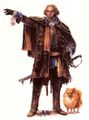
A portrait of Lee as he appeared in early concept art can be seen in the Finnegans' residence during the memory "The Color of Right" in Assassin's Creed: Rogue. A similar portrait also appears in Isabelle Ardant's London office in Assassin's Creed: Syndicate. In many of his pieces of concept art, Lee is shown accompanied by a dog, referencing his becoming a dog breeder in his later life.[24]
Appearances[edit | edit source]
- Assassin's Creed III (first appearance)
- The Tyranny of King Washington (appears in Lucid Memory Fragment)
- Assassin's Creed: Forsaken
- Assassin's Creed: Initiates (mentioned in Database entry only)
- Assassin's Creed: Memories
- Assassin's Creed: Rogue
- Assassin's Creed: Syndicate (painting only)
- Assassin's Creed: The Official Collection
- Assassin's Creed: Nexus VR (mentioned in Database entry only)
References[edit | edit source]


| ||||||||||||||||||||||||||||||||||||||||
| ||||||||||||||||||||||||||||||||||
| |||||||||||||||||||||||||