

Sword of Eden 2

|
You cannot know anything. Only suspect. This article contains content from pre-release sources that may or may not be reflective of canon upon release. This article therefore likely contains spoilers. |

|
Patience, brothers. Soon we will reveal the secrets of Assassin's Creed Roleplaying Game. This article has been identified as being out of date. Please update the article to reflect recent releases and then remove this template once done. |
Sword of Eden #2[1] was one of the Swords of Eden, bladed artifacts created by the Isu scientist Hephaistos to use in the fight during the War of Unification. These Pieces of Eden seemed to grant their bearers great power and leadership, and were later used by influential humans in war and conquest. This particular sword, designed like a saber, was notably wielded by two leaders of the Mongol Empire.
Owners[edit | edit source]
- Isu[2] (until 75,000 BCE)[3]
- Genghis Khan (c. 1200s – 1227)[4]
- Altaïr Ibn-La'Ahad (1227)[1]
- Shengtong (1227)[1]
- Hülegü Khan (c. 1250s)[4]
- Xu brothers (early 16th century)[5]
History[edit | edit source]
The Sword of Eden was created by Hephaistos during the Isu Era to bring about the end of the War of Unification,[2] though its location was lost to memory following the Great Catastrophe around 75,000 BCE.[6] By the early 13th century, the Mongolian warlord Genghis Khan possessed the Sword and used it to lead his Empire through mass expansions into the West. By 1217, the Levantine Assassins' Mentor Altaïr Ibn-La'Ahad correctly suspected Genghis Khan of wielding the Sword.[7]
Thus, Altaïr, his wife Maria Thorpe, and their son Darim traveled to Mongolia intending to assassinate Khan and retrieve the Piece of Eden. Although Darim and the Mongolian Assassin Qulan Gal jointly killed Genghis Khan in 1227,[8][9] the artifact remained in Mongol hands, and Genghis Khan's grandson Hülegü Khan used it in his conquests of the Levant during the 1250s, notably during his attacks on the Assassin strongholds in Alamut and Masyaf.[4]
Gallery[edit | edit source]
-
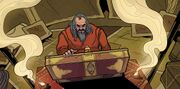 Genghis Khan admiring his Sword in its box
 -
 Genghis Khan wielding the Sword
 -
 The Sword in Assassin's Creed Roleplaying Game


Appearances[edit | edit source]
- Assassin's Creed II (indirect mention only)
- Assassin's Creed: The Secret Crusade (indirect mention only)
- Assassin's Creed: Memories (first appearance)
- Assassin's Creed: Reflections (mentioned only)
- Assassin's Creed Roleplaying Game – Legacy of the Brotherhood
References[edit | edit source]
- ↑ 1.0 1.1 1.2 Assassin's Creed Roleplaying Game – Legacy of the Brotherhood – The "Bearing Heaven" Temple
- ↑ 2.0 2.1 Assassin's Creed: Syndicate – Database: Reconstructed Data 003
- ↑ Assassin's Creed: Initiates – Timeline
- ↑ 4.0 4.1 4.2 Assassin's Creed: Memories
- ↑ Assassin's Creed Roleplaying Game – Legacy of the Brotherhood – Shao Jun: Adventure Hook 4
- ↑ Assassin's Creed: Initiates – Timeline
- ↑ Assassin's Creed II – Altaïr Ibn-La'Ahad's Codex, p. 29
- ↑ Assassin's Creed: The Secret Crusade – Chapter 50
- ↑ Assassin's Creed: Reflections – Issue #2
