


Horse: Difference between revisions
imported>Stormbeast AC3 bar |
|||
| Line 68: | Line 68: | ||
*In ''Assassin's Creed II'', if you run over 3-4 civilians accumulatively, your horse will automatically trip. | *In ''Assassin's Creed II'', if you run over 3-4 civilians accumulatively, your horse will automatically trip. | ||
*Other than the breeds of ''Brotherhood'', ''[[Assassin's Creed: Project Legacy]]'' also introduces the ceremonial [[wikipedia:Percheron|Percheron]], and two varieties of war horses. | *Other than the breeds of ''Brotherhood'', ''[[Assassin's Creed: Project Legacy]]'' also introduces the ceremonial [[wikipedia:Percheron|Percheron]], and two varieties of war horses. | ||
*In ''[[Assassin's Creed: Revelations]]'', the only time horses are encountered is during the carriage missions, and they are not ridable. | *In ''[[Assassin's Creed: Revelations]]'', the only time horses are encountered is during the carriage missions, and they are not ridable. Selim I and a janissary are the only characters who are seen riding horses. | ||
'''''Assassin's Creed: Brotherhood''''' | '''''Assassin's Creed: Brotherhood''''' | ||
Revision as of 04:34, 3 April 2012

|
Ezio, my friend! How may I be of service? This article is in desperate need of a revamp. Please improve it in any way necessary in order for it to achieve a higher standard of quality in accordance with our Manual of Style. |
- "Any worthwhile mercenary will know the value of a reliable, trained horse. Riding an animal that startles on the battlefield or loses speed quickly is a risk we will not take."
- ―Mario Auditore.[src]

Horses are a species of hooved mammals used as a means of transport throughout most of recorded human history. Their presence and use was widespread throughout the Middle Ages and Renaissance era.
Appearance
Colors
During the Third Crusade, horses residing in the stables just outside Masyaf were always either white, black, or chestnut; however, those found within the Kingdom, or at the entrances of cities, varied greatly in color.[1]
Horses scattered throughout Renaissance Italy could also be found in a variety of colors.[2]
Breeds

- "The stable keeper gives me a short tour. He presents the different breeds - some bred stocky for labor, some wiry for travel, and of course, the unflinching steeds we will ride into combat."
- ―Mario Auditore surveying the horses of Monteriggioni.[src]
Three breeds of horse could be found and used throughout Rome, and differed in both appearance and characteristics.[3]
The common horse or "Rouncey,"[4] heavily laden with saddle bags, could usually be found in the Antico and Campagna Districts, with the guards riding them (possibly messengers) always pushing them into a quick gallop.[3]

The standard horse or "Jennet"[4] was mostly found in the Centro and Vaticano districts, and was usually ridden by civilians. This horse was the fastest of the three breeds.[3]
The rarest type, the armored warhorse or "Destrier,"[4] could be found in any of Rome's districts still occupied by the Borgia, or at stables after all had been renovated. Despite being the slowest type of horse, these armored horses were able to withstand more damage from enemy attacks without tripping.[3]
History
The horse and the horse-drawn carriage were common modes of transportation, and indispensable for the Assassin Order from the Third Crusade until the Renaissance.[1][2]
Third Crusade
The stables outside of Masyaf housed horses for the use of any Assassin who had been tasked to depart for any of the other cities, for missions or assassinations. A variety of horses could be found throughout the Kingdom as well, either in corrals and stables, or standing alone on the path, with their rider nearby.[1]
However, guards stationed along the paths of the Kingdom were always wary of horsemen, particularly if they were riding hard, or acted as if they were being pursued. As such, most Assassins made it a point to ride slowly when in the presence of alert guards.[1]
Renaissance

By the Renaissance, though ridden horses still held their importance, horse-drawn carriages had also grown in popularity. Travel stations could often be found just outside of major cities, and offered citizens safe and easy carriage rides, for a price.[2]
Horses were also essential for warfare. Mario Auditore, as ruler and protector of Monteriggioni, always held the horses in high regard; since, as Mario once noted, "some of them will die alongside us; others will actually be key to keeping us alive." As such, each of his mercenaries were made to get to know their horse before riding out into battle.[5]
Unlike in other cities previously, Ezio Auditore faced mounted opponents upon his arrival in Rome. As such, he learned to fight on horseback, assassinate horsemen, and dismount enemy riders, by either attacking them, or their horses.[3]
Roman horses were used by citizens, guards and Assassins alike, with the latter able to hijack horses from the former two.[3]
Combat and movement

Altaïr Ibn-La'Ahad was a skilled horseman, and was able to use his sword to combat opponents while on horseback. When fleeing enemies, horses could usually outrun most pursuers, though they could be tripped by a strike from an enemy sword.[1]
Though horses could easily plow through crowds, pulling the horse into a rear would normally startle nearby civilians, and clear a path.[1]
Ezio Auditore was equally skilled at riding and combat, though he could also use a horse directly before or after free-running. He was able stand on the saddle at any time, and jump from horseback onto a wall or beam. Inversely, he could also jump directly onto horseback from a nearby building, or from a parachute.[3]
Unlike Altaïr, Ezio (as well as any opponent he faced) was able to use a variety of his weapons while on horseback, both long and short-ranged; however, this excluded any heavy or two-handed weapon and the Hidden Blade.[3]

Though Ezio could not remain on horseback while wielding his Hidden Blade, he could perform assassinations from horseback, or on enemy horsemen. He could leap from the saddle to assassinate either an enemy on the ground, or a mounted horseman (wherein he would subsequently steal their mount). When facing a mounted opponent while on the ground, Ezio could drag them from the saddle, and assassinate them.[3]
Upon dismounting a horse, depending on whether or not the steed had been stolen, it would either follow its rider, or flee immediately. Additionally, if their rider was in battle next to them, horses would often kick out at attacking guards, and cause them to fall.[1][3]
Trivia
- In Assassin's Creed, horses taken from within the Kingdom have a tendency to abruptly change color when passing from one region to another.
- Though Assassin's Creed: Brotherhood was the first to allow horses inside cities, early gameplay videos show that riding horses inside of a city was originally intended to be possible in Assassin's Creed.
- Horses are only used by guards in Assassin's Creed II during one mission, "Romagna Holiday", wherein they attack Leonardo da Vinci's carriage.
- So far throughout the Assassin's Creed series, only two rideable horses have ever died. The first died during the Fall of Monteriggioni, when it was hit by a collapsing tower damaged by cannon fire, and the second during the Siege of Viana, when it was struck by a cannonball.
- Never once in full, physical gameplay can a ridable horse die, only ever merely trip and cause the player to fall off. This can particularly be seen during the memory "Outgunned," as horses shot by the Machine gun will not die, and will only trip and get up again.
- In Assassin's Creed II, if you run over 3-4 civilians accumulatively, your horse will automatically trip.
- Other than the breeds of Brotherhood, Assassin's Creed: Project Legacy also introduces the ceremonial Percheron, and two varieties of war horses.
- In Assassin's Creed: Revelations, the only time horses are encountered is during the carriage missions, and they are not ridable. Selim I and a janissary are the only characters who are seen riding horses.
Assassin's Creed: Brotherhood
- Brotherhood is the first game where citizens are shown on horseback; though this leads to a minor anachronism: female citizens are depicted as straddling their horse rather than side-saddle. Seeing a woman's legs spread apart was a most vulgar and insulting sight during the Renaissance period.
- Galloping is disabled throughout Rome; and is only possible in Viana, Monteriggioni, Colli Albani, and the Colosseo's Lair of Romulus.
- When the game was ported to the PC, the gallop option was reintroduced.
- Jumping from a horse onto a beam 20 times is a requirement for the completion of the Thieves guild challenge.

- The achievement "Grand Theft Dressage" can be unlocked by stealing five horses in a row, without touching the ground. However, you need the DLC to be able to obtain it.
- Destriers cannot be found in any color but white, despite their image in the in-game manual showing a black-furred coat.
- A minor glitch may occur if Ezio is using his sword while on horseback. If he is knocked off while attacking, when he gets back to his feet, he will still hold his sword with his arm raised above his head. It will remain this way, even when supposedly attacking or countering, until the weapon is sheathed.
- Players are able to rear Ezio's horse, by using the attack button with Fists equipped.
Gallery
-
Ezio on a horse jumping in Tuscany.
-
Ezio on a horse running from soldiers on the Passetto di Borgo.
-
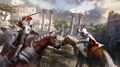 A horseback battle between Ezio and a Borgia soldier.
 -
Ezio throwing a spear at a mounted guard.
-
 Ezio and his Apprentices on horseback.
 -
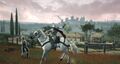 Ezio fighting from horseback.
 -
Ezio performing an aerial assassination on a moving horseman.
-
 Ezio attacking horseman with a spear.
 -
 Horses used in the Defense of Monteriggioni.


References
| ||||||||||||||||||||||||||||
| |||||||||||||||||||||||||||||||||||||
| ||||||||||||||||||||||||||||||||||||||||
| ||||||||||||||||||||||||||||
| |||||||||||||||||||||||||||||||||||||