

Athens: Difference between revisions
imported>Lady Kyashira mNo edit summary |
imported>Sadelyrate No edit summary |
||
| Line 1: | Line 1: | ||
{{Era|Locations}} | {{Era|Locations}} | ||
{{WP-REAL}} | {{WP-REAL}} | ||
{{Revamp}} | |||
{{Imageneed}} | {{Imageneed}} | ||
{{Stub}} | {{Stub}} | ||
| Line 21: | Line 22: | ||
|founded = {{wiki|Cecrops I}} | |founded = {{wiki|Cecrops I}} | ||
|date = c. 1556 BCE | |date = c. 1556 BCE | ||
|landmark = [[Parthenon]]<br>[[ | |landmark = [[Parthenon]]<br>[[Agora of Athens|Agora]]<br>[[Odeon of Perikles]]<br>[[Theater of Dionysos]] | ||
|targets = }} | |targets = }} | ||
'''Athens''' is the capital and largest city of [[Greece]]. Situated at the heart of the [[Attika|Attika peninsula]], it is the birthplace of {{wiki|democracy}}, and in the 5th century BCE, was the preeminent city-state in the region, wielding hegemony over the Hellenic civilization. | '''Athens''' is the capital and largest city of [[Greece]]. Situated at the heart of the [[Attika|Attika peninsula]], it is the birthplace of {{wiki|democracy}}, and in the 5th century BCE, was the preeminent city-state in the region, wielding hegemony over the Hellenic civilization. | ||
| Line 28: | Line 29: | ||
==History== | ==History== | ||
In the 5th century BCE, Athens was a city-state which rose to prominence under a highly distinct and intricate political system known as democracy. In an alliance with other ''poleis'', most notably [[Sparta]], Athens defended Greece from the [[Iran|Persian]] invasions in the first half of the century following which it emerged as the leader of the [[Delian League]].<ref name=" | In the 5th century BCE, Athens was a city-state which rose to prominence under a highly distinct and intricate political system known as democracy. In an alliance with other ''poleis'', most notably [[Sparta]], Athens defended Greece from the [[Iran|Persian]] invasions in the first half of the century following which it emerged as the leader of the [[Delian League]].<ref name="ACOd">''[[Assassin's Creed: Odyssey]]''</ref> | ||
===Golden Age=== | ===Golden Age=== | ||
From this position, Athens began to assert its hegemony over the other Greek city-states, often aggressively. Popularly known as the Golden Age of Athens, this period of Athenian ascendancy witnessed an explosion of cultural and intellectual developments, with philosophers such as [[Sokrates]] and his pupil [[Plato]] leaving a lasting legacy on the future [[Europe]]an academic tradition. Major milestones regarded as the origins of European fields include the works of [[Herodotus]] and [[Hippokrates]], called the "Fathers of History and Medicine" by Western scholars respectively.<ref name="ACOd" | From this position, Athens began to assert its hegemony over the other Greek city-states, often aggressively. Popularly known as the Golden Age of Athens, this period of Athenian ascendancy witnessed an explosion of cultural and intellectual developments, with philosophers such as [[Sokrates]] and his pupil [[Plato]] leaving a lasting legacy on the future [[Europe]]an academic tradition. Major milestones regarded as the origins of European fields include the works of [[Herodotus]] and [[Hippokrates]], called the "Fathers of History and Medicine" by Western scholars respectively.<ref name="ACOd" /> | ||
Under the leadership of the general [[Perikles]], the Golden Age entered its final stage, with his partner [[Aspasia]], a high society [[ | Under the leadership of the general [[Perikles]], the Golden Age entered its final stage, with his partner [[Aspasia]], a high society [[courtesan|''hetaera'']], hosting numerous social events for contemporary artists, philosophers, and politicians.<ref name="ACOd" /> | ||
===Peloponnesian War=== | ===Peloponnesian War=== | ||
Those city-states under Athens' suzerainty, however, resented its dominance, and in 431 BCE, a rivalry between Athens and the militaristic Sparta of the [[Peloponnesian League]] erupted into open warfare. Wary of the Spartans' infamous reputation as the best warriors of Greece, Perikles refused to meet the enemy in battle, instead having his forces turtle within the city's walls, | Those city-states under Athens' suzerainty, however, resented its dominance, and in 431 BCE, a rivalry between Athens and the militaristic Sparta of the [[Peloponnesian League]] erupted into open warfare. Wary of the Spartans' infamous reputation as the best warriors of Greece, Perikles refused to meet the enemy in battle, instead having his forces turtle within the city's walls, putting him at odds with fellow statesman [[Kleon]].<ref name="ACOd" /> | ||
That year, the Spartan ''[[Mercenary|misthios]]'' [[Kassandra]] travelled to Athens on the suggestion of [[Herodotos]], who befriended Perikles during his travels.<ref name=" | That year, the Spartan ''[[Mercenary|misthios]]'' [[Kassandra]] travelled to Athens on the suggestion of [[Herodotos]], who had befriended Perikles during his travels.<ref name="ACOd" /> | ||
===Ottoman era=== | ===Ottoman era=== | ||
| Line 47: | Line 48: | ||
Not long after, [[Templars|Templar]] agents began paying Ottoman soldiers for the goods of wealthy Athenians, thereby instigating them into open robbery of these citizens' homes. The explicit order of Sultan [[Bayezid II]] against such raiding could not dissuade these soldiers from the promise of handsome profits, leading to the intervention of the Ottoman Assassins. After these Assassins defended the Athenians from further robbery, they discovered the Templar background of the affair and assassinated the leaders behind it.<ref name="Mediterranean Defense" /> | Not long after, [[Templars|Templar]] agents began paying Ottoman soldiers for the goods of wealthy Athenians, thereby instigating them into open robbery of these citizens' homes. The explicit order of Sultan [[Bayezid II]] against such raiding could not dissuade these soldiers from the promise of handsome profits, leading to the intervention of the Ottoman Assassins. After these Assassins defended the Athenians from further robbery, they discovered the Templar background of the affair and assassinated the leaders behind it.<ref name="Mediterranean Defense" /> | ||
Subsequently, remnants of [[Isu]] technology were uncovered beneath the [[ | Subsequently, remnants of [[Isu]] technology were uncovered beneath the [[Akropolis Sanctuary|acropolis]]. In response, further Turkish agents were sent by Ezio to guard the site while Assassin scholars conducted a thorough survey.<ref name="Mediterranean Defense" /> | ||
By the end of 1512, Athens was fully under the control of the Assassin Brotherhood as with the other major cities in the [[Mediterranean Sea|Mediterranean]].<ref name="Mediterranean Defense" /> | By the end of 1512, Athens was fully under the control of the Assassin Brotherhood as with the other major cities in the [[Mediterranean Sea|Mediterranean]].<ref name="Mediterranean Defense" /> | ||
==Geography== | ==Geography== | ||
Characterized by a {{wiki|Mediterranean climate|dry summer climate}}, the environment of Athens is the definition of the Greek atmosphere. | Characterized by a {{wiki|Mediterranean climate|dry summer climate}}, the environment of Athens is the definition of the Greek atmosphere. The city is divided into thirty districts, including the Pottery District called [[Kerameikos]].<ref name="ACOd" /> | ||
==Economy== | ==Economy== | ||
During the 5th century BCE, the Athenian economy was largely fueled by taxes paid by city-states it held suzerainty over as the head of the Delian League.<ref name="ACOd | During the 5th century BCE, the Athenian economy was largely fueled by taxes paid by city-states it held suzerainty over as the head of the Delian League.<ref name="ACOd /"> | ||
==Appearances== | ==Appearances== | ||
Revision as of 15:42, 12 January 2019

|
Ezio, my friend! How may I be of service? This article is in desperate need of a revamp. Please improve it in any way necessary in order for it to achieve a higher standard of quality in accordance with our Manual of Style. |

|
Where are the paintings? This article is in need of more images and/or better quality pictures from official media in order to achieve a higher status. You can help the Assassin's Creed Wiki by uploading better images on this page. |

Athens is the capital and largest city of Greece. Situated at the heart of the Attika peninsula, it is the birthplace of democracy, and in the 5th century BCE, was the preeminent city-state in the region, wielding hegemony over the Hellenic civilization.
After a period of cultural flourishing during which the origin of much of Western intellectual thought was established, Athens was engulfed in the Peloponnesian War against its militaristic rival, Sparta. Centuries later with the fall of the Byzantine Empire, Athens came under the control of the Ottoman Empire where Assassin influence was firmly established.
History
In the 5th century BCE, Athens was a city-state which rose to prominence under a highly distinct and intricate political system known as democracy. In an alliance with other poleis, most notably Sparta, Athens defended Greece from the Persian invasions in the first half of the century following which it emerged as the leader of the Delian League.[1]
Golden Age
From this position, Athens began to assert its hegemony over the other Greek city-states, often aggressively. Popularly known as the Golden Age of Athens, this period of Athenian ascendancy witnessed an explosion of cultural and intellectual developments, with philosophers such as Sokrates and his pupil Plato leaving a lasting legacy on the future European academic tradition. Major milestones regarded as the origins of European fields include the works of Herodotus and Hippokrates, called the "Fathers of History and Medicine" by Western scholars respectively.[1]
Under the leadership of the general Perikles, the Golden Age entered its final stage, with his partner Aspasia, a high society hetaera, hosting numerous social events for contemporary artists, philosophers, and politicians.[1]
Peloponnesian War
Those city-states under Athens' suzerainty, however, resented its dominance, and in 431 BCE, a rivalry between Athens and the militaristic Sparta of the Peloponnesian League erupted into open warfare. Wary of the Spartans' infamous reputation as the best warriors of Greece, Perikles refused to meet the enemy in battle, instead having his forces turtle within the city's walls, putting him at odds with fellow statesman Kleon.[1]
That year, the Spartan misthios Kassandra travelled to Athens on the suggestion of Herodotos, who had befriended Perikles during his travels.[1]
Ottoman era
With the Fall of Constantinople in 1453 and the end of the Byzantine Empire, the Ottoman Empire entered Greece as its new ruler. Resentment against the new Turkish regime remained fresh as late as 1511, when the local Assassins struggled to maintain public faith given their transnational policies.[2]
That year, with Ezio Auditore da Firenze, Mentor of the Italian Brotherhood taking over operations in Constantinople, Ottoman Assassins were sent to Athens to revitalize the Greek branch. These Turkish Assassins were instrumental in helping their Greek counterparts reestablish the Athenians' trust by convincing the common people that their cause transcended national sentiments, prioritizing humanity as a whole.[2]
Not long after, Templar agents began paying Ottoman soldiers for the goods of wealthy Athenians, thereby instigating them into open robbery of these citizens' homes. The explicit order of Sultan Bayezid II against such raiding could not dissuade these soldiers from the promise of handsome profits, leading to the intervention of the Ottoman Assassins. After these Assassins defended the Athenians from further robbery, they discovered the Templar background of the affair and assassinated the leaders behind it.[2]
Subsequently, remnants of Isu technology were uncovered beneath the acropolis. In response, further Turkish agents were sent by Ezio to guard the site while Assassin scholars conducted a thorough survey.[2]
By the end of 1512, Athens was fully under the control of the Assassin Brotherhood as with the other major cities in the Mediterranean.[2]
Geography
Characterized by a dry summer climate, the environment of Athens is the definition of the Greek atmosphere. The city is divided into thirty districts, including the Pottery District called Kerameikos.[1]
Economy
During the 5th century BCE, the Athenian economy was largely fueled by taxes paid by city-states it held suzerainty over as the head of the Delian League.<ref name="ACOd /">
Appearances
- Assassin's Creed: Revelations (mentioned only)
- Assassin's Creed: Odyssey (first appearance)
Gallery
-
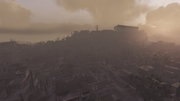 Athens during the plague in 429 BCE

References