

White Desert: Difference between revisions
imported>UJ112013 Expanded |
imported>UJ112013 Added some concept arts |
||
| Line 11: | Line 11: | ||
==Gallery== | ==Gallery== | ||
<gallery position="center" widths="180" captionalign="center"> | <gallery position="center" widths="180" captionalign="center"> | ||
ACO White Desert Exploration Concept Art - Martin Deschambault.jpg|Concept art of White Desert Exploration | |||
ACO White Desert Concept Art - Martin Deschambault.jpg|Concept art of White Desert | |||
ACO White Desert Composition Sketches - Martin Deschambault.jpg|Concept art of White Desert Composition Sketches | |||
ACO Promotional Screenshot 12.jpg|The rock formations in the desert | ACO Promotional Screenshot 12.jpg|The rock formations in the desert | ||
ACReb - The Jackal's Path.jpg|Excavation site of the Sect of the Ibis Reborn | ACReb - The Jackal's Path.jpg|Excavation site of the Sect of the Ibis Reborn | ||
Revision as of 14:56, 26 September 2022
- "Spectacular boulders of chalk rocks define the White Desert and hint at its past as a sea."
- ―description[src]

The White Desert in the northeast of the Sahara Desert is a desert situated south of the Black Desert in Egypt and west of its oasis, characterized by its boulders of chalk rock formations. These rock formations are a result of wind erosion, the most famous of these so-called "stone mushrooms" is referred to as the Finger of God. Its name is derived from the desert's white limestone soil against the yellow sand.[1]
History
Before 46 BCE, after the hunting of the Order of the Ancients by Medjay Bayek, Menkhtu, a priest who served under the Oracle of Amun Medunamun, discovered a lost underground tomb in the White Desert. After studying the tomb, he learned a god temple was under the Great Pyramid of Giza. He believed he can absorb god's power in the temple.[2] To retrieve the power of god and avoid the hunter, Menkhtu decided to recall the remnants of the Order of the Ancients to create a new cult. He wore his former master's mask and claimed the Ibis reborn himself. He started his plan to decoy the Hidden Ones.[3]
In 46 BCE, soon after the foundation of the Hidden Ones, their Mentor Bayek sent a group of his disciples to the White Desert in pursuit of an individual who claimed to be the Ibis reborn. The Sect of the Ibis Reborn had been seen in the area by Hidden One scouts. The Hidden Ones then closed in on the suspected location of its leader.[2] Following them to a tomb, the Hidden Ones searched for any sign of the Ibis Reborn among the priests, but only met decoys. However, piecing together their last words, the Hidden Ones learned that The Ibis Reborn had accessed the Isu Vault under the Great Pyramid of Giza.[4]
Gallery
-
 Concept art of White Desert Exploration
 -
 Concept art of White Desert
 -
 Concept art of White Desert Composition Sketches
 -
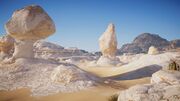 The rock formations in the desert
 -
 Excavation site of the Sect of the Ibis Reborn
 -
 Entrance of the tomb found by the Sect


Appearances
- Assassin's Creed: Origins (first appearance)
- Discovery Tour: Ancient Egypt
- Assassin's Creed: Rebellion – The Mask of the Ibis
References
- ↑ Discovery Tour: Ancient Egypt – Tours: Deserts of Egypt – White Desert
- ↑ 2.0 2.1 Assassin's Creed: Rebellion – The Mask of the Ibis – The Jackal's Path
- ↑ Assassin's Creed: Rebellion – The Mask of the Ibis – The Night of the Eagles
- ↑ Assassin's Creed: Rebellion – The Mask of the Ibis – The Buried Halls
| |||||||||||||||||||||||||||||||||||||||||||||||||||||||||||