

François de la Serre: Difference between revisions
imported>Master Sima Yi |
imported>Darman36 Finally found this 8yrs later! Vid by diff school and was after the talk I cited, but it's same one I saw when I'd heard a local university was hosting while in town. Where is birth date given? Still needs more novel info & personality in regards to Arno's life |
||
| Line 1: | Line 1: | ||
{{Era|Individuals|Templars}} | {{Era|Individuals|Templars}} | ||
{{Update|[[Assassin's Creed: Unity]], its [[Assassin's Creed: Unity (novel)|novel]], and the [[Assassin's Creed Unity: Abstergo Entertainment – Employee Handbook|Abstergo handbook]]}} | |||
{{Quote|I know that that monarch is appointed by God and I believe that a corrupt monarch can be persuaded to see the error of his ways.|François de la Serre on Louis XVI and monarchy, 1775.|Assassin's Creed: Unity (novel)}} | {{Quote|I know that that monarch is appointed by God and I believe that a corrupt monarch can be persuaded to see the error of his ways.|François de la Serre on Louis XVI and monarchy, 1775.|Assassin's Creed: Unity (novel)}} | ||
{{Character Infobox | {{Character Infobox | ||
| image = ACU De La Serre Render.png | | image = ACU De La Serre Render.png | ||
| birth = 1733<br | | birth = 1733<br>[[Kingdom of France]] | ||
| death = 5 May 1789<br | | death = 5 May 1789<br>[[Versailles]], Kingdom of France | ||
| species = [[Human]] | | species = [[Human]] | ||
| affiliates = [[Templars]] | | affiliates = [[Templars]] | ||
| Line 10: | Line 11: | ||
| database = [[Database: François De La Serre|François De La Serre]] | | database = [[Database: François De La Serre|François De La Serre]] | ||
}} | }} | ||
'''François de la Serre''' (1733 – 1789) was the [[Grand Master of the Templar Order|Grand Master]] of the [[Parisian Rite of the Templar Order|Parisian Rite]] of the [[Templars|Templar Order]] during the late 18th century. He was the father of [[Élise de la Serre]] and adoptive father of [[Arno Dorian]]. | '''François de la Serre''' (1733{{Cite|12 Nov 2014}} – 1789) was the [[Grand Master of the Templar Order|Grand Master]] of the [[Parisian Rite of the Templar Order|Parisian Rite]] of the [[Templars|Templar Order]] during the late 18th century. He was the father of [[Élise de la Serre]] and adoptive father of [[Arno Dorian]]. | ||
A supporter of the absolutist [[monarchy]] of the {{Wiki|Ancien Régime}}, he expelled his [[Lieutenant of the Templar Order|lieutenant]] | A supporter of the absolutist [[monarchy]] of the {{Wiki|Ancien Régime}}, he expelled his [[Lieutenant of the Templar Order|lieutenant]] [[François-Thomas Germain]] from the Order for his radical ideas of unseating the aristocracy from power and instead giving it to the rising middle class. Germain came to see de la Serre as a complacent Grand Master who had forgotten the Templars' [[New World Order|true goals]], and had him killed in 1789 as part of a coup within the Order. | ||
==Biography== | ==Biography== | ||
===Early life=== | ===Early life=== | ||
François was born in 1733 to the de la Serres, a family of minor nobles<ref name="Database">''[[Assassin's Creed: Unity]]'' – [[Database: François De La Serre]]</ref> who had held the position of Grand Master of the Paris Rite for several generations. At some point before 1768, | François was born in 1733 to the de la Serres, a family of minor nobles<ref name="Database">''[[Assassin's Creed: Unity]]'' – [[Database: François De La Serre]]</ref> who had held the position of Grand Master of the Paris Rite for several generations. By 1756, his actions as a high-ranking Templar had caught the attention of the [[American Brotherhood of Assassins|Colonial Assassins]]' [[Mentor]] [[Achilles Davenport]], who added the Frenchman on a notice board in the [[Davenport Homestead]].<ref>''[[Assassin's Creed: Rogue]]''</ref> At some point before 1768, François married his fellow Templar [[Julie de la Serre|Julie]] and acquired an [[De la Serre estate, Versailles|estate]] in [[Versailles]] overseen by his majordomo [[Olivier (majordomo)|Olivier]] as well as a smaller [[De la Serre estate, Paris|residence]] in [[Paris]]<ref name="Novel">[[Assassin's Creed: Unity (novel)|''Assassin's Creed: Unity'' novel]]</ref><ref name="Database"/> within the historic [[Le Marais]] district.<ref name="ACU">''Assassin's Creed: Unity''</ref> Rising to the [[Templar rank|position]] of Grand Master, François had a daughter, Élise, with Julie in 1768. At some point, he became a close confidant of King [[Louis XVI of France|Louis XVI]] and [[Honoré Gabriel Riqueti, comte de Mirabeau]], Mentor of the [[Parisian Brotherhood of Assassins|Parisian Brotherhood]] of [[Assassins]].<ref name="Database"/> | ||
In 1776, the | In December 1776, the [[American Rite of the Templar Order|Colonial Templar]] [[Shay Cormac]]<ref>''Assassin's Creed: Rogue'' – [[QXNzYXNzaW5hdGlvbg0K]]</ref> murdered the French Assassin [[Charles Dorian]] and François adopted the Charles' son Arno.<ref>''Assassin's Creed: Unity'' – [[Memories of Versailles]]</ref> Out of respect for Arno's father and at the request of his wife and daughter, François did not attempt to bring Arno into the Templar Order, although he asked Élise to influence him in joining their cause. As Julie deteriorated due to her illness, he started spending time with the boy and arranged his time table for him to take lessons from the governor and [[hunting]].<ref name="Novel"/> | ||
===Expulsion of Germain and death=== | ===Expulsion of Germain and death=== | ||
At some point in time, de la Serre expelled his lieutenant François-Thomas Germain from the Templar Order | At some point in time, de la Serre expelled his lieutenant François-Thomas Germain from the Templar Order<ref name="Hoarders">''Assassin's Creed: Unity'' – [[Hoarders]]</ref> for spreading radical ideas supporting the idea of a violent revolution.<ref>''Assassin's Creed: Unity'' – [[A Cautious Alliance]]</ref> De la Serre attempted to persuade his lieutenant to abandon his radical ideas, but to no avail, forcing de la Serre to expel Germain.<ref name="Hoarders"/><ref name="ACU"/> | ||
Later on, the [[Roi des Thunes]] appealed to de la Serre for a position in the Order. However, his appeal was rebuffed by de la Serre, who proceeded to state that he had no use for the | Later on, the [[Roi des Thunes]] appealed to de la Serre for a position in the Order. However, his appeal was rebuffed by de la Serre, who proceeded to state that he had no use for the "intrigues of [[rat]]s".<ref name="LeRoiEstMort">''Assassin's Creed: Unity'' – [[Le Roi Est Mort]]</ref><ref name="Confession">''Assassin's Creed: Unity'' – [[Confession]]</ref> This unfortunately sealed his fate, as it was this remark that caused the slighted Roi des Thunes to pledge his allegiance to Germain's radical faction and vow to kill de la Serre.<ref name="LeRoiEstMort"/> During the [[Estates-General of 1789]], François was a delegate for the nobility of Second Estate. He attempted to make peace with the Assassins,<ref name="TheEstatesGeneral">''Assassin's Creed: Unity'' – [[The Estates General]]</ref> but this was not accepted by other Templars,<ref name="Novel"/> especially his advisor [[Chrétien Lafrenière]], who believed that Mirabeau could not be trusted.<ref name="TheProphet">''Assassin's Creed: Unity'' – [[The Prophet]]</ref> | ||
On the night of his daughter's [[Initiation into the Templar Order|induction]] into the Templar Order, de la Serre was unaware of the plot by his erstwhile advisors to assassinate him. After Elise was officially inducted, de la Serre was called to the palace gardens by one of his advisors, [[Charles Gabriel Sivert]]. Upon arrival, he asked what could be so important as to draw him away from the ceremony; Sivert's response was to punch him in the stomach. Despite the ambush, de la Serre quickly rallied by headbutting Sivert and slashing his left eye with his [[sword]]. However, the Roi des Thunes snuck behind the Grand Master<ref name="Confession"/> and struck him with a [[poison]]-laced [[Templar pin]].<ref name="HighSociety">''Assassin's Creed: Unity'' – [[High Society]]</ref><ref name="Confession"/> | |||
While the two assailants made their escape, de la Serre succumbed to the effects of the poison and died in front of Arno's eyes. Taking advantage of the chaos, Sivert pinned the blame of de la Serre's murder on Arno,<ref name="HighSociety"/><ref name="Confession"/> leading to the latter's imprisonment in the [[Bastille]].<ref>''Assassin's Creed: Unity'' – [[Imprisoned]]</ref> After de la Serre's death, the Order split between the small remains of a conservative faction led by Élise<ref name="Novel"/> and the followers of the usurping Grand Master Germain who wanted to encourage the rise of the middle class at the expense of the aristocracy.<ref name="ACU"/> | |||
While the two assailants made their escape, de la Serre succumbed to the effects of the poison and died in front of Arno's eyes. Taking advantage of the chaos, Sivert pinned the blame of de la Serre's murder on Arno, leading to the latter's imprisonment in the [[Bastille]].<ref | |||
After | |||
==Personality and traits== | ==Personality and traits== | ||
{{Quote|What we Templars know, is that despite exhortations otherwise, the people don't want real freedom and true responsibility, because these things are too great a burden to bear, and only the very strongest minds can do so.|François explaining the Templar ideology to Élise, 1775.|Assassin's Creed: Unity (novel)}}François held relatively moderate views in regards to the Templar ideology. Rather than eradicating free will entirely, he appeared content with preserving the ordered society under the absolutist monarchy in France. As he believed that strong and powerful leaders were necessary in order to advance society, he was opposed to the notions of a constitutional monarchy. François held that a king was chosen by [[Christianity|God]] to lead, and thus believed that Louis XVI should be influenced to rule France more competently, rather than be deposed. François felt that the traditional ways of thinking had been beneficial in guiding humanity for millennia, and therefore found the Assassins' [[Assassin-Templar War|support of freedom]], independent thinking, and radical ideas to be anarchic.<ref name="Novel"/> | {{Quote|What we Templars know, is that despite exhortations otherwise, the people don't want real freedom and true responsibility, because these things are too great a burden to bear, and only the very strongest minds can do so.|François explaining the Templar ideology to Élise, 1775.|Assassin's Creed: Unity (novel)}} | ||
François held relatively moderate views in regards to the Templar ideology. Rather than eradicating free will entirely, he appeared content with preserving the ordered society under the absolutist monarchy in France. As he believed that strong and powerful leaders were necessary in order to advance society, he was opposed to the notions of a constitutional monarchy. François held that a king was chosen by [[Christianity|God]] to lead, and thus believed that Louis XVI should be influenced to rule France more competently, rather than be deposed. François felt that the traditional ways of thinking had been beneficial in guiding humanity for millennia, and therefore found the Assassins' [[Assassin-Templar War|support of freedom]], independent thinking, and radical ideas to be anarchic.<ref name="Novel"/> In another departure from established Templar practice to rely on criminal connections just as strongly as the Assassins, such as the [[Levantine Rite of the Templar Order|Levantine Rite]]'s black arms [[merchant]] [[Tamir]] or the Colonial Rite's counterfeiter [[Thomas Hickey]], François apparently did not see the use of the potential information the lower classes could provide, demeaning the position and the Roi des Thunes' entreaty to join as supplying nothing more than useless noise.<ref name="LeRoiEstMort"/> | |||
While Chrétien Lafrenière considered the Assassin Mentor Mirabeau immoral and self-serving, François trusted the latter and believed him a good and honest man. Together, the two leaders attempted to broker a truce between their opposing orders while meeting at the Estates-General of 1789.<ref name=" | Despite these strong philosophical differences, he was reluctant in starting open conflict with the Assassins, in stark contrast to his advisors. Even though he was convinced that an earlier ambush on Julie and Élise was the work of Assassins, he claimed to his advisors that he held no such suspicions, wishing to silence calls for reprisal against the Brotherhood.<ref name="Novel"/> While Chrétien Lafrenière considered the Assassin Mentor Mirabeau immoral and self-serving, François trusted the latter and believed him a good and honest man.<ref name="TheProphet"/> Together, the two leaders attempted to broker a truce between their opposing orders while meeting at the Estates-General of 1789.<ref name="TheEstatesGeneral"/> François believed that they held common ground on the nation's future, even if both knew that the truce would not last beyond the [[French Revolution]].<ref name="Novel"/> | ||
In regards to attire, François usually wore a powdered wig and a black coat adorned with a Templar pin.<ref name="ACU"/> His favorite hat was a feathered black [[beaver]] hat.<ref name="Novel"/> Francois was also a skilled swordsman, managing to slash out | In regards to attire, François usually wore a powdered wig and a black coat adorned with a Templar pin.<ref name="ACU"/> His favorite hat was a feathered black [[beaver]] hat.<ref name="Novel"/> Francois was also a skilled swordsman, managing to slash out Sivert's eye when he was ambushed and would most surely have prevailed over Sivert had he not been stabbed from behind by the Roi des Thunes.<ref name="Confession"/> | ||
==Behind the scenes== | ==Behind the scenes== | ||
François de la Serre is a character in the game ''[[Assassin's Creed: Unity]]'' | François de la Serre is a historical character from Versailles whose name [[Ubisoft]]'s Production Coordinator [[Maxime Durand]] found in digitized copies of the city's obituaries records from before the Revolution.<ref>{{Cite web|url=https://carleton.ca/history/news/shannon-lecture/from-dreams-to-realities/|title=From Dreams to Realities: Performing History in the Assassin's Creed® video game series|author=Durand, Maxime|date=23 October 2015|publisher={{Wiki|Carleton University}}|archiveurl=https://web.archive.org/web/20220128053242/https://carleton.ca/history/news/shannon-lecture/from-dreams-to-realities/|archivedate=28 January 2022|accessdate=30 September 2023}}<br>↑{{Youtube|video=rheZCOql9kg|text=From Dreams to Realities: Performing History in the Assassin's Creed Video Game Series|channel=@vanderbilt|channelname=Vanderbilt University}} "[W]hen you make a game about assassinating people, obviously you need people who die. Real people as much as possible, otherwise we make them up. The example up top is François de la Serre, so if you played ''Assassin's Creed: Unity'', it's one of the first characters that you get to meet. Uh, so, he's Élise's father. He was—I found him in the, uh, death record for Versailles, so for two, three days, or maybe it was a week, I can't remember. So I looked into these, into the digital archives there online. So I, I looked at these until I found "Oh! This guy's perfect: He's a nobleman, he dies in Versailles at the perfect time just before the beginning of the French Revolution. Uh, OK, let's find more about this guy." And then we realized there wasn't much more to learn about him unless going to, like, uh, paper archives, and, and so it was perfect. It was a character with not much background but with a good name and the right place; let's create a character out of him. So you see where we play with history? So maybe he wasn't a Templar in real life." from 0:56:55–0:58:00</ref>. He was first introduced in the 2014 video games ''[[Assassin's Creed: Rogue]]'' and ''[[Assassin's Creed: Unity]]'', where he only had a portrait in ''Rogue'' but was voiced in ''Unity'' by the [[Canada|Canadian]] actor [[Julian Casey]]. The etymology of his name has a variety of different backgrounds. François is a French variant of the name Franciscus, Latin for "Frenchman". The family name comes from the French "''[[wikt:serre|Serre]]''", meaning "talon" or "greenhouse", while ''de la'', "from the", indicates nobility. | ||
==Gallery== | ==Gallery== | ||
<gallery captionalign="center" position="center | <gallery captionalign="center" position="center" widths="180"> | ||
ACU De la Serre - Concept Art.jpg|Concept art of de la Serre | |||
ACU De la Serre - Concept Art 2.jpg|Concept art of de la Serre | ACU De la Serre - Concept Art 2.jpg|Concept art of de la Serre | ||
ACU De La Serre's Murder - Concept Art.jpg|Concept art of de la Serre's murder | ACU De La Serre's Murder - Concept Art.jpg|Concept art of de la Serre's murder | ||
Young de la Serre - Head Sculpts.jpg|Head sculpts of a young de la Serre | Young de la Serre - Head Sculpts.jpg|Head sculpts of a young de la Serre | ||
| Line 68: | Line 60: | ||
==Appearances== | ==Appearances== | ||
*''[[Assassin's Creed: Rogue]]'' {{c| | *''[[Assassin's Creed: Rogue]]'' {{1st}} {{c|simultaneous with ''Assassin's Creed: Unity''}} | ||
*''[[Assassin's Creed: Unity]]'' {{c| | *''[[Assassin's Creed: Unity]]'' {{1st}} {{c|simultaneous with ''Assassin's Creed: Rogue''}} | ||
*[[Assassin's Creed: Unity (novel)|''Assassin's Creed: Unity'' novel]] | *[[Assassin's Creed: Unity (novel)|''Assassin's Creed: Unity'' novel]] | ||
*''[[Assassin's Creed: Rebellion]]'' {{Mdat}} | *''[[Assassin's Creed: Rebellion]]'' {{Mdat}} | ||
| Line 88: | Line 80: | ||
[[Category:Grand Masters]] | [[Category:Grand Masters]] | ||
[[Category:De la Serre family|Francois de la Serre]] | [[Category:De la Serre family|Francois de la Serre]] | ||
[[de:François de la Serre]] | [[de:François de la Serre]] | ||
[[es:François de la Serre]] | [[es:François de la Serre]] | ||
Revision as of 05:00, 30 September 2023

|
Patience, brothers. Soon we will reveal the secrets of Assassin's Creed: Unity, its novel, and the Abstergo handbook. This article has been identified as being out of date. Please update the article to reflect recent releases and then remove this template once done. |
- "I know that that monarch is appointed by God and I believe that a corrupt monarch can be persuaded to see the error of his ways."
- ―François de la Serre on Louis XVI and monarchy, 1775.[src]
François de la Serre (1733 [citation needed] – 1789) was the Grand Master of the Parisian Rite of the Templar Order during the late 18th century. He was the father of Élise de la Serre and adoptive father of Arno Dorian.
A supporter of the absolutist monarchy of the Ancien Régime, he expelled his lieutenant François-Thomas Germain from the Order for his radical ideas of unseating the aristocracy from power and instead giving it to the rising middle class. Germain came to see de la Serre as a complacent Grand Master who had forgotten the Templars' true goals, and had him killed in 1789 as part of a coup within the Order.
Biography
Early life
François was born in 1733 to the de la Serres, a family of minor nobles[1] who had held the position of Grand Master of the Paris Rite for several generations. By 1756, his actions as a high-ranking Templar had caught the attention of the Colonial Assassins' Mentor Achilles Davenport, who added the Frenchman on a notice board in the Davenport Homestead.[2] At some point before 1768, François married his fellow Templar Julie and acquired an estate in Versailles overseen by his majordomo Olivier as well as a smaller residence in Paris[3][1] within the historic Le Marais district.[4] Rising to the position of Grand Master, François had a daughter, Élise, with Julie in 1768. At some point, he became a close confidant of King Louis XVI and Honoré Gabriel Riqueti, comte de Mirabeau, Mentor of the Parisian Brotherhood of Assassins.[1]
In December 1776, the Colonial Templar Shay Cormac[5] murdered the French Assassin Charles Dorian and François adopted the Charles' son Arno.[6] Out of respect for Arno's father and at the request of his wife and daughter, François did not attempt to bring Arno into the Templar Order, although he asked Élise to influence him in joining their cause. As Julie deteriorated due to her illness, he started spending time with the boy and arranged his time table for him to take lessons from the governor and hunting.[3]
Expulsion of Germain and death
At some point in time, de la Serre expelled his lieutenant François-Thomas Germain from the Templar Order[7] for spreading radical ideas supporting the idea of a violent revolution.[8] De la Serre attempted to persuade his lieutenant to abandon his radical ideas, but to no avail, forcing de la Serre to expel Germain.[7][4]
Later on, the Roi des Thunes appealed to de la Serre for a position in the Order. However, his appeal was rebuffed by de la Serre, who proceeded to state that he had no use for the "intrigues of rats".[9][10] This unfortunately sealed his fate, as it was this remark that caused the slighted Roi des Thunes to pledge his allegiance to Germain's radical faction and vow to kill de la Serre.[9] During the Estates-General of 1789, François was a delegate for the nobility of Second Estate. He attempted to make peace with the Assassins,[11] but this was not accepted by other Templars,[3] especially his advisor Chrétien Lafrenière, who believed that Mirabeau could not be trusted.[12]
On the night of his daughter's induction into the Templar Order, de la Serre was unaware of the plot by his erstwhile advisors to assassinate him. After Elise was officially inducted, de la Serre was called to the palace gardens by one of his advisors, Charles Gabriel Sivert. Upon arrival, he asked what could be so important as to draw him away from the ceremony; Sivert's response was to punch him in the stomach. Despite the ambush, de la Serre quickly rallied by headbutting Sivert and slashing his left eye with his sword. However, the Roi des Thunes snuck behind the Grand Master[10] and struck him with a poison-laced Templar pin.[13][10]
While the two assailants made their escape, de la Serre succumbed to the effects of the poison and died in front of Arno's eyes. Taking advantage of the chaos, Sivert pinned the blame of de la Serre's murder on Arno,[13][10] leading to the latter's imprisonment in the Bastille.[14] After de la Serre's death, the Order split between the small remains of a conservative faction led by Élise[3] and the followers of the usurping Grand Master Germain who wanted to encourage the rise of the middle class at the expense of the aristocracy.[4]
Personality and traits
- "What we Templars know, is that despite exhortations otherwise, the people don't want real freedom and true responsibility, because these things are too great a burden to bear, and only the very strongest minds can do so."
- ―François explaining the Templar ideology to Élise, 1775.[src]
François held relatively moderate views in regards to the Templar ideology. Rather than eradicating free will entirely, he appeared content with preserving the ordered society under the absolutist monarchy in France. As he believed that strong and powerful leaders were necessary in order to advance society, he was opposed to the notions of a constitutional monarchy. François held that a king was chosen by God to lead, and thus believed that Louis XVI should be influenced to rule France more competently, rather than be deposed. François felt that the traditional ways of thinking had been beneficial in guiding humanity for millennia, and therefore found the Assassins' support of freedom, independent thinking, and radical ideas to be anarchic.[3] In another departure from established Templar practice to rely on criminal connections just as strongly as the Assassins, such as the Levantine Rite's black arms merchant Tamir or the Colonial Rite's counterfeiter Thomas Hickey, François apparently did not see the use of the potential information the lower classes could provide, demeaning the position and the Roi des Thunes' entreaty to join as supplying nothing more than useless noise.[9]
Despite these strong philosophical differences, he was reluctant in starting open conflict with the Assassins, in stark contrast to his advisors. Even though he was convinced that an earlier ambush on Julie and Élise was the work of Assassins, he claimed to his advisors that he held no such suspicions, wishing to silence calls for reprisal against the Brotherhood.[3] While Chrétien Lafrenière considered the Assassin Mentor Mirabeau immoral and self-serving, François trusted the latter and believed him a good and honest man.[12] Together, the two leaders attempted to broker a truce between their opposing orders while meeting at the Estates-General of 1789.[11] François believed that they held common ground on the nation's future, even if both knew that the truce would not last beyond the French Revolution.[3]
In regards to attire, François usually wore a powdered wig and a black coat adorned with a Templar pin.[4] His favorite hat was a feathered black beaver hat.[3] Francois was also a skilled swordsman, managing to slash out Sivert's eye when he was ambushed and would most surely have prevailed over Sivert had he not been stabbed from behind by the Roi des Thunes.[10]
Behind the scenes
François de la Serre is a historical character from Versailles whose name Ubisoft's Production Coordinator Maxime Durand found in digitized copies of the city's obituaries records from before the Revolution.[15]. He was first introduced in the 2014 video games Assassin's Creed: Rogue and Assassin's Creed: Unity, where he only had a portrait in Rogue but was voiced in Unity by the Canadian actor Julian Casey. The etymology of his name has a variety of different backgrounds. François is a French variant of the name Franciscus, Latin for "Frenchman". The family name comes from the French "Serre", meaning "talon" or "greenhouse", while de la, "from the", indicates nobility.
Gallery
-
 Concept art of de la Serre
 -
 Concept art of de la Serre
 -
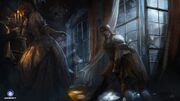 Concept art of de la Serre's murder
 -
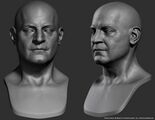 Head sculpts of a young de la Serre
 -
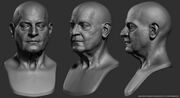 Head sculpts of an old de la Serre
 -
 Head renders of de la Serre
 -
 François expelling Germain from the Templar Order
 -
 François taking Arno under his wing
 -
 François keeping Arno from being arrested
 -
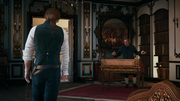 François scolding Arno
 -
 François standing behind Louis XVI
 -
 François speaking with Mirabeau
 -
 François succumbing to his wounds
 -
 Arno checking on François


Appearances
- Assassin's Creed: Rogue (first appearance) (simultaneous with Assassin's Creed: Unity)
- Assassin's Creed: Unity (first appearance) (simultaneous with Assassin's Creed: Rogue)
- Assassin's Creed: Unity novel
- Assassin's Creed: Rebellion (mentioned in Database entry only)
References
- ↑ 1.0 1.1 1.2 Assassin's Creed: Unity – Database: François De La Serre
- ↑ Assassin's Creed: Rogue
- ↑ 3.0 3.1 3.2 3.3 3.4 3.5 3.6 3.7 Assassin's Creed: Unity novel
- ↑ 4.0 4.1 4.2 4.3 Assassin's Creed: Unity
- ↑ Assassin's Creed: Rogue – QXNzYXNzaW5hdGlvbg0K
- ↑ Assassin's Creed: Unity – Memories of Versailles
- ↑ 7.0 7.1 Assassin's Creed: Unity – Hoarders
- ↑ Assassin's Creed: Unity – A Cautious Alliance
- ↑ 9.0 9.1 9.2 Assassin's Creed: Unity – Le Roi Est Mort
- ↑ 10.0 10.1 10.2 10.3 10.4 Assassin's Creed: Unity – Confession
- ↑ 11.0 11.1 Assassin's Creed: Unity – The Estates General
- ↑ 12.0 12.1 Assassin's Creed: Unity – The Prophet
- ↑ 13.0 13.1 Assassin's Creed: Unity – High Society
- ↑ Assassin's Creed: Unity – Imprisoned
- ↑ Durand, Maxime (23 October 2015). From Dreams to Realities: Performing History in the Assassin's Creed® video game series. Carleton University. Archived from the original on 28 January 2022. Retrieved on 30 September 2023.
↑ From Dreams to Realities: Performing History in the Assassin's Creed Video Game Series on the Vanderbilt University YouTube channel "[W]hen you make a game about assassinating people, obviously you need people who die. Real people as much as possible, otherwise we make them up. The example up top is François de la Serre, so if you played Assassin's Creed: Unity, it's one of the first characters that you get to meet. Uh, so, he's Élise's father. He was—I found him in the, uh, death record for Versailles, so for two, three days, or maybe it was a week, I can't remember. So I looked into these, into the digital archives there online. So I, I looked at these until I found "Oh! This guy's perfect: He's a nobleman, he dies in Versailles at the perfect time just before the beginning of the French Revolution. Uh, OK, let's find more about this guy." And then we realized there wasn't much more to learn about him unless going to, like, uh, paper archives, and, and so it was perfect. It was a character with not much background but with a good name and the right place; let's create a character out of him. So you see where we play with history? So maybe he wasn't a Templar in real life." from 0:56:55–0:58:00
| |||||||||||||||||||||||||||||||||||||||||||||||||||||||


de:François de la Serre es:François de la Serre fr:François de la Serre hu:François de la Serre it:François de la Serre pl:François de la Serre pt-br:François de la Serre ru:Франсуа де ла Серр zh:弗朗索瓦·德·拉塞尔