

Plato: Difference between revisions
imported>The Wikia Editor Created page with "{{Era|AC2|ACS}} {{WP-REAL}} '''Plato''' (428/427 or 424/423 – 348/347 BC) was an ancient Greek philosopher, widely considered the most pivotal figure in the devel..." |
m Text replacement - ">''Assassin's Creed: Origins''" to ">''Assassin's Creed: Origins''" |
||
| (50 intermediate revisions by 25 users not shown) | |||
| Line 1: | Line 1: | ||
{{Era| | {{Era|Individuals}}{{WP-REAL}} | ||
{{ | {{Quote|Is there an age where it would suddenly be OK to debate with them? What then of the night before I turn that age? Should we be prevented from doing what we wish due to the world's view of us?|A young Plato to Kassandra, 420s BCE.|Assassin's Creed: Odyssey|Persuasion Check}} | ||
'''Plato''' ( | {{Character Infobox | ||
|name = Plato | |||
|native = | |||
|image = ACOD - Plato.png | |||
|birth = 420s BCE<br>[[Athens]], [[Greece]] | |||
|death = 348/347 BCE<br>Athens, Greece | |||
|active = | |||
|species = [[Human]] | |||
|database = | |||
|affiliates = [[Academy|Platonic Academy]] | |||
}} | |||
'''Plato''' (c. 427 BCE or c. 424 BCE – c. 347 BCE), born '''Aristokles''', was an ancient [[Greece|Greek]] philosopher, widely considered the most pivotal figure in the development of philosophy, especially the Western tradition. He was a student of [[Sokrates]] and the teacher of [[Aristotle]]. | |||
==Biography== | |||
Aristokles was only a young boy in the early years of the [[Peloponnesian War]]. At one point, he made the acquaintance of the [[Sparta]]n ''[[Mercenary|misthios]]'' [[Kassandra]]. After she gathered supporters to help Sokrates out of jail, he introduced himself to her but also shared that he did not like the name. Kassandra suggested he choose a new one, and he settled on 'Plato', a name by which his {{Wiki|Antiphon brother of Plato|brother}} used to call him. He also told Kassandra of his passion for debate and how he hoped to be student of Sokrates one day.<ref name="Persuasion">''[[Assassin's Creed: Odyssey]]'' – [[Persuasion Check]]</ref> | |||
Plato eventually went on to become an renowned author and philosopher. Around 388 BCE, he founded a school of philosophy that later came to known as the [[Academy|Platonic Academy]]. The school attracted numerous mathematicians and geometers such as [[Archytas]], a [[Pythagoras|Pythagorean]] philosopher, and [[Eudoxos of Knidos]], an astronomer. He was later eventually succeeded by his nephew [[Speusippos]].<ref name="DT">''[[Discovery Tour: Ancient Greece]]'' – [[Tours: School of Greece - Philosophy]]: "Importance of Philosophy"</ref> | |||
== | In his work ''{{Wiki|Republic (Plato)|The Republic}}'', Plato made his famous {{Wiki|Allegory of the Cave}}, in which prisoners were chained inside a cave and forced to look at a cave wall. They were not able to see the world outside, but only the reflections on the wall that the outside world made. The prisoners are able to free themselves when they see that the intangible, represented by the reflections, is real.<ref>''[[Assassin's Creed: Origins]]'' – [[Layla Hassan's personal files]]: The Empirical Truth</ref> | ||
==Legacy== | |||
Three centuries after his death, the last [[Egypt]]ian [[pharaoh]] [[Cleopatra]] revealed her knowledge of Plato's works. When the visiting [[Roman Republic|Roman]] general [[Gaius Julius Caesar|Julius Caesar]] told an anecdote about [[Catullus]]' insulting mention of him in {{Wiki|Poetry of Catullus|his poetry}}, she commented that Plato was right to disdain poets as also outlined in ''The Republic'', to which Caesar laughed at and agreed.<ref>''[[Assassin's Creed: Origins]]'' – [[Aya: Blade of the Goddess]]</ref> | |||
In 1497, during the [[Bonfire of the Vanities]], [[Preacher (Piagnone)|one]] of [[Girolamo Savonarola]]'s nine lieutenants stated that Savonarola condemned the teachings of both Plato and Aristotle, remarking that the only good thing they owed them was bringing forward many arguments which they could use against the heretics and that they and other philosophers were in Hell.<ref>''[[Assassin's Creed II]]'' – ''[[Bonfire of the Vanities (DLC)|Bonfire of the Vanities]]'' – [[Doomsday]]</ref> | |||
In 1868, [[Evie Frye]] quoted Plato while talking to her brother [[Jacob Frye|Jacob]] although Jacob mistakenly believed that she was quoting their father, [[Ethan Frye]].<ref>''[[Assassin's Creed: Syndicate]]'' – [[Double Trouble]]</ref> | |||
==Gallery== | |||
<gallery position="center" widths="180" captionalign="center"> | |||
ACOD Persuasion Check 2.png|A young Plato observing the philosophers' debate | |||
ACOD Persuasion Check 5.png|Plato meeting Kassandra | |||
ACOD Persuasion Check 6.png|Plato speaking to Kassandra | |||
ACOD Young Plato Closeup.png|Closeup of a young Plato | |||
DTAG Plato Teaching in the Grove at Academia - Joshua Cristall.jpg|Plato teaching in the gardens of the Academy, painting by {{Wiki|Joshua Cristall}} | |||
DTAG - Head of Plato.png|Head of Plato as seen in Discovery Tour: Ancient Greece | |||
</gallery> | |||
==Appearances== | |||
*''[[Assassin's Creed II]]'' {{Mo}} | |||
*''[[Assassin's Creed: Syndicate]]'' {{Mo}} | |||
*''[[Assassin's Creed: Origins]]'' {{Mo}} | |||
*''[[Assassin's Creed: Odyssey]]'' {{1st}} | |||
*''[[Discovery Tour: Ancient Greece]]'' {{Mo}} | |||
*''[[Assassin's Creed: Rebellion]]'' {{Mdat}} | |||
==References== | |||
{{Reflist}} | {{Reflist}} | ||
{{ACOD}} | |||
<!--[fr:Platon] | |||
[zh:柏拉图]--> | |||
[[Category:420s BCE births]] | [[Category:420s BCE births]] | ||
[[Category:340s BCE deaths]] | [[Category:340s BCE deaths]] | ||
[[Category:Individuals]] | [[Category:Individuals]] | ||
[[Category:Greeks]] | [[Category:Greeks]] | ||
[[Category:Athenians]] | |||
[[Category:Ethnic Greeks]] | |||
[[Category:Occultists]] | |||
[[Category:Philosophers]] | [[Category:Philosophers]] | ||
[[Category:Writers]] | |||
Latest revision as of 05:45, 22 September 2026
Plato (c. 427 BCE or c. 424 BCE – c. 347 BCE), born Aristokles, was an ancient Greek philosopher, widely considered the most pivotal figure in the development of philosophy, especially the Western tradition. He was a student of Sokrates and the teacher of Aristotle.
Biography[edit | edit source]
Aristokles was only a young boy in the early years of the Peloponnesian War. At one point, he made the acquaintance of the Spartan misthios Kassandra. After she gathered supporters to help Sokrates out of jail, he introduced himself to her but also shared that he did not like the name. Kassandra suggested he choose a new one, and he settled on 'Plato', a name by which his brother used to call him. He also told Kassandra of his passion for debate and how he hoped to be student of Sokrates one day.[1]
Plato eventually went on to become an renowned author and philosopher. Around 388 BCE, he founded a school of philosophy that later came to known as the Platonic Academy. The school attracted numerous mathematicians and geometers such as Archytas, a Pythagorean philosopher, and Eudoxos of Knidos, an astronomer. He was later eventually succeeded by his nephew Speusippos.[2]
In his work The Republic, Plato made his famous Allegory of the Cave, in which prisoners were chained inside a cave and forced to look at a cave wall. They were not able to see the world outside, but only the reflections on the wall that the outside world made. The prisoners are able to free themselves when they see that the intangible, represented by the reflections, is real.[3]
Legacy[edit | edit source]
Three centuries after his death, the last Egyptian pharaoh Cleopatra revealed her knowledge of Plato's works. When the visiting Roman general Julius Caesar told an anecdote about Catullus' insulting mention of him in his poetry, she commented that Plato was right to disdain poets as also outlined in The Republic, to which Caesar laughed at and agreed.[4]
In 1497, during the Bonfire of the Vanities, one of Girolamo Savonarola's nine lieutenants stated that Savonarola condemned the teachings of both Plato and Aristotle, remarking that the only good thing they owed them was bringing forward many arguments which they could use against the heretics and that they and other philosophers were in Hell.[5]
In 1868, Evie Frye quoted Plato while talking to her brother Jacob although Jacob mistakenly believed that she was quoting their father, Ethan Frye.[6]
Gallery[edit | edit source]
-
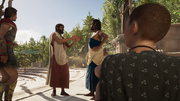 A young Plato observing the philosophers' debate
 -
 Plato meeting Kassandra
 -
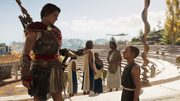 Plato speaking to Kassandra
 -
 Closeup of a young Plato
 -
 Plato teaching in the gardens of the Academy, painting by Joshua Cristall
 -
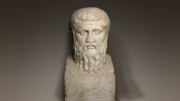 Head of Plato as seen in Discovery Tour: Ancient Greece


Appearances[edit | edit source]
- Assassin's Creed II (mentioned only)
- Assassin's Creed: Syndicate (mentioned only)
- Assassin's Creed: Origins (mentioned only)
- Assassin's Creed: Odyssey (first appearance)
- Discovery Tour: Ancient Greece (mentioned only)
- Assassin's Creed: Rebellion (mentioned in Database entry only)
References[edit | edit source]
- ↑ Assassin's Creed: Odyssey – Persuasion Check
- ↑ Discovery Tour: Ancient Greece – Tours: School of Greece - Philosophy: "Importance of Philosophy"
- ↑ Assassin's Creed: Origins – Layla Hassan's personal files: The Empirical Truth
- ↑ Assassin's Creed: Origins – Aya: Blade of the Goddess
- ↑ Assassin's Creed II – Bonfire of the Vanities – Doomsday
- ↑ Assassin's Creed: Syndicate – Double Trouble