
Ishaq ibn Khalid

|
Where are the paintings? This article is in need of more images and/or better quality pictures from Valley of Memory in order to achieve a higher status. You can help the Assassin's Creed Wiki by uploading better images on this page. |
Ishaq ibn Khalid[1] (Arabic: إسحاق بن خالد) was an architect active in early to mid-9th century Samarra, then the capital of the Abbasid Caliphate. He was responsible for the construction of the renowned Great Mosque of Samarra, and was the father of Basim ibn Ishaq.
Biography[edit | edit source]
Early life[edit | edit source]
At some point while visiting Samarra's bazaar, Ishaq caught sight of a Norse woman brought as a slave from across the seas. Struck by her beauty, he bought, freed and eventually married her.[2] Around 844,[3] Ishaq's wife gave birth to their son, Basim, though she would later die from an unspecified illness, leaving Ishaq devastated and solely responsible for their young son's care.[2]
Despite the pain of losing his wife, Ishaq was a loving and devoted father to Basim, taking care that all of his son's needs were met. He built him toys, including a wooden wheeled horse that Basim was particularly fond of. He also played with him, sang him lullabies,[4] and imparted what wisdom he could onto the young boy.[5]
Exile[edit | edit source]
- Ishaq: "Do not cry, Basim. Remember, you are the one who smiles. But I must go. Dervis—he will take care of you now."
- Basim: "Father, please! Do not leave me! Is it because of the toy I broke?"
- Ishaq: "No, Basim, no!"
- Basim: "I am sorry! I will be good! I promise! Don't leave me! Please, Father!"
- —Ishaq leaving a young Basim, c. 851.[src]-[m]
Eventually, Ishaq became a renowned architect[6] and would oversee the construction of Samarra's famous Great Mosque.[7] However, upon its completion in 851,[8] Caliph al-Mutawakkil[6] stole his credit,[9] and court intrigue[6] forced Ishaq into exile.[7] Knowing he could never return to his beloved hometown, and not wanting Basim to suffer the shame and dangers he was about to face during his exile,[2] a heartbroken Ishaq left his seven-year-old son[10] with the peddler Dervis, who was responsible for the care of several other orphaned children.[1]
Following his departure from Samarra, Ishaq made his way to the city of al-Ula on the edges of the caliphate, which he had always wished to visit.[2] There, he would eventually settle into a house in the oasis near the city, and became known among the local townsfolk for his stories of his time as the caliph's architect, though some doubted their validity, believing Ishaq to be merely an "old fool".[11]
Meanwhile, in his father's absence, Basim grew up an orphan on the streets of Baghdad,[12] struggling with feelings of abandonment[1] as he blamed himself for his father's departure.[4] Despite this, he continued to hold cherished memories of his father, seeing Ishaq as someone who had "dedicated his life to the betterment of his people... only to be slighted and forgotten."[5]
Reunion with Basim[edit | edit source]
By the 860s, the elderly Ishaq had become senile and forgotten much of his past.[2] At some point, he made a tile painting depicting him and his son in front of their old house in Samarra, which was later stolen by a gang of robbers that had recently begun plaguing the region. After being purchased by a traveling Bedouin merchant, the painting eventually came into the possession of Dervis, who in turn showed it to Basim.[13]
Believing this was a sign that his father was still alive, Basim embarked on a journey to al-Ula alongside Dervis to find Ishaq and achieve closure over his past.[13] By the time he managed to track down Ishaq, however, his father had been abducted by the robbers[4] on the orders of their leader, Nimlot,[14] who sought to enact revenge on Basim for assassinating his own father, Mas'ood Al-Ya'qoob.[2]
Taken to Nimlot's base of operations at the Roman Fort Ruins, Ishaq was eventually rescued by Basim, who killed Nimlot before the latter could murder his father. After freeing Ishaq, however, Basim was dismayed to discover his father's severe cognitive decline, which prevented him from recognizing his son. In fact, he did not remember any details of his life after his exile and still believed himself to be in Samarra.[2]
As the two took a walk through the desert near al-Ula, Ishaq recounted what few details he remembered of his past to Basim, including the love he held for both his late wife and son. After Basim decided against revealing his identity to his father, Ishaq expressed hope that his son would grow into a fine man and that they would be reunited one day, but until then, they both had their own lives to live. With that, an oblivious Ishaq parted ways with Basim for the final time, walking alone into the desert.[2]
Legacy[edit | edit source]
Despite his promise to never forget his father and have him in his heart wherever he traveled,[2] Basim's opinion of Ishaq seemingly changed as he grew older and unlocked Loki's dormant memories inside him. In 867, during a mission to Constantinople with his Hidden One apprentice Hytham, Basim told the young Acolyte that his father had been a cruel man who "had no love in him for his son" and had nothing but violence to pass on to him.[15]
Around 874, during his travels in England with the Viking Eivor Varinsdottir, Basim again reminisced of his father, mentioning his construction of Samarra's Great Mosque and his exile. By this time, Basim appeared to be convinced that Ishaq had passed away, as he told Eivor that his father had died in poverty during his exile.[7]
Gallery[edit | edit source]
-
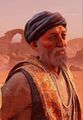 Ishaq
Ishaq

Behind the scenes[edit | edit source]
Ishaq ibn Khalid is a fictional character whose existence was first implied through an indirect mention by Basim in the 2020 video game Assassin's Creed: Valhalla. Since Arabic names often feature a nasab, a patronymic or matronymic that denotes the bearer's lineage, Basim could also be referred to as "Basim, son of Ishaq", thereby confirming Ishaq's identity. He made his first appearance in Valley of Memory, a 2025 downloadable expansion for the 2023 game Assassin's Creed: Mirage.
Throughout Valley of Memory—its dialogue subtitles, database entries, and achievement descriptions—Ubisoft consistently stylizes his name as "Is'haq", incorrectly adding a ⟨'⟩ to represent a sukūn ⟨ ْ⟩ denoting the preceding syllable ends in the consonant. This is a non-standardized way to romanize the Arabic إسحاق and is used to signify that the ⟨sh⟩ is not a digraph pronounced as a single phoneme. In standard transliteration schemes, a ⟨'⟩ is used to represent a hamza, which indicates a full glottal stop.
Appearances[edit | edit source]
- Assassin's Creed: Valhalla (first mentioned) (indirect mention only)
- Assassin's Creed: The Golden City (indirect mention only)
- The World of Assassin's Creed Valhalla: Journey to the North – Logs and Files of a Hidden One (indirect mention only)
- Assassin's Creed: Mirage (indirect mention only)
- Valley of Memory (first appearance)
References[edit | edit source]
- ↑ 1.0 1.1 1.2 Assassin's Creed: Mirage – Valley of Memory – The Ones Who Remain
- ↑ 2.0 2.1 2.2 2.3 2.4 2.5 2.6 2.7 2.8 Assassin's Creed: Mirage – Valley of Memory – In the Vulture's Nest
- ↑
 Assassin's Creed Mirage: Developer Trailer Breakdown | #UbiForward on the Ubisoft YouTube channel. "Basim is around 17 years old, on the trailer here. It's actually the beginning of the game."
- ↑ 4.0 4.1 4.2 Assassin's Creed: Mirage – Valley of Memory – House of Memories
- ↑ 5.0 5.1 Assassin's Creed: Mirage – The Master Thief of Anbar
- ↑ 6.0 6.1 6.2 Assassin's Creed: Mirage – Valley of Memory – Database: Is'haq ibn Khalid
- ↑ 7.0 7.1 7.2 Assassin's Creed: Valhalla – A Bloody Welcome
- ↑
 Great Mosque of Samarra on Wikipedia
- ↑ Assassin's Creed: Mirage – A Life's Work
- ↑ Peachy, Jack (6 October 2025). Assassin's Creed Mirage Devs talk Valley of Memory DLC and taking the game out of Baghdad. Game Rant. Archived from the original on 13 October 2025. Retrieved on 13 October 2025.
- ↑ Assassin's Creed: Mirage – Valley of Memory – The Heart of Corruption
- ↑
 Assassin's Creed Mirage on Ubisoft's official website (backup link)
- ↑ 13.0 13.1 Assassin's Creed: Mirage – Valley of Memory – Valley of Memory
- ↑ Assassin's Creed: Mirage – Valley of Memory – Tracks in the Desert
- ↑ Assassin's Creed: The Golden City – Chapter 25