

Discovery Tour: AlUla

Discovery Tour: AlUla is the Discovery Tour educational mode for Valley of Memory, a downloadable content expansion package for Assassin's Creed: Mirage, that released on 3 September 2026 as a free app for Apple,[1] Android,[2] and all desktop devices. Made for quick access while gaming or on the go,[3] it gives users access to select database entries from Valley of Memory, as well as original ones, about cultural life in the Al-Ula Valley. Its "Access Codex" mode presents digital models of artifacts through augmented reality, while its "Explore AlUla" game mode reworks the database into a 90-minute choose your own adventure that puts users in the protagonist role of an unnamed Alamut Hidden One apprentice.
Summary[edit | edit source]
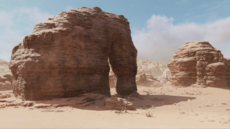
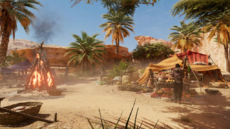
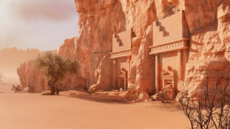
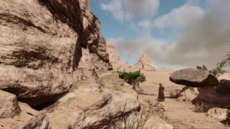
Step into the heart of a legendary oasis in Discovery Tour App: Ancient AlUla, an educational adventure that invites players to explore the ancient landscape of AlUla. Using the rich world of Assassin's Creed Mirage: Valley of Memory, this standalone experience blends historical discovery with interactive gameplay as you explore AlUla from the Dadanite and Lihyanite kingdoms to the Nabataean city of Hegra and the medieval town on the pilgrimage road to Mecca.
Explore AlUla: embark on a gamified, narrative-driven journey that takes approximately 90 minutes to complete. Each mission tasks you with investigating historical locations, gathering and studying intel, and using this acquired knowledge to carry out missions for the Hidden Ones and reveal the secret message hidden within the ancient carvings.
Access Codex: consult carefully selected encyclopedic entries on the history, art, and culture of ancient and medieval AlUla and the kingdoms that shaped it. Benefit from additional historical information and interact with this content by manipulating 3D images and using the Augmented Reality functionality for some entries.
Crafted in collaboration with historians and cultural experts, Discovery Tour: Ancient AlUla delivers an educational experience that's deeply engaging and fully interactive. With intuitive controls, multi-language support, and a focus on meaningful discovery, it offers a unique way to learn through play, anchored in one of history's most remarkable locations.[1][2]
Introduction letter[edit | edit source]
- Welcome to AlUla, a land marked by ancient civilisations and shaped by a unique natural evolution.
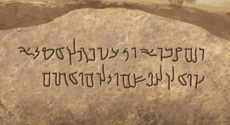
You need to decipher an ancient inscription. It appears to be written in the language of the Nabataeans, one of the civilisations that occupied this land many centuries ago.
Travel across the valley, gain knowledge and help people in the region. In exchange, they will provide you with fragments of different inscriptions that you can use to decipher the ancient inscription.
Codex[edit | edit source]
A Cultural Hub[edit | edit source]
| Hegra | Memory of an Old Civilization | Dadanites, Lihyanites & Nabataeans |
| Sanctuary Ruins | The Romans in AlUla | The Overlook Fortress |
| Heritage and Archaeology |
A Natural Wonder[edit | edit source]
| Ramm Valley | Prehistoric Life | Shapes in the Sandstone |
| Flora of the Oasis | Leopards of Arabia | The Arabian Ostrich |
Connecting the World[edit | edit source]
| The Incense Road | Frankincense | Life of a Merchant |
| The Nomadic World | Masjid Al'Itham | A Crossroads of Cultural Influences |
Life in the Oasis[edit | edit source]
| The Old Town | The Thriving Town | Tayyarahs |
| Farming the Oasis | Mastering the Water | Tantora |
| Food in AlUla | The Melody Makers | Stargazing |
Honoring the Dead[edit | edit source]
| The Ones that Defied Time | A City Surrounded by the Dead and the Gods |
Rites of Passage |
| The Triclinium | The Path to Eternity | Remembrance of the Forgotten |
| Carving for the Ages |
Timeline[edit | edit source]
- Palaeolithic (c. 250,000 BCE)
- The first anatomically modern humans (Homo Sapiens) migrate into the region. They are hunter-gatherers whose presence is evidenced by archaeological remains, notably in AlUla.
- Neolithic (c. 6000–5000 BCE)
- Livestock farming develops among mobile communities. The first megalithic structures appear, along with rock art depicting humans and animals.
- Bronze Age (c. 3,000–1200 BCE)
- Funerary constructions multiply, transforming the landscape.
- Ancient Kingdoms of Dadan & Lihyan (c. 600 - 500 BCE)
- The town of Dadan establishes itself as the capital of the Dadanite and Lihyanite kingdoms. Water management enables the development of agriculture, while the incense trade is a source of prosperity. The earliest North Arabian scripts emerge.
- Nabataean Kingdom (c. 400 BCE–106 CE)
- Access to the Mediterranean exposes the incense route to new cultural influences.
The Nabataean kingdom extends across the region, making Hegra its southern capital. Spectacular tombs are carved into the rock.
- Access to the Mediterranean exposes the incense route to new cultural influences.
- Roman presence in Arabia Petraea (c. 100–600 CE)
- The Nabataean kingdom is absorbed into the Roman Empire. A small fort is established at Hegra to protect the incense route.
- Islamic Period – Qurh & Old Town (c. 650–1100)
- Towns emerge: Qurh (c. 650–1100) and then the Old Town (c. 1,200–c. 1980), whose prosperity is driven by both trade and pilgrimages. Irrigation techniques reach their peak, supporting extensive local agriculture.
- Advances in Pilgrim Travel (c. 1600 - 1900)
- A fortress and other defensive structures are built to protect pilgrims, as well as a railway station and associated structures.
- The Cultural Heritage (today)
- Archaeological missions are carried out in AlUla. The site's extraordinary heritage is revealed to the entire world as part of a vast cultural promotion and preservation programme.
Memories[edit | edit source]
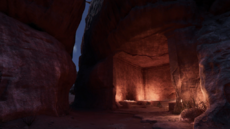
|
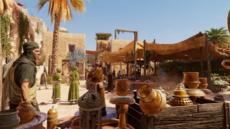
|
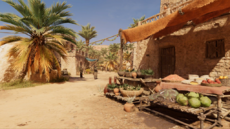
|
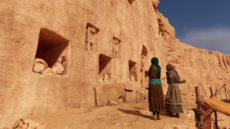
|
| The Dinner | The Merchant | The Farmer | The Artist |
|
|
|
|
| The Guard | The Runaway | The Engineer | The Scholar |
| |||
| Deciphering the Inscription | |||
Gameplay[edit | edit source]
If users opt to learn the above entries in a gamified format, they are presented with a map of the city and initiate their investigations from eight different landmarks in Al-Ula Valley, learning the entries while uncovering clues about the mysterious inscription. Each mission has a number of sections where player choice impacts the end result's tone, and players must select the optimal choice out of a total three options that are scored from best (3) to worst (1). Regardless what they pick, they are guaranteed to acquire a relevant inscription, though the NPCs will react accordingly to any poor decisions.
Gallery[edit | edit source]
-
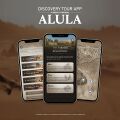 Promotional image
 -
 Promotional image
 -
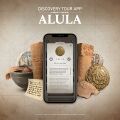 Promotional image


External links[edit | edit source]

References[edit | edit source]
- ↑ 1.0 1.1 Ubisoft (September 2026). Discovery Tour App: AlUla on the App Store. App Store. Archived from the original on 19 September 2026. Retrieved on 19 September 2026.
- ↑ 2.0 2.1 Ubisoft (3 September 2026). Discovery Tour App: AlUla. Google Play. Archived from the original on 19 September 2026. Retrieved on 19 September 2026.
- ↑
 Assassin's Creed (@assassinscreed) on Twitter "Step into the history of AlUla 🦅
The Discovery Tour App: AlUla is now available on mobile ⏳
Dive into the rich heritage of the region through Codex entries, engaging interactions, and mini games.
Download for FREE: https://assassinscreed.com/discovery-tour-app-alula"