

Minotaur: Difference between revisions
imported>Sadelyrate |
imported>Sadelyrate No edit summary |
||
| Line 16: | Line 16: | ||
==Mythology== | ==Mythology== | ||
According to the Greek mythology, the gods cursed the Kretan queen and wife of king [[Minos]], [[Pasiphae]], to desire the [[Kretan Bull]]. To fulfill this desire, Pasiphae ordered the [[Ostracism|exiled]] [[Athens|Athenian]] inventor [[Daidalos]] to craft herself a cow suit. From this dalliance, the Minotaur was born.<ref>'' | According to the Greek mythology, the gods cursed the Kretan queen and wife of king [[Minos]], [[Pasiphae]], to desire the [[Kretan Bull]].<ref>''[[Assassin's Creed: Odyssey]]'' – [[Historical Locations#Messara|Messara: Gortyn]]</ref> <ref>''Assassin's Creed: Odyssey'' – [[Discovery Tour#Art, Religion, and Myths|Discovery Tour – "Art, Religion, and Myths"]] – Knossos: Birth of the Minotaur</ref> To fulfill this desire, Pasiphae ordered the [[Ostracism|exiled]] [[Athens|Athenian]] inventor [[Daidalos]] to craft herself a cow suit. From this dalliance, the Minotaur was born.<ref>''Assassin's Creed: Odyssey'' – Discovery Tour: Art, Religion, and Myths – Knossos: Daidalos</ref> | ||
King Minos couldn't kill the creature, but instead ordered Daidalos to create the labyrinth to keep the beast in.<ref>''Assassin's Creed: Odyssey'' – Discovery Tour: Art, Religion, and Myths – Knossos: Birth of the Minotaur</ref> To feed the beast, and angered by the death of his son {{Wiki|Androgeus (son of Minos)|Androgeos}} in Athens, Minos commanded the Athenians to send fourteen of their finest men and women to Knossos' labyrinth each year.<ref>''Assassin's Creed: Odyssey'' – ''Famous Cities'' – Knossos: Reparation</ref> This lasted until [[Theseus]] was sent, promising to kill the beast. In this, he was aided by Minos' daughter [[Ariadne]], who had fallen madly in love with the Athenian. After he had succeeded in his task, they left together for Athens.<ref>''Assassin's Creed: Odyssey'' – ''Famous Cities'' – Knossos: The Minotaur's Death</ref> | King Minos couldn't kill the creature, but instead ordered Daidalos to create the labyrinth to keep the beast in.<ref>''Assassin's Creed: Odyssey'' – Discovery Tour: Art, Religion, and Myths – Knossos: Birth of the Minotaur</ref> To feed the beast, and angered by the death of his son {{Wiki|Androgeus (son of Minos)|Androgeos}} in Athens, Minos commanded the Athenians to send fourteen of their finest men and women to Knossos' labyrinth each year.<ref>''Assassin's Creed: Odyssey'' – ''Famous Cities'' – Knossos: Reparation</ref> This lasted until [[Theseus]] was sent, promising to kill the beast. In this, he was aided by Minos' daughter [[Ariadne]], who had fallen madly in love with the Athenian. After he had succeeded in his task, they left together for Athens.<ref>''Assassin's Creed: Odyssey'' – ''Famous Cities'' – Knossos: The Minotaur's Death</ref> | ||
Revision as of 07:54, 28 October 2019

|
Patience, brothers. Soon we will reveal the secrets of Assassin's Creed: Odyssey. This article has been identified as being out of date. Please update the article to reflect recent releases and then remove this template once done. |

|
Where are the paintings? This article is in need of more images and/or better quality pictures from official media in order to achieve a higher status. You can help the Assassin's Creed Wiki by uploading better images on this page. |

The Minotaur was a hybrid beast created by the Isu as part of the Olympos Project. A large creature possessing the body of a man and the head and fur of a bull, the Minotaur was powered by an Atlantis artifact capable of transmuting the wielder into the beast.
The beast was kept within a great labyrinth beneath the Knossos Palace in Messara on the Greek island of Krete.
Mythology
According to the Greek mythology, the gods cursed the Kretan queen and wife of king Minos, Pasiphae, to desire the Kretan Bull.[1] [2] To fulfill this desire, Pasiphae ordered the exiled Athenian inventor Daidalos to craft herself a cow suit. From this dalliance, the Minotaur was born.[3]
King Minos couldn't kill the creature, but instead ordered Daidalos to create the labyrinth to keep the beast in.[4] To feed the beast, and angered by the death of his son Androgeos in Athens, Minos commanded the Athenians to send fourteen of their finest men and women to Knossos' labyrinth each year.[5] This lasted until Theseus was sent, promising to kill the beast. In this, he was aided by Minos' daughter Ariadne, who had fallen madly in love with the Athenian. After he had succeeded in his task, they left together for Athens.[6]
History
The Minotaur outlasted its creators by far.
At some point during the 5th century BCE, a group of Messaran men, including Nikios and Swordfish, entered the labyrinth in search of riches and treasures. Instead, they were attacked by the Minotaur. Nikios was locked in with the beast while the others fled, terrified to their core.[7]
By the time of the Peloponnesian War, the myth of the creature had spellbound the people of Pephka, and they had turned the city of Lato into a shrine to the beast, erecting statues of it and even emblazoning their banners with its visage.[8] One of the many entrepreneurs in the region seeking to take advantage of the myth's popularity was Leiandros, who lured glory-hungry champions to the Cave of the Brave to face the 'Minotaur', who in fact was Leiandros himself, wearing a mask.[9]
Around the same time the Spartan misthios Kassandra hunted down and defeated another iteration of the creature in her quest to retrieve the artifact that seemingly gave the creature life. After defeating the Minotaur and claiming its prize, the transformation was undone, leaving behind a desiccated corpse.[7]
Personality and traits
The Minotaur displayed massive amounts of mindless rage and anger, being unable to differentiate friend from foe. Basically it had a behavior almost similar to that of a bull, following an animal routine.[8]
Equipment and Abilities
The Minotaur was a timeless beast who outlived his creators. The creature displayed superhuman strength, muscle mass, mobility and durability. The beast furthermore had a large bull head with incredibly powerful bull horns and wielded a large battle axe.[8]
Trivia
- The tapestry depicting Theseus and Minotaur in Assassin's Creed: Odyssey is based on a painting on a stamnos from the 5th century BCE.
- Being a child of Pasiphaë, a queen of Krete and the wife of king Minos, the Minotaur is regarded as half-brother of the princesses Ariadne and Phaidra in Greek mythology.
Gallery
-
 Concept art of the Minotaur
 -
 A statue depicting Minotaur in Pephka
 -
 Theseus slaying the Minotaur as depicted in a tapestry
 -
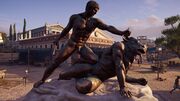 A bronze statue of Theseus slaying the Minotaur
 -
 The banner of Pephka, bearing the Minotaur's image
 -
 Concept Art
 -
 Concept Art
 -
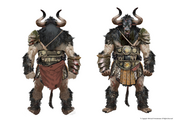 Concept Art
 -
 The symbol of the Minotaur at the Gateway to the Lost City
 -
 Concept Art of the Minotaur in battle


Appearances
- Assassin's Creed: Odyssey (first appearance)
References
- ↑ Assassin's Creed: Odyssey – Messara: Gortyn
- ↑ Assassin's Creed: Odyssey – Discovery Tour – "Art, Religion, and Myths" – Knossos: Birth of the Minotaur
- ↑ Assassin's Creed: Odyssey – Discovery Tour: Art, Religion, and Myths – Knossos: Daidalos
- ↑ Assassin's Creed: Odyssey – Discovery Tour: Art, Religion, and Myths – Knossos: Birth of the Minotaur
- ↑ Assassin's Creed: Odyssey – Famous Cities – Knossos: Reparation
- ↑ Assassin's Creed: Odyssey – Famous Cities – Knossos: The Minotaur's Death
- ↑ 7.0 7.1 Assassin's Creed: Odyssey – Of Minotaurs and Men
- ↑ 8.0 8.1 8.2 Assassin's Creed: Odyssey
- ↑ Assassin's Creed: Odyssey – Minotour De Force