

Medusa: Difference between revisions
imported>Sadelyrate |
imported>Sadelyrate No edit summary |
||
| Line 19: | Line 19: | ||
In 47 BCE, the [[Medjay]] [[Bayek]] of [[Siwa]] acquired a rare [[heavy weapons|heavy weapon]] named after Medusa, owing to her ferocity.<ref name="ACO">''[[Assassin's Creed: Origins]]''</ref> | In 47 BCE, the [[Medjay]] [[Bayek]] of [[Siwa]] acquired a rare [[heavy weapons|heavy weapon]] named after Medusa, owing to her ferocity.<ref name="ACO">''[[Assassin's Creed: Origins]]''</ref> | ||
==Trivia== | |||
*The mural depicting the Perseus and Medusa in ''[[Assassin's Creed: Odyssey]]'' is based on a [https://www.theoi.com/Gallery/P23.7.html painting] on a hydria from the 6th century BCE. | |||
==Gallery== | ==Gallery== | ||
Revision as of 16:06, 9 February 2019
Medusa was the most famous incarnation of the Writhing Dread, and by extension, the gorgons, a type of hybrid beast created by the Isu as part of the Olympos Project. Medusa was originally a human but taken over by an Atlantis artifact known as the Prize of the Medusa, to act as a guardian for it in order to seal the Gates of Atlantis.[1]
History
Myths
In Greek mythology, she was described as having had hair composed of live venomous snakes, wings and a visage so monstrous that all who beheld it turned into stone. According to the myth, she was slain by the hero Perseus with a Sword of Eden,[2], which might have been a harpe, given to him by Hermes.[3]
Influence and legacy
In Korinthia, the story of Medusa inspired someone to carve a monumental statue of her grimacing head, known as the Cyclopean Head of Medusa, though later its creation was attributed to the Cyclopes.[3]
It was also said that after Perseus had brought Medusa's head to Argos, the head was found in a mound of earth near Argos' agora.[3]
In 47 BCE, the Medjay Bayek of Siwa acquired a rare heavy weapon named after Medusa, owing to her ferocity.[4]
Trivia
- The mural depicting the Perseus and Medusa in Assassin's Creed: Odyssey is based on a painting on a hydria from the 6th century BCE.
Gallery
-
 Concept art of the Cyclopean Head of Medusa
 -
 The Head with the Kephisos' Sanctuary Ruins behind
 -
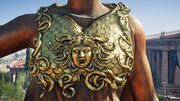 Gorgon, possibly Medusa, as part of the Aegis on the Statue of Athena in Athens
 -
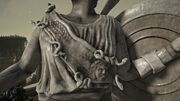 Gorgon, possibly Medusa, as part of the Aegis on a marble statue of Athena
 -
 The face of a gorgon, possibly Medusa, on a shield
 -
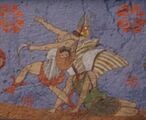 A 5th century BCE mural depicting Perseus beheading Medusa


Appearances
- Assassin's Creed III: Liberation (mentioned only)
- Assassin's Creed: Origins (mentioned only)
- Assassin's Creed: Odyssey (statue only)
References