
Aten (afterlife): Difference between revisions
imported>Cristophorus35 m template added |
imported>Cristophorus35 gallery added |
||
| Line 10: | Line 10: | ||
==Trivia== | ==Trivia== | ||
*An architectural model of Amarna, the city upon which Aten is based, can be seen within the tomb of [[Nefertiti]]'s royal architect, near [[Set-Ma'at]]. | *An architectural model of Amarna, the city upon which Aten is based, can be seen within the tomb of [[Nefertiti]]'s royal architect, near [[Set-Ma'at]]. | ||
==Gallery== | |||
<gallery position="center" widths="200" captionalign="center"> | |||
Anubis' Priest.jpg|One of the priests of Anubis keeping guard to a chest in Aten | |||
</gallery> | |||
==Appearances== | ==Appearances== | ||
Revision as of 03:43, 21 February 2019

|
Where are the paintings? This article is in need of more images and/or better quality pictures from official media in order to achieve a higher status. You can help the Assassin's Creed Wiki by uploading better images on this page. |

Aten was an aspect of the Egyptian afterlife reserved for those who followed Akhenaten's monotheistic worship of the Aten. It took the form of the ancient Egyptian city of Amarna – the one-time capital of Egypt during Akhenaten's reign – in its prime and was dominated by a representation of the sun disk, Aten.
History
Around 38 BCE the Mentor of the Hidden Ones in Egypt, Bayek of Siwa, seemingly travelled to Aten in order to combat the disembodied spirit of Akhenaten, which had been returned to the world of the living thanks to the Curse of the Pharaohs that was plaguing the city of Thebes.[1]
Trivia
- An architectural model of Amarna, the city upon which Aten is based, can be seen within the tomb of Nefertiti's royal architect, near Set-Ma'at.
Gallery
-
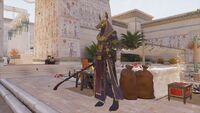 One of the priests of Anubis keeping guard to a chest in Aten

Appearances
References