

Paris: Difference between revisions
imported>Francesco75 No edit summary |
imported>Francesco75 No edit summary |
||
| Line 46: | Line 46: | ||
In 1307, the Assassin [[Mentor]] [[Guillaume de Nogaret]] persuaded the King Philip to arrest the Templar Order and of their [[Grand Master of the Templar Order|Grand Master]] [[Jacques de Molay]]. The 13 October, the Assassins, disguised as flemish [[Mercenary|mercenaries]], attacked the Temple de Paris with the French troops. The [[Master Assassin]] [[Thomas de Carneillon]] led the attack and tried to take [[Sword of Eden 1|Sword of Eden]], a powerful [[Pieces of Eden|piece of Eden]], and also the [[Codex Pater Intellectus]], de Molay's writings . During the attack, Carneillon fought [[Jacques de Molay's advisor]] but was out of action after he received a blast from the Sword of Eden. The advisor hid the Sword and the Codex in Jacques de Molay's vault before be killed by Carneillon who did found the artefacts. De Molay was arrested and imprisonned. In his cell, he hid the [[Heart]], an artefact which unlock the abilities of the Sword of Eden. Jacques de Molay, who was also a [[Sages|Sage]], an reincarnation of the [[Isu|First Civilization]] [[Aita]], decided to reformed the Templar Order as a secret society revealing the secrets of the First Civilisation to nine Templars. On 18 March 1314, Jacques de Molay was burned at the stake before the King Philip and the Pope [[Clement V]] on the Île de la Cité. In his last words, de Molay cursed the the Pope and the royal family to the thirteen generation. De Molay's death marked the dissolution of the Knights Templar as a public organization and influenced their conversion into a secret faction.<ref name="ACU">''[[Assassin's Creed: Unity]]''</ref> | In 1307, the Assassin [[Mentor]] [[Guillaume de Nogaret]] persuaded the King Philip to arrest the Templar Order and of their [[Grand Master of the Templar Order|Grand Master]] [[Jacques de Molay]]. The 13 October, the Assassins, disguised as flemish [[Mercenary|mercenaries]], attacked the Temple de Paris with the French troops. The [[Master Assassin]] [[Thomas de Carneillon]] led the attack and tried to take [[Sword of Eden 1|Sword of Eden]], a powerful [[Pieces of Eden|piece of Eden]], and also the [[Codex Pater Intellectus]], de Molay's writings . During the attack, Carneillon fought [[Jacques de Molay's advisor]] but was out of action after he received a blast from the Sword of Eden. The advisor hid the Sword and the Codex in Jacques de Molay's vault before be killed by Carneillon who did found the artefacts. De Molay was arrested and imprisonned. In his cell, he hid the [[Heart]], an artefact which unlock the abilities of the Sword of Eden. Jacques de Molay, who was also a [[Sages|Sage]], an reincarnation of the [[Isu|First Civilization]] [[Aita]], decided to reformed the Templar Order as a secret society revealing the secrets of the First Civilisation to nine Templars. On 18 March 1314, Jacques de Molay was burned at the stake before the King Philip and the Pope [[Clement V]] on the Île de la Cité. In his last words, de Molay cursed the the Pope and the royal family to the thirteen generation. De Molay's death marked the dissolution of the Knights Templar as a public organization and influenced their conversion into a secret faction.<ref name="ACU">''[[Assassin's Creed: Unity]]''</ref> | ||
During the 14th century, the Kings of France entered in the [[Hundred Years' War]] against the Kings of [[England]]. The attacked of the English troops created an eonomic instability, leading in 1358 to a ''Jacquerie'', a peasant revolt. Other uprisings followed during the rest of the war. The King [[Charles V of France]] decided to reinforce the defense of Paris in this context. He deplaced the royal resident in the fortress of the Louvre and ordered the construction of the [[Bastille]], a fort which will protected the east side of Paris from English attack.<ref name="ACU"> | In 1334, the Abbot of Cluny purrchased the remains of a Roman thermal bath and turn it into a townhouse. The building was known as the [[Hôtel de Cluny]]. | ||
During the 14th century, the Kings of France entered in the [[Hundred Years' War]] against the Kings of [[England]]. The attacked of the English troops created an eonomic instability, leading in 1358 to a ''Jacquerie'', a peasant revolt. Other uprisings followed during the rest of the war. The King [[Charles V of France]] decided to reinforce the defense of Paris in this context. He deplaced the royal resident in the fortress of the Louvre and ordered the construction of the [[Bastille]], a fort which will protected the east side of Paris from English attack.<ref name="ACU"/> | |||
At the end of the 14th century, the scrivener and alchemist [[Nicolas Flamel]] established in Paris one of his laboratory under Notre-Dame. Thank to the [[Book of Abraham]], he created the [[Philosopher's stone]] and the [[Elixir of life]], which made him, according the legends, rich and immortal.<ref name="PL"/> With his fortune, Flamel financed the reconstruction of the Holy Innocent's Cemetery. Before his death, he seperated the Book of Abraham in two and giving one half to the nephew of his wife, Pernelle Flamel. In 1418, Flamel was buried in the Church of Saint-Jacques-la-Boucherie before be deplaced in the Holy Innocent's Cemetery where his wife was buried.<ref name="ACU"/> | |||
===Rennaissance=== | ===Rennaissance=== | ||
During the [[Renaissance]], France was ruled by King [[Louis XII of France|Louis XII]], though he left the kingdom under the charge of his courtiers, who were secretly allied with the Templars. A group of [[Italian Brotherhood of Assassins|Italian Assassins]], sent by their [[Mentor]], [[Ezio Auditore da Firenze]], traveled to Paris to battle that Templar influence.<ref>''[[Assassin's Creed: Project Legacy]]'' - [[Contracts (Project Legacy)|Contracts]]</ref> | During the [[Renaissance]], France was ruled by King [[Louis XII of France|Louis XII]], though he left the kingdom under the charge of his courtiers, who were secretly allied with the Templars. A group of [[Italian Brotherhood of Assassins|Italian Assassins]], sent by their [[Mentor]], [[Ezio Auditore da Firenze]], traveled to Paris to battle that Templar influence.<ref>''[[Assassin's Creed: Project Legacy]]'' - [[Contracts (Project Legacy)|Contracts]]</ref> | ||
In 1527, [[Giovanni Borgia]] and [[Maria Amiel]] traveled to the Louvre in order to find the second half of " | In 1527, [[Giovanni Borgia]] and [[Maria Amiel]] traveled to the Louvre in order to find the second half of "Book of Abraham". Afterwards, they visited the Flamel tomb in Paris' Holy Innocents' Cemetery, but only found it devoid of bodies, or any sign of the Book.<ref name="PL">''Assassin's Creed: Project Legacy'' - [[Divine Science: Chapter 1 - Maria Amiel]]</ref> | ||
===Before the Revolution=== | ===Before the Revolution=== | ||
Revision as of 08:45, 16 October 2018
| This article is about the capital city of France. You may be looking for the Trojan prince Paris. |
Paris is the capital and largest city of France. During the French Revolution, the city was divided in seven districts: Le Louvre, Île de la Cité, Le Marais, La Bièvre, Les Invalides, Quartier Latin, and Ventre de Paris.
History
Formation
Paris was founded during the 3rd century BCE, when a Celtic tribe named the Parisii built a fortified settlement on the Île de la Cité.[1]
Roman era
In 52 BCE, the Romans, led by Julius Caesar, conquered the Parisii Celts who inhabited the area and built a town on the Seine river, named Lutetia Parisiorum ("Swamp of the Parisii"). In the late 3rd century, Paris and its surrounding region were converted to Christianity. According to the legend, the bishop of Paris, Denis, was beheaded and martyred at Montmartre by the Romans around 250 CE. Afterwards the saint's corpse walked to the village of Catolacus which became Saint-Denis, carrying his own head.[2]
In the 5th century, the Roman Empire was in decline; the Franks subsequently captured Paris in 486.
Middle Ages
In 558, the Abbey of Saint-Germain-des-Prés was constructed near Paris and will become one of the richiest abbey in France.[1]
In the middle of the 7th century, the nobility funded the Hôtel-Dieu to serve as a refuge for the poor and sick. It became the first hospital of the city.[1]
During the 10th century, the Kings of France established their resident in the Conciergerie on the Île de la Cité.[1]
In 1130, the King Louis VI of France reinforced a wooden tower of which became the stone fortress of Grand Châtelet near the Place de Grève. Louis also ordered the construction of Les Halles and of the church and cemetery of Holy Innocents which became the cemetery for all churches.[1]
In 1160 began the construction of the Notre-Dame Cathedral which was only ended in 1345. Notre-Dame was one of the first buildings to use flying buttresses in Europe.[1]
During the Middle Ages, Paris grew rapidly and became one of the largest cities in Europe. In response to its expansion, King Philip Augustus constructed the Louvre fortress and a wall surrounding the town during the end of the 12th century. During his reign various markets and fairs were established in a place called Les Champeaux which will become known as Les Halles.[1]
In 1240, returning from the Crusades, the Templars Order built their headquarters in Paris. The fortress was known as the Temple of Paris.[1]
In 1242, King Louis IX of France ordered the construction of the Sainte-Chapelle to house the crown of thorns of Jesus Christ. The monument was finished in 1248 and served as the royal chapel. The Sainte-Chapelle was also the entry of the headquarters of the sworn ennemies of the Templars, the Assassins Brotherhood. The Brotherhood, established under the Île Saint-Louis, used the underground tunnels to navigate easily through the city.[1]
In 1246, King Louis IX invented the position of Provost of the Merchants, which served as the mayor of the city of Paris. Robert de Sorbon, King's chaplain, sought to facilitate the education of underpriviliged children in theology. Louis IX gave him an house in the rue Coupe Gueule which was transformed as the university Sorbonne.[1]
In 1296, the King Philip IV of France ordered the construction of the Palais de Justice in the Palais de la Cité, which served as juridical court for the Parlement de Paris.[1]
In 1307, the Assassin Mentor Guillaume de Nogaret persuaded the King Philip to arrest the Templar Order and of their Grand Master Jacques de Molay. The 13 October, the Assassins, disguised as flemish mercenaries, attacked the Temple de Paris with the French troops. The Master Assassin Thomas de Carneillon led the attack and tried to take Sword of Eden, a powerful piece of Eden, and also the Codex Pater Intellectus, de Molay's writings . During the attack, Carneillon fought Jacques de Molay's advisor but was out of action after he received a blast from the Sword of Eden. The advisor hid the Sword and the Codex in Jacques de Molay's vault before be killed by Carneillon who did found the artefacts. De Molay was arrested and imprisonned. In his cell, he hid the Heart, an artefact which unlock the abilities of the Sword of Eden. Jacques de Molay, who was also a Sage, an reincarnation of the First Civilization Aita, decided to reformed the Templar Order as a secret society revealing the secrets of the First Civilisation to nine Templars. On 18 March 1314, Jacques de Molay was burned at the stake before the King Philip and the Pope Clement V on the Île de la Cité. In his last words, de Molay cursed the the Pope and the royal family to the thirteen generation. De Molay's death marked the dissolution of the Knights Templar as a public organization and influenced their conversion into a secret faction.[1]
In 1334, the Abbot of Cluny purrchased the remains of a Roman thermal bath and turn it into a townhouse. The building was known as the Hôtel de Cluny.
During the 14th century, the Kings of France entered in the Hundred Years' War against the Kings of England. The attacked of the English troops created an eonomic instability, leading in 1358 to a Jacquerie, a peasant revolt. Other uprisings followed during the rest of the war. The King Charles V of France decided to reinforce the defense of Paris in this context. He deplaced the royal resident in the fortress of the Louvre and ordered the construction of the Bastille, a fort which will protected the east side of Paris from English attack.[1]
At the end of the 14th century, the scrivener and alchemist Nicolas Flamel established in Paris one of his laboratory under Notre-Dame. Thank to the Book of Abraham, he created the Philosopher's stone and the Elixir of life, which made him, according the legends, rich and immortal.[3] With his fortune, Flamel financed the reconstruction of the Holy Innocent's Cemetery. Before his death, he seperated the Book of Abraham in two and giving one half to the nephew of his wife, Pernelle Flamel. In 1418, Flamel was buried in the Church of Saint-Jacques-la-Boucherie before be deplaced in the Holy Innocent's Cemetery where his wife was buried.[1]
Rennaissance
During the Renaissance, France was ruled by King Louis XII, though he left the kingdom under the charge of his courtiers, who were secretly allied with the Templars. A group of Italian Assassins, sent by their Mentor, Ezio Auditore da Firenze, traveled to Paris to battle that Templar influence.[4]
In 1527, Giovanni Borgia and Maria Amiel traveled to the Louvre in order to find the second half of "Book of Abraham". Afterwards, they visited the Flamel tomb in Paris' Holy Innocents' Cemetery, but only found it devoid of bodies, or any sign of the Book.[3]
Before the Revolution
In 1776, the Assassin Charles Dorian, attended an Assassin meeting at the Palace of Versailles. However, as Charles searched for his son upon its conclusion, he was assassinated by the Templar Shay Cormac.[5]
As he died, Charles told Shay that the American Revolution had undone the Templars' work in the newly-formed United States of America. Shay suggested that the Templars could stage another revolution, in order to restore the balance of power between the two factions.[5]
French Revolution
From 1789 to 1799, a period of social and political upheaval occurred in France due to the extravagance of the aristocracy. This, coupled by famine and economic turmoil, gradually enraged the French working class and inevitably sparked a revolution against the monarchy and upper classes. The Assassin Arno Dorian lived in Paris during the Revolution.[1]
19th century
In the 19th century, Napoleon I embellished the city with monuments to military glory. It became the European capital of fashion, and the scene of two more revolutions in 1830 and 1848. Under Napoleon III, nephew of Napoleon I, and his Prefect of the Seine, Georges-Eugène Haussmann, between 1852 and 1870 the center of Paris was rebuilt with wide new avenues, squares, and parks, and the city was expanded to its present limits in 1860. In the latter part of the century, in the Belle Epoch era, millions of tourists came to see the Paris International Expositions and the new Eiffel Tower.
Sometime towards the end of the 19th century, Samuel Liddell Mathers, accompanied by the disembodied being of William Robert Woodman, met one of the Secret Chiefs in Paris. The Chief, who wore a ring marked with the Templar insignia, informed Mathers that his Order's partnership with the Hermetic Order of the Golden Dawn had ended.[6]
20th century
In the 20th century, Paris suffered bombardment in World War I and German occupation from 1940 until 1944 in World War II. Between the two wars, Paris was the capital of modern art and a magnet for intellectuals, writers and artists from around the world.
Modern era
Abstergo Industries maintained a secret laboratory in Paris for the purpose of researching Precursor artifacts and genetic material until it was destroyed in October 2014 by a team of Assassins led by Gavin Banks.[7]
In November, Eric Cooper set up an Assassin headquarters in Paris to help infiltrate a data hub for the Helix, Abstergo Entertainment's upcoming cloud-based game service.[8]
Gallery
-
 Giovanni Borgia and Maria Amiel at the Seine riverside
 -
 A map of 18th century Paris
 -
 Paris seen in Project Legacy
 -
 Le Louvre district
 -
 Île de la Cité district
 -
 Le Marais district
 -
 La Bièvre district
 -
 Les Invalides district
 -
 Quartier Latin district
 -
 Ventre de Paris district
 -
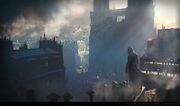 Arno Dorian near Notre-Dame
 -
 A Templar in a Parisian alley
 -


References
- ↑ 1.00 1.01 1.02 1.03 1.04 1.05 1.06 1.07 1.08 1.09 1.10 1.11 1.12 1.13 1.14 Assassin's Creed: Unity
- ↑ Assassin's Creed: Unity - Dead Kings
- ↑ 3.0 3.1 Assassin's Creed: Project Legacy - Divine Science: Chapter 1 - Maria Amiel
- ↑ Assassin's Creed: Project Legacy - Contracts
- ↑ 5.0 5.1 Assassin's Creed: Rogue
- ↑ Assassin's Creed: Project Legacy - Divine Science: Chapter 4 - Frater V.O.V.
- ↑ Assassin's Creed: Syndicate
- ↑ Twitter - AC: Initiates
| ||||||||||||||||||||||||||||
| |||||||||||||||||||||||||||||||
de:Paris
es:París
fr:Paris
hu:Párizs
it:Parigi
pl:Paryż
pt-br:Paris
ru:Париж
zh:巴黎