

Alamut
Alamut Castle was a fortress located in Persia which served as a stronghold for the Hidden Ones and later the capital of the Levantine Brotherhood of Assassins when it became a public state. It was also the site of a small Isu temple, which contained dozens of Memory Seals.[1]
The fortress was the parent of several other castles established throughout the mountains of Persia and Syria, most notably Masyaf. It remained in operation until the Mongol Empire destroyed it in 1256 in retaliation for Darim Ibn-La'Ahad and Qulan Gal's joint roles in the assassination of Genghis Khan, after which the fortress was abandoned.
History[edit | edit source]
Isu Era[edit | edit source]
During the Isu Era, the area where Alamut Castle would eventually be built served as the site of a prison for rogue Isu. Its sizeable collection of Memory Seals, some of which held the recorded memories of the prison's inmates, weathered the Great Catastrophe and remaied functioning long after millennia reduced the Alamut Temple to little more than a series of underground ruins, with debris and natural rock formations covering most of its entrances.[2]
Middle Ages[edit | edit source]
Hidden Ones stronghold[edit | edit source]
In the 9th century, the Hidden Ones discovered the ruins of the Alamut Temple. Seeking to protect the site from the Order of the Ancients, they decided to establish a permanent base of operations in the region,[2] setting up a camp in the Talysh Mountains.[3]

In 840, while hunting in the Talysh Mountains, Wahsudan ibn Marzuban caught sight of an eagle landing on a nearby rock. He took it as a sign and ordered the construction of what would eventually become the Alamut Castle.[4] The Hidden Ones later continued the foundations laid by Wahsudan, seeking to make the fortress their main base. They also formed an uneasy alliance with the Tahirids, who protected the grounds Alamut Castle was being built on.[5]
In 861, as construction of the fortress was nearing completion, the Master Assassin Roshan brought a new initiate, Basim ibn Ishaq, to Alamut and trained him in the Brotherhood's ways. Two months into his training, Basim and his fellow Hidden One Nur spotted a group of mercenaries while on patrol duty and dispatched them. Deducing that the mercenaries had been sent by the Order to find the location of the Hidden Ones' camp, Mentor Rayhan sent Nur to Baghdad to conduct an investigation.[5] When Nur later returned to Alamut wounded, Rayhan assigned Basim, Roshan, and Fuladh Al Haami to continue his investigation.[6]
After being informed by Qabiha, the Ra's Al-Af'a of the Order, that the Alamut Temple held the answers to his questions, Basim returned to Alamut to access the temple. However, he arrived in the midst of an attack by the Tahirids, who had ended their protection of Alamut due to a deal made by Baghdad's governor Muhammad ibn Tahir with the Order. Basim was quickly beset by two Tahirid soldiers but was rescued by Nur, who had been sent to find reinforcements.[2]

With Nur having been mortally wounded, Basim sought to avenge him and killed many of the Tahirid attackers, freeing several captive Hidden Ones in the process. This allowed the Brotherhood to gain the upper hand and repel the remaining soldiers, while Basim continued onwards to the Isu temple. Following a confrontation with Roshan, who tried to stop him, Basim ventured into the temple, where he discovered and embraced his nature as the Isu Loki's incarnation.[2]
In 879, Fuladh, following his promotion to Mentor of the Hidden Ones in the Justanid region of Persia, was set to host a council within the newly constructed fortress of Alamut. Rayhan invited Hytham, Basim's former apprentice who had started a new Hidden Ones chapter in England, to attend the council and provide a full account of Basim's betrayal.[7]
Assassin stronghold[edit | edit source]
Under Hassan-i Sabbāh's leadership, Alamut became the principal base of the Levantine Brotherhood when he transformed the order into a public state for the first time, in the late 11th century.[8] During Hassan the Younger's tenure as Mentor, an Assassin later popularly known as Al Mualim left the castle to establish the fortress at Masyaf in the An-Nusayriyah Mountains, ostensibly to spread Assassin influence to the Levant.[9] Despite rumors that this was the result of a schism between Hassan and his subordinate,[9] the two continued to co-exist as major strongholds for the Levantine Brotherhood throughout the medieval period.[10]
By 1228, Altaïr Ibn-La'Ahad, his son Darim, the wife of his late son Sef, and his grandchildren sought refuge in Alamut after Abbas Sofian staged a coup to take over the Assassin Order in Masyaf. Altaïr remained in exile in the fortress for almost two decades, during which time he made several discoveries, in addition to creating a number of inventions through knowledge gained from his Apple of Eden.[10] Altaïr also discovered the ruins of the Isu temple underneath Alamut,[1] and took six of the Memory Seals he found there with him, later using five of them as the keys to his library in Masyaf.[11]
In 1256, Assassin control of Alamut was lost to the invading Mongol Empire,[10] and its famous library was destroyed by fire on the order of Ata-Malik Juvayni, a servant of the Mongol court.[3]
Modern Era[edit | edit source]
In the early 18th century, the British Assassin Edward Kenway visited the ruins of Alamut and its Isu temple as part of his search for Precursor sites around the world.[12]
Trivia[edit | edit source]
- "Alamut" is a Persian word meaning "Eagle's Nest". It is also the name of the novel that partly inspired the first iteration of the Assassin's Creed franchise.
- Historically, Alamut, not Masyaf, was the last Assassin stronghold to fall to the Mongols after the Assassins' leader Rukn al-Din Khurshah was executed by the Mongols at 1256. In the series' lore, Masyaf falls in 1257, after Alamut.
- Although Alamut is in Persia, not the Levant, and Al Mualim's split from Hassan the Younger suggests that Alamut and Masyaf may have hosted separate branches, Assassin's Creed: The Essential Guide names Hassan-i Sabbah as a Levantine Assassin. This indicates that, at least officially if not in practice, Alamut and Masyaf belonged to the one and same branch, the Levantine Brotherhood.
Gallery[edit | edit source]
-
 Early Concept art for the Alamut Fortress
 -
 Concept art
 -
 Concept art
 -
 Concept art
 -
 Concept art
 -
 Concept art
 -
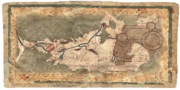 A map of Alamut's construction plans
 -
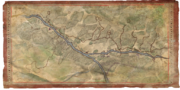 A map of Alamut Valley
 -
 Basim looking at the Alamut Castle from the valley
 -
 Basim and Nehal arriving at Alamut
 -
 Alamut Castle under construction


Appearances[edit | edit source]
- Assassin's Creed: The Secret Crusade (first appearance)
- Assassin's Creed: Rogue (mentioned only)
- Assassin's Creed: Valhalla (mentioned only)
- Shared History (mentioned only)
- Echoes of History (mentioned only)
- Assassin's Creed: Mirage
- Assassin's Creed: Mirage – A Soar of Eagles
References[edit | edit source]
- ↑ 1.0 1.1 Assassin's Creed: Revelations Official Game Guide
- ↑ 2.0 2.1 2.2 2.3 Assassin's Creed: Mirage – In Pursuit of Truth
- ↑ 3.0 3.1
 Alamut Castle on Wikipedia
- ↑ Assassin's Creed: Mirage – Database: Alamut
- ↑ 5.0 5.1 Assassin's Creed: Mirage – A New Beginning
- ↑ Assassin's Creed: Mirage – Taking Flight
- ↑ Assassin's Creed: Valhalla – Breaking the Order
- ↑ Assassin's Creed Encyclopedia
- ↑ 9.0 9.1 Assassin's Creed: Official Game Guide
- ↑ 10.0 10.1 10.2 Assassin's Creed: The Secret Crusade
- ↑ Assassin's Creed: Revelations
- ↑ Assassin's Creed: Rogue – War Letters: "Lawrence of America"