

Siwa: Difference between revisions
imported>Lady Kyashira mNo edit summary |
imported>Lady Kyashira mNo edit summary |
||
| Line 7: | Line 7: | ||
|state = Egypt | |state = Egypt | ||
|rulers = [[Ptolemaic dynasty|Ptolemaic Kingdom]] {{C|305 BCE–30 BCE}}<br>[[Roman Empire]] {{C|30 BCE–641 CE}}<br>[[Ottoman Empire]] {{C|1517–1867}}<br>Republic of Egypt {{C|1953–present}} | |rulers = [[Ptolemaic dynasty|Ptolemaic Kingdom]] {{C|305 BCE–30 BCE}}<br>[[Roman Empire]] {{C|30 BCE–641 CE}}<br>[[Ottoman Empire]] {{C|1517–1867}}<br>Republic of Egypt {{C|1953–present}} | ||
|factions = [[ | |factions = [[Medjay]]<br>[[Order of the Ancients]] | ||
|date = c. 665 BCE {{C|possibly}} | |date = c. 665 BCE {{C|possibly}} | ||
|landmark = [[Temple of Amun]] | |landmark = [[Temple of Amun]] | ||
|targets = [[Medunamun]]}} | |targets = [[Medunamun]]}} | ||
'''Siwa''' is an oasis and village located in [[Egypt]]. In ancient times, it was renowned for its [[Oracle of Amun]], which hailed [[Alexander the Great]] as ''Son of [[Jupiter|Ammon]]'' during his liberation of Egypt from [[ | '''Siwa''' is an oasis and village located in [[Egypt]]. In ancient times, it was renowned for its [[Oracle of Amun]], which hailed [[Alexander the Great]] as ''Son of [[Jupiter|Ammon]]'' during his liberation of Egypt from [[Persia]]n rule. | ||
Siwa also was the home of the [[Medjay]]-turned-[[Hidden One]] [[Bayek]] during the reigns of the two last Pharaohs of Egypt, [[Ptolemy XIII]], and [[Cleopatra]]. | Siwa also was the home of the [[Medjay]]-turned-[[Hidden One]] [[Bayek]] during the reigns of the two last Pharaohs of Egypt, [[Ptolemy XIII]], and [[Cleopatra]]. | ||
| Line 18: | Line 18: | ||
==History== | ==History== | ||
The [[Temple of Amun]] was built during the 6th century BCE, by Pharaoh [[Amasis]]. <ref>''[[Discovery Tour: Ancient Egypt]]'' – "Siwa" – The Ram-Headed Sphinxes</ref>[[Eubotas]], a | ===Classical period=== | ||
The [[Temple of Amun]] was built during the 6th century BCE, by Pharaoh [[Amasis]].<ref>''[[Discovery Tour: Ancient Egypt]]'' – "Siwa" – The Ram-Headed Sphinxes</ref> [[Eubotas]], a [[Cyrene|Cyrenaean]] athlete, consulted the oracle asking if he would win the 93rd [[Olympic Games]] race in 408 BCE. When he won the race, the standing of the Siwan Oracle was enhanced.<ref>''Discovery Tour: Ancient Egypt'' – "Siwa" – Predicting Victory</ref> | |||
In February 332 BCE, | ===Hellenistic period=== | ||
In February 332 BCE, Siwa was visited by the [[Makedonia]]n king [[Alexander the Great]] to consult the oracle at the Temple of Amun, emulating the actions of the mythical Greek heroes such as [[Herakles|Hercules]] and [[Perseus]]. This earned the approval of the oracle, who validated his claim as Pharaoh of Egypt. Proclaiming him to be the son of [[Amun|Ammon]], the most legitimate claim to the Egyptian throne to ever be given to a foreign invader.<ref>''Discovery Tour: Ancient Egypt'' – "Siwa" – Alexander the Great, Son of Ammon</ref> | |||
In 49 BCE, | [[File:Origins Quest04TheFalseOracle Part01.PNG|thumb|250px|left|The Order of the Ancients with a captured Bayek and Khemu]] | ||
In 49 BCE, the [[Order of the Ancients]] came to the village in search of a [[Siwa Vault|vault]] located beneath the [[Temple of Amun]]. Believing the Medjay Bayek to have knowledge regarding the vault, they kidnapped him and his son [[Khemu]], bringing them to the entrance. While the Order was distracted by the impending arrival of Ptolemy XIII, Khemu untied his father, who attempted to fight off the Order. Amidst the confusion, Khemu was killed by the Order, who then knocked Bayek unconscious.<ref name="The False Oracle">''Assassin's Creed: Origins'' – [[The False Oracle]]</ref> Bayek then began a quest of vengeance against the Order, leaving the village and his Medjay duties to hunt them down. His friend [[Hepzefa]] took over the Medjay duties during this period of time.<ref name="ACO">''[[Assassin's Creed: Origins]]''</ref> | |||
In 48 BCE, Bayek returned to Siwa, having assassinated his first target, [[Rudjek]]. Along the way, he was confronted by [[Hypatos]], Rudjek's personal bodyguard who had pursued Bayek to seek vengeance. The two fought and fell into the Old Kingdom ruin with Bayek later killing Hypatos. Navigating his way to the exit, Bayek was reunited with Hepzefa, helping him fend off Hypatos' men.<ref name="Homecoming">''Assassin's Creed: Origins'' – [[Homecoming (Origins)|Homecoming]]</ref> The two later rode on [[camel]]s back to the village, with Hepzefa informing Bayek of the corrupted tenure of the [[Oracle of Amun]], [[Medunamun]], who was a member of the Order of the Ancients.<ref name="The Oasis">''Assassin's Creed: Origins'' – [[The Oasis]]</ref> | In 48 BCE, Bayek returned to Siwa, having assassinated his first target, [[Rudjek]]. Along the way, he was confronted by [[Hypatos]], Rudjek's personal bodyguard who had pursued Bayek to seek vengeance. The two fought and fell into the Old Kingdom ruin with Bayek later killing Hypatos. Navigating his way to the exit, Bayek was reunited with Hepzefa, helping him fend off Hypatos' men.<ref name="Homecoming">''Assassin's Creed: Origins'' – [[Homecoming (Origins)|Homecoming]]</ref> The two later rode on [[camel]]s back to the village, with Hepzefa informing Bayek of the corrupted tenure of the [[Oracle of Amun]], [[Medunamun]], who was a member of the Order of the Ancients.<ref name="The Oasis">''Assassin's Creed: Origins'' – [[The Oasis]]</ref> | ||
Returning to Hepzefa's home, Bayek began making preparations to hunt down his next target, despite Hepzefa requesting him to rest. They were interrupted by the arrival of the village [[Doctor|healer]], [[Rabiah]], who tended to Bayek's injuries. Unable to refuse her aid, Bayek rested while Rabiah worked. After recovering, Bayek visited Hepzefa outside his home. Discovering Bayek's old bow to be broken, Hepzefa gave him a [[Hunting Bow|replacement]], which he tested. Shortly after, a villager came to inform Hepzefa that Ptolemaic soldiers were looking for him, due to the recent murder of Rudjek.<ref name="The Oasis" /> | Returning to Hepzefa's home, Bayek began making preparations to hunt down his next target, despite Hepzefa requesting him to rest. They were interrupted by the arrival of the village [[Doctor|healer]], [[Rabiah]], who tended to Bayek's injuries. Unable to refuse her aid, Bayek rested while Rabiah worked. After recovering, Bayek visited Hepzefa outside his home. Discovering Bayek's old bow to be broken, Hepzefa gave him a [[Hunting Bow|replacement]], which he tested. Shortly after, a villager came to inform Hepzefa that Ptolemaic soldiers were looking for him, due to the recent murder of Rudjek.<ref name="The Oasis" /> | ||
==Locations== | |||
'''Settlements''' | |||
*Siwa | |||
'''Military locations''' | |||
*[[Coral Escarpment Camp]] | |||
*[[Camp Shetjeh]] | |||
'''Treasure locations''' | |||
*[[Amanai Cave]] | |||
*[[Halma Point]] | |||
*[[Bayek's Home|Home]] | |||
*[[Lysandros' Oracle Offerings]] | |||
*[[Temple of Amun]] | |||
'''Tombs''' | |||
*[[Mountain of the Dead]] | |||
'''Papyrus locations''' | |||
*[[House of Life]] | |||
==Trivia== | ==Trivia== | ||
*Siwa's in-game name during Bayek's memories is anachronistic. In ancient Egypt, Siwa's name was '''Sekth-am'''. Greek geographers and historians called it '''Ammonium'''. Early Arab geographers termed the place as '''Santariyyah''', and the modern name "Siwa" didn't appear until the 15th century | *In the map of ''Assassin's Creed: Origins'', Siwa comprises one of the regions of Egypt. | ||
*Siwa's in-game name during Bayek's memories is anachronistic. In ancient Egypt, Siwa's name was '''Sekth-am'''. Greek geographers and historians called it '''Ammonium'''. Early Arab geographers termed the place as '''Santariyyah''', and the modern name "Siwa" didn't appear until the 15th century CE. | |||
==Gallery== | ==Gallery== | ||
Revision as of 05:00, 14 February 2020
- "Ah, Siwa. My home. A sacred oasis."
- ―Bayek describing Siwa, 48 BCE.[src]
Siwa is an oasis and village located in Egypt. In ancient times, it was renowned for its Oracle of Amun, which hailed Alexander the Great as Son of Ammon during his liberation of Egypt from Persian rule.
Siwa also was the home of the Medjay-turned-Hidden One Bayek during the reigns of the two last Pharaohs of Egypt, Ptolemy XIII, and Cleopatra.
Far removed from the center of Egypt, Siwa was more isolated from the culture of the Greek Ptolemaic dynasty than other parts of the country. Consequently, its people continued to hold the Nubian military order of the Medjay in high esteem, heralding Bayek, the last Medjay, as a hero.[1]
History
Classical period
The Temple of Amun was built during the 6th century BCE, by Pharaoh Amasis.[2] Eubotas, a Cyrenaean athlete, consulted the oracle asking if he would win the 93rd Olympic Games race in 408 BCE. When he won the race, the standing of the Siwan Oracle was enhanced.[3]
Hellenistic period
In February 332 BCE, Siwa was visited by the Makedonian king Alexander the Great to consult the oracle at the Temple of Amun, emulating the actions of the mythical Greek heroes such as Hercules and Perseus. This earned the approval of the oracle, who validated his claim as Pharaoh of Egypt. Proclaiming him to be the son of Ammon, the most legitimate claim to the Egyptian throne to ever be given to a foreign invader.[4]

In 49 BCE, the Order of the Ancients came to the village in search of a vault located beneath the Temple of Amun. Believing the Medjay Bayek to have knowledge regarding the vault, they kidnapped him and his son Khemu, bringing them to the entrance. While the Order was distracted by the impending arrival of Ptolemy XIII, Khemu untied his father, who attempted to fight off the Order. Amidst the confusion, Khemu was killed by the Order, who then knocked Bayek unconscious.[5] Bayek then began a quest of vengeance against the Order, leaving the village and his Medjay duties to hunt them down. His friend Hepzefa took over the Medjay duties during this period of time.[6]
In 48 BCE, Bayek returned to Siwa, having assassinated his first target, Rudjek. Along the way, he was confronted by Hypatos, Rudjek's personal bodyguard who had pursued Bayek to seek vengeance. The two fought and fell into the Old Kingdom ruin with Bayek later killing Hypatos. Navigating his way to the exit, Bayek was reunited with Hepzefa, helping him fend off Hypatos' men.[7] The two later rode on camels back to the village, with Hepzefa informing Bayek of the corrupted tenure of the Oracle of Amun, Medunamun, who was a member of the Order of the Ancients.[8]
Returning to Hepzefa's home, Bayek began making preparations to hunt down his next target, despite Hepzefa requesting him to rest. They were interrupted by the arrival of the village healer, Rabiah, who tended to Bayek's injuries. Unable to refuse her aid, Bayek rested while Rabiah worked. After recovering, Bayek visited Hepzefa outside his home. Discovering Bayek's old bow to be broken, Hepzefa gave him a replacement, which he tested. Shortly after, a villager came to inform Hepzefa that Ptolemaic soldiers were looking for him, due to the recent murder of Rudjek.[8]
Locations
Settlements
- Siwa
Military locations
Treasure locations
Tombs
Papyrus locations
Trivia
- In the map of Assassin's Creed: Origins, Siwa comprises one of the regions of Egypt.
- Siwa's in-game name during Bayek's memories is anachronistic. In ancient Egypt, Siwa's name was Sekth-am. Greek geographers and historians called it Ammonium. Early Arab geographers termed the place as Santariyyah, and the modern name "Siwa" didn't appear until the 15th century CE.
Gallery
-
 Concept art of Siwa
 -
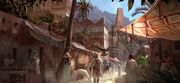 Concept art of Bayek at Siwa
 -
 Siwa Hieroglyph
 -
 Overview of Siwa


Appearances
- Assassin's Creed: Desert Oath (first appearance)
- Assassin's Creed: Origins
References
- ↑ Assassin's Creed Origins - What You Need To Know About Its New Setting, New Hero and New Action-RPG Gameplay
- ↑ Discovery Tour: Ancient Egypt – "Siwa" – The Ram-Headed Sphinxes
- ↑ Discovery Tour: Ancient Egypt – "Siwa" – Predicting Victory
- ↑ Discovery Tour: Ancient Egypt – "Siwa" – Alexander the Great, Son of Ammon
- ↑ Assassin's Creed: Origins – The False Oracle
- ↑ Assassin's Creed: Origins
- ↑ Assassin's Creed: Origins – Homecoming
- ↑ 8.0 8.1 Assassin's Creed: Origins – The Oasis