

Saint-Denis: Difference between revisions
imported>Gener4l Cl4ank4 No edit summary |
imported>Gener4l Cl4ank4 No edit summary |
||
| Line 14: | Line 14: | ||
==History== | ==History== | ||
===Origins=== | ===Origins=== | ||
According to legend, the bishop [[Saint Denis of Paris|Denis]] of Paris was beheaded and martyred sometime during the 3rd century. Undeterred, the man reportedly picked up his head, tucked it under his arm and then walked all the way to the village of Catolacus, where he finally collapsed and was buried.<ref name="DK">''[[Assassin's Creed: Unity]] – [[Dead Kings]]'' – [[Database: Franciade]] | According to legend, the bishop [[Saint Denis of Paris|Denis]] of Paris was beheaded and martyred sometime during the 3rd century. Undeterred, the man reportedly picked up his head, tucked it under his arm, and then walked all the way to the [[Roman Empire|Roman]] village of Catolacus, where he finally collapsed and was buried.<ref name="DK">''[[Assassin's Creed: Unity]] – [[Dead Kings]]'' – [[Database: Franciade]]</ref> | ||
In reality, this legend was the result of an unknown person using an [[Apple of Eden 1|Apple of Eden]] found by Denis to imprint a false memory within the minds of the general populace. Feeling the Apple's influence negatively affecting him, Denis' successor later created a special lantern to house it, which would come to be known as the [[Head of Saint Denis]], and returned the artifact to the [[Isu]] [[Temple (Isu)|temple]] where the bishop had originally found it.<ref name="Notes">''[[Assassin's Creed: Valhalla]] – [[The Siege of Paris]]'' – [[Notes from Eivor's travels]]: "Ancient Stone Tablet 2"</ref> | |||
Centuries after his death, Denis was canonized as a patron saint of France, and Catolacus was renamed Saint-Denis in his honor. A [[Basilica of Saint-Denis|church]] was also built on the site where Denis had allegedly collapsed with his severed head.<ref name="Basilica DB">''Assassin's Creed: Unity – Dead Kings'' – [[Database: Basilica of Saint Denis]]</ref> This site coincided with the entrance to the Isu temple housing the Head of Saint Denis.<ref name="Book Thief">''Assassin's Creed: Unity – Dead Kings'' – [[The Book Thief]]</ref> | |||
===Middle Ages=== | ===Middle Ages=== | ||
Over time, Saint-Denis would flourish | Over time, Saint-Denis would flourish thanks to its influential church and [[Abbey of Saint-Denis|abbey]], populated by abbots such as [[Suger of Saint-Denis|Suger]], who were advisors to the monarchy.<ref name="DK" /> The town was also notable for being the final resting place of a number of France's royalty,<ref name="Basilica DB" /> including [[Marie de' Medici]].<ref>''Assassin's Creed: Unity – Dead Kings'' – [[The Unopened Rose]]</ref> | ||
During the [[Siege of Paris (885–886)|Siege of Paris]] in 886 CE, the [[Vikings|Viking]] [[shieldmaiden]] and ''[[ | During the [[Siege of Paris (885–886)|Siege of Paris]] in 886 CE, the [[Vikings|Viking]] [[shieldmaiden]] and ''[[jarl]]skona'' of the [[Raven Clan]], [[Eivor Varinsdottir]], visited Saint-Denis and found a treasure hoard map. She also explored a crypt near the town's abbey, which led to the entrance of the Isu temple beneath Saint-Denis, though Eivor could only observe it from afar.<ref name="SoP">''Assassin's Creed: Valhalla – The Siege of Paris''</ref> | ||
===French Revolution=== | ===French Revolution=== | ||
| Line 27: | Line 29: | ||
The rise of anti-royalist sentiment during the French Revolution led to the [[National Convention]] ordering the destruction of the Saint-Denis Basilica's royal necropolis in 1793. Citizens of the time were traumatized to see the bodies of the kings, along with their buried relics, simply tossed out in the street by revolutionaries.<ref name="Basilica DB" /> By 1794, Saint-Denis, having been renamed Franciade, had adopted the atmosphere of a ghost town.<ref name="DK" /> | The rise of anti-royalist sentiment during the French Revolution led to the [[National Convention]] ordering the destruction of the Saint-Denis Basilica's royal necropolis in 1793. Citizens of the time were traumatized to see the bodies of the kings, along with their buried relics, simply tossed out in the street by revolutionaries.<ref name="Basilica DB" /> By 1794, Saint-Denis, having been renamed Franciade, had adopted the atmosphere of a ghost town.<ref name="DK" /> | ||
Around this time, a group of tomb [[ | Around this time, a group of tomb [[raider]]s led by [[Philippe Rose]] arrived in the commune to search the catacombs for valuables. They had been hired by [[Napoleon Bonaparte]], who sought access to the fabled [[Saint-Denis Temple]] built beneath the town's basilica, in order to gain possession of the artifact stored within.<ref name="Book Thief" /> | ||
However, the ex-[[Assassins|Assassin]] [[Arno Dorian]], who had traveled to Franciade in an effort to leave France, became embroiled in a conflict with the raiders. Spurred on by a local boy named [[Léon]], Arno ensured the | However, the ex-[[Assassins|Assassin]] [[Arno Dorian]], who had traveled to Franciade in an effort to leave France, became embroiled in a conflict with the raiders. Spurred on by a local boy named [[Léon]], Arno ensured that the artifact—which he discovered to be the Head of Saint-Denis—did not fall into Napoleon's hands. Arno subsequently removed the Apple of Eden from the lantern and sent it to the Assassins in [[Egypt]], while Napoleon was arrested for deserting his post and putting Franciade under martial law during his search for the relic.<ref name="Crown of Thorns">''Assassin's Creed: Unity – Dead Kings'' – [[A Crown of Thorns]]</ref> | ||
==Gallery== | ==Gallery== | ||
Revision as of 21:25, 19 July 2025
Saint-Denis is a city north of Paris, France. In 1793, during the French Revolution, it was briefly renamed Franciade to show a rejection of religion, but reverted to its original name in 1803.
History
Origins
According to legend, the bishop Denis of Paris was beheaded and martyred sometime during the 3rd century. Undeterred, the man reportedly picked up his head, tucked it under his arm, and then walked all the way to the Roman village of Catolacus, where he finally collapsed and was buried.[1]
In reality, this legend was the result of an unknown person using an Apple of Eden found by Denis to imprint a false memory within the minds of the general populace. Feeling the Apple's influence negatively affecting him, Denis' successor later created a special lantern to house it, which would come to be known as the Head of Saint Denis, and returned the artifact to the Isu temple where the bishop had originally found it.[2]
Centuries after his death, Denis was canonized as a patron saint of France, and Catolacus was renamed Saint-Denis in his honor. A church was also built on the site where Denis had allegedly collapsed with his severed head.[3] This site coincided with the entrance to the Isu temple housing the Head of Saint Denis.[4]
Middle Ages
Over time, Saint-Denis would flourish thanks to its influential church and abbey, populated by abbots such as Suger, who were advisors to the monarchy.[1] The town was also notable for being the final resting place of a number of France's royalty,[3] including Marie de' Medici.[5]
During the Siege of Paris in 886 CE, the Viking shieldmaiden and jarlskona of the Raven Clan, Eivor Varinsdottir, visited Saint-Denis and found a treasure hoard map. She also explored a crypt near the town's abbey, which led to the entrance of the Isu temple beneath Saint-Denis, though Eivor could only observe it from afar.[6]
French Revolution
- "Is France back in a state of terror? After only days of uneventful stability, soldiers of an unknown republican army have been spotted within Franciade. We were told they follow the young and charismatic general of the Army of Italy, Bonaparte, though he has not been spotted in person."
- ―A newspaper article on the presence of Napoleon's troops in Franciade, 1794.[src]
The rise of anti-royalist sentiment during the French Revolution led to the National Convention ordering the destruction of the Saint-Denis Basilica's royal necropolis in 1793. Citizens of the time were traumatized to see the bodies of the kings, along with their buried relics, simply tossed out in the street by revolutionaries.[3] By 1794, Saint-Denis, having been renamed Franciade, had adopted the atmosphere of a ghost town.[1]
Around this time, a group of tomb raiders led by Philippe Rose arrived in the commune to search the catacombs for valuables. They had been hired by Napoleon Bonaparte, who sought access to the fabled Saint-Denis Temple built beneath the town's basilica, in order to gain possession of the artifact stored within.[4]
However, the ex-Assassin Arno Dorian, who had traveled to Franciade in an effort to leave France, became embroiled in a conflict with the raiders. Spurred on by a local boy named Léon, Arno ensured that the artifact—which he discovered to be the Head of Saint-Denis—did not fall into Napoleon's hands. Arno subsequently removed the Apple of Eden from the lantern and sent it to the Assassins in Egypt, while Napoleon was arrested for deserting his post and putting Franciade under martial law during his search for the relic.[7]
Gallery
-
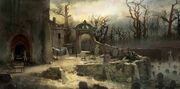 Concept art of a cemetery in Saint-Denis
 -
 Concept art of the streets of Saint-Denis
 -
 Level art of Saint-Denis during the 9th century
 -
 Level art of Saint-Denis during the 9th century
 -
 Level art of Saint-Denis during the 9th century
 -
 Level art of Saint-Denis during the 9th century


Appearances
- Assassin's Creed: Unity – Dead Kings (first appearance)
- Assassin's Creed: Valhalla – The Siege of Paris
References
- ↑ 1.0 1.1 1.2 Assassin's Creed: Unity – Dead Kings – Database: Franciade
- ↑ Assassin's Creed: Valhalla – The Siege of Paris – Notes from Eivor's travels: "Ancient Stone Tablet 2"
- ↑ 3.0 3.1 3.2 Assassin's Creed: Unity – Dead Kings – Database: Basilica of Saint Denis
- ↑ 4.0 4.1 Assassin's Creed: Unity – Dead Kings – The Book Thief
- ↑ Assassin's Creed: Unity – Dead Kings – The Unopened Rose
- ↑ Assassin's Creed: Valhalla – The Siege of Paris
- ↑ Assassin's Creed: Unity – Dead Kings – A Crown of Thorns
| |||||||||||||||||||||||||||||||||||||||||||||||||||||||||