

Parthenon: Difference between revisions
imported>Sadelyrate No edit summary |
imported>VilkaTheWolf No edit summary |
||
| Line 22: | Line 22: | ||
In 429 BCE, while the [[Plague of Athens|plague]] was wreaking havoc in Athens, Perikles made it his mission to come to Parthenon and seek to please the gods. Instead, he met his end at the hands of the [[Cult of Kosmos]]' enforcer, [[Alexios|Deimos]].<ref name="Last Hope" /> | In 429 BCE, while the [[Plague of Athens|plague]] was wreaking havoc in Athens, Perikles made it his mission to come to Parthenon and seek to please the gods. Instead, he met his end at the hands of the [[Cult of Kosmos]]' enforcer, [[Alexios|Deimos]].<ref name="Last Hope" /> | ||
The worship of Athena continued on for nearly one millennium. However, parts of the temple was destroyed during the {{Wiki|Sack of Athens (267 AD)|Sack of Athens}} in 267 CE by the {{Wiki|Herules|Heruli}}.<ref name="Discovery Tour">''Assassin's Creed: Odyssey'' – ''[[Discovery Tour]]'' | The worship of Athena continued on for nearly one millennium. However, parts of the temple was destroyed during the {{Wiki|Sack of Athens (267 AD)|Sack of Athens}} in 267 CE by the {{Wiki|Herules|Heruli}}.<ref name="Discovery Tour">''Assassin's Creed: Odyssey'' – ''[[Discovery Tour]]'' – "The Akropolis of Athens" – Parthenon Exterior</ref> | ||
In 590, the Parthenon was converted into a {{Wiki|Christianity|Christian}} church dedicated to Maria Parthenos—the {{Wiki|Mary, mother of Jesus|Virgin Mary}} who replaced Athena as the new patron protector of Athens. It became the fourth most important pilgrimage destination in the [[Byzantine Empire]], after [[Constantinople]], {{Wiki|Ephesus}}, and {{Wiki|Thessalonica}}.<ref name="Discovery Tour" /> | In 590, the Parthenon was converted into a {{Wiki|Christianity|Christian}} church dedicated to Maria Parthenos—the {{Wiki|Mary, mother of Jesus|Virgin Mary}} who replaced Athena as the new patron protector of Athens. It became the fourth most important pilgrimage destination in the [[Byzantine Empire]], after [[Constantinople]], {{Wiki|Ephesus}}, and {{Wiki|Thessalonica}}.<ref name="Discovery Tour" /> | ||
Revision as of 14:17, 15 October 2019
| This article is about landmark in Athens. You may be looking for the Panthéon in Paris or the Pantheon in Rome. |
The Parthenon (Greek: Παρθενώνας), also called Temple of Athena[1], is a former temple on the Akropolis Sanctuary in Athens, Greece, dedicated to the goddess Athena, the patron god of Athens.
Made of Pentelic marble, the temple was known for housing the massive statue of Athena made by the renowned sculptor Phidias. The structure also held the city's and Delian League's riches during the classical period.[2]
History
Antiquity
At the command of Perikles, the construction of Parthenon began in 447 BCE when the Athenian Empire was at the peak of its power. It was completed in 438 BCE, although decoration of the building continued until 432 BCE.[3]
In 429 BCE, while the plague was wreaking havoc in Athens, Perikles made it his mission to come to Parthenon and seek to please the gods. Instead, he met his end at the hands of the Cult of Kosmos' enforcer, Deimos.[1]
The worship of Athena continued on for nearly one millennium. However, parts of the temple was destroyed during the Sack of Athens in 267 CE by the Heruli.[4]
In 590, the Parthenon was converted into a Christian church dedicated to Maria Parthenos—the Virgin Mary who replaced Athena as the new patron protector of Athens. It became the fourth most important pilgrimage destination in the Byzantine Empire, after Constantinople, Ephesus, and Thessalonica.[4]
Middle Ages
In 1204, Athens was occupied by the Latin Empire which turned the city into a Crusader duchy. During this period, the Parthenon was converted into a Roman Catholic cathedral of Our Lady.[4]
After the conquer of the Byzantine Empire by the Ottoman Empire in 1458, the church was transformed once again, this time into an Islamic mosque.[4]
In 1683, the Great Turkish War broke out between the Ottoman Empire and the Holy League organized by the Pope. The Parthenon was soon converted into a storehouse for gunpowder. In 1687, the Republic of Venice laid siege to Athens and during the siege, a cannon ball struck the Parthenon, blowing the roof apart and greatly damaging the walls, columns and metopes of the building.[4]
Trivia
- Instead of its real marble pedimental sculptures, the Parthenon has the same fictional bronze pedimental sculptures depicting the Gigantomachy, the battle between the Giants and the Greek gods in Greek mythology that are also shared by other temples in game.[5][6]
- Like many other temples in game, the Parthenon inaccurately has the metopes of the Temple of Zeus in Olympia which show the Labours of Hercules instead of its actual metopes.[5]
Gallery
-
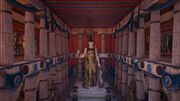 The statue of Athena Parthenos at the back hall of the temple
 -
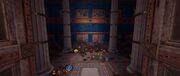 Offerings and treasury at the main hall


Appearances
References
- ↑ 1.0 1.1 Assassin's Creed: Odyssey – Athens's Last Hope
- ↑ Assassin's Creed: Odyssey – Attika: Parthenon
- ↑ Assassin's Creed: Odyssey
- ↑ 4.0 4.1 4.2 4.3 4.4 Assassin's Creed: Odyssey – Discovery Tour – "The Akropolis of Athens" – Parthenon Exterior
- ↑ 5.0 5.1 1/3 Here are some composite images I made featuring the east and west pediments and the metopes of the Parthenon both real and imagined in Assassin's Creed: Odyssey.. Tweet by @adreinhard. Accessed 29 August 2019.
- ↑ Why do the Elgin Marbles on the Parthenon are made out bronze in the game?. reddit.com. Accessed 29 August 2019.