

Minoan civilization: Difference between revisions
imported>Sadelyrate No edit summary |
imported>Sadelyrate No edit summary |
||
| Line 1: | Line 1: | ||
{{Era|Culture}} | {{Era|Culture}} | ||
{{WP-REAL}} | {{WP-REAL}} | ||
{{Stub}} | {{Stub}} | ||
[[File:ACOd-mural-MinoanBullleapingFresco.jpg|thumb|250px|A Minoan bull-leaping fresco]] | |||
The '''Minoan civilization''' was a culture that flourished on the [[Greece|Greek]] island of [[Krete]] in {{Wiki|Bronze Age}}. It was named by the archaeologist {{Wiki|Arthur Evans|Arthur John Evans}} after king [[Minos]]. | The '''Minoan civilization''' was a culture that flourished on the [[Greece|Greek]] island of [[Krete]] in {{Wiki|Bronze Age}}. It was named by the archaeologist {{Wiki|Arthur Evans|Arthur John Evans}} after king [[Minos]]. | ||
| Line 23: | Line 23: | ||
==Legacy and influence== | ==Legacy and influence== | ||
Due to the extent of the Minoan civilization, it influenced the myths and histories of Greece in general. The [[Minotaur]], 'bull of Minos', and the inhabitant of [[Daidalos]]' [[Labyrinth of Lost Souls|Labyrinth]], lived on in Greek retellings into modern age.<ref>''Assassin's Creed: Odyssey''</ref> | Due to the extent of the Minoan civilization, it influenced the myths and histories of Greece in general. The [[Minotaur]], 'bull of Minos', and the inhabitant of [[Daidalos]]' [[Labyrinth of Lost Souls|Labyrinth]], lived on in Greek retellings into modern age.<ref>''Assassin's Creed: Odyssey''</ref> | ||
==Gallery== | |||
<gallery captionalign="center" position="center"> | |||
ACOd-mural-MinoanCup-bearerFresco.jpg|A Minoan mural featuring cup-bearers | |||
ACOd-mural-MinoanGriffinFresco+.jpg|A Minoan mural featuring a griffin, [[lion]]s and antelopes | |||
</gallery> | |||
==Appearances== | ==Appearances== | ||
Revision as of 13:08, 24 September 2019


The Minoan civilization was a culture that flourished on the Greek island of Krete in Bronze Age. It was named by the archaeologist Arthur John Evans after king Minos.
History
The golden age of the Minoan civilization lasted from around 1700 BCE to around 1400 BCE was also called the Neopalatial period due to the building, destroying, and rebuilding of palaces, chief among them the Knossos Palace.[1]
Economy
This culture thrived on trade, and its influence extended over the eastern Mediterranean, usually through peaceful means.[1]
Cattle were valued, especially bulls, and they are mentioned in documents written in Linear B.[2]
Art
The Minoan civilization created its own writing modes, first using what is known as Linear A and then later Linear B, used to record things like business transactions. These were discovered by the archaeologist Arthur John Evans.[3]
A notable amount of Minoan art depicts bulls, the best known example being the Bull-Leaping Fresco, found on the wall of the Knossos Palace.[2]
End
After 1400 BCE, the Mycenaeans from the mainland Greece conquered Krete, and the Minoan palace centers collapsed, signalling the end of the Minoan civilization.[4]
Legacy and influence
Due to the extent of the Minoan civilization, it influenced the myths and histories of Greece in general. The Minotaur, 'bull of Minos', and the inhabitant of Daidalos' Labyrinth, lived on in Greek retellings into modern age.[5]
Gallery
-
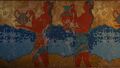 A Minoan mural featuring cup-bearers
 -
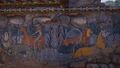 A Minoan mural featuring a griffin, lions and antelopes


Appearances
- Assassin's Creed: Odyssey (mentioned only)
References
- ↑ 1.0 1.1 Assassin's Creed: Odyssey – Famous Cities – Knossos: Minoan Civilization
- ↑ 2.0 2.1 Assassin's Creed: Odyssey – Famous Cities – Knossos: The Birth of the Minotaur
- ↑ Assassin's Creed: Odyssey – Famous Cities – Knossos: Minoan Art
- ↑ Assassin's Creed: Odyssey – Famous Cities – Knossos: Knossos
- ↑ Assassin's Creed: Odyssey