

Iltani: Difference between revisions
imported>Lady Kyashira mNo edit summary |
imported>Jasca Ducato m Citations should only be in the introduction if there is nowhere else they could be |
||
| Line 7: | Line 7: | ||
|active = 4th century BCE<br />[[Babylonia]] and [[Achaemenid Empire]] | |active = 4th century BCE<br />[[Babylonia]] and [[Achaemenid Empire]] | ||
|species = [[Human]] | |species = [[Human]] | ||
|affiliates = [[Iltani's Order]] | |affiliates = [[Iltani's Order]]<ref name="ACCI">''[[Assassin's Creed Chronicles: India]]''</ref> | ||
}} | }} | ||
'''Iltani''' was a member of | '''Iltani''' was a Babylonian Proto-Assassin and member of a secret [[Iltani's Order|Order]] who sought to preserve free will. To this end, she assassinated the [[Makedonia|Macedonian]] king [[Alexander the Great]], by poisoning, in 323 BCE. | ||
For her deeds | |||
For her deeds, Iltani later became famous amongst the [[Assassins]], and is considered to be one of the first followers of the Assassin ideals to this day. | |||
==Biography== | ==Biography== | ||
Revision as of 13:09, 24 January 2019
- "I have found the Achaemenid, and he gave me the secret of his poison. Not as fast as I would have hoped, but always fatal. Ironically, Alexander will die by the poison of those whom he had vanquished in battle."
- ―Iltani in a message for her Order.[src]
Iltani was a Babylonian Proto-Assassin and member of a secret Order who sought to preserve free will. To this end, she assassinated the Macedonian king Alexander the Great, by poisoning, in 323 BCE.
For her deeds, Iltani later became famous amongst the Assassins, and is considered to be one of the first followers of the Assassin ideals to this day.
Biography
During Iltani's lifetime, Persia was conquered by the Macedonian Empire under Alexander the Great, and she watched as the ambitious, young king swept through her homeland with a Staff of Eden provided to him by proto-Templars.[2][3][1]
Determined to put an end to Alexander's path of conquest, Iltani tracked him to Herat in modern-day Afghanistan, where he was holed up in a mighty citadel.[4] Despite its high walls, she managed to infiltrate the citadel but remained apprehensive that she would be able to eliminate him through force.[5] Sure enough, she became aware that through cunning, Alexander had somehow divined her presence within the fortress. Realizing that the risks were too great, she aborted her mission and withdrew from Herat.[6]
Her failure did not disrupt her resolve, and she quickly devised an alternative plan, one that involved meeting with a renowned Achaemenid alchemist who was then being hunted by the Greeks. After a perilous journey,[7] she arrived in Babylon, where she found the alchemist and acquired the secret formula for a deadly poison. While the poison was not as fast-acting as she had hoped, it was virulent enough to guarantee death.[8]
Throughout her mission to kill Alexander, she had left messages across the lands she traveled, including India and Herat. These messages chronicled her quest and could only be deciphered through Eagle Vision. In the event that her assassination were to fail, she even left behind the recipe of the poison on her last message, hoping it would serve her Order.[8]
This proved unnecessary, as in June 323 BCE, Iltani successfully poisoned Alexander the Great after infiltrating the palace of Nebuchadnezzar II. True to the slow nature of her poison, Alexander withered away over several days until he finally perished.[9][3]
Legacy
By the time of the Renaissance, a tomb dedicated to Iltani was located on the top of Santa Maria del Fiore in Florence, Italy. The Italian Assassin Ezio Auditore da Firenze explored the tomb and took the hidden seal from the sarcophagus, which later allowed him to obtain the Armor of Altaïr Ibn-La'Ahad sealed in the Sanctuary beneath Villa Auditore in Monteriggioni.[3]
In 1841, the Indian Assassin Arbaaz Mir came across her scrolls during his travels. With the Eagle Vision, he was able to decipher the scrolls and learn its content.[1]
In the year 2000, a statue of Iltani stood in the Mentor's office in Dubai.[10]
Trivia
- Iltani is the feminine form of a Babylonian word meaning 'lucky' or 'favored by the god(dess)'. It is also the Babylonian name for the north wind.
Gallery
-
 Iltani's statue and sarcophagus
 -
 The Seal of Iltani
 -
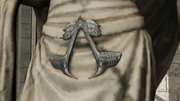 Iltani's insignia


Appearances
- Assassin's Creed II (statue only)
- Assassin's Creed: Brotherhood (statue only)
- Assassin's Creed: The Fall (statue only)
- Assassin's Creed Chronicles: India (mentioned only)
References
- ↑ 1.0 1.1 1.2 Assassin's Creed Chronicles: India
- ↑ Assassin's Creed Encyclopedia
- ↑ 3.0 3.1 3.2 Assassin's Creed II
- ↑ Assassin's Creed Chronicles: India – Database: Iltani's Story 1
- ↑ Assassin's Creed Chronicles: India – Database: Iltani's Story 2
- ↑ Assassin's Creed Chronicles: India – Database: Iltani's Story 3
- ↑ Assassin's Creed Chronicles: India – Database: Iltani's Story 4
- ↑ 8.0 8.1 Assassin's Creed Chronicles: India – Database: Iltani's Story 5
- ↑ Assassin's Creed: Initiates
- ↑ Assassin's Creed: The Fall – Issue #3


| |||||||||||||||||||||||||||||||