

Herodotos: Difference between revisions
imported>Jasca Ducato m Website makes no such claim on cited pages, so far as I can see |
imported>Jasca Ducato mNo edit summary |
||
| Line 15: | Line 15: | ||
'''Herodotos''' (born c. 484 BCE), alternatively '''Herodotus''', was one of the earliest [[Greece|Greek]] historians. Often referred to as "The Father of History" in {{wiki|Western world|Western society}}, his most famous work is the ''{{wiki|Histories (Herodotus)|Histories}}'', a chronicle of Greece that was later divided into nine books named after the [[Muses]].<ref name="ACO">''[[Assassin's Creed: Origins]]''</ref> Detractors, however, mocked him as "The Father of Lies" owing to his penchant for embellishment.<ref name="ACOD Characters">[https://assassinscreed.ubisoft.com/game/en-ca/odyssey/characters ''Assassin's Creed: Odyssey'' – Characters]. Ubisoft. Accessed 14 June 2018.</ref> | '''Herodotos''' (born c. 484 BCE), alternatively '''Herodotus''', was one of the earliest [[Greece|Greek]] historians. Often referred to as "The Father of History" in {{wiki|Western world|Western society}}, his most famous work is the ''{{wiki|Histories (Herodotus)|Histories}}'', a chronicle of Greece that was later divided into nine books named after the [[Muses]].<ref name="ACO">''[[Assassin's Creed: Origins]]''</ref> Detractors, however, mocked him as "The Father of Lies" owing to his penchant for embellishment.<ref name="ACOD Characters">[https://assassinscreed.ubisoft.com/game/en-ca/odyssey/characters ''Assassin's Creed: Odyssey'' – Characters]. Ubisoft. Accessed 14 June 2018.</ref> | ||
During the [[Peloponnesian War]], Herodotos accompanied [[Kassandra]] on her adventures | During the [[Peloponnesian War]], Herodotos accompanied [[Kassandra]] on her adventures and [[Lost Histories|documented her ordeals]]. These records would eventually become lost to time until their rediscovery in 2018 by [[Layla Hassan]] of the [[Assassins|Assassin Brotherhood]].<ref name="Kotaku">Totilo, Stephen. [https://www.kotaku.com.au/2018/06/everything-we-learned-about-assassins-creed-odyssey-after-playing-it/ "Everything We Learned About Assassin's Creed Odyssey After Playing It"]. Kotaku, 12 June 2018. Accessed 14 June 2018.</ref><ref name="ACOD book">[[Assassin's Creed: Odyssey (novel)|''Assassin's Creed: Odyssey'' novelization]]</ref> | ||
==Biography== | ==Biography== | ||
Revision as of 15:44, 7 March 2019

|
Where are the paintings? This article is in need of more images and/or better quality pictures from official media in order to achieve a higher status. You can help the Assassin's Creed Wiki by uploading better images on this page. |

Herodotos (born c. 484 BCE), alternatively Herodotus, was one of the earliest Greek historians. Often referred to as "The Father of History" in Western society, his most famous work is the Histories, a chronicle of Greece that was later divided into nine books named after the Muses.[1] Detractors, however, mocked him as "The Father of Lies" owing to his penchant for embellishment.[2]
During the Peloponnesian War, Herodotos accompanied Kassandra on her adventures and documented her ordeals. These records would eventually become lost to time until their rediscovery in 2018 by Layla Hassan of the Assassin Brotherhood.[3][4]
Biography
Early life
Herodotos was born in 484 BCE in the city of Halicarnassus. He was eventually forced into exile on the island of Samos by the tyrant Lygdamis II of Halicarnassus, before later returning to overthrow him in a coup.[5]
Meeting the misthios
Prior to the Peloponnesian War, Herodotos met and became aquainted with the captain of the Adrestia Barnabas.[6] Herotodos also befriended the Athenian statesman Perikles, who led Athens in the later half of the 5th century BCE.[7]
In 431 BCE, Herodotos was tasked by Perikles to seek the Pythia's guidance at the Sanctuary of Delphi. There, he was reunited with Barnabas and was introduced to Kassandra who came to seek the Pythia's help on her family's whereabouts. Recognising the Spear of Leonidas, Herotodos introduced himself to Kassandra and explained his mission in Delphi. Herotodos informed Kassandra that something was strange in Delphi; the number of guards were increasing and people were being turned away from the Oracle.[7]
Nevertheless, Kassandra went ahead and visited the Pythia for answers, but eventually end up being prevented so by the guards. She met with Herodotos outside the temple, who informed her that Barnabas had returned to her ship.[7]
After Kassandra's Spear of Leonidas eventually ran out of energy, Kassandra gifted it to Herodotos for his research. The spear was later buried along with his research until 2018, when it was found by Layla Hassan.[6]
Legacy
In 38 BCE, Herodotos' notes about Egypt were used by the priests of the Temple of Thoth in Sinai for research. However, they were later deemed to be filled with misinformation and odd anecdotes, resulting in some of his research being dismissed.[8]
Gallery
-
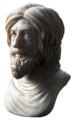 A bust depicting Herodotos
 -
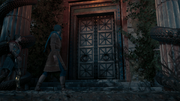 Herodotos and Kassandra in front of the door to the Cult's lair
 -
 Herodotos and Kassandra in front of the Lion of Leonidas
 -
 Concept Art


Appearances
- Assassin's Creed: Origins (mentioned only)
- The Hidden Ones (mentioned only)
- Assassin's Creed: Odyssey (first appearance)
References
- ↑ Assassin's Creed: Origins
- ↑ Assassin's Creed: Odyssey – Characters. Ubisoft. Accessed 14 June 2018.
- ↑ Totilo, Stephen. "Everything We Learned About Assassin's Creed Odyssey After Playing It". Kotaku, 12 June 2018. Accessed 14 June 2018.
- ↑ Assassin's Creed: Odyssey novelization
- ↑ Assassin's Creed: Odyssey – Packing for Greece
- ↑ 6.0 6.1 Assassin's Creed: Odyssey
- ↑ 7.0 7.1 7.2 Assassin's Creed: Odyssey – Consulting a Ghost
- ↑ Assassin's Creed: Origins – The Hidden Ones