


Greek fire: Difference between revisions
imported>Gener4l Cl4ank4 No edit summary |
imported>Lacrossedeamon no need for that line in intro given the history section; added Odyssey stuff; can someone check the leo III stuff; added Mirage stuff; converted and moved trivia into BTS; is there a standardized way to order images in the gallery? |
||
| Line 3: | Line 3: | ||
{{Quote|Tales from the West tell of a substance called Greek fire, whose flames cannot be doused with any volume of water, only serving to intensify its fury instead!|Yun Pyeong-Gyu, 1725.|Assassin's Creed: Forgotten Temple|Assassin's Creed: Forgotten Temple Episode 48}} | {{Quote|Tales from the West tell of a substance called Greek fire, whose flames cannot be doused with any volume of water, only serving to intensify its fury instead!|Yun Pyeong-Gyu, 1725.|Assassin's Creed: Forgotten Temple|Assassin's Creed: Forgotten Temple Episode 48}} | ||
[[File:Setting_sail_9.png|thumb|250px|Ezio using Greek fire]] | [[File:Setting_sail_9.png|thumb|250px|Ezio using Greek fire]] | ||
'''Greek fire''' was a powerful [[Byzantine Empire|Byzantine]] incendiary weapon that was a closely guarded military secret. Its true composition remains unknown to this day, despite multiple theories. Famously, it was reputed to burn more fiercely on contact with water, making it particularly valuable in naval warfare.<ref>{{WP|Greek fire}} | '''Greek fire''' was a powerful [[Byzantine Empire|Byzantine]] incendiary weapon that was a closely guarded military secret. Its true composition remains unknown to this day, despite multiple theories. Famously, it was reputed to burn more fiercely on contact with water, making it particularly valuable in naval warfare.<ref name="Greek fire">{{WP|Greek fire}}</ref> | ||
==History== | ==History== | ||
===Antiquity=== | ===Antiquity=== | ||
A precursor to Greek fire was used during the [[Peloponnesian War]] with the Boeotian flamethrower being used at the [[Battle of Boeotia]]<ref>[[Assassin's Creed: Odyssey (novel)|''Assassin's Creed Odyssey'' novel]] – Chapter 13</ref> and later at the {{wiki|Battle of Delium}}<ref>{{WP|Battle of Delium}}</ref>. Additionally the [[Cult of Kosmos]] was manufacturing Boeotian flamethrowers at the [[Ancient Stronghold]] on [[Lemnos]].<ref>''[[Assassin's Creed: Odyssey]]''</ref> Around the same time the [[Order of the Ancients]] were also looking to create their own Greek fire fueled weapon,<ref>''Assassin's Creed: Odyssey'' – ''[[Legacy of the First Blade: Shadow Heritage]]'' – [[Persian Puppetry]]</ref> commissioning the [[Achaia]]n engineer [[Gyras]] to design a naval mounted delivery system called the [[Chimera's Breath]].<ref>''Assassin's Creed: Odyssey'' – ''Legacy of the First Blade: Shadow Heritage'' – [[Theatrics and Espionage]]</ref> However the plans were instead recovered by the ''[[misthios]]'' [[Kassandra]] who installed it on to her ship the ''[[Adrestia]]''<ref>''Assassin's Creed: Odyssey'' – ''Legacy of the First Blade: Shadow Heritage'' – [[Tides of War]]</ref> and used it to break the Order's blockade of [[Greece]]<ref>''Assassin's Creed: Odyssey'' – ''Legacy of the First Blade: Shadow Heritage'' – [[Leviathan's Maw]]</ref> | |||
[[File:ACO Playing with Fire 9.png|thumb|250px|left|Bayek discovering Agrippa's stockpiles of Greek fire]] | [[File:ACO Playing with Fire 9.png|thumb|250px|left|Bayek discovering Agrippa's stockpiles of Greek fire]] | ||
At some point prior to 47 BCE, a precursor to Greek fire was developed by the [[Rome|Roman]] architect [[Vitruvius]]. After realizing its potential for destruction, Vitruvius hid the formula away to prevent the weapon from ever being produced, but [[Agrippa]], a general serving under [[Flavius Metellus]], eventually discovered it and began mass producing the weapon for the [[Roman army]]. Vitruvius sought the help of the [[Medjay]] [[Bayek]] of [[Siwa]] to recover the formula and destroy the stockpiles of Greek fire already produced by the Romans, which he did.<ref name="Playing with Fire">''[[Assassin's Creed: Origins]]'' – [[Playing with Fire]]</ref> | At some point prior to 47 BCE, a another precursor to Greek fire was developed by the [[Rome|Roman]] architect [[Vitruvius]]. After realizing its potential for destruction, Vitruvius hid the formula away to prevent the weapon from ever being produced, but [[Agrippa]], a general serving under [[Flavius Metellus]], eventually discovered it and began mass producing the weapon for the [[Roman army]]. Vitruvius sought the help of the [[Medjay]] [[Bayek]] of [[Siwa]] to recover the formula and destroy the stockpiles of Greek fire already produced by the Romans, which he did.<ref name="Playing with Fire">''[[Assassin's Creed: Origins]]'' – [[Playing with Fire]]</ref> | ||
===Middle Ages=== | ===Middle Ages=== | ||
Greek fire was first used by the Byzantine Emperor {{Wiki|Leo III the Isaurian|Leon III}}'s army, when enemy vessels laid siege to Constantinople in the year 717. In the battle, the napalm-like substance burned through the enemy fleet, forcing them to call off their attack and flee west.<ref>{{WP|Siege of Constantinople (717–718)}}</ref> | Greek fire was first used by the Byzantine Emperor {{Wiki|Leo III the Isaurian|Leon III}}'s army, when enemy vessels laid siege to [[Constantinople]] in the year 717. In the battle, the napalm-like substance burned through the enemy fleet, forcing them to call off their attack and flee west.<ref>{{WP|Siege of Constantinople (717–718)}}</ref> Likewise the [[Abbasid Caliphate|Abbasid]] army used Greek fire employing ''Naffatah'' [[soldier]]s equipped with grenades and siphons.<ref>''[[Assassin's Creed: Mirage]]'' – [[Database: Naffatah]]</ref> | ||
In the 9th century, [[Endubis]], a former general of the [[Aksumite Kingdom]]-turned-cult leader, lined the walls of the [[Church of Abuna Yemata]] with Greek fire. When his stronghold came under attack by the [[Assassins|Hidden Ones]] [[Fuladh Al Haami]] and [[Roshan]] and their allies, Endubis ignited the substance, opting to destroy the church rather than let it fall to the invaders.<ref name="Soar of Eagles 2">''[[Assassin's Creed: Mirage – A Soar of Eagles]]'' – [[Assassin's Creed: Mirage – A Soar of Eagles 2|Issue #2]]</ref> | In the 9th century, [[Endubis]], a former general of the [[Aksumite Kingdom]]-turned-cult leader, lined the walls of the [[Church of Abuna Yemata]] with Greek fire. When his stronghold came under attack by the [[Assassins|Hidden Ones]] [[Fuladh Al Haami]] and [[Roshan]] and their allies, Endubis ignited the substance, opting to destroy the church rather than let it fall to the invaders.<ref name="Soar of Eagles 2">''[[Assassin's Creed: Mirage – A Soar of Eagles]]'' – [[Assassin's Creed: Mirage – A Soar of Eagles 2|Issue #2]]</ref> | ||
In 1507, during the [[Siege of Viana]], the defenders used Greek fire against the attacking forces led by [[Cesare Borgia]].<ref name="ACB novel">[[Assassin's Creed: Brotherhood (novel)|''Assassin's Creed: Brotherhood'' novel]]</ref> Four years later, the [[Italian Brotherhood of Assassins|Italian Assassin]] [[Ezio Auditore da Firenze|Ezio Auditore]] used Greek fire in order to destroy several ships preventing him from leaving Constantinople.<ref name="Setting Sail">''[[Assassin's Creed: Revelations]]'' – [[Setting Sail]]</ref> The [[Ottoman Brotherhood of Assassins|Ottoman Assassins]] also mounted Greek fire weapons along the barricades they used to defend their dens from [[Templars|Templar]] attacks.<ref name="ACR" /> | In 1507, during the [[Siege of Viana]], the defenders used Greek fire against the attacking forces led by [[Cesare Borgia]].<ref name="ACB novel">[[Assassin's Creed: Brotherhood (novel)|''Assassin's Creed: Brotherhood'' novel]]</ref> Four years later, the [[Italian Brotherhood of Assassins|Italian Assassin]] [[Ezio Auditore da Firenze|Ezio Auditore]] used Greek fire in order to destroy several ships preventing him from leaving Constantinople.<ref name="Setting Sail">''[[Assassin's Creed: Revelations]]'' – [[Setting Sail]]</ref> The [[Ottoman Brotherhood of Assassins|Ottoman Assassins]] also mounted Greek fire weapons along the barricades they used to [[Den Defense|defend]] their [[Assassin Den|dens]] from [[Templars|Templar]] attacks.<ref name="ACR">''[[Assassin's Creed: Revelations]]''</ref> | ||
===18th century=== | ===18th century=== | ||
| Line 33: | Line 33: | ||
Later, Yun also invented Greek fire flamethrowers, which the Zhang Wei Union made use of during a battle against the [[Rattan Shield Company]] and [[Shimazu clan]] [[ninja]];<ref name="FT 84">''[[Assassin's Creed: Forgotten Temple]]'' – [[Assassin's Creed: Forgotten Temple Episode 84|Episode 84]]</ref> trapping the ninja by creating a wall of fire around them and allowing the Union members to eliminate them.<ref name="FT 85">''[[Assassin's Creed: Forgotten Temple]]'' – [[Assassin's Creed: Forgotten Temple Episode 85|Episode 85]]</ref> | Later, Yun also invented Greek fire flamethrowers, which the Zhang Wei Union made use of during a battle against the [[Rattan Shield Company]] and [[Shimazu clan]] [[ninja]];<ref name="FT 84">''[[Assassin's Creed: Forgotten Temple]]'' – [[Assassin's Creed: Forgotten Temple Episode 84|Episode 84]]</ref> trapping the ninja by creating a wall of fire around them and allowing the Union members to eliminate them.<ref name="FT 85">''[[Assassin's Creed: Forgotten Temple]]'' – [[Assassin's Creed: Forgotten Temple Episode 85|Episode 85]]</ref> | ||
==Gallery== | ==Gallery== | ||
<gallery captionalign="center" position="center" widths="180"> | <gallery captionalign="center" position="center" widths="180"> | ||
ACOd Greek Fire Machine 01.png|Boeotian flamethrower | |||
ACOD Chimera's Breath.jpg|The [[Chimera's Breath]] installed on the ''[[Adrestia]]'' | |||
ACMirage DB Naffatah.png|An [[Abbasid Caliphate|Abbasid]] ''Naffatah'' soldier | |||
Greek fire gun Concept.PNG|Concept art of the Greek fire cannon | Greek fire gun Concept.PNG|Concept art of the Greek fire cannon | ||
Greek Fire Firing Nozel Concept.JPG|Concept art of the Greek fire mechanism | Greek Fire Firing Nozel Concept.JPG|Concept art of the Greek fire mechanism | ||
ACR Weapon Greek Fire.png|A Greek fire cannon | ACR Weapon Greek Fire.png|A Greek fire cannon | ||
ACR Greek Fire Siege Cannon.png|Siege weapon equipped with a Greek fire siphon | |||
Assassin's Creed Revelations (4).jpg|Greek fire used during a Den Defense | Assassin's Creed Revelations (4).jpg|Greek fire used during a Den Defense | ||
ACFT - Greek fire bomb.png|A Greek fire bomb | ACFT - Greek fire bomb.png|A Greek fire bomb | ||
ACFT - Flamethrowers.png|The Zhang Wei Union using Greek fire flamethrowers | ACFT - Flamethrowers.png|The Zhang Wei Union using Greek fire flamethrowers | ||
</gallery> | </gallery> | ||
==Behind the scenes== | |||
Greek fire proper was invented sometime in the 7th century by the Byzantines although it had antecedents. It stopped being mentioned in historical records by the 12th century but variant recipes for the mixture still called Greek fire existed at least until the 16th century.<ref name="Greek fire" /> | |||
The Greek fire flamethrowers built by Yun Pyeong-Gyu are modeled after the {{Wiki|Fierce-fire Oil Cabinet}}, an incendiary weapon first utilized in [[China]] in the 10th century CE.<ref>{{WP|Fierce-fire Oil Cabinet}}</ref> | |||
==Appearances== | ==Appearances== | ||
| Line 53: | Line 57: | ||
*''[[Assassin's Creed: Revelations]]'' | *''[[Assassin's Creed: Revelations]]'' | ||
*''[[Assassin's Creed: Origins]]'' | *''[[Assassin's Creed: Origins]]'' | ||
*''[[Assassin's Creed: Odyssey]]'' | |||
**''[[Legacy of the First Blade]]'' | |||
*[[Assassin's Creed: Odyssey (novel)|''Assassin's Creed Odyssey'' novel]] | |||
*''[[Assassin's Creed: The Golden City]]'' | *''[[Assassin's Creed: The Golden City]]'' | ||
*''[[Assassin's Creed: Mirage]]'' | *''[[Assassin's Creed: Mirage]]'' | ||
Revision as of 05:43, 10 May 2025

|
He who increaseth knowledge, increaseth sorrow. This article contains spoilers, meaning it has information and facts concerning Assassin's Creed: Mirage – A Soar of Eagles. If you do not want to know about these events, it is recommended to read on with caution, or not at all. |

Greek fire was a powerful Byzantine incendiary weapon that was a closely guarded military secret. Its true composition remains unknown to this day, despite multiple theories. Famously, it was reputed to burn more fiercely on contact with water, making it particularly valuable in naval warfare.[1]
History
Antiquity
A precursor to Greek fire was used during the Peloponnesian War with the Boeotian flamethrower being used at the Battle of Boeotia[2] and later at the Battle of Delium[3]. Additionally the Cult of Kosmos was manufacturing Boeotian flamethrowers at the Ancient Stronghold on Lemnos.[4] Around the same time the Order of the Ancients were also looking to create their own Greek fire fueled weapon,[5] commissioning the Achaian engineer Gyras to design a naval mounted delivery system called the Chimera's Breath.[6] However the plans were instead recovered by the misthios Kassandra who installed it on to her ship the Adrestia[7] and used it to break the Order's blockade of Greece[8]

At some point prior to 47 BCE, a another precursor to Greek fire was developed by the Roman architect Vitruvius. After realizing its potential for destruction, Vitruvius hid the formula away to prevent the weapon from ever being produced, but Agrippa, a general serving under Flavius Metellus, eventually discovered it and began mass producing the weapon for the Roman army. Vitruvius sought the help of the Medjay Bayek of Siwa to recover the formula and destroy the stockpiles of Greek fire already produced by the Romans, which he did.[9]
Middle Ages
Greek fire was first used by the Byzantine Emperor Leon III's army, when enemy vessels laid siege to Constantinople in the year 717. In the battle, the napalm-like substance burned through the enemy fleet, forcing them to call off their attack and flee west.[10] Likewise the Abbasid army used Greek fire employing Naffatah soldiers equipped with grenades and siphons.[11]
In the 9th century, Endubis, a former general of the Aksumite Kingdom-turned-cult leader, lined the walls of the Church of Abuna Yemata with Greek fire. When his stronghold came under attack by the Hidden Ones Fuladh Al Haami and Roshan and their allies, Endubis ignited the substance, opting to destroy the church rather than let it fall to the invaders.[12]
In 1507, during the Siege of Viana, the defenders used Greek fire against the attacking forces led by Cesare Borgia.[13] Four years later, the Italian Assassin Ezio Auditore used Greek fire in order to destroy several ships preventing him from leaving Constantinople.[14] The Ottoman Assassins also mounted Greek fire weapons along the barricades they used to defend their dens from Templar attacks.[15]
18th century

In 1725, the Chinese Assassins Xiao Han, Liu Qing, and Xue Yan carried bombs filled with Greek fire, which they used while boarding the Zhang Wei Union's flagship Fenghuang. The engineer Yun Pyeong-Gyu recognized the substance from the stories he had heard about it and instructed the ship's crew to use sand instead of water to extinguish the flames.[16]
After repelling the Chinese Assassins' attack, Yun was able to reproduce the formula for Greek fire inside his laboratory, which the British Assasasin Edward Kenway recognized from the Brotherhood's records. He then suggested making a stop at Java to acquire petroleum, which would allow them to produce larger quantities of the substance.[17]
Fortunately for the Zhang Wei Union, the trip to Java became unnecessary after Yun stumbled upon a warehouse filled with barrels of petroleum during the crew's imprisonment in Manila. Following the crew's escape, Yun had these barrels loaded onto the Fenghuang, allowing the engineer to resume production of Greek fire.[18] Xialun Qing used her knowledge of alchemy to assist Yun, remaking that the process was similar to the distillation of alcohol.[19]
The two inventors later used Greek fire to fuel one of their creations, the Celestial Chariot, a prototype hot air balloon. However, the substance's highly flammable nature proved to be a drawback in this case, when the Greek fire spilled into the balloon mid-flight, causing it to catch fire and resulting in its destruction.[20] Later, Yun built a second Celestial Chariot which had its burner installed above the balloon's basket to prevent a similar accident from occuring again.[21]

While in Cebu, Yun found another application for the substance and invented Greek fire bombs, which upon being fired from a cannon, created thick flames on the water's surface, preventing ships from passing through.[22] The Fenghuang's crew used these bombs to repel an attack by Admiral Jeong's fleet, allowing them to sail to safety and escape Cebu.[23]
Later, Yun also invented Greek fire flamethrowers, which the Zhang Wei Union made use of during a battle against the Rattan Shield Company and Shimazu clan ninja;[24] trapping the ninja by creating a wall of fire around them and allowing the Union members to eliminate them.[25]
Gallery
-
 Boeotian flamethrower
 -
 The Chimera's Breath installed on the Adrestia
 -
 An Abbasid Naffatah soldier
 -
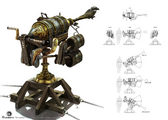 Concept art of the Greek fire cannon
 -
 Concept art of the Greek fire mechanism
 -
 A Greek fire cannon
 -
Siege weapon equipped with a Greek fire siphon
-
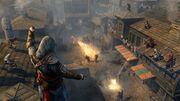 Greek fire used during a Den Defense
 -
 A Greek fire bomb
 -
 The Zhang Wei Union using Greek fire flamethrowers


.jpg)


Behind the scenes
Greek fire proper was invented sometime in the 7th century by the Byzantines although it had antecedents. It stopped being mentioned in historical records by the 12th century but variant recipes for the mixture still called Greek fire existed at least until the 16th century.[1]
The Greek fire flamethrowers built by Yun Pyeong-Gyu are modeled after the Fierce-fire Oil Cabinet, an incendiary weapon first utilized in China in the 10th century CE.[26]
Appearances
- Assassin's Creed: Brotherhood novel (first appearance)
- Assassin's Creed: Revelations
- Assassin's Creed: Origins
- Assassin's Creed: Odyssey
- Assassin's Creed Odyssey novel
- Assassin's Creed: The Golden City
- Assassin's Creed: Mirage
- Assassin's Creed: Forgotten Temple
- Assassin's Creed: Mirage – A Soar of Eagles
References
- ↑ 1.0 1.1
 Greek fire on Wikipedia
- ↑ Assassin's Creed Odyssey novel – Chapter 13
- ↑ Battle of Delium on Wikipedia
- ↑ Assassin's Creed: Odyssey
- ↑ Assassin's Creed: Odyssey – Legacy of the First Blade: Shadow Heritage – Persian Puppetry
- ↑ Assassin's Creed: Odyssey – Legacy of the First Blade: Shadow Heritage – Theatrics and Espionage
- ↑ Assassin's Creed: Odyssey – Legacy of the First Blade: Shadow Heritage – Tides of War
- ↑ Assassin's Creed: Odyssey – Legacy of the First Blade: Shadow Heritage – Leviathan's Maw
- ↑ Assassin's Creed: Origins – Playing with Fire
- ↑ Siege of Constantinople (717–718) on Wikipedia
- ↑ Assassin's Creed: Mirage – Database: Naffatah
- ↑ Assassin's Creed: Mirage – A Soar of Eagles – Issue #2
- ↑ Assassin's Creed: Brotherhood novel
- ↑ Assassin's Creed: Revelations – Setting Sail
- ↑ Assassin's Creed: Revelations
- ↑ Assassin's Creed: Forgotten Temple – Episode 48
- ↑ Assassin's Creed: Forgotten Temple – Episode 50
- ↑ Assassin's Creed: Forgotten Temple – Episode 53
- ↑ Assassin's Creed: Forgotten Temple – Episode 58
- ↑ Assassin's Creed: Forgotten Temple – Episode 60
- ↑ Assassin's Creed: Forgotten Temple – Episode 68
- ↑ Assassin's Creed: Forgotten Temple – Episode 72
- ↑ Assassin's Creed: Forgotten Temple – Episode 73
- ↑ Assassin's Creed: Forgotten Temple – Episode 84
- ↑ Assassin's Creed: Forgotten Temple – Episode 85
- ↑ Fierce-fire Oil Cabinet on Wikipedia
| |||||||||||||||||||||||||||||||||||||
| ||||||||||||||