

Boris Yeltsin: Difference between revisions
m Text replacement - "the the " to "the " |
mNo edit summary |
||
| Line 2: | Line 2: | ||
{{Quote|Declared the White Knight of the people, Yeltsin stands up to Communist threat!|Clay Kaczmarek|Assassin's Creed II|Rifts}} | {{Quote|Declared the White Knight of the people, Yeltsin stands up to Communist threat!|Clay Kaczmarek|Assassin's Creed II|Rifts}} | ||
[[File:BorisYeltsin.jpg|thumb|250px|Boris Yeltsin (right)]] | [[File:BorisYeltsin.jpg|thumb|250px|Boris Yeltsin (right)]] | ||
'''Boris Nikolayevich Yeltsin''' (Russian: Борис Николаевич Ельцин; 1 February 1931 – 23 April 2007) was the first President of [[Russia]], after the collapse of the [[Soviet Union]]. He was in office from 1991 to 1999. | '''Boris Nikolayevich Yeltsin''' (Russian: Борис Николаевич Ельцин; 1 February 1931 – 23 April 2007) was the first President of [[Russia]], after the collapse of the [[Soviet Union]]. He was in office from 1991 to 1999.<ref>{{WP}}</ref> | ||
==Biography== | ==Biography== | ||
In August 1991, following a failed | In August 1991, following a failed [[Communism|communist]] coup against the Soviet Union then-leader [[Mikhail Gorbachev]], Boris Yeltsin spoke up against ideology. The people dubbed him their "White Knight", leading to Yeltsin becoming a dominant political figure and for public opinion of Gorbachev to drop.<ref>{{WP|1991 Soviet coup attempt}}</ref> When [[Abstergo Industries]] realized that Gorbachev did not recognize the company's goals, they manipulated [[Margaret Thatcher]] to send a letter to Yeltsin telling him of their intention to depose Gorbachev. In December of that year, a secret meeting was called in [[Białowieża Forest]], and Yeltsin was appointed to unseat Gorbachev and take over control of Russia. He dissolved the Soviet Union and thus Gorbachev's reforms, turning Russia into a more [[Capitalism|capitalist]] nation.<ref name="Rift6">''[[Assassin's Creed: Brotherhood]]'' – [[Rifts]]: Cluster 6</ref> | ||
By 1992, the Russian economy was opened up to elite oligarchs and private companies.<ref name="Rift6"/> On 3 January 1993, at the Kremlin, Yeltsin signed the {{Wiki|START II | By 1992, the Russian economy was opened up to elite oligarchs and private companies.<ref name="Rift6"/> On 3 January 1993, at the Kremlin, Yeltsin signed the {{Wiki|START II}} Treaty with [[United States]] President {{Wiki|George H. W. Bush}}, with the aim of significantly reducing each superpower's nuclear arsenal.<ref>{{WP|START II}}</ref> From September to October of that same year,<ref>{{WP|1993 Russian constitutional crisis}}</ref> the Russian parliament had turned against Yeltsin, who in turn issued Decree 1400, dissolving the parliament in a self-coup. After a brief power struggle against communists and nationalists, Yeltsin regained power with help via a $2.5 billion donation from the U.S. Congress.<ref name="Rift6"/> | ||
On 23 October 1995, after meeting with the succeeding US President {{Wiki|Bill Clinton}} to hold a press conference in Hyde Park, New York, Yeltsin and Clinton discussed the relations between their countries and the ratifications of the START II Treaty.<ref>{{WP|Timeline of the Bill Clinton presidency (1995)}}</ref> They also shared a joke over their similar shoe sizes,<ref>{{Cite web| url=https://clinton.presidentiallibraries.us/exhibits/show/hyde-park/hyde-park-press-conference| title=Laughter and Diplomacy: The 1995 Hyde Park Conference| publisher=Presidential Libraries| accessdate=10 August 2026}}</ref> which was later photographed.<ref name="Rift6"/> | On 23 October 1995, after meeting with the succeeding US President {{Wiki|Bill Clinton}} to hold a press conference in Hyde Park, New York, Yeltsin and Clinton discussed the relations between their countries and the ratifications of the START II Treaty.<ref>{{WP|Timeline of the Bill Clinton presidency (1995)}}</ref> They also shared a joke over their similar shoe sizes,<ref>{{Cite web| url=https://clinton.presidentiallibraries.us/exhibits/show/hyde-park/hyde-park-press-conference| title=Laughter and Diplomacy: The 1995 Hyde Park Conference| publisher=Presidential Libraries| accessdate=10 August 2026}}</ref> a moment which was later photographed.<ref name="Rift6"/> | ||
Following the September 1999 {{Wiki|Russian | Following the September 1999 {{Wiki|Russian apartment bombings}} by {{Wiki|Chechens|Chechen}} terrorists in the cities of {{Wiki|Buynaksk}}, [[Moscow]], and {{Wiki|Volgodonsk}}, Yeltsin's popularity waned in favour of his friend and protégé, [[Vladimir Putin]]. Unbeknownst to Yelstin these bombings were orchestrated by Abstergo to depose him and install Putin as President, and after Yelstin resigned as head of state on 31 December 1999, their plan was set in motion. Putin would succeed him and continued capitalizing Russia.<ref name="Rift6"/> | ||
==Gallery== | ==Gallery== | ||
| Line 35: | Line 35: | ||
[[Category:Presidents of Russia]] | [[Category:Presidents of Russia]] | ||
[[Category:Templar puppets]] | [[Category:Templar puppets]] | ||
Latest revision as of 02:51, 11 August 2026

Boris Nikolayevich Yeltsin (Russian: Борис Николаевич Ельцин; 1 February 1931 – 23 April 2007) was the first President of Russia, after the collapse of the Soviet Union. He was in office from 1991 to 1999.[1]
Biography[edit | edit source]
In August 1991, following a failed communist coup against the Soviet Union then-leader Mikhail Gorbachev, Boris Yeltsin spoke up against ideology. The people dubbed him their "White Knight", leading to Yeltsin becoming a dominant political figure and for public opinion of Gorbachev to drop.[2] When Abstergo Industries realized that Gorbachev did not recognize the company's goals, they manipulated Margaret Thatcher to send a letter to Yeltsin telling him of their intention to depose Gorbachev. In December of that year, a secret meeting was called in Białowieża Forest, and Yeltsin was appointed to unseat Gorbachev and take over control of Russia. He dissolved the Soviet Union and thus Gorbachev's reforms, turning Russia into a more capitalist nation.[3]
By 1992, the Russian economy was opened up to elite oligarchs and private companies.[3] On 3 January 1993, at the Kremlin, Yeltsin signed the START II Treaty with United States President George H. W. Bush, with the aim of significantly reducing each superpower's nuclear arsenal.[4] From September to October of that same year,[5] the Russian parliament had turned against Yeltsin, who in turn issued Decree 1400, dissolving the parliament in a self-coup. After a brief power struggle against communists and nationalists, Yeltsin regained power with help via a $2.5 billion donation from the U.S. Congress.[3]
On 23 October 1995, after meeting with the succeeding US President Bill Clinton to hold a press conference in Hyde Park, New York, Yeltsin and Clinton discussed the relations between their countries and the ratifications of the START II Treaty.[6] They also shared a joke over their similar shoe sizes,[7] a moment which was later photographed.[3]
Following the September 1999 Russian apartment bombings by Chechen terrorists in the cities of Buynaksk, Moscow, and Volgodonsk, Yeltsin's popularity waned in favour of his friend and protégé, Vladimir Putin. Unbeknownst to Yelstin these bombings were orchestrated by Abstergo to depose him and install Putin as President, and after Yelstin resigned as head of state on 31 December 1999, their plan was set in motion. Putin would succeed him and continued capitalizing Russia.[3]
Gallery[edit | edit source]
-
 Yeltsin speaking out against the attempted coup against Gorbachev
 -
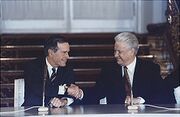 Yeltsin and Bush sign the Start II Treaty
 -
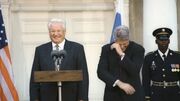 Yeltsin and Clinton Press Conference


Appearances[edit | edit source]
- Assassin's Creed: Brotherhood (photo only)
References[edit | edit source]
- ↑
 Boris Yeltsin on Wikipedia
- ↑ 1991 Soviet coup attempt on Wikipedia
- ↑ 3.0 3.1 3.2 3.3 3.4 Assassin's Creed: Brotherhood – Rifts: Cluster 6
- ↑ START II on Wikipedia
- ↑ 1993 Russian constitutional crisis on Wikipedia
- ↑ Timeline of the Bill Clinton presidency (1995) on Wikipedia
- ↑ Laughter and Diplomacy: The 1995 Hyde Park Conference. Presidential Libraries. Retrieved on 10 August 2026.

