

Malis: Difference between revisions
imported>Lady Kyashira mNo edit summary |
imported>Lady Kyashira mNo edit summary |
||
| Line 1: | Line 1: | ||
{{Era|Locations}} | {{Era|Locations}} | ||
{{WP-REAL|Thermopylae}} | {{WP-REAL|Thermopylae}} | ||
{{Quote|Thermopylai...They say you can't walk this battlefield without getting blood on your toes.|Kassandra upon arriving in Malis.|Assassin's Creed: Odyssey}} | {{Quote|Thermopylai...They say you can't walk this battlefield without getting blood on your toes.|Kassandra upon arriving in Malis.|Assassin's Creed: Odyssey}} | ||
[[File:ACOD_Malis.jpg|thumb|250px|Malis]] | [[File:ACOD_Malis.jpg|thumb|250px|Malis]] | ||
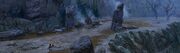
'''Malis''', known in modern times as '''Thermopylae''', was a region in ancient [[Greece]] containing a narrow coastal [[Hot Gates of Thermopylai|passage]] where the [[Sparta]]n King [[Leonidas I of Sparta|Leonidas]] and his Greek forces stood their [[Battle of Thermopylae|ground]] against the invading [[Iran|Persian]] army of [[Xerxes I of Persia|Xerxes]] in 480 BCE. | '''Malis''', known in modern times as '''Thermopylae''' or '''Thermopylai''', was a region in ancient [[Greece]] containing a narrow coastal [[Hot Gates of Thermopylai|passage]] where the [[Sparta]]n King [[Leonidas I of Sparta|Leonidas]] and his Greek forces stood their [[Battle of Thermopylae|ground]] against the invading [[Iran|Persian]] army of [[Xerxes I of Persia|Xerxes]] in 480 BCE. | ||
Once a highly contested area, it was mostly inhabited by wild animals, hunters, and outlaws during the [[Peloponnesian War]], when the Spartan ''[[Mercenary|misthios]]'' [[Kassandra]] explored the area. | Once a highly contested area, it was mostly inhabited by wild animals, hunters, and outlaws during the [[Peloponnesian War]], when the Spartan ''[[Mercenary|misthios]]'' [[Kassandra]] explored the area. | ||
| Line 10: | Line 9: | ||
==History== | ==History== | ||
===Battle of Thermopylae=== | ===Battle of Thermopylae=== | ||
In 480 BCE, during the [[Greco-Persian Wars]], the narrow passage of Malis was defended by King Leonidas of Sparta alongside [[Dienekes]] with a combined Spartan and Greek army. For seven days, the Spartans defended against the massive waves of Persian army. However, they were betrayed by [[Ephialtes of Trachis]], who revealed a path to go around the passage to the Persians, allowing them to maneuver and surround the Spartans. Leonidas and his men were eventually overwhelmed and perished in battle.<ref name="ACOD">''[[Assassin's Creed: Odyssey]]''</ref> | |||
After the battle and the Persian retreat from Greece, the Greeks erected a [[Lion of Leonidas|monument]] near the passage to commemorate Leonidas and the Greeks who fell during the battle.<ref name="ACOD" /> | After the battle and the Persian retreat from Greece, the Greeks erected a [[Lion of Leonidas|monument]] near the passage to commemorate Leonidas and the Greeks who fell during the battle.<ref name="ACOD" /> | ||
===Peloponnesian War=== | ===Peloponnesian War=== | ||
During the Peloponnesian War, the historian [[Herodotos]] travelled to Malis with Kassandra to visit the lion monument, suspecting that Kassandra may have a connection to King Leonidas. His theory was confirmed as Kassandra was revealed to be Leonidas' granddaughter through her mother [[Myrrine]].<ref>''Assassin's Creed: Odyssey'' – [[Memories Awoken]]</ref> | During the Peloponnesian War, the historian [[Herodotos]] travelled to Malis with Kassandra to visit the lion monument, suspecting that Kassandra may have a connection to King Leonidas. His theory was confirmed as Kassandra was revealed to be Leonidas' granddaughter through her mother [[Myrrine]].<ref>''[[Assassin's Creed: Odyssey]]'' – [[Memories Awoken]]</ref> | ||
After her meeting with Herodotos, Kassandra returned to Malis sometime later, this time helping a blacksmith from [[Lalaia]] to recover a type of [[Aphrodite Ore|ore]] found in a [[Persian Remains|cave]] in a cliff.<ref>''Assassin's Creed: Odyssey'' – [[The Ore of Aphrodite]]</ref> | After her meeting with Herodotos, Kassandra returned to Malis sometime later, this time helping a blacksmith from [[Lalaia]] to recover a type of [[Aphrodite Ore|ore]] found in a [[Persian Remains|cave]] in a cliff.<ref>''[[Assassin's Creed: Odyssey]]'' – [[The Ore of Aphrodite]]</ref> | ||
==Regions== | ==Regions== | ||
Revision as of 16:23, 6 August 2020
- "Thermopylai...They say you can't walk this battlefield without getting blood on your toes."
- ―Kassandra upon arriving in Malis.[src]

Malis, known in modern times as Thermopylae or Thermopylai, was a region in ancient Greece containing a narrow coastal passage where the Spartan King Leonidas and his Greek forces stood their ground against the invading Persian army of Xerxes in 480 BCE.
Once a highly contested area, it was mostly inhabited by wild animals, hunters, and outlaws during the Peloponnesian War, when the Spartan misthios Kassandra explored the area.
History
Battle of Thermopylae
In 480 BCE, during the Greco-Persian Wars, the narrow passage of Malis was defended by King Leonidas of Sparta alongside Dienekes with a combined Spartan and Greek army. For seven days, the Spartans defended against the massive waves of Persian army. However, they were betrayed by Ephialtes of Trachis, who revealed a path to go around the passage to the Persians, allowing them to maneuver and surround the Spartans. Leonidas and his men were eventually overwhelmed and perished in battle.[1]
After the battle and the Persian retreat from Greece, the Greeks erected a monument near the passage to commemorate Leonidas and the Greeks who fell during the battle.[1]
Peloponnesian War
During the Peloponnesian War, the historian Herodotos travelled to Malis with Kassandra to visit the lion monument, suspecting that Kassandra may have a connection to King Leonidas. His theory was confirmed as Kassandra was revealed to be Leonidas' granddaughter through her mother Myrrine.[2]
After her meeting with Herodotos, Kassandra returned to Malis sometime later, this time helping a blacksmith from Lalaia to recover a type of ore found in a cave in a cliff.[3]
Regions
Malis was comprised of three regions:
Gallery
-
 Concept art

Appearances
References