

Hippokrates: Difference between revisions
imported>Sadelyrate No edit summary |
imported>Lacrossedeamon No edit summary |
||
| Line 9: | Line 9: | ||
| death = 370 BCE<br />[[Larissa]], [[Greece]] | | death = 370 BCE<br />[[Larissa]], [[Greece]] | ||
| species = [[Human]] | | species = [[Human]] | ||
| affiliates = [[Hippokratic School of Medicine]] | | affiliates = [[Hippokratic School of Medicine]]<br />[[Periklean Circle]] | ||
| voice = [[Adam Wilson]]}} | | voice = [[Adam Wilson]]}} | ||
'''Hippokrates''' (c. 460 BCE – c. 370 BCE), alternatively '''Hippocrates''', was a [[Greece|Greek]] [[doctor|physician]] who is widely credited as the "Father of Medicine" for his enduring contributions to the field. He revolutionized medicine by subjecting it to systematic study rather than depending on religious guidance, a methodology that clashed with the orthodox views in Greece during his time.<ref name="ACOD site">[https://assassinscreed.ubisoft.com/game/en-us/odyssey/characters ''Assassin's Creed: Odyssey'' – Characters]. Ubisoft. Accessed 14 June 2018.</ref> | '''Hippokrates''' (c. 460 BCE – c. 370 BCE), alternatively '''Hippocrates''', was a [[Greece|Greek]] [[doctor|physician]] who is widely credited as the "Father of Medicine" for his enduring contributions to the field. He revolutionized medicine by subjecting it to systematic study rather than depending on religious guidance, a methodology that clashed with the orthodox views in Greece during his time.<ref name="ACOD site">[https://assassinscreed.ubisoft.com/game/en-us/odyssey/characters ''Assassin's Creed: Odyssey'' – Characters]. Ubisoft. Accessed 14 June 2018.</ref> | ||
Revision as of 08:24, 23 April 2019

|
Ezio, my friend! How may I be of service? This article is in desperate need of a revamp. Please improve it in any way necessary in order for it to achieve a higher standard of quality in accordance with our Manual of Style. |

Hippokrates (c. 460 BCE – c. 370 BCE), alternatively Hippocrates, was a Greek physician who is widely credited as the "Father of Medicine" for his enduring contributions to the field. He revolutionized medicine by subjecting it to systematic study rather than depending on religious guidance, a methodology that clashed with the orthodox views in Greece during his time.[1]
Religiously devout citizens deemed his secular approach to curing disease impious — as though to attempt to defy what the gods had already willed. Despite this controversy, his efficacy attracted those in need of proper medical treatment who met him in secret for his services if their local area was especially conservative. This also drew several apprentices to him, one of which was Sostratos. Hippokrates was targeted by the Cult of Kosmos, but he was also aided by the Spartan misthios Kassandra, who came to question him about her mother.[1]
Biography
In his youth while serving as a healer assistant, Hippokrates met Myrrine, the daughter of King Leonidas I of Sparta, during his travels. Years later during the Peloponnesian War he met Myrrine's daughter Kassandra in Argolis.[2]

When the plague reached Athens around 429 BCE, Hippokrates came to the city in order to help. He realized the disease was spread via the feces of the infected, and that the best method of dealing with the dead was to burn their corpses. However, he was harassed by the Followers of Ares who disagreed with his practice, and when he met Kassandra in the city, he asked for her help in dealing with them.[3]

Around 428 BCE, Hippokrates made his way to the city of Thebes in Boeotia, and set up a temporary clinic there. Like in Argolis, people lined up to see him. One of his patients told him that they'd heard screams in the wilderness beyond the city's walls, and they suspected that a hunting party had met their match during their hunt. To help any possible survivors, Hippokrates asked for Kassandra's help. She agreed and following his directions, found a couple of bears were advancing on a man south of the Snake Head Rock. Kassandra saved the man and took him back to Hippokrates.[4]
Hippokrates recognized the man as the slaver Galeos and was loathe to help him. He agreed to do so, however, if Kassandra agreed to save Galeos' victims. The misthios did as asked, freeing the slaves at Galeos' camp.[5]
Trivia
- Being regarded as the 'Father of Medicine', Hippocratic Oath derives its name from his; it's the oath that compels a physician to follow specific ethical standards, one of the key principles of which is "do no harm".
Gallery
-
 Concept Art
 -
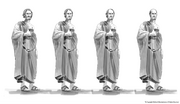 Concept Sketches
 -
 Hippokrates treating Galeos in Thebes


Appearances
References
- ↑ 1.0 1.1 Assassin's Creed: Odyssey – Characters. Ubisoft. Accessed 14 June 2018.
- ↑ Assassin's Creed: Odyssey
- ↑ Assassin's Creed: Odyssey – A Growing Sickness
- ↑ Assassin's Creed: Odyssey – The Hunting Party
- ↑ Assassin's Creed: Odyssey – Let My Patients Go