

-
 Bird's eye view of Havana
 -
 Havana's skyline
 -
 Havana's port
 -
 Fortifications in Havana
 -
 Rowers entering Havana Bay
 -
 View of the Havana Bay
 -
 View of the Havana Bay
 -
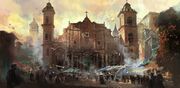
-
 Plaza de la Catedral
 -
 A plaza in Havana
 -
 Streets of Havana
 -
 Streets of Havana
 -
 An alleyway in Havana
 -
 An alcove in Havana
 -
 Database image of Havana
 -
 Various types of buildings
 -
 Various landmarks
Welcome to Assassin's Creed Wiki! Log in and join the community.
Havana: Difference between revisions
Jump to navigation
Jump to search
imported>The Forgotten Fragment Undo revision 445060 by 71.224.66.128 (talk) |
m Text replacement - "’" to "'" |
||
| (133 intermediate revisions by 49 users not shown) | |||
| Line 1: | Line 1: | ||
{{Era| | {{Era|Locations}}{{WP-REAL}} | ||
{{WP-REAL}} | {{Update|''[[Assassin's Creed: Pirates]]''}} | ||
{{ | {{Quote|Havana was a low port surrounded by green forest and tall palm trees, their fronds a lush green that wafted gently in the breeze, waving us in as our schooner sailed into port. In the busy town, white-stone buildings with red-slate roofs looked dilapidated and weather-beaten, bleached by the sun and blasted by the wind.|Edward Kenway describing Havana, 1715.|Assassin's Creed: Black Flag}} | ||
'''Havana''' is the capital and | {{Location Infobox | ||
|image = AC4 Havana.png | |||
|state = [[Cuba]] | |||
|rulers = [[Spanish Empire]] {{c|1514 – 1902}}<br>{{Wiki|Republic of Cuba}} {{c|1902 – 1959}}<br>Cuba {{c|1959 – present}} | |||
|founded = [[Diego Velázquez de Cuéllar]] | |||
|date = c. 1514 | |||
|landmark = [[Cathedral of Havana]]<br>[[Basilica Menor de San Francisco de Asis]]<br>[[Castillo de la Real Fuerza]]<br>[[Castillo Morro]]<br>[[Castillo de San Salvador de la Punta]] | |||
}} | |||
'''Havana''' (Spanish: ''La Habana'') is the capital and commercial center of the island country of [[Cuba]], and the largest city in the [[Caribbean]]. Founded by [[Spain|Spaniards]] in the 16th century, Havana served as a springboard for the {{Wiki|Spanish colonization of the Americas|Spanish colonization}} of the [[Americas]] and became a stopping point for the treasure-laden Spanish [[Man O' War|galleons]] on the crossing between the New World and the Old World. As a result, the city flourished both economically and culturally.<ref>{{WP}}</ref> | |||
==History== | |||
===Humble beginnings=== | |||
In the early 1500s, several attempts were made to found a town near the Havana Bay,<ref name="Database">''[[Assassin's Creed IV: Black Flag]]'' – [[Database: Havana]]</ref> with a settlement eventually being established on the southern coast by the Spanish conquistador [[Diego Velázquez de Cuéllar]] around 1514.<ref name="Database" /><ref name="Identity_Database">''[[Assassin's Creed: Identity]]'' – [[Database: Havana (Identity)]]</ref> However, the city was moved north in 1519 for strategic reasons, namely the narrow passageway of the bay which provided easy shelter for [[ship]]s, with three different harbors constructed due to the island's large size.<ref name="Encyclopedia">''[[Assassin's Creed Encyclopedia]]''</ref> | |||
== | Sitting on a bay that opened to the Gulf Stream, Havana became a natural stopping point between [[Europe]] and the Americas. As the city grew around its trade port, Havana became a target for buccaneer and [[privateer]] attacks. In 1555, Havana was partially burnt to the ground by the [[France|French]] corsair [[Jacques de Sores]], forcing the Spanish Crown to build [[Forts|fortifications]].<ref name="Database" /><ref name="Encyclopedia" /><ref name="Identity_Database" /> | ||
* | |||
{{ | ===Key to the New World=== | ||
[[ | {{Quote|Well they don't take kindly to pirates here, do they? Wonder how many stolen reales bought these men this perch?|Edward Kenway on Havana, 1715.|Assassin's Creed IV: Black Flag|Lively Havana}} | ||
Following a Royal Decree in 1561, all ships of the annual [[Spanish Treasure Fleet|treasure fleet]] were required to meet up in Havana before they crossed the [[Atlantic Ocean]]. This boosted commerce and development of the city, with Havana supplying food and equipment for most of the Spanish fleet. It eventually became the richest and largest port in the Caribbean,<ref name="Encyclopedia" /> making it a prime target for [[Piracy|pirates]], who hoped to rob the treasure fleet's ships of their riches.<ref name="Database" /> The pirates were able to infiltrate Havana, contributing to the rise of corruption.<ref name="ACI">''[[Assassin's Creed: Initiates]]'' – The Golden Age of Piracy: "The Fortified City"</ref> | |||
[[File:AC4_Castillo_de_San_Salvador_de_la_Punta.png|thumb|250px|left|Castillo de San Salvador de la Punta]] | |||
To ward off potential attackers, military forts such as the [[Castillo de San Salvador de la Punta]] and the [[Castillo Morro]] were constructed.<ref>''[[Assassin's Creed IV: Black Flag]]'' – [[Database: Castillo San Salvador de la Punta]]</ref><ref>''[[Assassin's Creed IV: Black Flag]]'' – [[Database: Castillo Morro]]</ref> Despite this, attacks from pirates and privateers continued.<ref name="ACI" /> In 1634, Havana was officially designated the "Key to the New World and Rampart of the West Indies" by the Spanish Crown.<ref name="Encyclopedia" /> | |||
In 1708, the [[Templars|Templar]] [[Laureano de Torres y Ayala]] was appointed Governor of Cuba with the help of his allies in the Spanish Court.<ref>''[[Assassin's Creed: Initiates]]'' – [[Database: Grand Master Torres]]</ref> Establishing his own [[West Indies Rite of the Templar Order|Order]] in the West Indies, he orchestrated Templar involvement in the Caribbean from his [[Governor's Mansion, Havana|mansion]] within the city. Torres would also make many lasting improvements to the city, fortifying the island's defenses and kick-starting the production of tobacco. He remained governor until 1716, following which he retired and dedicated his life to charitable functions, such as financing hospitals.<ref>''[[Assassin's Creed IV: Black Flag]]'' – [[Database: Laureano Torres y Ayala]]</ref><ref name="Identity_Database" /> | |||
The [[Assassins|Assassin Order]] also maintained a presence in Havana during this time, running an [[Assassin bureau]] headed by [[Rhona Dinsmore]].<ref>''[[Assassin's Creed IV: Black Flag]]'' – [[Bureau Under Attack]]</ref><ref name="Identity_Database" /> She faced opposition from Templar agent [[Hilary Flint]], who used local [[Pickpocketing#Pickpockets|pickpockets]] to fund an arms race against her,<ref>''[[Assassin's Creed IV: Black Flag]]'' – [[A Thief in the Market]]</ref><ref>''[[Assassin's Creed IV: Black Flag]]'' – [[Arms Race]]</ref> though he was eliminated by the combined efforts of Dinsmore and [[Edward Kenway]] in 1717.<ref>''[[Assassin's Creed IV: Black Flag]]'' – [[Flint's End]]</ref> Following Torres' death in 1722 and the subsequent decline of the Caribbean Templars,<ref>''[[Assassin's Creed IV: Black Flag]]'' – [[Ever a Splinter]]</ref><ref name="Identity_Database" /> she was able to expand her branch of Assassins and secure full control of the city for many years, focusing on keeping it safe from territorial squabbles.<ref>''[[Assassin's Creed: Rogue]]'' – [[War Letters]]: "A Thief in the Night"</ref><ref>''[[Assassin's Creed: Rogue]]'' – [[War Letters]]: "Cuban Salvage"</ref> | |||
By the mid-18th century, Havana had reached a population of more than 70,000 people, exceeding the size of other New World settlements like [[New York City|New York]] and [[Boston]].<ref name="Identity_Database" /><ref name="Encyclopedia" /> Despite Dinsmore's efforts, the city eventually became embroiled in the [[Seven Years' War]] and was captured by the [[United Kingdom|British]] in 1762. [[Israel Putnam]], then a Colonel in with the [[British Army]], participated in their {{Wiki|Siege of Havana|siege}} to capture Havana, though his ship was [[Shipwreck|wrecked]] in the attempt and he was its sole survivor.<ref>''[[Assassin's Creed III]]'' – [[Conflict Looms]]</ref> During the war, Templar [[Shay Cormac]] sent two envoys to the city: one to collect a document from a Spanish commander friendly to the Templar cause,<ref>''[[Assassin's Creed: Rogue]]'' – [[The Naval Campaign]]: Sailing Down to Havana</ref> and another to pay respects to the current governor, making him feel important and more loyal to them.<ref>''[[Assassin's Creed: Rogue]]'' – [[The Naval Campaign]]: Paying Respects</ref> | |||
Less than a year later, the [[Database: Treaty of Paris|Treaty of Paris]] secured Havana's return to Spain in exchange for Spain's cession of [[Florida]] to Great Britain.<ref name="Encyclopedia" /> However, Britain would return Florida to Spain in 1783, following the British defeat in the [[American Revolutionary War]]. | |||
In the late 18th century, the [[de Grandpré company]], under the administration of [[Aveline de Grandpré]], conducted business in the city, importing and exporting a variety of products.<ref>''[[Assassin's Creed III: Liberation]]'' – Trade system</ref> The body of [[Christopher Columbus]] was transferred to Havana in 1795, before being sent to [[Seville]], Spain, in 1899.<ref>''[[Assassin's Creed: The Official Movie Novelization]]'' – Chapter 25</ref> | |||
===Later developments=== | |||
During the 19th century, Havana flourished, benefitting greatly from trade with the [[United States]]. Having become an economic and cultural center, the city was referred to as the "[[Paris]] of the Caribbean".<ref name="Encyclopedia" /> | |||
In 1898, while the Cubans were fighting their {{Wiki|Cuban War of Independence|war of independence}}, the battleship ''USS Maine'' exploded in the port of Havana. The incident gave the [[United States]] a pretext to occupy the wealthy island for four years, starting the Spanish-American War. Later still, {{Wiki|Fidel Castro}} would lead a revolution to install a [[Communism|communist]] regime that nationalized all foreign assets, including the powerful American United Fruit Company.<ref name="Encyclopedia" /> | |||
===Modern times=== | |||
{{Quote|La Havana: Treasure of the West Indies, haven to the poor, seat of the rich, replete with nooks and crannies, and ideal opportunities for a quick escape.|An Abstergo Entertainment employee introducing Havana in Wolfpack's Discovery mode.|Assassin's Creed IV: Black Flag}} | |||
In 2013, Havana was used as a simulated location created by [[Abstergo Industries]]' [[Abstergo Entertainment|entertainment branch]], in order to influence the general public through the console stage of their [[Animus]] technology.<ref>''[[Assassin's Creed IV: Black Flag]]'' – [[Multiplayer/ACIV|Multiplayer]]</ref> | |||
==Trivia== | |||
*Havana is the only city in ''[[Assassin's Creed IV: Black Flag]]'' in which no animals can be [[Hunting|hunted]]. | |||
*Several in-game sources refer to Havana's "Poor District", despite cities in ''Black Flag'' not being divided into districts. Furthermore, district specification of "Poor", "Middle", and "Rich" is identical to the one seen in ''[[Assassin's Creed]]''. | |||
==Gallery== | |||
<tabber>Concept art= | |||
<gallery captionalign="center" position="center" widths="180"> | |||
AC4BF Arriving in Havana - Concept Art.jpg|Bird's eye view of Havana | |||
Assassin's Creed IV Black Flag Havana Skyline by Donglu.jpg|Havana's skyline | |||
AC4BF Havana Port - Concept Art.jpg|Havana's port | |||
ACIFortifiedCity.jpg|Fortifications in Havana | |||
AC4BF Havana Bay Approach - Concept Art.jpg|Rowers entering Havana Bay | |||
AC4BF Havana Dusk - Concept Art.jpg|View of the Havana Bay | |||
Assassin's Creed IV Black Flag Havana exploration by Donglu.jpg|View of the Havana Bay | |||
Caribbean city ACIV.jpg|The [[Cathedral of Havana]] | |||
Havana Cathedral's Plaza - Concept Art.jpg|Plaza de la Catedral | |||
AC4BFLaHavane.jpg|A plaza in Havana | |||
AC4BF Havana Streets - Concept Art.jpg|Streets of Havana | |||
AC4BF Docked - Concept Art.jpg|Streets of Havana | |||
Assassin's Creed IV Black Flag Havana alley by Donglu.jpg|An alleyway in Havana | |||
Assassin's Creed IV Black Flag Havana City by Donglu.jpg|An alcove in Havana | |||
Havana (Identity).png|[[Database: Havana (Identity)|Database]] image of Havana | |||
Assassin's Creed IV Black Flag Havana city block set by Donglu.jpg|Various types of buildings | |||
Assassin's Creed IV Black Flag Havana city landmarks set by Donglu.jpg|Various landmarks | |||
</gallery> | |||
|-|In-game= | |||
<gallery captionalign="center" position="center" widths="180"> | |||
AC4 Map.png|In-game map of Havana | |||
Lively Havana 3.png|Edward Kenway on a viewpoint in Havana | |||
A Man They Call The Sage 9.png|The Cathedral of Havana | |||
Lively Havana 1.png|Stede Bonnet and Edward at the port of Havana | |||
</gallery> | |||
</tabber> | |||
==Appearances== | |||
*''[[Assassin's Creed III]]'' {{1stm}} | |||
*''[[Assassin's Creed III: Liberation]]'' {{Mo}} | |||
*''[[Assassin's Creed: Initiates]]'' {{Mo}} | |||
*''[[Assassin's Creed IV: Black Flag]]'' {{1st}} | |||
*''[[Assassin's Creed: Pirates]]'' | |||
*''[[Assassin's Creed: Identity]]'' {{Mdat}} | |||
*''[[Assassin's Creed: Rogue]]'' {{Mo}} | |||
*''[[Assassin's Creed: The Official Movie Novelization]]'' {{Mo}} | |||
*''[[Animus Hub]]'' {{Mdat}} | |||
==References== | |||
{{Scroll box|content={{Reflist}}}} | |||
{{ACIV}} | |||
{{ACP}} | |||
[[Category:Port cities]] | |||
[[Category:Capital cities]] | |||
[[Category:Cuba]] | [[Category:Cuba]] | ||
[[Category:Animi virtual locations]] | |||
[[Category:Quaternary stage locations]] | |||
Latest revision as of 00:16, 12 August 2026

|
Patience, brothers. Soon we will reveal the secrets of Assassin's Creed: Pirates. This article has been identified as being out of date. Please update the article to reflect recent releases and then remove this template once done. |
- "Havana was a low port surrounded by green forest and tall palm trees, their fronds a lush green that wafted gently in the breeze, waving us in as our schooner sailed into port. In the busy town, white-stone buildings with red-slate roofs looked dilapidated and weather-beaten, bleached by the sun and blasted by the wind."
- ―Edward Kenway describing Havana, 1715.[src]
Havana (Spanish: La Habana) is the capital and commercial center of the island country of Cuba, and the largest city in the Caribbean. Founded by Spaniards in the 16th century, Havana served as a springboard for the Spanish colonization of the Americas and became a stopping point for the treasure-laden Spanish galleons on the crossing between the New World and the Old World. As a result, the city flourished both economically and culturally.[1]
History[edit | edit source]
Humble beginnings[edit | edit source]
In the early 1500s, several attempts were made to found a town near the Havana Bay,[2] with a settlement eventually being established on the southern coast by the Spanish conquistador Diego Velázquez de Cuéllar around 1514.[2][3] However, the city was moved north in 1519 for strategic reasons, namely the narrow passageway of the bay which provided easy shelter for ships, with three different harbors constructed due to the island's large size.[4]
Sitting on a bay that opened to the Gulf Stream, Havana became a natural stopping point between Europe and the Americas. As the city grew around its trade port, Havana became a target for buccaneer and privateer attacks. In 1555, Havana was partially burnt to the ground by the French corsair Jacques de Sores, forcing the Spanish Crown to build fortifications.[2][4][3]
Key to the New World[edit | edit source]
Following a Royal Decree in 1561, all ships of the annual treasure fleet were required to meet up in Havana before they crossed the Atlantic Ocean. This boosted commerce and development of the city, with Havana supplying food and equipment for most of the Spanish fleet. It eventually became the richest and largest port in the Caribbean,[4] making it a prime target for pirates, who hoped to rob the treasure fleet's ships of their riches.[2] The pirates were able to infiltrate Havana, contributing to the rise of corruption.[5]

To ward off potential attackers, military forts such as the Castillo de San Salvador de la Punta and the Castillo Morro were constructed.[6][7] Despite this, attacks from pirates and privateers continued.[5] In 1634, Havana was officially designated the "Key to the New World and Rampart of the West Indies" by the Spanish Crown.[4]
In 1708, the Templar Laureano de Torres y Ayala was appointed Governor of Cuba with the help of his allies in the Spanish Court.[8] Establishing his own Order in the West Indies, he orchestrated Templar involvement in the Caribbean from his mansion within the city. Torres would also make many lasting improvements to the city, fortifying the island's defenses and kick-starting the production of tobacco. He remained governor until 1716, following which he retired and dedicated his life to charitable functions, such as financing hospitals.[9][3]
The Assassin Order also maintained a presence in Havana during this time, running an Assassin bureau headed by Rhona Dinsmore.[10][3] She faced opposition from Templar agent Hilary Flint, who used local pickpockets to fund an arms race against her,[11][12] though he was eliminated by the combined efforts of Dinsmore and Edward Kenway in 1717.[13] Following Torres' death in 1722 and the subsequent decline of the Caribbean Templars,[14][3] she was able to expand her branch of Assassins and secure full control of the city for many years, focusing on keeping it safe from territorial squabbles.[15][16]
By the mid-18th century, Havana had reached a population of more than 70,000 people, exceeding the size of other New World settlements like New York and Boston.[3][4] Despite Dinsmore's efforts, the city eventually became embroiled in the Seven Years' War and was captured by the British in 1762. Israel Putnam, then a Colonel in with the British Army, participated in their siege to capture Havana, though his ship was wrecked in the attempt and he was its sole survivor.[17] During the war, Templar Shay Cormac sent two envoys to the city: one to collect a document from a Spanish commander friendly to the Templar cause,[18] and another to pay respects to the current governor, making him feel important and more loyal to them.[19]
Less than a year later, the Treaty of Paris secured Havana's return to Spain in exchange for Spain's cession of Florida to Great Britain.[4] However, Britain would return Florida to Spain in 1783, following the British defeat in the American Revolutionary War.
In the late 18th century, the de Grandpré company, under the administration of Aveline de Grandpré, conducted business in the city, importing and exporting a variety of products.[20] The body of Christopher Columbus was transferred to Havana in 1795, before being sent to Seville, Spain, in 1899.[21]
Later developments[edit | edit source]
During the 19th century, Havana flourished, benefitting greatly from trade with the United States. Having become an economic and cultural center, the city was referred to as the "Paris of the Caribbean".[4]
In 1898, while the Cubans were fighting their war of independence, the battleship USS Maine exploded in the port of Havana. The incident gave the United States a pretext to occupy the wealthy island for four years, starting the Spanish-American War. Later still, Fidel Castro would lead a revolution to install a communist regime that nationalized all foreign assets, including the powerful American United Fruit Company.[4]
Modern times[edit | edit source]
- "La Havana: Treasure of the West Indies, haven to the poor, seat of the rich, replete with nooks and crannies, and ideal opportunities for a quick escape."
- ―An Abstergo Entertainment employee introducing Havana in Wolfpack's Discovery mode.[src]
In 2013, Havana was used as a simulated location created by Abstergo Industries' entertainment branch, in order to influence the general public through the console stage of their Animus technology.[22]
Trivia[edit | edit source]
- Havana is the only city in Assassin's Creed IV: Black Flag in which no animals can be hunted.
- Several in-game sources refer to Havana's "Poor District", despite cities in Black Flag not being divided into districts. Furthermore, district specification of "Poor", "Middle", and "Rich" is identical to the one seen in Assassin's Creed.
Gallery[edit | edit source]


.png)


-
 In-game map of Havana
 -
 Edward Kenway on a viewpoint in Havana
 -
 The Cathedral of Havana
 -
 Stede Bonnet and Edward at the port of Havana


Appearances[edit | edit source]
- Assassin's Creed III (first mentioned)
- Assassin's Creed III: Liberation (mentioned only)
- Assassin's Creed: Initiates (mentioned only)
- Assassin's Creed IV: Black Flag (first appearance)
- Assassin's Creed: Pirates
- Assassin's Creed: Identity (mentioned in Database entry only)
- Assassin's Creed: Rogue (mentioned only)
- Assassin's Creed: The Official Movie Novelization (mentioned only)
- Animus Hub (mentioned in Database entry only)
References[edit | edit source]

| |||||||||||||||||||||||||||||||