

Train: Difference between revisions
imported>Crookandcharlatan No edit summary |
mNo edit summary |
||
| (60 intermediate revisions by 31 users not shown) | |||
| Line 1: | Line 1: | ||
{{Era| | {{Era|Transportation}}{{WP-REAL}} | ||
{{ | [[File:ACS Off the Rails 3.png|thumb|250px|Evie Frye fighting Blighters atop a train]] | ||
{{ | A '''train''' is a form of rail transport that consists of a chain of vehicles designed to move along rail tracks, with motive power typically provided by either a {{wiki|locomotive}} at the front or by motors in {{wiki|Multiple unit|each unit}} working in concert. Their principal function is the transport of cargo and passengers across large distances. | ||
[[File:ACS Promotional Screenshot 13.jpg|thumb|250px| | |||
'''Trains''' are | Trains arose during the 19th century in the midst of the [[Industrial Revolution]] as a new and innovative mode of transportation that allowed individuals to travel vast distances with greater speed and efficiency. It also complemented the surge in mass production by facilitating the transport of copious resources and products in a far shorter span of time. | ||
Notably, the [[British Brotherhood of Assassins|British Assassins]] under [[Jayadeep Mir|Henry Green]], [[Evie Frye]], and [[Jacob Frye]] employed a train as the [[Train Hideout|hideout]] for their [[Assassin Guild|guild]] during their [[Liberation of London|operations]] in [[London]] in 1868. The mobile nature of the base ensured that it was well-suited to eluding detection by their enemies, the [[Templars]]. | |||
==History== | |||
===Victorian London=== | |||
During the 19th century, [[London]] trains provided routes for {{Wiki|Edinburgh}}, [[Liverpool]], [[Oxford]], [[Cambridge]], {{Wiki|Brighton}}, and [[Dover]]. Open-topped carriages were available for the poor. In 1834, [[England|English]] and [[Scotland|Scottish]] rail lines merged, allowing people to travel faster between the two places. Queen [[Victoria]] was the very first [[Monarchy|monarch]] to ride a train in 1842.<ref>[[XIXth Century Search Engine]] – {{Cite|6 Jan 2025}}</ref> | |||
[[File:ACS Gang War (Whitechapel) 7.png|thumb|250px|left|Rexford Kaylock standing atop his train]] | |||
The first rail factory was owned by the Starrick family and inherited by their youngest son [[Crawford Starrick|Crawford]], who used it to expand his [[Templars|Templar]] influence and [[Starrick Industries|business]] throughout London.<ref>''[[Assassin's Creed: Syndicate]]'' – [[Database: Crawford Starrick]]</ref> Sometime in the mid-19th century, Starrick impounded a [[Train Hideout|Herwicke Steam Engine]] which was owned by [[Agnes MacBean]] and nicknamed "Bertha". He then placed the train and MacBean under the command of his Templar accomplice, [[Rexford Kaylock]]. Kaylock, as the [[Whitechapel]] [[Blighters]]' gang leader, equipped the locomotive for their operations.<ref>''[[Assassin's Creed: Syndicate]]'' – [[Database: Agnes MacBean]]</ref> | |||
In 1860, several large railway companies donated money for the first underground railway transport under the plans of [[Charles Pearson]]. [[John Fowler, 1st Baronet|John Fowler]] was also hired as the chief engineer. However, the construction caused many families to lose homes and roads to be blocked. It also used the technique "cut and cover", which involved the sinking of trenches and reinstating the surface.<ref>''[[Assassin's Creed: Underworld]]''</ref> | |||
The [[United States|American]] businessman [[Ned Wynert]] and his group of [[Thief|thieves]] used London's transit systems as cover for their criminal activities. In this way, Wynert was able to rob many shipments coming into the city of their valuables.<ref name="ACS">''[[Assassin's Creed: Syndicate]]''</ref> | |||
[[File:ACS Promotional Screenshot 13.jpg|thumb|250px|The British Assassins' train hideout]] | |||
In 1868, the [[Assassins|Assassin]] siblings [[Jacob Frye|Jacob]] and [[Evie Frye]] destroyed the Whitechapel Blighters with their new syndicate, the [[Rooks]]. With MacBean's permission, the twins made her locomotive their mobile hideout and residence, each claiming a carriage for themselves to live in during their stay in London.<ref>''[[Assassin's Creed: Syndicate]]'' – [[Gang War (Whitechapel)]]</ref> Later on, they gained the aid of [[Nigel Bumble]], who worked under MacBean in fixing and maintaining the train.<ref>''[[Assassin's Creed: Syndicate]]'' – [[Stalk the Stalker]]</ref> | |||
With Wynert's assistance, the Rooks would also rob trains carrying money to fund their operations. In addition, Jacob and Evie frequently visited various train stations in London to assassinate Templars and destroy Blighter shipments.<ref name="ACS"/> | |||
===Russian Empire=== | |||
In 1888, the [[Russian Brotherhood of Assassins|Russian Assassin]] [[Nikolai Orelov]] attempted to kill Tsar [[Alexander III of Russia|Alexander III]] while he and his family were traveling by train from {{Wiki|Crimea}} to [[Saint Petersburg]]. However, Nikolai and Alexander's fight caused the imperial train to [[Borki train disaster|derail]] and careen off the tracks, tearing apart several of the cars. The Tsar was able to hold up the roof of the dining car long enough for his family to get away to safety, whereupon he confronted an injured Nikolai but ultimately spared him.<ref>''[[Assassin's Creed: The Fall]]'' – [[Assassin's Creed: The Fall 1|Issue #01]]</ref> | |||
[[File:ACCR TToR (17).jpg|thumb|250px|left|Nikolai and Anastasia leaping from the burning train]] | |||
In 1918, Nikolai and Grand Duchess [[Anastasia Nikolaevna of Russia|Anastasia Nikolaevna]] hid on a train traveling to [[Kazan]] following their escape from [[Yekaterinburg]]. In the city, they hoped to secure transportation to [[Moscow]], where the Russian Brotherhood was located, but during the ride, the [[Russian Rite of the Templar Order|Russian Templars]] boarded the train and began searching for the pair. Wishing to keep Anastasia safe, Nikolai dispatched the Templars, but more arrived, riding an armored train equipped with [[Machine Gun|machine gun]]s.<ref name="ACCR">''[[Assassin's Creed Chronicles: Russia]]'' – [[The Train of Revolution]]</ref> | |||
After the Templars opened fire on Nikolai and Anastasia's train, causing it to catch fire, the latter ran towards Nikolai, who covered her. Using his own machine gun, the Assassin killed all the attacking Templars before he and Anastasia jumped off the burning train and boarded another locomotive, which brought them safely to their destination.<ref name="ACCR"/> | |||
===China=== | |||
By 1927, the [[Shanghai Rite of the Templar Order|Templars]] in [[China]] had constructed an armored train known as the ''[[Great Wall (train)|Great Wall]]''. However, that year, the locomotive was hijacked by the Templar turncoat [[Yuri Dolinsky]], who intended to use it to transport {{Wiki|White movement|White Russian}} troops to support warlord [[Zhang Zongchang]] in his fight against the Templar-backed [[Chiang Kai-shek]] in [[Zhejiang]].<ref name="Great Wall">''[[Assassin's Creed FCBD 2016 Edition]] – Great Wall''</ref> | |||
[[File:AC FCBD - Great Wall.png|thumb|250px|The ''Great Wall'']] | |||
Learning about this, the [[Black Cross]] [[Albert Bolden]] set off a car [[bomb]] near the train and boarded it. As the troops set the train in reverse, the Black Cross engaged Dolinsky in combat, with Dolinsky gloating that the ''Great Wall'' could move and keep away foes in all directions. However, the Black Cross had already cut the tracks to the opposite direction, forcing the train to brake. Bolden killed Dolinsky and left as Chiang's nationalist forces stormed the train.<ref name="Great Wall"/> | |||
==Behind the scenes== | |||
Trains as a gameplay element and means of transportation debuted in the 2015 video game ''[[Assassin's Creed: Syndicate]]'', where multiple trains can be seen traveling around London. Stations visited by the trains include [[Waterloo station]], [[Cannon Street station]], [[Bishopsgate station]], [[London Bridge station]], [[Victoria station]], and [[Charing Cross station]]. While some of these stations, such as Victoria station, require the trains to reverse out of them, the locomotives are unable to do this in-game, resulting in trains entering the stations from the opposite direction compared to their real-life counterparts. | |||
The [[Train Hideout]] is a unique train that serves as the primary base of operations for the British Assassins and the Rooks, and the residence of Jacob and Evie Frye during the events of ''Syndicate''. The train is not stationary, moving constantly between the various stations in London, but the route it takes depends on the current sequence of the game. | |||
Two of the train models present in the game contain [[Easter eggs]] referencing other installments of the series: | |||
*The London Brighton & South Coast Railway locomotive is named "The Great Eagle" and has the serial number 1191, referencing the sobriquet of [[Altaïr Ibn-La'Ahad]] and the year the events of ''[[Assassin's Creed]]'' took place in. The locomotive is a red Duke class 4-4-0 tender engine seen hauling passenger trains, with occasional mixed or freight trains. | |||
*The South Eastern Railway engine has the serial number 1476, a reference to the year [[Ezio Auditore da Firenze]] began his quest to avenge the deaths of his father and brothers. It is based on an LB&SCR A1x Terrier class 0-6-0 tank engine, though painted in British Railways' lined black livery, complete with a smokebox number plate, and lettered for the S.E.R. | |||
Both types of engine are historically inaccurate for the setting of ''Syndicate''. The A1x class tank engines in their original form, as the A1 class, were only introduced in the 1870s, and the black livery of the A1x was not used until the late 1940s. The Duke class started being built in 1895 and never wore the red livery seen in-game. In addition, neither locomotive is part of their respective companies and running numbers. | |||
Additionally, there was a green painted locomotive for the London and South Western Railway seen in early trailers and concept art for the game, which was cut before release. It was based on the Great Northen Railway Stirling Single 4-2-2, but as the class wasn't built until 1870 and was not part of the LSWR, its inclusion would have been anachronistic. | |||
==Gallery== | ==Gallery== | ||
<gallery captionalign="center" position="center | <gallery captionalign="center" position="center" widths="180"> | ||
Apple Symbols Steam Locomotive.png| | Apple Symbols Steam Locomotive.png|An [[Isu]] symbol of a steam locomotive | ||
ACS King's Cross Train Station - Concept Art.jpg|Concept art of the King's Cross | ACS King's Cross Train Station - Concept Art.jpg|Concept art of the King's Cross train station | ||
ACS Trapped on a Train - Concept Art.jpg|Concept art of an | ACS Trapped on a Train - Concept Art.jpg|Concept art of an Assassin locked in combat on a train | ||
ACS Trains - Industrial Line Exploration Sketches.jpg|Concept art of a train | |||
ACS Train Hideout Locomotive 1 - Concept Art.jpg|Concept art of the Train Hideout | |||
ACS Train Hideout Locomotive 2 - Concept Art.jpg|Concept art of the Train Hideout | |||
ACS Train Hideout Locomotive 3 - Concept Art.jpg|Concept art of the Train Hideout | |||
ACCR TToR (1).jpg|A train traveling to Kazan | |||
</gallery> | </gallery> | ||
== | ==Appearances== | ||
*[ | *''[[Assassin's Creed: The Fall]]'' {{1st}} | ||
*''[[Assassin's Creed: Syndicate | *''[[Assassin's Creed: Syndicate]]'' | ||
[[Category: | *''[[Assassin's Creed: Underworld]]'' | ||
*''[[Assassin's Creed Chronicles: Russia]]'' | |||
*''[[Assassin's Creed FCBD 2016 Edition]]'' | |||
*''[[Assassin's Creed: The Engine of History – The Resurrection Plot]]'' | |||
*''[[Assassin's Creed Roleplaying Game]]'' {{Mo}} | |||
==References== | |||
{{Reflist}} | |||
{{ACS}} | |||
{{ACC}} | |||
[[Category:Transportation]] | |||
Latest revision as of 17:24, 6 June 2026

A train is a form of rail transport that consists of a chain of vehicles designed to move along rail tracks, with motive power typically provided by either a locomotive at the front or by motors in each unit working in concert. Their principal function is the transport of cargo and passengers across large distances.
Trains arose during the 19th century in the midst of the Industrial Revolution as a new and innovative mode of transportation that allowed individuals to travel vast distances with greater speed and efficiency. It also complemented the surge in mass production by facilitating the transport of copious resources and products in a far shorter span of time.
Notably, the British Assassins under Henry Green, Evie Frye, and Jacob Frye employed a train as the hideout for their guild during their operations in London in 1868. The mobile nature of the base ensured that it was well-suited to eluding detection by their enemies, the Templars.
History[edit | edit source]
Victorian London[edit | edit source]
During the 19th century, London trains provided routes for Edinburgh, Liverpool, Oxford, Cambridge, Brighton, and Dover. Open-topped carriages were available for the poor. In 1834, English and Scottish rail lines merged, allowing people to travel faster between the two places. Queen Victoria was the very first monarch to ride a train in 1842.[1]
_7.png)
The first rail factory was owned by the Starrick family and inherited by their youngest son Crawford, who used it to expand his Templar influence and business throughout London.[2] Sometime in the mid-19th century, Starrick impounded a Herwicke Steam Engine which was owned by Agnes MacBean and nicknamed "Bertha". He then placed the train and MacBean under the command of his Templar accomplice, Rexford Kaylock. Kaylock, as the Whitechapel Blighters' gang leader, equipped the locomotive for their operations.[3]
In 1860, several large railway companies donated money for the first underground railway transport under the plans of Charles Pearson. John Fowler was also hired as the chief engineer. However, the construction caused many families to lose homes and roads to be blocked. It also used the technique "cut and cover", which involved the sinking of trenches and reinstating the surface.[4]
The American businessman Ned Wynert and his group of thieves used London's transit systems as cover for their criminal activities. In this way, Wynert was able to rob many shipments coming into the city of their valuables.[5]

In 1868, the Assassin siblings Jacob and Evie Frye destroyed the Whitechapel Blighters with their new syndicate, the Rooks. With MacBean's permission, the twins made her locomotive their mobile hideout and residence, each claiming a carriage for themselves to live in during their stay in London.[6] Later on, they gained the aid of Nigel Bumble, who worked under MacBean in fixing and maintaining the train.[7]
With Wynert's assistance, the Rooks would also rob trains carrying money to fund their operations. In addition, Jacob and Evie frequently visited various train stations in London to assassinate Templars and destroy Blighter shipments.[5]
Russian Empire[edit | edit source]
In 1888, the Russian Assassin Nikolai Orelov attempted to kill Tsar Alexander III while he and his family were traveling by train from Crimea to Saint Petersburg. However, Nikolai and Alexander's fight caused the imperial train to derail and careen off the tracks, tearing apart several of the cars. The Tsar was able to hold up the roof of the dining car long enough for his family to get away to safety, whereupon he confronted an injured Nikolai but ultimately spared him.[8]
.jpg)
In 1918, Nikolai and Grand Duchess Anastasia Nikolaevna hid on a train traveling to Kazan following their escape from Yekaterinburg. In the city, they hoped to secure transportation to Moscow, where the Russian Brotherhood was located, but during the ride, the Russian Templars boarded the train and began searching for the pair. Wishing to keep Anastasia safe, Nikolai dispatched the Templars, but more arrived, riding an armored train equipped with machine guns.[9]
After the Templars opened fire on Nikolai and Anastasia's train, causing it to catch fire, the latter ran towards Nikolai, who covered her. Using his own machine gun, the Assassin killed all the attacking Templars before he and Anastasia jumped off the burning train and boarded another locomotive, which brought them safely to their destination.[9]
China[edit | edit source]
By 1927, the Templars in China had constructed an armored train known as the Great Wall. However, that year, the locomotive was hijacked by the Templar turncoat Yuri Dolinsky, who intended to use it to transport White Russian troops to support warlord Zhang Zongchang in his fight against the Templar-backed Chiang Kai-shek in Zhejiang.[10]

Learning about this, the Black Cross Albert Bolden set off a car bomb near the train and boarded it. As the troops set the train in reverse, the Black Cross engaged Dolinsky in combat, with Dolinsky gloating that the Great Wall could move and keep away foes in all directions. However, the Black Cross had already cut the tracks to the opposite direction, forcing the train to brake. Bolden killed Dolinsky and left as Chiang's nationalist forces stormed the train.[10]
Behind the scenes[edit | edit source]
Trains as a gameplay element and means of transportation debuted in the 2015 video game Assassin's Creed: Syndicate, where multiple trains can be seen traveling around London. Stations visited by the trains include Waterloo station, Cannon Street station, Bishopsgate station, London Bridge station, Victoria station, and Charing Cross station. While some of these stations, such as Victoria station, require the trains to reverse out of them, the locomotives are unable to do this in-game, resulting in trains entering the stations from the opposite direction compared to their real-life counterparts.
The Train Hideout is a unique train that serves as the primary base of operations for the British Assassins and the Rooks, and the residence of Jacob and Evie Frye during the events of Syndicate. The train is not stationary, moving constantly between the various stations in London, but the route it takes depends on the current sequence of the game.
Two of the train models present in the game contain Easter eggs referencing other installments of the series:
- The London Brighton & South Coast Railway locomotive is named "The Great Eagle" and has the serial number 1191, referencing the sobriquet of Altaïr Ibn-La'Ahad and the year the events of Assassin's Creed took place in. The locomotive is a red Duke class 4-4-0 tender engine seen hauling passenger trains, with occasional mixed or freight trains.
- The South Eastern Railway engine has the serial number 1476, a reference to the year Ezio Auditore da Firenze began his quest to avenge the deaths of his father and brothers. It is based on an LB&SCR A1x Terrier class 0-6-0 tank engine, though painted in British Railways' lined black livery, complete with a smokebox number plate, and lettered for the S.E.R.
Both types of engine are historically inaccurate for the setting of Syndicate. The A1x class tank engines in their original form, as the A1 class, were only introduced in the 1870s, and the black livery of the A1x was not used until the late 1940s. The Duke class started being built in 1895 and never wore the red livery seen in-game. In addition, neither locomotive is part of their respective companies and running numbers.
Additionally, there was a green painted locomotive for the London and South Western Railway seen in early trailers and concept art for the game, which was cut before release. It was based on the Great Northen Railway Stirling Single 4-2-2, but as the class wasn't built until 1870 and was not part of the LSWR, its inclusion would have been anachronistic.
Gallery[edit | edit source]
-
 An Isu symbol of a steam locomotive
 -
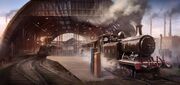 Concept art of the King's Cross train station
 -
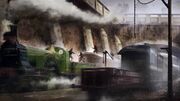 Concept art of an Assassin locked in combat on a train
 -
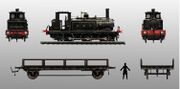 Concept art of a train
 -
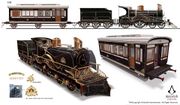 Concept art of the Train Hideout
 -
 Concept art of the Train Hideout
 -
 Concept art of the Train Hideout
 -
 A train traveling to Kazan


.jpg)
Appearances[edit | edit source]
- Assassin's Creed: The Fall (first appearance)
- Assassin's Creed: Syndicate
- Assassin's Creed: Underworld
- Assassin's Creed Chronicles: Russia
- Assassin's Creed FCBD 2016 Edition
- Assassin's Creed: The Engine of History – The Resurrection Plot
- Assassin's Creed Roleplaying Game (mentioned only)
References[edit | edit source]
- ↑ XIXth Century Search Engine – [citation needed]
- ↑ Assassin's Creed: Syndicate – Database: Crawford Starrick
- ↑ Assassin's Creed: Syndicate – Database: Agnes MacBean
- ↑ Assassin's Creed: Underworld
- ↑ 5.0 5.1 Assassin's Creed: Syndicate
- ↑ Assassin's Creed: Syndicate – Gang War (Whitechapel)
- ↑ Assassin's Creed: Syndicate – Stalk the Stalker
- ↑ Assassin's Creed: The Fall – Issue #01
- ↑ 9.0 9.1 Assassin's Creed Chronicles: Russia – The Train of Revolution
- ↑ 10.0 10.1 Assassin's Creed FCBD 2016 Edition – Great Wall
| |||||||||||||||||||||||||||||||