


User:IlMualim/sandbox V

|
Ezio, my friend! How may I be of service? This article is in desperate need of a revamp. Please improve it in any way necessary in order for it to achieve a higher standard of quality in accordance with our Manual of Style. |

The Memory Corridor was a digital construct that allowed the Animus to recreate accurate images from a subject's genetic memory. It appeared to the user as an empty virtual space located within Animi. When the memory loaded, the virtual environment would be recreated over the memory corridor.[1][2][3][4]
Usage[edit | edit source]
The corridor was mainly used as a "loading screen" between memories, where the user could roam around while a memory was being compiled. The memory corridor appeared to be an endless void, having a different appearance in each software version of the Animus. If the user got desynchronised while reliving a memory, his avatar returned back to the corridor, allowing the memory to load again.[1][2][3][4]
Additionally, the final moments of Assassination targets were displayed in the memory corridor, where the Assassin shared his final words with the target, before performing their last rites.[1][2]
It was also used as a location for the tutorial for Desmond Miles, when he first used the Animus at Abstergo[1] and later, as an interface for Rebecca Crane's Animus Virtual Training Program.[3]
Appearance[edit | edit source]
The corridor had different appearances, varying with the version of Animus being used and the type of memory being accessed.
Animus 1.28[edit | edit source]
The Abstergo Industries Animus 1.28 originally had an icy-blue background, that included fog and parts of computer code existent. The user could move the avatar of his ancestor freely around this simulation, and could use all weapons.[1]
Animus 2.0[edit | edit source]

This background was a light grey with white lines, and was the main corridor used within the Animus 2.0, and 2.03, coming to be known as the "White Room".
In the Animus 2.0, the avatar could only be made to run or walk around, but this restriction was removed in the upgraded versions, allowing the user to use weapons as well.[2]
The background changed for certain memories, such as repressed memories, or traumatic parts of the ancestor's life. Examples of repressed memories were Cristina memories, a ghost-like Ezio Auditore chased another phantom figure – Cristina Vespucci – through a dark, red-hued corridor with floating binary code. This corridor remained for a much longer time than most other memories, and the memory could take a very long time to compile.[3]
Pax Romana was an example of a traumatic memory. The corridor took on an orange colouration with broken fragments of data. This occurred when Desmond first tried accessing the memory and after the death of Cesare Borgia, once Ezio threw Cesare off of the Viana castle wall.[3]
Animus 3.0[edit | edit source]
The Animus 3.0's background was similar to that of the Animus 1.28, in that it was icy-blue, but without the fog. It also to be composed of triangular fragments.[5]
Animi Training Program[edit | edit source]
During the first training stage of the Animi Training Program, the memory corridor appeared to be a combination of the Animus 1.28 and 2.03. It had both a blue, fog-filled background and white lines.[3]
The corridor within the Animi that was used for the second stage of Abstergo's training program had a gray background with cubical fragments.[4]
Safe mode[edit | edit source]
The safe mode program built into the Animus, known as the "Black Room", had a varying dark and bright blue background with black lines, the polar opposite of the appearance of Animus 2.03 in its stable condition.[4]
First Civilization[edit | edit source]
While viewing the memories of Altaïr Ibn-La'Ahad that were stored on memory seals, the corridor developed golden symbols similar to those embedded on the Masyaf Keys.[4]
Bleeding effect[edit | edit source]
When a person experienced the bleeding effect, he experienced something similar to the memory corridor, albeit in all black. At first figures and objects in the memory would appear to be white on a black background, though they got gradually more detailed, until a point where the memory corridor disappeared and got replaced with a memory, in a similar manner to an Animus.[2]
Trivia[edit | edit source]
General
- No matter what position or method the assassination target was killed in, or how far away the Assassin was from the target, upon entering the corridor, the Assassin would always be right next to them.
- The memory corridor was also used in two failed and two spared assassinations. These included Maria Thorpe, Rodrigo Borgia, Micheletto Corella, and Shahkulu.
- All weapons used in the corridor did not emit sound.
Assassin's Creed
- During a sufficiently long loading period, it was possible for Altaïr to run far enough that glitches and other symbols surrounding him were left behind.
- Glitches appeared frequently in the corridor, prompting Desmond to change the angle of the scene, and allowed an assassinated target to walk around as they spoke, appearing uninjured.
Assassin's Creed II
- Dante Moro and Silvio Barbarigo appeared in the memory corridor together, even if they were killed separately.
- Ezio could use only his fists while he was displayed in the corridor.
Assassin's Creed: Brotherhood
- When the Templar agents situated in Rome were killed and entered the corridor, they did not speak. Ezio simply said "Requiescat in pace," before closing their eyes and walking away.
- It was possible to run out of ammunition if Ezio used the Hidden Gun, throwing knives or the crossbow.
Assassin's Creed: Revelations
- The memory corridor allowed for the testing of bombs.
- Ezio wrote letters to his sister, Claudia Auditore, inside the corridor.
Gallery[edit | edit source]
-
 Altaïr and Sibrand in Animus 1.28 memory corridor.
 -
 Ezio and Jacopo de' Pazzi in Animus 2.0 memory corridor.
 -
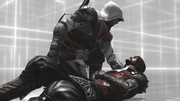 Ezio and Cesare Borgia in Animus 2.01 memory corridor.
 -
 Memory corridor of a Cristina memory.
 -
 Memory Seal corridor.
 -
 Ezio and Manuel Palaiologos in Animus 2.03 memory corridor.


References[edit | edit source]
| ||||||||||||||||||||||||||||
| |||||||||||||||||||||||||||||||||||||
| |||||||||||||||||||||||||||||||||||||
| ||||||||||||||||||||||||||||||||||||||||