


Lucius Septimius

|
He who increaseth knowledge, increaseth sorrow. This article contains spoilers, meaning it has information and facts concerning recent or upcoming releases from the Assassin's Creed series. If you do not want to know about these events, it is recommended to read on with caution, or not at all. |

Lucius Septimius (c. 90s BCE – 44 BCE), also known as The Jackal, was a Roman Gabiniani stationed in Alexandria to protect the Ptolemaic kings and queens. He was a member of the Order of the Ancients and the killer of Pompey in 48 BCE. After the Battle of the Nile, he was pardoned by Julius Caesar and, along with Flavius Metellus, managed to turn him and Cleopatra to side with the Order. He was killed by the Hidden One Aya on the {{Wiki|Ides of March]], briefly before the death of Caesar.
Biography
Early life
Septimius was the model of the Roman legionary, being both strong, imposing and athletic. In 67 BCE, he served with Pompey in the general's campaign against pirates in the Mediterranean Sea. He was later stationed in Alexandria as one of the Gabiniani, a group of 2000 Roman legionaries serving Pharaoh Ptolemy XII Auletes, and took a liking to his adopted country of Egypt. He and the Gabiniani were eventually tasked with protecting the royal family.
Quest for the vault
By 49 BCE, Septimius had become a member of the Order of the Ancients, taking on the code-name of "The Jackal". That year, he and his fellow members Medunamun, Flavius Metellus, Pothinus and Rudjek traveled to Siwa, a remote village and the location of the Temple of Amun, beneath which lay an ancient Isu Vault. The Order sought to unlock the Vault with the Apple of Eden in their possession to achieve the "power of the gods", hoping to subdue and control Egypt by establishing a New World Order. However, the temple priests refused to help them, and they decided to capture the local Medjay Bayek, hoping he would know how to unlock the Vault.
They had their soldiers capture Chenzira, a friend of Bayek's son Khemu, and convinced the boy and his mother Rebecca that they only wished to speak with the Medjay. Chenzira led the soldiers to Halma Point, where Bayek was defeated in combat and knocked unconscious, after which he was brought inside the Temple of Amun and before the Vault door. Septimius held Khemu as a hostage, suggesting that Pothinus try his method of calmly asking for Bayek's help. Medunamun showed him the Apple, but the Medjay did not, in fact, know anything about the Vault.
The interrogation was interrupted by the arrival of Pharaoh Ptolemy XIII, and several members of the Order left to distract him. Septimius threatened Bayek, telling him that he would never see Khemu again unless he unlocked the Vault before their return. With the help of Khemu, Bayek was freed from his bondings and acquired a knife, trying desperately to fight off his captors. However, Flavius grabbed him and redirected the knife into Khemu's heart, killing him, before knocking Bayek unconscious. At some point during his time in Siwa, Septimius and his men also captured the Nubian tribeswoman Kensa, but she eventually escaped.
Alexandrine Civil War
After the incident at the Vault, Septimius and the Order believed Bayek dead, not knowing that he had in fact begun to hunt them down out of revenge for his son's death. In 48 BCE, Septimius and the Gabiniani launched an assassination attempt on Cleopatra, the sister and rival throne claimant to Ptolemy, the Order's puppet. He paid his subordinate, a man named Venator, drachma for his own pleasure and for arming his men. Venator arranged for several of his men to infiltrate Cleopatra's palace in Herakleion, but Bayek and his wife Aya were able to foil the attempt, and Venator and his men were killed.
Gallery
-
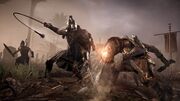 Bayek engaging Septimius in combat

Appearance
Trivia
- Septimius wears a Corinthian helmet, though this type of helmet was obsolete by the time of Origins.
Reference