

Krokodilopolis: Difference between revisions
imported>Lady Kyashira mNo edit summary |
imported>Lady Kyashira mNo edit summary |
||
| Line 27: | Line 27: | ||
ACO Krokodilopolis Entrance Concept Art - Jing Cherng Wong.jpg|Concept Art | ACO Krokodilopolis Entrance Concept Art - Jing Cherng Wong.jpg|Concept Art | ||
ACO Krokodilopolis Hieroglyph.PNG|Krokodilopolis Hieroglyph | ACO Krokodilopolis Hieroglyph.PNG|Krokodilopolis Hieroglyph | ||
DT - Krokodilopolis.jpg|Drawing of Krokodilopolis by {{Wiki|Jean-Claude Golvin}} | |||
ACO Promotional Screenshot 1.jpg|Faiyum | ACO Promotional Screenshot 1.jpg|Faiyum | ||
</gallery> | </gallery> | ||
Revision as of 15:12, 12 July 2020
Krokodilopolis was an ancient Egyptian city located in the Faiyum Oasis, west of the Nile. During the reign of Ptolemy XIII, Berenike was the nomarch of the region and city.
History
Prior to the Ptolemaic dynasty, the city was known as Shedet, and was the center of the worship of the crocodile god Sobek, housing a large temple dedicated to him. The city was subsequently renamed as "Krokodilopolis", also the Crocodile City, because of this.[1]
In 48 BCE, the Medjay Bayek of Siwa travelled to the city in search of the killer of Hotephres and Khenut's daughter, Shadya. Reuniting with Kensa, an old friend of his, Bayek teamed up with her as the gladiator duo Guardians of Siwa, and rose through the ranks of the gladiator arena and learned of Berenike's identity as the killer and a member of the Order of the Ancients, the Crocodile.[2]
The next day, Bayek tracked Berenike to her villa in the Kerkesoucha Granary, killing her.[2]
Gallery
-
 Concept Art
 -
 Krokodilopolis Hieroglyph
 -
 Drawing of Krokodilopolis by Jean-Claude Golvin
 -
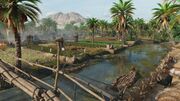 Faiyum


Appearances
References