


Greek fire: Difference between revisions
imported>Nachtblueten m Added interwiki (script) |
imported>Darman36 |
||
| Line 50: | Line 50: | ||
*''[[Assassin's Creed: Mirage]]'' | *''[[Assassin's Creed: Mirage]]'' | ||
*''[[Assassin's Creed: Forgotten Temple]]'' | *''[[Assassin's Creed: Forgotten Temple]]'' | ||
*''[[Assassin's Creed: Mirage – A Soar of Eagles]]'' | |||
==References== | ==References== | ||
Revision as of 01:50, 8 May 2025

Greek fire was a powerful Byzantine incendiary weapon that was a closely guarded military secret. Its true composition remains unknown to this day, despite multiple theories. Famously, it was reputed to burn more fiercely on contact with water, making it particularly valuable in naval warfare.[1]
Greek fire was both used by ships, and in the struggles for control of Assassin Dens in Constantinople during the Ottoman Civil War.[2]
History
Early history
Greek fire was first used by the Byzantine Emperor Leon III's army, when enemy vessels laid siege to Constantinople in the year 717. In the battle, the napalm-like substance burned through the enemy fleet, forcing them to call off their attack and flee west. [citation needed]
In 1511, the Italian Assassin Ezio Auditore used Greek fire in order to destroy several ships preventing him from leaving Constantinople.[3] The Ottoman Assassins also mounted Greek fire weapons along the barricades they used to defend their dens from Templar attacks.[2]
18th century

In 1725, the Chinese Assassins Xiao Han, Liu Qing, and Xue Yan carried bombs filled with Greek fire, which they used while boarding the Zhang Wei Union's flagship Fenghuang. The engineer Yun Pyeong-Gyu recognized the substance from the stories he had heard about it and instructed the ship's crew to use sand instead of water to extinguish the flames.[4]
After repelling the Chinese Assassins' attack, Yun was able to reproduce the formula for Greek fire, which the British Assasasin Edward Kenway recognized from the Brotherhood's records. He then suggested making a stop at Java to acquire petroleum, which would allow them to produce larger quantities of the substance.[5]
Fortunately for the Zhang Wei Union, the trip to Java became unnecessary after Yun stumbled upon a warehouse filled with barrels of petroleum during the crew's imprisonment in Manila. Following the crew's escape, Yun had these barrels loaded onto the Fenghuang, allowing the engineer to resume production of Greek fire.[6] Xialun Qing used her knowledge of alchemy to assist Yun, remaking that the process was similar to the distillation of alcohol.[7]
The two inventors later used Greek fire to fuel one of their creations, the Celestial Chariot, a prototype hot air balloon. However, the substance's highly flammable nature proved to be a drawback in this case, when the Greek fire spilled into the balloon mid-flight, causing it to catch fire and resulting in its destruction.[8] Later, Yun built a second Celestial Chariot which had its burner installed above the balloon's basket to prevent a similar accident from occuring again.[9]

While in Cebu, Yun found another application for the substance and invented Greek fire bombs, which upon being fired from a cannon, created thick flames on the water's surface, preventing ships from passing through.[10] The Fenghuang's crew used these bombs to repel an attack by Admiral Jeong's fleet, allowing them to sail to safety and escape Cebu.[11]
Later, Yun also invented Greek fire flamethrowers, which the Zhang Wei Union made use of during a battle against the Rattan Shield Company and Shimazu clan ninja;[12] trapping the ninja by creating a wall of fire around them and allowing the Union members to eliminate them.[13]
Trivia
- Historically, the secret of Greek fire was already lost by the Ottoman era and was never used by them.
- In the Assassin's Creed: Brotherhood novelization, the defenders used Greek fire during the 1507 Siege of Viana.[14]
- Greek fire is referenced in Assassin's Creed: Origins, during a side memory; in 47 BCE, the Medjay Bayek of Siwa is tasked by the architect Vitruvius to destroy the reserves of "a Greek Fire of sorts" manufactured by the Roman General Agrippa.[15]
- In Assassin's Creed: Odyssey's downloadable expansion Legacy of the First Blade: Shadow Heritage, a flamethrower weapon akin to Greek fire called Chimera's Breath was introduced.
- The Greek fire flamethrowers built by Yun Pyeong-Gyu are modeled after the Fierce-fire Oil Cabinet, an incendiary weapon first utilized in China in the 10th century CE.[16]
Gallery
-
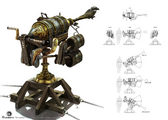 Concept art of the Greek fire cannon
 -
 Concept art of the Greek fire mechanism
 -
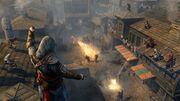 Greek fire used during a Den Defense
 -
 A Greek fire bomb
 -
 The Zhang Wei Union using Greek fire flamethrowers


.jpg)


Appearances
- Assassin's Creed: Brotherhood novel (first appearance)
- Assassin's Creed: Revelations
- Assassin's Creed: Origins
- Assassin's Creed: The Golden City
- Assassin's Creed: Mirage
- Assassin's Creed: Forgotten Temple
- Assassin's Creed: Mirage – A Soar of Eagles
References
- ↑
 Greek fire on Wikipedia
- ↑ 2.0 2.1 Assassin's Creed: Revelations
- ↑ Assassin's Creed: Revelations – Setting Sail
- ↑ Assassin's Creed: Forgotten Temple – Episode 48
- ↑ Assassin's Creed: Forgotten Temple – Episode 50
- ↑ Assassin's Creed: Forgotten Temple – Episode 53
- ↑ Assassin's Creed: Forgotten Temple – Episode 58
- ↑ Assassin's Creed: Forgotten Temple – Episode 60
- ↑ Assassin's Creed: Forgotten Temple – Episode 68
- ↑ Assassin's Creed: Forgotten Temple – Episode 72
- ↑ Assassin's Creed: Forgotten Temple – Episode 73
- ↑ Assassin's Creed: Forgotten Temple – Episode 84
- ↑ Assassin's Creed: Forgotten Temple – Episode 85
- ↑ Assassin's Creed: Brotherhood novel
- ↑ Assassin's Creed: Origins – Playing with Fire
- ↑ Fierce-fire Oil Cabinet on Wikipedia
| |||||||||||||||||||||||||||||||||||||