


Eudoros: Difference between revisions
imported>Aristonike |
imported>Gener4l Cl4ank4 No edit summary |
||
| Line 1: | Line 1: | ||
{{Era|Individuals|Ancients}} | {{Era|Individuals|Ancients}}{{WP-REAL|Eudorus of Alexandria}} | ||
{{Quote|That forsaken shithole? I had nothing to do with that disaster!|Eudoros to Bayek, denying involvement in the Order's actions in Siwa, 48 BCE.|Assassin's Creed: Origins|End of the Snake}} | |||
{{Quote|That forsaken shithole | |||
{{Character Infobox | {{Character Infobox | ||
|image = Eudoros render.png | |image = Eudoros render.png | ||
| Line 11: | Line 8: | ||
|affiliates = [[Order of the Ancients]] | |affiliates = [[Order of the Ancients]] | ||
|voice = [[Vlasta Vrána]]}} | |voice = [[Vlasta Vrána]]}} | ||
'''Eudoros''' (c. 100s BCE – 48 BCE), also known as '''The Hippo''', was a [[Greece|Greek]] scribe who served in the royal court of pharaoh [[Ptolemy XIII]]. He was also a member of the [[Order of the Ancients]] who sought to manipulate the young pharaoh for | '''Eudoros''' (c. 100s BCE – 48 BCE), also known as '''The Hippo''', was a [[Greece|Greek]] scribe who served in the royal court of pharaoh [[Ptolemy XIII]]. He was also a member of the [[Order of the Ancients]] who sought to manipulate the young [[pharaoh]] for the Order's own gain. | ||
==Biography== | ==Biography== | ||
| Line 17: | Line 14: | ||
Hailing from Greece, Eudoros excelled at the {{Wiki|Peripatetic school}} of philosophy, becoming an accomplished philosopher.<ref name="Prima Guide">''[[Assassin's Creed Origins: Official Game Guide]]''</ref> He later moved to [[Alexandria]], where he became one of the most respected intellectuals in the city, eventually becoming the Royal Scribe in Ptolemy XIII's court. Eudoros also suffered from a discomforting skin condition, resulting in him frequenting the bathhouse to ease his condition.<ref name="End of the Snake">''[[Assassin's Creed: Origins]]'' – [[End of the Snake]]</ref> | Hailing from Greece, Eudoros excelled at the {{Wiki|Peripatetic school}} of philosophy, becoming an accomplished philosopher.<ref name="Prima Guide">''[[Assassin's Creed Origins: Official Game Guide]]''</ref> He later moved to [[Alexandria]], where he became one of the most respected intellectuals in the city, eventually becoming the Royal Scribe in Ptolemy XIII's court. Eudoros also suffered from a discomforting skin condition, resulting in him frequenting the bathhouse to ease his condition.<ref name="End of the Snake">''[[Assassin's Creed: Origins]]'' – [[End of the Snake]]</ref> | ||
At some point in 48 BCE, Eudoros sought to promote himself further by publishing a scientific treatise on the [[Nile]]. Unbeknownst to all, his work was, in fact, plagiarized from the famed intellectual [[Aristo of Alexandria]]. Aristo sued him in court, and after months of pointless arguing, Eudoros finally used his influence to have the case settled in his favor. Aristo was then arrested by the [[phylakitai]] and condemned to public humiliation by being driven through the streets in a cage until he finally escaped and fled Egypt.<ref name="The Shifty Scribe">''Assassin's Creed: Origins'' – [[The Shifty Scribe]]</ref> | At some point prior to 49 BCE, Eudoros joined the Order of the Ancients, which aimed to gain control of [[Egypt]] by manipulating Ptolemy XIII. That year, five of Eudoros' fellow Order members traveled to [[Siwa]] in an attempt to access an [[Isu]] [[Temple (Isu)|vault]] beneath the [[Temple of Amun]] using an [[Apple of Eden 2|Apple of Eden]] in their possession. However, the mission ended in failure,<ref name="The False Oracle">''[[Assassin's Creed: Origins]]'' – [[The False Oracle]]</ref> and Eudoros came to regard the incident as a "disaster".<ref name="End of the Snake" /> | ||
In 48 BCE, Eudoros sought to promote himself further by publishing a scientific treatise on the [[Nile]]. Unbeknownst to all, his work was, in fact, plagiarized from the famed intellectual [[Aristo of Alexandria]]. Aristo sued him in court, and after months of pointless arguing, Eudoros finally used his influence to have the case settled in his favor. Aristo was then arrested by the [[phylakitai]] and condemned to public humiliation by being driven through the streets in a cage until he finally escaped and fled Egypt.<ref name="The Shifty Scribe">''[[Assassin's Creed: Origins]]'' – [[The Shifty Scribe]]</ref> | |||
===Death=== | ===Death=== | ||
{{Dialogue|Bayek|It is worth the loss to slay the Snake at last.|Eudoros|The Snake?... The Snake will never die.|Eudoros last words to Bayek, 48 BCE.|Assassin's Creed: Origins|End of the Snake}} | {{Dialogue|Bayek|It is worth the loss to slay the Snake at last.|Eudoros|The Snake?... The Snake will never die.|Eudoros' last words to Bayek, 48 BCE.|Assassin's Creed: Origins|End of the Snake}} | ||
That same year, Eudoros wrote a letter to [[Medunamun]], a fellow member known as "The Ibis", informing him to remain vigilant due to recent deaths of [[Rudjek]], [[Actaeon]], and [[Ktesos]]. Eudoros kept these letters in his office at the [[Ptolemaic Royal Palace]], and they were eventually found by the [[Medjay]] [[Bayek]] of [[Siwa]], who | That same year, Eudoros wrote a letter to [[Medunamun]], a fellow Order member known as "The Ibis", informing him to remain vigilant due to the recent deaths of [[Rudjek]], [[Actaeon]], and [[Ktesos]]. Eudoros kept these letters in his office at the [[Ptolemaic Royal Palace]], and they were eventually found by the [[Medjay]] [[Bayek]] of [[Siwa]], who sought to eliminate the Order as revenge for their actions in Siwa, during which his son [[Khemu]] had been killed.<ref name="End of the Snake" /> | ||
[[File:Origins Quest08EndOfTheSnake Part03.PNG|thumb|250px|left|Bayek assassinating Eudoros]] | |||
After infiltrating Eudoros' office, Bayek was able to confirm his identity as a member of the Order and subsequently traveled to Alexandria's bathhouse to [[Assassination|assassinate]] him. Although caught by surprise by the Medjay, Eudoros was able to fight him off and gained the upper during the resulting struggle, until Bayek stabbed him in the throat with his [[Hidden Blade]], at the cost of his own ring finger.<ref name="End of the Snake" /> | |||
= | As Eudoros lay dying, Bayek accused him of being "the Snake" and responsible for Khemu's death, but Eudoros denied involvement in the events in Siwa and taunted the Medjay, claiming that the Snake could never die.<ref name="End of the Snake" /> Bayek would later learn from Queen [[Cleopatra]] that "the Snake" was another name for the Order itself, and that Eudoros' cryptonym had been "The Hippo".<ref name="Egypt's Medjay">''[[Assassin's Creed: Origins]]'' – [[Egypt's Medjay]]</ref> | ||
==Trivia== | ==Trivia== | ||
*In the ''Official Guide'', Eudoros is listed as being born in Greece. Historically, however, he was born in Alexandria. | *The name ''Eudoros'' is derived from the words εὖ (''eû'') meaning 'well' and δῶρον (''dôron''), meaning 'gift'. In Modern Greek, Εὔδωρος (''Eudóros'') means 'well-gifted'. | ||
*When infiltrating the bathhouse, a man can be heard saying that Eudoros likes to stare at naked boys, suggesting that Eudoros | *In the ''[[Assassin's Creed Origins: Official Game Guide]]'', Eudoros is listed as being born in Greece. Historically, however, he was born in Alexandria. | ||
*Eudoros himself mentions how he ''"should never have consorted with that sailor"'', believing his skin condition to have been a venereal disease.<ref name="End of the Snake" /> | *When infiltrating the bathhouse, a man can be heard saying that Eudoros likes to stare at naked boys, suggesting that Eudoros was possibly homosexual or bisexual. | ||
**Eudoros himself mentions how he ''"should never have consorted with that sailor"'', believing his skin condition to have been a venereal disease.<ref name="End of the Snake" /> | |||
*After assassinating Eudoros, an opium pipe and hippopotamus meat are looted from his body, | *After assassinating Eudoros, an [[opium]] pipe and hippopotamus meat are looted from his body, foreshadowing the reveal of his identity as "The Hippo". | ||
==Gallery== | ==Gallery== | ||
<gallery captionalign="center" position="center | <gallery captionalign="center" position="center" widths="180"> | ||
Eudoros - Concept art.jpg|Concept art of Eudoros | Eudoros - Concept art.jpg|Concept art of Eudoros | ||
ACO Eudoros Head Model - Eugene Fokin.jpg|Head model of Eudoros | ACO Eudoros Head Model - Eugene Fokin.jpg|Head model of Eudoros | ||
| Line 41: | Line 42: | ||
ACO End of the Snake - Flashback - Eudoros and Pothinus.png|Eudoros conversing with Pothinus | ACO End of the Snake - Flashback - Eudoros and Pothinus.png|Eudoros conversing with Pothinus | ||
ACO Eudoros.jpg|Eudoros in the bathhouse | ACO Eudoros.jpg|Eudoros in the bathhouse | ||
Origins Quest08EndOfTheSnake Part06.PNG|Bayek facing Eudoros in the [[Memory Corridor]] | |||
Origins Quest08EndOfTheSnake Part06.PNG|Bayek facing Eudoros | Origins Quest08EndOfTheSnake Part08.PNG|Eudoros' soul being sent to the [[Duat]] | ||
Origins Quest08EndOfTheSnake Part08.PNG|Eudoros' soul | |||
</gallery> | </gallery> | ||
Revision as of 11:56, 28 September 2024
Eudoros (c. 100s BCE – 48 BCE), also known as The Hippo, was a Greek scribe who served in the royal court of pharaoh Ptolemy XIII. He was also a member of the Order of the Ancients who sought to manipulate the young pharaoh for the Order's own gain.
Biography
Early life
Hailing from Greece, Eudoros excelled at the Peripatetic school of philosophy, becoming an accomplished philosopher.[1] He later moved to Alexandria, where he became one of the most respected intellectuals in the city, eventually becoming the Royal Scribe in Ptolemy XIII's court. Eudoros also suffered from a discomforting skin condition, resulting in him frequenting the bathhouse to ease his condition.[2]
At some point prior to 49 BCE, Eudoros joined the Order of the Ancients, which aimed to gain control of Egypt by manipulating Ptolemy XIII. That year, five of Eudoros' fellow Order members traveled to Siwa in an attempt to access an Isu vault beneath the Temple of Amun using an Apple of Eden in their possession. However, the mission ended in failure,[3] and Eudoros came to regard the incident as a "disaster".[2]
In 48 BCE, Eudoros sought to promote himself further by publishing a scientific treatise on the Nile. Unbeknownst to all, his work was, in fact, plagiarized from the famed intellectual Aristo of Alexandria. Aristo sued him in court, and after months of pointless arguing, Eudoros finally used his influence to have the case settled in his favor. Aristo was then arrested by the phylakitai and condemned to public humiliation by being driven through the streets in a cage until he finally escaped and fled Egypt.[4]
Death
That same year, Eudoros wrote a letter to Medunamun, a fellow Order member known as "The Ibis", informing him to remain vigilant due to the recent deaths of Rudjek, Actaeon, and Ktesos. Eudoros kept these letters in his office at the Ptolemaic Royal Palace, and they were eventually found by the Medjay Bayek of Siwa, who sought to eliminate the Order as revenge for their actions in Siwa, during which his son Khemu had been killed.[2]

After infiltrating Eudoros' office, Bayek was able to confirm his identity as a member of the Order and subsequently traveled to Alexandria's bathhouse to assassinate him. Although caught by surprise by the Medjay, Eudoros was able to fight him off and gained the upper during the resulting struggle, until Bayek stabbed him in the throat with his Hidden Blade, at the cost of his own ring finger.[2]
As Eudoros lay dying, Bayek accused him of being "the Snake" and responsible for Khemu's death, but Eudoros denied involvement in the events in Siwa and taunted the Medjay, claiming that the Snake could never die.[2] Bayek would later learn from Queen Cleopatra that "the Snake" was another name for the Order itself, and that Eudoros' cryptonym had been "The Hippo".[5]
Trivia
- The name Eudoros is derived from the words εὖ (eû) meaning 'well' and δῶρον (dôron), meaning 'gift'. In Modern Greek, Εὔδωρος (Eudóros) means 'well-gifted'.
- In the Assassin's Creed Origins: Official Game Guide, Eudoros is listed as being born in Greece. Historically, however, he was born in Alexandria.
- When infiltrating the bathhouse, a man can be heard saying that Eudoros likes to stare at naked boys, suggesting that Eudoros was possibly homosexual or bisexual.
- Eudoros himself mentions how he "should never have consorted with that sailor", believing his skin condition to have been a venereal disease.[2]
- After assassinating Eudoros, an opium pipe and hippopotamus meat are looted from his body, foreshadowing the reveal of his identity as "The Hippo".
Gallery
-
 Concept art of Eudoros
 -
 Head model of Eudoros
 -
 Models of Eudoros
 -
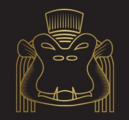 Eudoros' Order symbol
 -
 Eudoros conversing with Pothinus
 -
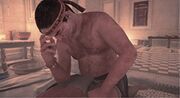 Eudoros in the bathhouse
 -
 Bayek facing Eudoros in the Memory Corridor
 -
 Eudoros' soul being sent to the Duat


Appearances
References
es:Eudoros fr:Eudoros pt-br:Eudoros ru:Евдор uk:Євдор zh:欧多拉斯