


Charlemagne: Difference between revisions
imported>Lady Kyashira mNo edit summary |
imported>VilkaIsBack No edit summary |
||
| Line 15: | Line 15: | ||
==Biography== | ==Biography== | ||
===Reign=== | |||
In the spring of 774, following the Lombards' {{Wiki|Siege of Pavia (773–74)|siege of Pavia}}, Charlemagne visited [[Rome]] to confirm and reassert his {{Wiki|Pepin the Short|father's}} {{Wiki|Donation of Pepin|grants of land}}.<ref name="AC2" /> | In the spring of 774, following the Lombards' {{Wiki|Siege of Pavia (773–74)|siege of Pavia}}, Charlemagne visited [[Rome]] to confirm and reassert his {{Wiki|Pepin the Short|father's}} {{Wiki|Donation of Pepin|grants of land}}.<ref name="AC2" /> | ||
In May 804, Charlemagne was written a letter by [[Alcuin]] regarding the existence of the Order of the Ancients and how they were a parasitic group neglecting [[Christianity|God]]'s teaching and instead worshipping a race of precursor beings known as the [[Isu]]. Alcuin also informed Charlemagne about the Order's obsession with [[sage]]s, Isu allegedly reborn as [[human]]s. Believing the Order to be blasphemers, Alcuin was unaware that Charlemagne himself was a member of said order. Despite being a pious defender of God's will, Charlemagne hid his allegiance well. The Order then had Alcuin killed a week later as he knew too much and his letter was never sent.<ref name="PoorFellowSoldier"/> | In May 804, Charlemagne was written a letter by [[Alcuin]] regarding the existence of the Order of the Ancients and how they were a parasitic group neglecting [[Christianity|God]]'s teaching and instead worshipping a race of precursor beings known as the [[Isu]]. Alcuin also informed Charlemagne about the Order's obsession with [[sage]]s, Isu allegedly reborn as [[human]]s. Believing the Order to be blasphemers, Alcuin was unaware that Charlemagne himself was a member of said order. Despite being a pious defender of God's will, Charlemagne hid his allegiance well. The Order then had Alcuin killed a week later as he knew too much and his letter was never sent.<ref name="PoorFellowSoldier"/> | ||
==Legacy== | ===Legacy=== | ||
A slightly fictionalized version of Charlemagne appears in the epic poem, {{Wiki|Aspremont (chanson de geste)|Chanson d'Aspremont}}, published in the late 12th century, in which Charlemagne oversees the baptism of his [[Spain|Iberian]] royal messenger Balan. An illustrated version depicting this scene was published between 1240 and 1250.<ref>''[[Discovery Tour: Viking Age]]'' – [[Learnings: Baptism and Victory]]</ref> | |||
Somewhere between 1544 and 1566, the [[Italy|Italian]] artist {{Wiki|Taddeo Zuccari}} drew a depiction of Charlemagne confirming the Donation of Ravenna.<ref name="AC2" /> | Somewhere between 1544 and 1566, the [[Italy|Italian]] artist {{Wiki|Taddeo Zuccari}} drew a depiction of Charlemagne confirming the Donation of Ravenna.<ref name="AC2" /> | ||
Revision as of 08:00, 18 January 2024

|
Patience, brothers. Soon we will reveal the secrets of Siege of Paris and Discovery Tour: Viking Age. This article has been identified as being out of date. Please update the article to reflect recent releases and then remove this template once done. |
Charlemagne (Latin: Carolus Magnus; 742 – 814), also known as Charles the Great or Charles I was the King of the Franks from 768, the King of Lombards from 774, and from 800 the Emperor of the Carolingian Empire, which would eventually be succeeded by the Holy Roman Empire. He was also a leader of the Order of the Ancients.[1]
Biography
Reign
In the spring of 774, following the Lombards' siege of Pavia, Charlemagne visited Rome to confirm and reassert his father's grants of land.[2]
In May 804, Charlemagne was written a letter by Alcuin regarding the existence of the Order of the Ancients and how they were a parasitic group neglecting God's teaching and instead worshipping a race of precursor beings known as the Isu. Alcuin also informed Charlemagne about the Order's obsession with sages, Isu allegedly reborn as humans. Believing the Order to be blasphemers, Alcuin was unaware that Charlemagne himself was a member of said order. Despite being a pious defender of God's will, Charlemagne hid his allegiance well. The Order then had Alcuin killed a week later as he knew too much and his letter was never sent.[1]
Legacy
A slightly fictionalized version of Charlemagne appears in the epic poem, Chanson d'Aspremont, published in the late 12th century, in which Charlemagne oversees the baptism of his Iberian royal messenger Balan. An illustrated version depicting this scene was published between 1240 and 1250.[3]
Somewhere between 1544 and 1566, the Italian artist Taddeo Zuccari drew a depiction of Charlemagne confirming the Donation of Ravenna.[2]
In 2012, Charlemagne was one of many historical people included in the Glyph puzzles the late Assassin Clay Kaczmarek had left behind in the Animus as messages for his successor Desmond Miles to decipher. Desmond later did in September of that year.[4] Desmond solved this puzzle, which was part of a set titled "Instruments of Power" where Charlemagne was excluded from the list of historical individuals revealed by Clay to have wielded a Sword of Eden.[2] In the same year, he was included in a mnemonic set in Abstergo Industries' Project Legacy.[5]
In 2020, during Layla Hassan's Animus session of reliving the memories of the shieldmaiden Eivor Varinsdottir of the Raven Clan during the Viking expansion into England, she used a digital patch that allowed Eivor to equip a set of armor inspired by Charlemagne.[6]
Gallery
-
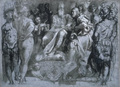 Portrait of Emperor Charlemagne by Taddeo Zuccaro
 -
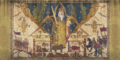 tapestry depicting the crowning of Charlemagne as Holy Roman Emperor in 800


Appearances
- Assassin's Creed II (appears in Glyphs only)
- Assassin's Creed: Project Legacy (appears in mnemonic set only)
- Echoes of History (mentioned only)
- Assassin's Creed: Valhalla (mentioned only)
- The Siege of Paris (tapestry only)
- Discovery Tour: Viking Age (mentioned only)
- Assassin's Creed: Mirage (mentioned in Database entry only)
References
- ↑ 1.0 1.1 Assassin's Creed: Valhalla – The Poor Fellow-Soldier
- ↑ 2.0 2.1 2.2 Assassin's Creed II – Glyph 5: "Instruments of Power"
- ↑ Discovery Tour: Viking Age – Learnings: Baptism and Victory
- ↑ Assassin's Creed: Initiates – The Desmond Files
- ↑ Assassin's Creed: Project Legacy
- ↑ Assassin's Creed: Valhalla
| |||||||||||||||||||||||||||||||